
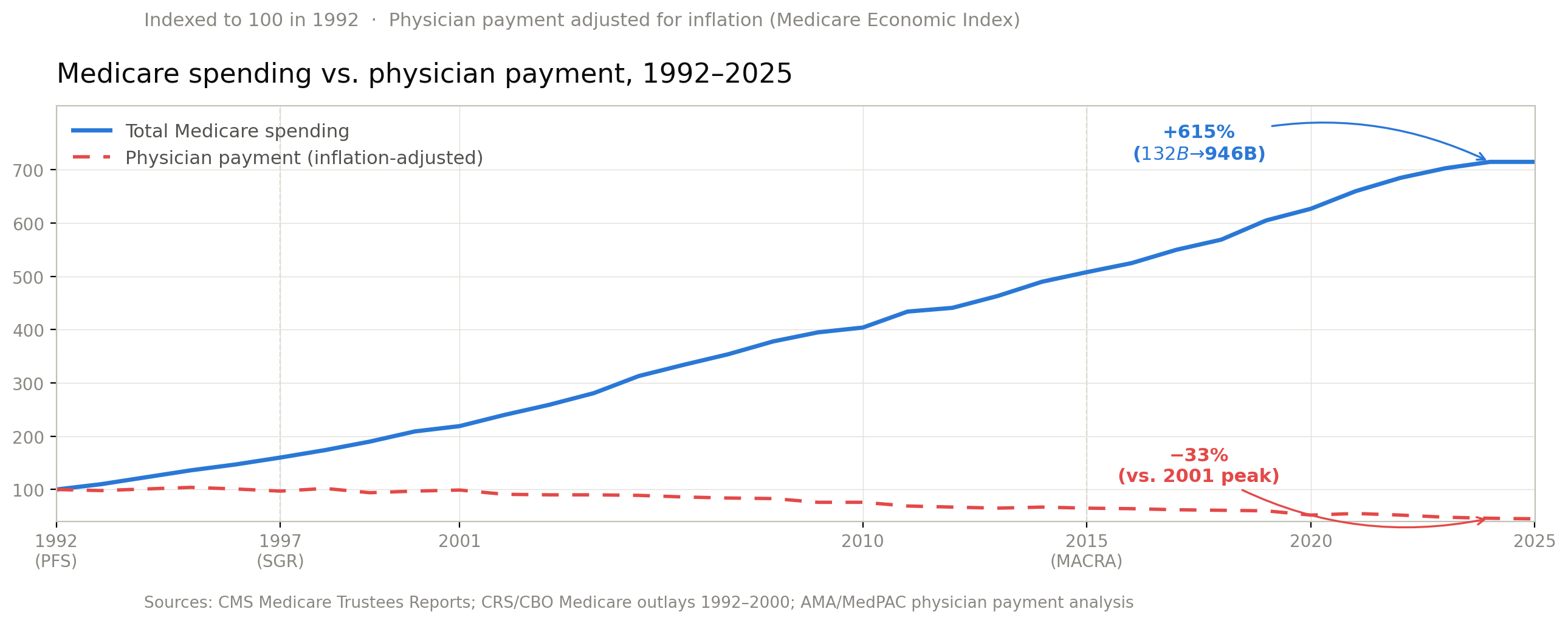
The Physician Fee Schedule (PFS) was established by legislation passed in 1989 and went into effect in 1992. Prior to that, Medicare paid physicians based on “customary, prevailing and reasonable” (CPR) charges — essentially a cost-plus approach, analogous to what hospitals operated under before the Inpatient Prospective Payment System (IPPS).
Cost-plus was breaking the budget, so Congress turned to setting prices for physician services being delivered. The framework for this is the RVU architecture. Every covered physician service is assigned a CPT code with three RVU components — Work, Practice Expense, and Malpractice — combined in this formula:
Payment = (wRVU + PE RVU + MP RVU) × Geographic Practice Cost Index × Conversion Factor
The Conversion Factor (CF) is what converts RVUs into dollars. In 2024 it was $32.74. Every year CMS proposes a low or negative CF, and every year Congress intervenes with a temporary patch. The pattern is not accidental — it reflects a structural constraint. CMS’s mandate is not to pay physicians well. It is to be budget neutral. This happened because the 1989 legislation that created the Physician Fee Schedule required that any RVU changes netting more than $20 million must be offset by a CF reduction.
If you’re a physician reading this, take a Valium before the next paragraph. The budget neutrality constraint that governs the PFS — where every dollar increase in one service must be offset by a dollar decrease somewhere else — applies only to the physician fee schedule. It does not apply to Medicare spending as a whole. Congress can and does appropriate additional money for hospitals, for MA plans, for drug coverage, for post-acute care — all outside the zero-sum straitjacket that governs physician payment.
The PFS is uniquely constrained in a way that other Medicare payment systems are not. The overall Medicare budget has grown substantially and the money didn’t disappear. It was redistributed to hospitals, drug companies, and Medicare Advantage plans, all operating outside the zero-sum straitjacket imposed on physicians. This is not an accident of poor policy design. It is the predictable outcome of who has the lobbying power to operate outside the constraint and who doesn’t.
Congress makes a lot of noise from time to time, but everything operates under the budget-neutral requirement for physicians. In 1997, the Balanced Budget Act introduced the Sustainable Growth Rate (SGR) formula, tying the CF update to GDP growth. When physician service volume grew faster than GDP — which it did every year — the SGR required compensatory CF reductions. By the mid-2000s the formula was calling for cuts exceeding 20%. Congress overrode it annually with “doc fix” patches until MACRA (2015) repealed the SGR and replaced it with MIPS and Alternative Payment Models. MACRA mandated CF increases of 0.25–0.75% per year. Medical inflation runs 3–5% annually. This is a pay cut.
Budget neutrality has not changed. If CMS increases RVUs for E&M services, it must reduce the CF to keep total outlays flat. Any gain for one set of services is an equivalent loss somewhere else. The physician fee schedule is zero sum, by the 1989 statute.
With that framework in mind, the proposed 2027 rule does several things — not all bad — but one provision stands out because it is really poorly thought out.
The Same-Day E/M Reduction: A Bad Idea Recycled
CMS proposes to reduce payment when a separately identifiable office/outpatient E/M visit is furnished by the same physician on the same day as a procedure. The more expensive service would be paid at 100%; the other at 50%. The stated rationale: there are “efficiencies” when a physician sees a patient and performs a procedure on the same day, and CMS believes it is “likely duplicating payment.”
This argument was rejected in 2019 when CMS first proposed it, and it is no better now.
The -25 modifier already exists precisely because CMS acknowledged this problem and built the solution. Modifier -25 requires that the E/M be a significant, separately identifiable service above and beyond the routine pre-procedure evaluation — the standard H&P that most proceduralists correctly treat as bundled into the global and do not bill separately. The modifier is the mechanism already designed to prevent the double-dipping CMS now claims to fix with a payment cut.
Notably, CMS’s entire published rationale consists of the single assertion that payment is “likely” duplicative. There is no supporting utilization data, no analysis of modifier -25 use patterns, and no acknowledgment that the RUC-derived global period valuations do not actually embed a full E/M’s worth of pre-procedure work. The global period’s pre-procedure evaluation was never valued by the RUC as a full E/M visit — it was valued as a brief confirmatory assessment worth a fraction of a full office visit’s work RVUs. CMS is now proposing a 50% payment penalty based on an overlap that its own RVU data does not support. (See Appendix for an explanation of how “the global surgery billing is structured)
The proposal ignores three routine clinical scenarios where same-day E/M and procedure work are entirely non-overlapping:
A patient presents with a new or acute problem; the physician evaluates it, independently decides to perform a procedure, and does so the same day — the E/M decision-making precedes and is clinically distinct from the procedure.
A patient arrives for a scheduled procedure but presents with a new comorbidity requiring separate assessment before proceeding.
A patient presents with chest pain; the physician evaluates, develops an independent assessment and plan, and orders and performs an echocardiogram the same day — two distinct cognitive tasks, both completely legitimate.
If the problem is modifier -25 abuse, the correct response is targeted audit and enforcement — not a blanket 50% payment reduction on a category of encounters that includes large numbers of legitimate, non-overlapping clinical situations.
There is also a perverse incentive CMS has not addressed: if this is finalized, the rational response for physicians is to split these encounters across two visits. The patient returns on a separate day for the procedure, each encounter is billed at 100%, and Medicare pays more in aggregate while the patient is significantly inconvenienced. Has CMS modeled the economics of this very obvious response from clinicians?
If CMS needs to find savings — and under budget neutrality it always does — telehealth and remote monitoring are more defensible targets, where third-party billing arrangements have generated documented utilization patterns that warrant scrutiny. A blunt reduction to legitimate same-day procedural care is the wrong place to find the money. But this is all target selection within a fundamentally broken framework. The problem isn’t which services get cut. It’s that something always has to be cut.
The Larger Fix: Allow Private Contracting for Enrolled Physicians
The deeper problem is structural and no amount of annual rulemaking will fix it. Budget neutrality means every E/M dollar gained is clawed back somewhere else. The CF trajectory is negative in real terms regardless of Congressional patches. The physician fee schedule is structurally and legally incapable of paying physicians appropriately under its current design.
This system doesn’t exist because it’s the best thing for physicians or patients. It came into being and has persisted for over thirty years now because it is politically expedient. Changing this requires understanding why it has been so hardy despite the fact that the system has embedded within it a reduction in physician payments every year relative to inflation. It’s not a bug in the system — it’s quite literally designed that way. And it works because it’s politically expedient.
If Medicare cut physician payment and patients immediately faced higher out-of-pocket costs or lost access to their doctors, there would be a visible, organized political constituency screaming at Congress. Seniors are the most powerful electoral demographic in American politics. Hurt them — or appear to — and your electoral chances quickly vanish. (Also why Medicare isn’t going anywhere anytime soon.)
Physicians generally absorb the cut quietly — through thinner margins, fewer staff, shorter appointments, earlier retirement, or exit from Medicare entirely. The degradation is gradual, diffuse, and invisible to patients on a year-over-year basis until their doctor stops taking Medicare or closes their practice. Most physicians, let alone patients, won’t connect the dots between the 1989 statutory design and the 2026 reality on the ground that creates an access problem.
Patients cannot signal their willingness to pay more because the system won’t let them. A Medicare patient who can and would gladly pay an extra $50 to keep seeing their cardiologist of 15 years has no legal mechanism to do so if that cardiologist is enrolled in Medicare. The current legally mandated structure is what inhibits any market signal or push for reform.
Think about it. Right now when CMS cuts physician payment the chain looks like this:
CMS cuts CF → physician margin compresses → physician exits Medicare or sells to hospital → patient loses access or faces higher costs through hospital billing → patient has no legal mechanism to pay more to restore access → patient complains to congressman abstractly about “healthcare access” → no specific legislative response to physician payment.
Every link in that chain attenuates the signal. By the time the patient’s experience reaches a legislator it has been converted from “Medicare is paying my cardiologist too little” into a vague complaint about healthcare that — depending on which congressman you’re complaining to — becomes a reason to support Medicare for All.
The current framework is binary: enrolled physicians are bound by Medicare rates for all covered services, or they opt out entirely and private-contract with everyone. There is no middle path.
The solution is logical, though politically difficult: allow voluntary private contracting between enrolled physicians and Medicare beneficiaries for covered services, without requiring full opt-out. Medicare would pay its standard rate; the patient could voluntarily agree to pay a supplemental amount above that. Medicare’s fiscal exposure is unchanged. Access is preserved — the physician remains in Medicare for all patients. No patient is coerced — the contract is voluntary, with full disclosure. And this is categorically different from balance billing — which patients cannot refuse and do not consent to in advance. Private contracting is disclosed, voluntary, and initiated only when both parties agree.
This also exposes the Medicare physician payment system to patients in a very concrete way. If enrolled physicians could private contract with Medicare patients, the chain changes fundamentally:
CMS cuts CF → physician offers patient a supplemental contract to maintain the relationship → patient must now visibly and immediately decide whether to pay more out of pocket → that decision produces a concrete, attributable cost that the patient directly experiences and can specifically blame. This is also a much healthier market. No doubt there are physicians who may be able to be more efficient and either not need to offer private contracts, or offer different rates than the cardiologist across the street.
When a 72-year-old in Bucks County, Pennsylvania is faced with writing a $200 check to keep seeing her cardiologist of 10 years, she knows that check is being written because Medicare cut physician payment. The blowback from that alone would make Medicare much more careful in how it approached physician payment. There is no political price to pay for her cardiologist quietly compressing his margins and seeing her for 10 minutes instead of 15 minutes.
This requires a statutory fix. The BBA 1997 requires full opt-out for any private contracting, a provision enacted because Congress feared a two-tiered system where wealthy beneficiaries could buy better access. That concern was not unreasonable. It was also wrong as a prediction: the two-tiered system materialized anyway, through concierge medicine and direct-pay practices that serve precisely the high-income patients Congress was worried about, while leaving mainstream Medicare patients with increasingly degraded access to independent physicians.
Physicians should be wary of solutions that involve the government simply increasing what they pay them. The money has to come from somewhere, there are many constituencies with their hands out at federal and state treasuries, and physicians are relatively high earners in an increasingly difficult work economy. We should not expect a lot of sympathy from the populace struggling to make a 15-year-old car work with little savings to speak of.
For patients, it’s important to understand that this is a market freedom argument, not purely a physician enrichment argument. The goal is to preserve access to high-quality independent physicians. The alternative — continued real payment cuts with no relief valve — is physician exit from Medicare, which produces exactly the access harm Congress was trying to prevent in 1997.
All physicians should unite behind a statutory fix to the ban on private contracting with Medicare patients. It is the one reform that breaks the zero-sum trap.
Anish Koka is a cardiologist in Philadelphia writing on medicine and health policy. He is co-host of the weekly podcast The Doctor’s Lounge. His X handle: @anish_koka
Physicians, please consider commenting on the proposed rule. This same rule was proposed in 2019 and was not enacted because of physician comments.
Go to regulations.gov/docket/CMS-2026-2377 and reference file code CMS-1848-P.
Comments are due September 14, 2026.
When commenting, consider:
Describe specific patient scenarios where a same-day E/M and procedure are genuinely non-overlapping — clinical specificity carries weight that general objections do not.
Note that if this proposal is finalized, the rational physician response is to split encounters across two visits — costing Medicare more and inconveniencing patients — and that CMS has not modeled the economics of this.
Understanding the Global period
When Medicare pays for a surgical or procedural service, the payment is not just for the procedure itself. It includes a bundled package of related services called the global surgical package, which covers:
The pre-procedure evaluation on the day of the procedure
The intraoperative work
All routine post-operative care for a defined period (0, 10, or 90 days depending on the procedure)
The global period payment is supposed to represent the totality of physician work associated with that procedure from pre-op through post-op recovery.
How the RUC Values the Global Package
When the RUC surveys physicians to establish work RVUs for a procedure code, it asks physicians to estimate the total work involved — including the pre-procedure evaluation component. That pre-procedure evaluation component is explicitly accounted for in the work RVU, but it is valued as a brief, focused, confirmatory assessment — not a full independent E/M visit.
The distinction is clinically real and the RUC agrees. The pre-procedure evaluation embedded in the global is:
Confirming the patient is the right person for the procedure
Verifying no new contraindications have emerged since the decision was made
Reviewing relevant recent labs or imaging
Obtaining informed consent
A brief focused exam
This is materially different from a full office visit involving history-taking, independent clinical reasoning, differential diagnosis, and a treatment decision. The RUC valued the embedded pre-procedure evaluation at a fraction of a full E/M’s work RVU value. A full new patient visit (99205) carries a work RVU of 3.50. A full established patient visit (99214) carries 1.92. The pre-procedure evaluation component embedded in most procedure global packages is valued in the 0.17–0.50 range depending on the procedure.
What CMS Is Claiming
CMS’s efficiency argument implicitly assumes that when a physician bills a -25 modified E/M on the same day as a procedure, there is meaningful overlap between that E/M and the pre-procedure evaluation already embedded in the global. The claim is that the physician is being paid twice for substantially the same work.
That Claim Doesn’t Hold
The pre-procedure work embedded in the global was never valued as a full E/M to begin with. It was valued as a brief confirmatory assessment worth a fraction of a full visit. If a physician bills a full E/M — say a 99214 at 1.92 wRVUs — on the same day as a procedure whose global embeds 0.35 wRVUs of pre-procedure work, the overlap CMS is claiming amounts to 0.35 wRVUs out of 1.92. That’s not duplication. That’s an 18% theoretical overlap at most — and even that assumes the brief confirmatory assessment and the full separately identifiable E/M are covering identical clinical ground, which in the scenarios where -25 is legitimately used, they aren’t.
CMS is treating the situation as if the global embeds a full E/M. It never did. The RUC didn’t value it that way, CMS accepted those valuations, and now CMS is proposing a 50% payment penalty based on an overlap assumption that its own RVU data contradicts.
No posts
Comments
Nothing yet. Say the first thing.
Sign in to join the conversation.