
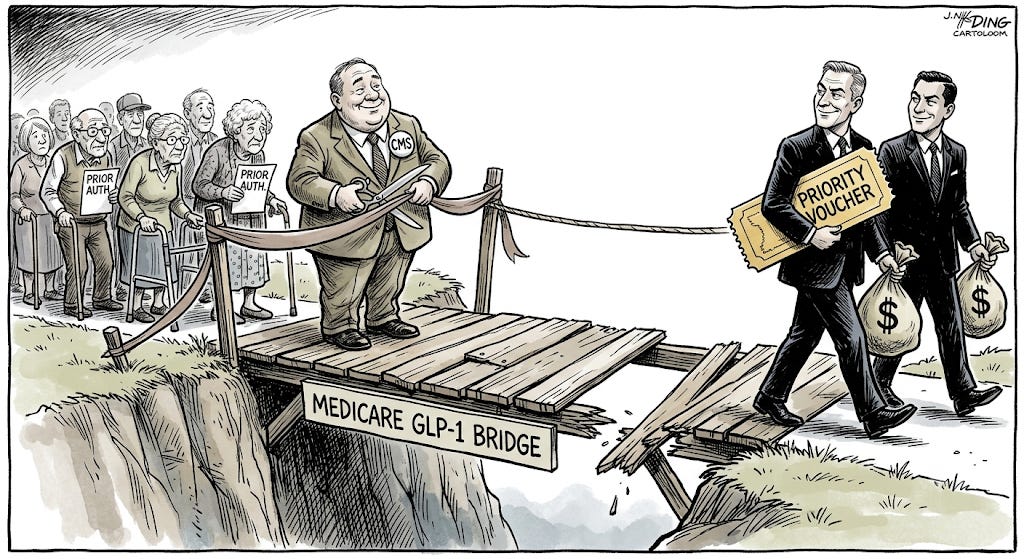
Like many physicians, I was excited to hear about the Medicare Bridge program from the Trump administration that promised to get cheaper GLP-1s to the Medicare population. It’s somewhat surreal to walk the halls of hospitals I haven’t been at in some time because I don’t recognize many now skinny clinicians who have been heavy for decades. Physicians, and other relatively high earning individuals have availed themselves of these peptides to their benefit for some time, but significantly overweight Medicare patients who don’t have a spare $300-$500 / month have not had access to this class of medications. The public relations campaign leading up to this summer heralded GLP-1s for weight loss for $50/month for Medicare patients. Naively, I transmitted the sales pitch to many of my Medicare patients. Four weeks into the program, I’ve learned there’s quite a gap between what was sold and reality. Always read the fine print! An illustrative case follows.
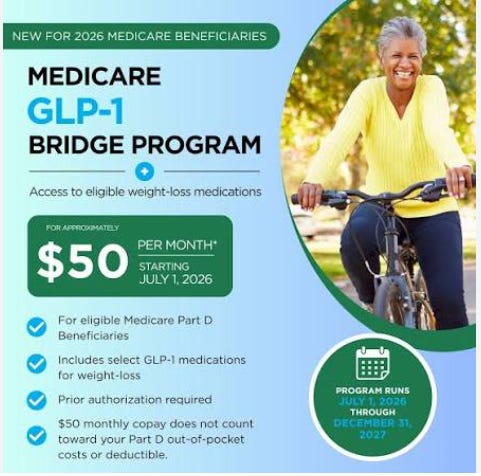
On July 11th, a fax arrived at my office on CMS letterhead. The subject line: NOTICE OF DENIAL FOR MEDICARE GLP-1 BRIDGE REQUEST. Sofia Abbruzese (name changed) was one of the patients I had told about the Bridge program. She was pretty excited about it. She had been paying ~$500 / month for the drug and had lost 30 pounds, but still had another 30 pounds to go. The denial letter dryly stated that her provider had indicated she did not meet one of the required criteria at the time of initiation of GLP-1 therapy. A bulleted list followed. This was the first time I had seen the CMS criteria for coverage.
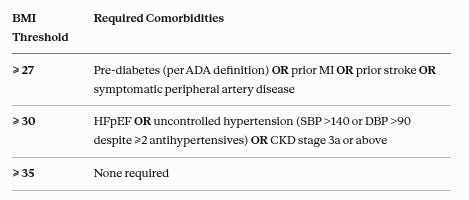
And those aren’t the only exclusions. The most confusing one for patients involves Medicare’s Part D prescription drug program.
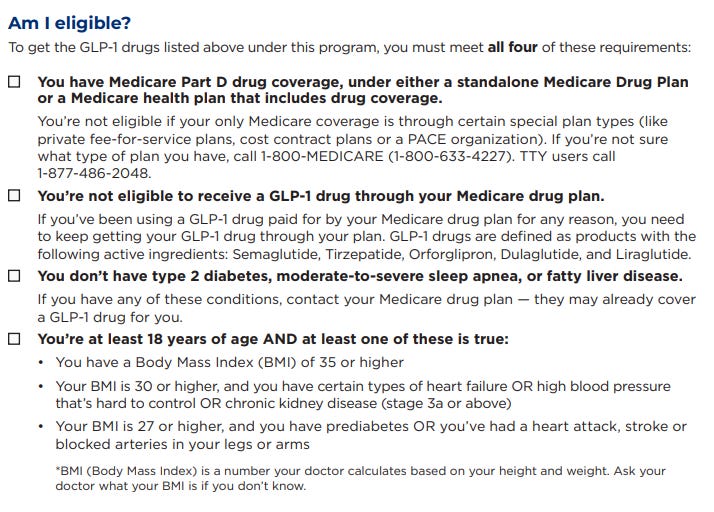
You have to be enrolled in a Medicare Part D Plan (Medicare’s prescription drug plan that requires a monthly premium) AND you cannot have received a GLP-1 through that Part D plan.
Patients who qualify for a GLP-1 as part of their Part D plan are not eligible for the Medicare GLP-1 Bridge program — and this holds regardless of which indication triggered that Part D coverage. So if your Part D plan “covers you” because you have moderate to severe sleep apnea and are over their BMI cutoff, you are not eligible for the $50/month Bridge plan. That means you will pay whatever your plan copay for the GLP-1 is up to your $2000 annual deductible. So even if your BMI is over 35, which would qualify you through the Bridge program, if moderate to severe sleep apnea is documented in your history and your Part D plan covers you on that basis, you aren’t eligible for the Bridge program. The same logic applies to type 2 diabetes, the single largest indication driving GLP-1 use in this population. If you’ve received a GLP-1 through your Part D plan, you are ineligible for the Bridge program. The graphic below is from CMS (you must check off all 4 boxes to qualify).
And so it comes to be that a large chunk of Medicare beneficiaries who clinically could be on GLP-1s through the Bridge program are kept imprisoned in a system that’s more expensive for them and more profitable for the Pharmacy Benefit Manager ecosystem. The Bridge program is directly administered by CMS at a net price CMS has negotiated of $249 (with a $50 copay for Medicare patients) and completely bypasses the Part D PBM ecosystem. And it turns out that there was no way the vested interests were going to allow that to happen. The optics on this are pretty poor given the public messaging leading up to the Bridge program roll out. There are going to be a lot of disappointed seniors and physicians who will correctly conclude the program was oversold, and not some hard won negotiation by the Trump Administration.
Think about what just happened: In exchange for agreeing to the $249 monthly price, the only two manufacturers of GLP-1s, Novo Nordisk and Eli Lilly, received guaranteed access to the largest single payer patient population in the United States. The Bridge program meant CMS would be handling prior authorizations, claims adjudication, and pharmacy payment. The manufacturers wouldn’t have to negotiate with individual Part D plans, fight to get on formularies, or manage rebates with PBMs, and they would now have direct access to a group of patients unreachable until a generous government subsidy came into being.
The part of the deal that doesn’t get much press, but may be the most consequential, was the government agreeing to take out the competition. For the three years preceding the Bridge launch, a parallel market for GLP-1 medications had been providing actual price competition for Novo Nordisk and Eli Lilly via compounding pharmacies operating under FDA’s 503A and 503B framework. They were operating under this framework because of the FD&C Act, which gives compounding pharmacies the legal right to compound copies of a drug if the FDA places a drug on the drug shortage list. This goes into effect when a drug is deemed “not commercially available.” A brief explanation on 503A/503B follows.
503A covers the traditional compounding pharmacy. This is a state licensed pharmacy that compounds a drug for an individual patient with a valid prescription from a licensed prescriber. 503B is an outsourcing facility to allow large scale compounding. This is the pathway that built the mass-market compounded GLP-1 industry. While semaglutide and tirzepatide were on the shortage list, 503B facilities could compound at scale without individual prescriptions, ship nationally, and supply the booming telehealth prescription mill platforms like Hims, Mochi and Henry Meds with inventory.
Wegovy was first added to the FDA drug shortage list in March 2022, Ozempic in August 2022. Tirzepatide was added December 15, 2022. The compounding market that mushroomed as a result offered patients access to weight loss medications at $150 to $300 per month compared to the brand-name list price that exceeded $1,000. The FDA shortage designation for both GLP-1s was resolved in early 2025 — tirzepatide in December 2024, semaglutide on February 21, 2025 — and by May 22, 2025, large scale compounding was legally prohibited. The competition was taken out more than a year before the Bridge program ever launched. The only pathway left is the clinical need exceptions that surviving telehealth compounders are exploiting: a documented allergy to an inactive ingredient in the commercial product, or a required dose strength that isn’t commercially available.
The federal government then moved to close even that door. In September 2025, the FDA issued a series of warning letters to online sellers of compounded GLP-1 medications, and in February 2026, Novo Nordisk filed suit against Hims & Hers, alleging patent infringement through compounded semaglutide products. On April 30, 2026, the FDA proposed to formally and permanently exclude semaglutide, tirzepatide, and liraglutide from the 503B outsourcing facility bulk drug substances list. If finalized, the rule would prohibit 503B facilities from compounding these agents under any circumstances, regardless of future market conditions, regardless of whether brand-name supply is adequate. The justification offered was patient safety, but the timing of it all — warning letters, patent litigation, permanent 503B exclusion — all landing within months of the Bridge launch seems hardly a coincidence.
And there’s more.
The Commissioner’s National Priority Voucher program is a pilot initiative that compresses FDA review timelines from the standard ten to twelve months down to one to two months. Two of the six vouchers in the second round went to GLP-1 drugs: Novo Nordisk’s semaglutide, directed toward a higher-dose formulation of Wegovy, and Eli Lilly’s orforglipron, an oral non-peptide small molecule that had not yet received FDA approval. The vouchers followed agreements from both companies to improve affordability of GLP-1s for Medicare and Medicaid patients, a mission announced by the executives of both companies as they stood alongside President Trump at a press conference in the Oval Office.

Novo Nordisk used its voucher to obtain approval for Wegovy HD — a 7.2mg high dose injectable formulation — in March 2026. Eli Lilly used its voucher for orforglipron, approved on April 1, 2026, under the brand name Foundayo, and described by the agency as the fastest approval of a new molecular entity since 2002. Both are now included in the Medicare GLP-1 Bridge program. The accelerated review means billions of extra dollars in revenue.
The administration’s framing was that the vouchers were granted because the companies agreed to increase affordability. Here’s former FDA commissioner Marty Makary:
“National priority vouchers are granted to a select group of products where the company has agreed to increase affordability, domesticate manufacturing as a national security issue, or address an unmet public health need.”
The companies’ framing was that they were engaging in a national health priority. The more accurate framing is that two pharmaceutical companies, in exchange for accepting a guaranteed federal price that was still more than double what the compounding market had been charging, received the elimination of their primary pricing competition, a federally administered patient acquisition program, and the fastest regulatory approvals in a generation for their next-gen products. Accelerating approval of these next-gen formulations by ten to eleven months doesn’t change the patent timeline, but it compresses the product cycle: a higher-dose Wegovy and an oral Foundayo reach physicians and patients sooner, generate revenue sooner, establish market position sooner, and create clinical inertia — patient stabilization on a specific formulation — that makes future price negotiation more difficult for any payer, including CMS.
The administration believed it had extracted meaningful price concessions while expanding historic access to a transformative class of medications. What it had actually done was agree to pay $249 per month — indefinitely, at federal scale, with no compounding alternative — for drugs the market had demonstrated could be produced and distributed profitably at half that price, in exchange for regulatory favors that compressed the manufacturers’ product timelines by nearly a year and opened a federally subsidized acquisition channel for the next generation of their pipelines.
The GLP-1 program is called the “Bridge” program because by law it cannot be a permanent program. This would be because Medicare Part D has been prohibited by statute from covering drugs for weight loss. Section 1860D-2(e)(2)(A) of the Social Security Act explicitly excludes from Medicare drug coverage any agent used for anorexia, weight loss, or weight gain. Interestingly, the multiple bills that have been introduced in Congress to address this have gone nowhere.
The loophole CMS is using to cover GLP-1s for weight loss is via its demonstration authority housed in the Center for Medicare and Medicaid Innovation (CMMI), established by the Affordable Care Act. Ostensibly, the Bridge program is a CMMI demonstration model to generate evidence about whether GLP-1s can be integrated into Medicare in a budget-neutral way. The projected spending figure for the Bridge program is $47.7 billion and it is not designed or able to continue indefinitely.
So the CMS plan was to stand up the Bridge program and quickly transition to the BALANCE program (also a CMMI model). Under BALANCE, CMS would negotiate directly with GLP-1 manufacturers for guaranteed net pricing and out of pocket limits for beneficiaries. The negotiated prices would run through the normal Part D benefit architecture, so patient cost sharing would count towards deductibles. This was a voluntary program that required 80% of Part D sponsors to participate. The threshold existed because of adverse selection: if only a minority of plans agreed to cover weight loss drugs, obese beneficiaries would rationally migrate into those plans during open enrollment, concentrating the highest-cost patients into the smallest risk pools and bankrupting exactly the plans that had volunteered to help. The threshold was CMS’s attempt to spread that risk across the entire Part D population — and it required near-universal participation to work. The voluntary structure guaranteed that the plans most able to absorb the risk — large national carriers with diversified enrolled populations — had no incentive to opt in and cross-subsidize smaller plans with higher-risk populations.
And the math hasn’t worked for private insurance plans for a reason: it requires indefinite use with no stopping criteria, and there’s a patent runway of 10+ years with no generic competition. Jefferson Health in Philadelphia recently faced roughly $180 million from insurance division losses in 2025, with about one-third of that financial strain driven by soaring costs for GLP-1 medications like Wegovy and Zepbound. Part D plans passed on participating in the BALANCE program, and so the Bridge program has now been extended to the end of 2027.
The gap between the public relations campaign and the fax on my desk is manufactured by a combination of legislative handcuffs, government bureaucratic incompetence, and regulatory capture. The administration was hoping to get a political win with the Bridge program. What it delivered is a near complete victory for the two drug manufacturers of GLP-1s.
Fundamentally this is a problem of the social welfare state our betters are constantly attempting to design. Inevitably billions of taxpayer dollars end up in the bank accounts of corporations that are much smarter than administrative bureaucrats who have no real skin in the game. (Smart bureaucrats do exist but they are such an existential threat to the ecosystem, they have a very limited lifespan in DC.). The executives on the other side of that table have nothing but skin in the game. It is the proverbial shooting fish in a barrel.
If the government really wanted to play hardball, it would highlight the tens of millions of Americans that cannot access these drugs at the prices the manufacturers have currently set and put GLP-1s back on the shortage list. This would reopen compounding, which would put intense pressure on that $249 a month “floor”. Some will say the FDA has explicitly ruled affordability does not constitute a clinical need. So what. Issue a new ruling. This is hardball, not softball.
This is, of course, extremely unlikely to happen. Which says a lot about the difference between what this administration says and what it is actually willing to do.
I still have to call Sofia Abbruzese. She has been paying $500 a month, she has thirty pounds to go, and I told her help was coming. I am going to have to explain that the program I described to her does exist, that she does not qualify for it, and that the cheaper option she could have used two years ago was made illegal in the run-up to the announcement.
It didn’t have to be this way.
Anish Koka, MD is a cardiologist in Philadelphia and writes at AnishKokaMD.Substack.com
No posts
Comments
Nothing yet. Say the first thing.
Sign in to join the conversation.