
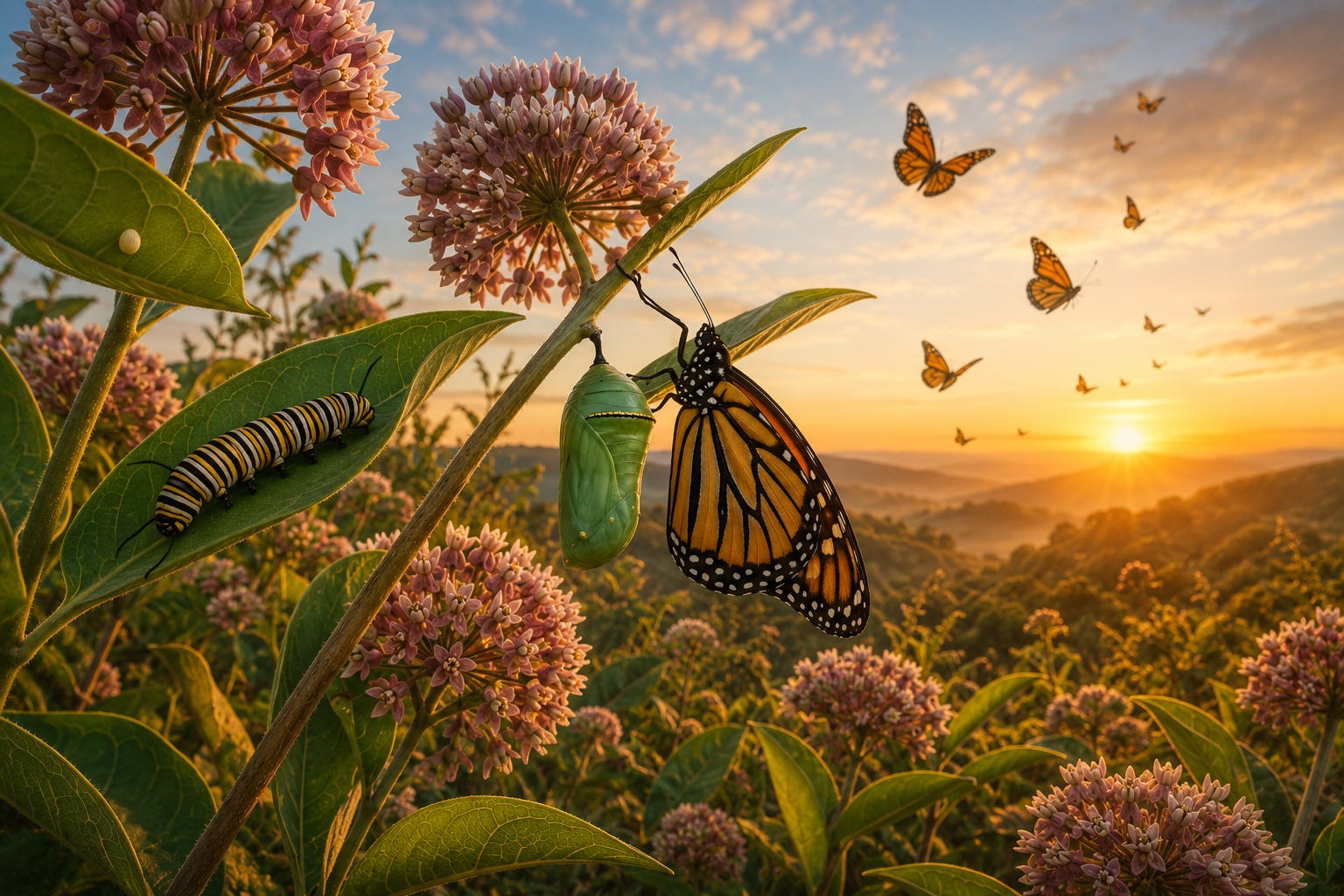
The monarch butterfly does not ask for our attention. It earns it, quietly, persistently, across generations that never meet yet somehow remember. Its survival is not the triumph of a single extraordinary insect, but of a living system that continues to work because each generation fulfills its part without seeing the whole. And that system depends on something startlingly specific: milkweed. Remove it, and the miracle begins to disappear.
We often tell this story as wonder, and it is. A creature that begins as something nearly invisible, a pinhead of intention placed on a milkweed leaf, becomes, through hunger and dissolution, a being capable of crossing a continent. Its transformation is not metaphorical. It is total.
The caterpillar does not improve itself; it becomes unrecognizable even to its own biology. It dissolves into a mass of living cells as imaginal cells begin building something entirely different. Remarkably, those imaginal cells are present long before the butterfly emerges. At first, they seem almost incidental to the life already underway. Only after the old structure begins to dissolve can the new one take shape. Institutions often behave the same way.
Their greatest resistance is not to failure, but to the ideas that might allow them to evolve.
Inside the chrysalis, there is no incremental progress, no measured reform. There is collapse followed by reassembly. For those of us who have spent our lives inside institutions, animal shelters, nonprofits, systems built on good intentions but compromised by inertia, the lesson is as unsettling as it is inspiring. Real transformation is rarely administrative. It is existential.
The monarch’s life cycle is also a story about dependence, though we often resist that word. The monarch cannot exist without milkweed. Not adapt. Not pivot. Not innovate around it. Without milkweed, there is no monarch. Period.
What is remarkable is not that we know this, but that the solution remains so elegantly simple. Restore the milkweed, and the monarch begins restoring itself. Conservation, at its best, is not the manufacture of survival. It is the restoration of what life requires.
Animal welfare has often taken the opposite path. Faced with preventable suffering, we have become increasingly sophisticated at rescue while investing comparatively less in prevention. We build larger systems to respond to crisis while leaving its causes largely intact.
Nature rarely works that way.
And yet, over the past several decades, we have steadily removed milkweed from much of the landscape, not because we set out to eliminate the monarch, but because the places where milkweed once flourished were increasingly reshaped for other purposes. We pursued more productive agriculture, cleaner roadsides, expanding development, and more intensive land management. The result, however unintended, has been the same: the quiet disappearance of one of nature's most essential relationships.
The monarch does not protest.
It simply declines.
There is something else, something even more profound, in the monarch’s migration. The final generation, the so-called “super generation,” undertakes a journey it has never been taught. No elder leads it. No map is passed down. It flies thousands of miles to a place it has never seen, guided by mechanisms we only partially understand: the sun, time itself, perhaps even the magnetic field of the Earth.
This is not just endurance. It is inheritance without instruction. The destination is remembered even though no individual remembers making the journey.
Nature asks remarkably little of the monarch. It asks only that each generation complete its part without exhausting the conditions that make the next generation possible.
It takes four generations to complete what we casually call “the migration.” No single butterfly sees the whole journey. Each generation carries the journey a little farther, handing it off, unknowingly, to the next. There is no ownership, no branding, no claim of credit. Just continuity.
In animal welfare, we speak often about metrics, intake, outcomes, live release rates. These matter. I have built a career on proving they matter. But metrics are only as meaningful as the systems that produce them. A butterfly population cannot be measured apart from milkweed any more than shelter outcomes can be measured apart from the communities, policies, and preventive investments that shape them. Healthy systems produce healthy metrics, not the other way around.
We are not there yet.
Instead, we see fragmentation: organizations competing for funding, incentives rewarding visibility over continuity, and data shaped to fit narratives rather than reveal truth.
Nature offers no awards for appearing successful.
The monarch’s only measure of success is whether another generation takes flight.
We see, in too many places, a reluctance to undergo the kind of transformation that the monarch accomplishes as a matter of course.
To dissolve what no longer works.
To trust what might emerge.
The monarch’s story is not just about beauty. It is about precision, interdependence, and fragility. Remove one element - milkweed, climate stability, migratory corridors - and the entire system begins to fail. Not dramatically at first. Quietly. Gradually. Then all at once.
Compassion is not merely the impulse to save what is suffering.
It is the discipline of restoring the relationships that allow life to flourish.
Nature almost always begins upstream.
To plant milkweed is a small act. Almost embarrassingly small in the face of global ecological decline. Yet nature has always reminded us that compassion begins with understanding what another life actually requires. Not what we wish it required. Not what is convenient for us to provide. But the conditions under which it may flourish.
In that sense, the monarch offers us a warning and a way forward.
Transformation is possible, but it demands more than intention. Survival is collective, but it depends on individual acts that honor the relationships on which life depends. And continuity, the thing we claim to value most, is built not through control, but through participation in systems larger than ourselves.
The next time a monarch passes through your field of vision, do not reduce it to a symbol.
It is not here to inspire us.
It is here despite us.
Whether the monarch returns next spring will depend less on how much we admire its journey than on whether we leave behind the world it needs to make it.
That may be the truest measure of what we choose to pass on.
Author’s Note: A friend recently forwarded me a beautiful reflection on the monarch butterfly. It prompted me to think less about the butterfly itself than about the conditions that allow life to flourish. This essay grew from that reflection. Thank you, Rosemary Hradek, for the inspiration.

Ed Boks is the former executive director of animal care and control agencies in New York City, Los Angeles, and Maricopa County, and a past board member of the National Animal Control Association. His work has appeared in the Los Angeles Times, New York Times, Newsweek, Real Clear Policy, Sentient Media, and now on Animal Politics, a lively community spanning 49 states and 73 countries.
Animal Politics is reader-supported. If this reporting matters to you, a paid subscription is the most direct way to keep it going.
No posts
Comments
Nothing yet. Say the first thing.
Sign in to join the conversation.