
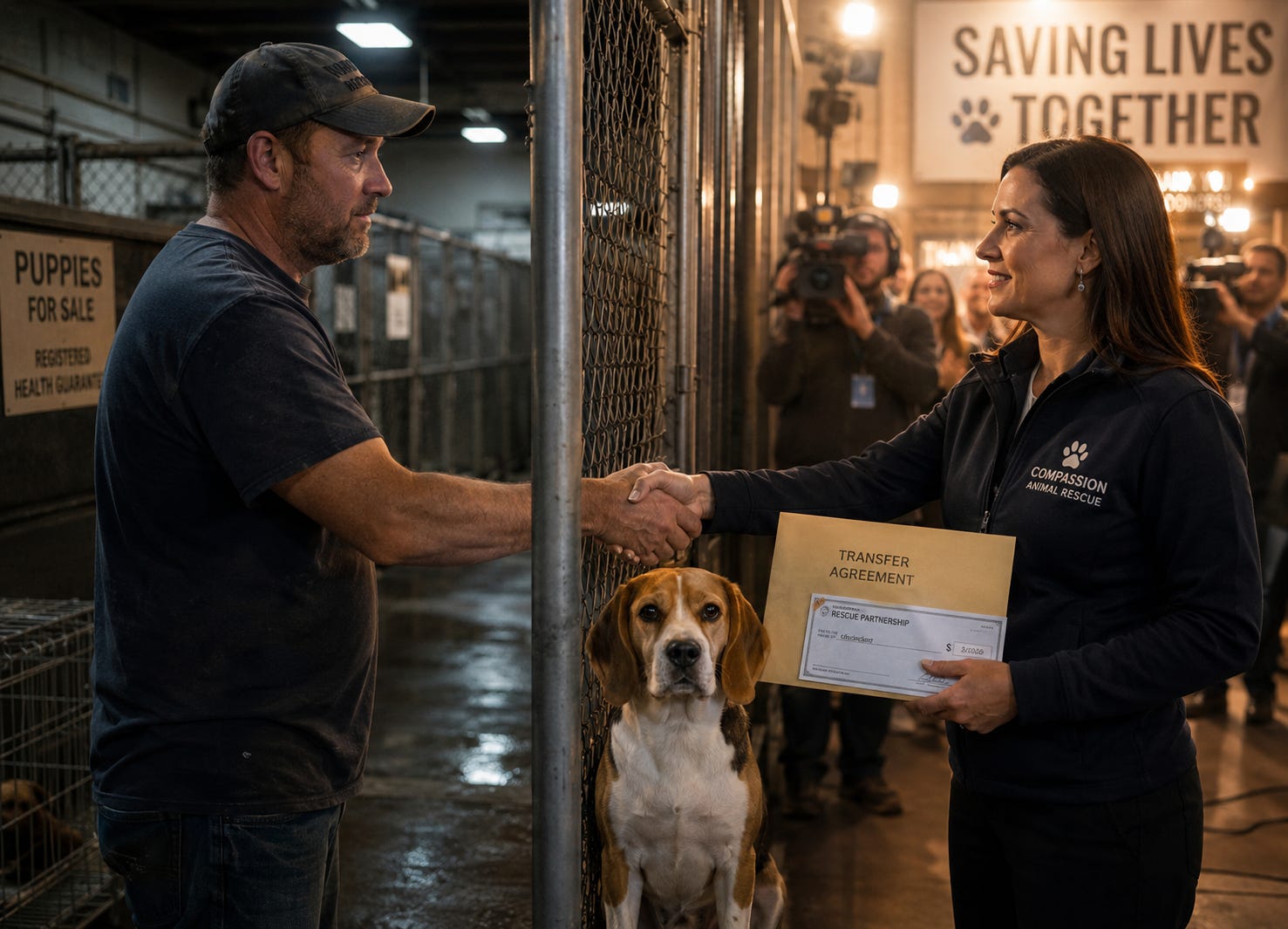
Rescue washing is the use of a nonprofit shelter or rescue organization to sanitize, legitimize, or financially sustain commercial breeding operations by wrapping them in the language and imagery of humane rescue. It gives the appearance of lifesaving work while helping sustain the very industries the public believes it is opposing. Over time, it can also teach commercial operators that rescue organizations may become reliable downstream customers.
From a Missouri dog auction to the final deal at Ridglan Farms, Big Dog Ranch Rescue (BDRR) did more than buy dogs from commercial sellers. It became a case study in how rescue can save animals while still rewarding the system that endangered them.
Most people think of rescue in simple terms. Dogs are found on the street, surrendered by owners, or seized in cruelty cases, and then shelters or rescues work to place them in homes. In that picture, the rescue is clearly separate from the commercial world that breeds and sells dogs. Ridglan and Missouri complicate that picture.
BDRR’s Missouri records and the Ridglan agreements suggest that rescue washing is not simply the product of individual decisions. Together, they point to a broader system of incentives shaping modern animal rescue. Institutions tend to produce the behavior their incentives reward, regardless of the ideals they profess.
In simple terms, this is a story about how good intentions and bad incentives can mix: a rescue that wants to save dogs ends up paying the very businesses that put them at risk, and then gets rewarded for doing so.
In animal welfare, dramatic rescue often attracts more money, media attention, and political recognition than the more difficult work of preventing animals from entering crisis or commercial pipelines in the first place. Once that imbalance exists, rescue washing becomes less surprising.
Palm Beach County saw this pattern emerging before Ridglan ever entered the story.
In 2023, county officials issued a violation notice to BDRR after concluding the rescue had been buying puppies from a Midwest auction and bringing them into Palm Beach County. Local ordinance bars humane societies and rescues from compensating breeders or pet dealers for dogs and cats. The rule exists because the county shelter tends to already be over capacity and officials say breeders “shouldn’t be enabled.”
Investigators followed the paper trail. Auction records and a state inspection confirmed the dogs were purchased, not surrendered or confiscated, and that BDRR had bought more than 580 puppies at two Missouri auctions. When county staff met with BDRR founder Lauree Simmons, she did not deny buying the dogs, saying she paid small amounts to keep them from worse outcomes and moved most to her Alabama facility, with a smaller number entering Palm Beach County for care.
County officials did not find cruelty at BDRR’s campus. They found dogs with food, water, shelter, and veterinary attention. The violation was not about how the dogs were kept. It was about how they entered the county. Palm Beach County drew a clear line. Rescues could not compensate commercial sellers for animals brought into the county, even if those animals later appeared in rescue narratives.
The concern is simple. Once a rescue starts paying breeders and auction houses for dogs, it begins to look less like an emergency safety net and more like another buyer in the market. That is what Palm Beach County was trying to prevent.
The investigation documented more than a dispute over Missouri auctions; it exposed the mechanics of a growing incentive system. Commercial breeders possess animals that evoke sympathy, and rescue organizations possess donors eager to help save them. The greater the public attention, the greater the rewards for the organization that becomes identified as the rescuer: donations increase, media coverage expands, political relationships deepen, and institutional prestige grows.
From that perspective, Missouri was more than an isolated controversy. It was an early sign that commercial sellers and rescues were learning how to meet in the same marketplace, each responding to what the other could offer. Ridglan Farms later became the test of how powerful those incentives had become.
Palm Beach County’s cease-and-desist order was an early attempt to draw a line before rescue washing became normalized.
Rescue washing is the public packaging of commercial transactions as humane rescue work. But rescue washing is not the whole story; it is the visible part. Beneath it lies the Hero Incentive.
Seen together, the pieces fit naturally:
Commercial breeders and auctions want revenue or a favorable exit.
Rescues want dogs whose stories generate donations, gratitude, and attention.
Donors reward dramatic saves, not invisible upstream work.
Media outlets reward clean rescue narratives.
Politicians reward high-profile victories.
When all these incentives line up, commercial purchases can be reframed as rescue without anyone needing a conspiracy or an outright lie. The system simply rewards one story more than another.
Ridglan Farms shows how that logic behaves in a hard case, where commercial breeding, public rescue narratives, and the Hero Incentive all collide.
Ridglan Farms was a beagle breeding and research facility in Wisconsin, supplying dogs to laboratories for decades and facing criticism over conditions inside the facility. In early 2026, activists carried out open rescue actions there, removing some beagles and publishing video of frightened dogs in stark concrete pens. Those images shocked the public and helped turn “free the Ridglan beagles” into a national cause.
By that point, Ridglan was already under legal and financial pressure. Under an agreement with a special prosecutor, it had committed to surrender its breeding license by July 1, 2026 and wind down operations. Activists, investigators, and prosecutors had forced change; the question was no longer whether Ridglan would close, but how the dogs would leave and who would own the story of their rescue.
For donors and much of the national media, Big Dog Ranch Rescue emerged as the public face of the Ridglan beagle rescue. The chronology surrounding that outcome matters not only because of who deserves credit, but because credit itself had become one of the incentives shaping the negotiations.
In the spring of 2026, a coalition led by the Center for a Humane Economy, with Beagle Freedom Project and other partners already involved, negotiated a confidential agreement with Ridglan to purchase roughly 1,500 beagles. In late April CHE and Big Dog Ranch Rescue formally signed that agreement. CHE then worked with Beagle Freedom Project and other coalition members to handle and place about 500 of those dogs and BDRR took 1,000. In June, CHE and BDRR jointly acquired another 135 beagles, bringing the total to 1,635 dogs removed from Ridglan.
In mid‑June, BDRR announced a final agreement covering the remaining 475 dogs. Ridglan confirmed that it would sell 325 dogs to BDRR and donate the rest, then shut down its breeding, sales, research, and testing operations.
The dogs needed to get out. The hard part was not whether action was needed, but which actions were acceptable and what incentives those actions would create. Advocates faced limited options: keep pushing for a non-payment release, accept a lower payment with strict limits, refuse any payment and risk leaving dogs at Ridglan longer, or pay more to secure the dogs immediately.
A later split between coalition partners suggests those choices were not merely theoretical. They became points of real disagreement during the negotiations. Reasonable people can disagree about which choice was right.
Ridglan also illustrates why hard cases can produce difficult precedents. According to those involved in the negotiations, there was a genuine concern that the remaining beagles could be sold to other research facilities if an agreement was not reached quickly. Faced with that possibility, paying Ridglan may have appeared to be the least harmful option. Many readers may conclude it was the right one.
But urgency does not eliminate incentives. It often amplifies them.
The more urgent it became to remove the dogs, the stronger Ridglan’s negotiating position became. Once more than one rescue organization was willing to pay for the same animals, the talks began to resemble a competitive market, even as everyone involved saw the outcome as a humanitarian success.
The irony is difficult to ignore. Ridglan reportedly warned that the remaining beagles might be sold to laboratories in what amounted to a fire sale. Yet once multiple rescue organizations began competing to purchase the dogs, the market moved in the opposite direction. Instead of fire‑sale prices, competition among charities strengthened Ridglan’s bargaining position; in economic terms, urgency increased the seller’s leverage.
Ridglan is best understood as a hard case. The beagles required immediate help, and reasonable people can disagree about how they should have been freed. But once money changed hands, another question emerged alongside the humanitarian one: who would receive public credit for saving the beagles? That is where the Hero Incentive becomes central.
As Blinded By The Light reported, the Ridglan story quickly became a contest over who would be seen as the beagles’ savior. Grassroots activists risked arrest in open rescue actions, lawyers negotiated behind the scenes, and politicians and celebrities arrived later, eager to stand with the rescued dogs.
In modern animal welfare, that hero role has real value. The group cast as rescuer can gain:
Donor enthusiasm and long-term fundraising power.
Media attention and narrative control.
Political access and influence.
Institutional prestige and partnerships.
Big Dog Ranch Rescue is a large, well-funded rescue based in Palm Beach County. It promotes itself as the “largest cage free no kill dog rescue in the United States” and regularly hosts celebrity‑driven events at Mar-a-Lago and other venues that raise millions of dollars. The Center for a Humane Economy (CHE), by contrast, is a national advocacy group that focuses on law, policy, and corporate campaigns and helped negotiate the two early transfers of 1,635 beagles from Ridglan. These differences matter when credit and control are at stake.
This helps answer a question that hangs over Ridglan: why would one rescue outbid another?
According to CHE president Wayne Pacelle, CHE’s lawyer believed he had secured terms for the remaining 475 dogs on June 4. On June 11, Ridglan’s counsel told CHE the owners had decided to go in a different direction. Pacelle said that BDRR had offered more money for the dogs and that CHE refused to enter a bidding war with a fellow charity.
Whether Pacelle’s account is accepted or disputed, it illustrates the incentive problem. Once multiple organizations are willing to bid against one another for the same animals, the seller’s position becomes stronger, regardless of which organization ultimately prevails.
The final Ridglan deal was not only about getting dogs out; it was also about who would control the last, most visible act of rescue and who would capture the rewards that came with being the hero.
Nothing in Palm Beach County’s investigation suggests that BDRR lacked compassion for the dogs it purchased. Likewise, nothing in CHE’s timeline diminishes its longstanding work to reduce animal experimentation or build legislative coalitions. Both organizations have contributed to animal welfare in significant ways.
The issue raised here is different. It is whether the incentives surrounding high-profile rescues encourage financial transactions that blur the line between rescue and commerce, regardless of the intentions of the participants.
Viewed in terms of incentives rather than intentions, the outcome becomes easier to understand. When the reward for becoming the Ridglan beagle rescuer is worth millions in donations and years of brand equity, paying more is economically understandable even if it remains morally troubling. The result is not necessarily bad people; it is a system that has learned to reward buyer behavior in moments framed as heroic emergency rescue.
If high‑profile rescues create a Hero Economy, the crucial test is whether local enforcement begins to bend toward the heroes it helps create.
Palm Beach County belongs inside this Hero Economy analysis, not outside it.
In 2023, Palm Beach County Animal Care and Control drew a bright line. It issued a violation notice and ordered BDRR to stop compensating anyone for animals brought into Palm Beach County, citing a local ordinance that bars rescues from purchasing animals from puppy mills or similar commercial sellers. County officials told the press that local shelters already had too many dogs and that breeders should not be enabled.
Yet BDRR founder Lauree Simmons now says the county approved the Ridglan arrangement as an exception because of the extraordinary circumstances. As of publication, Palm Beach County has not provided a clear public explanation of how such an exception fits within its earlier cease‑and‑desist order.
That silence matters, not because it proves corruption, but because agencies face incentives too. A local regulator does not want to be framed as the office that blocked the release of suffering beagles in a nationally celebrated rescue. A county that partners with BDRR and sees it raise millions for animal care may also be more inclined to treat it as a special case.
If Palm Beach County did quietly treat Ridglan as an exception while keeping its rule in place for everyone else, a basic fairness question follows. Would a small, low profile rescue without Mar-a-Lago fundraisers and national media coverage have received the same flexibility? If the answer is no, then enforcement itself has started to respond to the Hero Economy; powerful rescues may get to bend the rules when their actions are framed as dramatic lifesaving.
If Palm Beach County did grant a waiver, the key questions are simple and structural. What standard justified that waiver? Who approved it? Would a smaller, less visible rescue have received the same flexibility?
Those questions are not about villains. They are about governance.
The Missouri auction, the county investigation, the Ridglan contracts, the CHE–BDRR split, the Fox interviews, the Mar-a-Lago fundraisers, and the unresolved waiver all tell parts of the same story.
Rescue washing is the symptom. The Hero Incentive helps explain the underlying condition.
When the greatest rewards flow to the organization perceived as the rescuer, institutions begin competing to own the rescue narrative rather than eliminate the need for rescue in the first place. In that environment, commercial purchases become easier to rebrand as rescue, bidding wars become easier to justify, confidential contracts become easier to defend, and waivers become easier to grant. All of this can happen even while everyone involved believes they are acting humanely.
Missouri showed one rescue buying commercially bred dogs and defending the purchases as necessary to save animals. Palm Beach County said that crossed a line and tried to stop it. Ridglan then showed how similar behavior can reappear on a much larger stage, with more applause, more urgency, and more institutional rewards attached to the final rescue.
The Missouri investigation did not conclude that BDRR neglected dogs. County investigators repeatedly found the animals adequately cared for. Their concern was different. They concluded that the rescue had compensated commercial sellers in violation of county ordinance.
Three years later, Ridglan Farms raised the same underlying question at a far greater scale. When multiple rescue organizations compete financially for the same animals, the dynamics begin to resemble a market transaction even when every participant feels they are being compassionate. The organization that buys the animals receives public gratitude. The seller receives payment. Donors celebrate a rescue. The media celebrate heroes. The transaction is remembered as lifesaving rather than as a commercial exchange.
That is why rescue washing deserves to be understood as the outcome rather than the cause. The cause is the incentive structure. As long as animal welfare rewards organizations more for dramatic rescues than for preventing animals from entering commercial breeding pipelines in the first place, markets will naturally emerge around those rescues. Organizations need not intend to support those markets. They simply respond to the incentives placed before them.
The county attempted to draw a line between rescue and commerce. Ridglan suggests that line becomes harder to maintain when humanitarian urgency, donor expectations, media attention, and institutional prestige all reward the organization that completes the rescue. The participants may all be acting compassionately. The outcomes, however, increasingly reflect the incentives built into the system as much as the ideals the movement professes.
Ridglan therefore leaves the animal protection movement with a question larger than one rescue, one breeder, or one controversy:
Can a movement devoted to ending commercial exploitation of animals used in research and breeding afford to reward the selling and the purchase of its victims?
That is the lesson of the Hero Incentive. When credit is shared, partnerships are respected, and donors are kept informed, the desire to be seen as the rescuer can accelerate humane work rather than undermine it. The danger arises when the race for recognition begins to outbid partners, weaken rules, or turn commercial transactions into celebrated exceptions.
It’s not that we don’t need heroes. We desperately do. Every day, rescuers, investigators, veterinarians, foster families, transport volunteers, and advocates step into heartbreaking situations that demand courage, compassion, and sacrifice.
The question is not whether heroism matters. It is whether the incentives surrounding heroism reward the choices most likely to reduce animal suffering over the long term. When recognition, donations, and influence flow disproportionately to the most visible rescues, even principled organizations can find themselves responding to incentives that reinforce the very inhumane systems they hope to dismantle.
The challenge for animal welfare is not to celebrate heroes less. It is to build a movement in which the greatest rewards go to preventing crises before heroes are needed.
The real heroes may not be those who rescue the most animals from crisis. They may be those whose work quietly prevents the crisis from happening at all.
This article uses terms such as rescue washing, Hero Incentive, and Hero Economy. Definitions for these and many other concepts are available in the Animal Politics Lexicon, offered as a free resource in gratitude for your support. (Update 06/28/26)

Ed Boks is the former executive director of animal care and control agencies in New York City, Los Angeles, and Maricopa County, and a past board member of the National Animal Control Association. His work has appeared in the Los Angeles Times, New York Times, Newsweek, Real Clear Policy, Sentient Media, and now on Animal Politics, a lively community spanning 49 states and 73 countries.
Animal Politics is reader-supported. If this reporting matters to you, a paid subscription is the most direct way to keep it going.
No posts
Comments
Nothing yet. Say the first thing.
Sign in to join the conversation.