
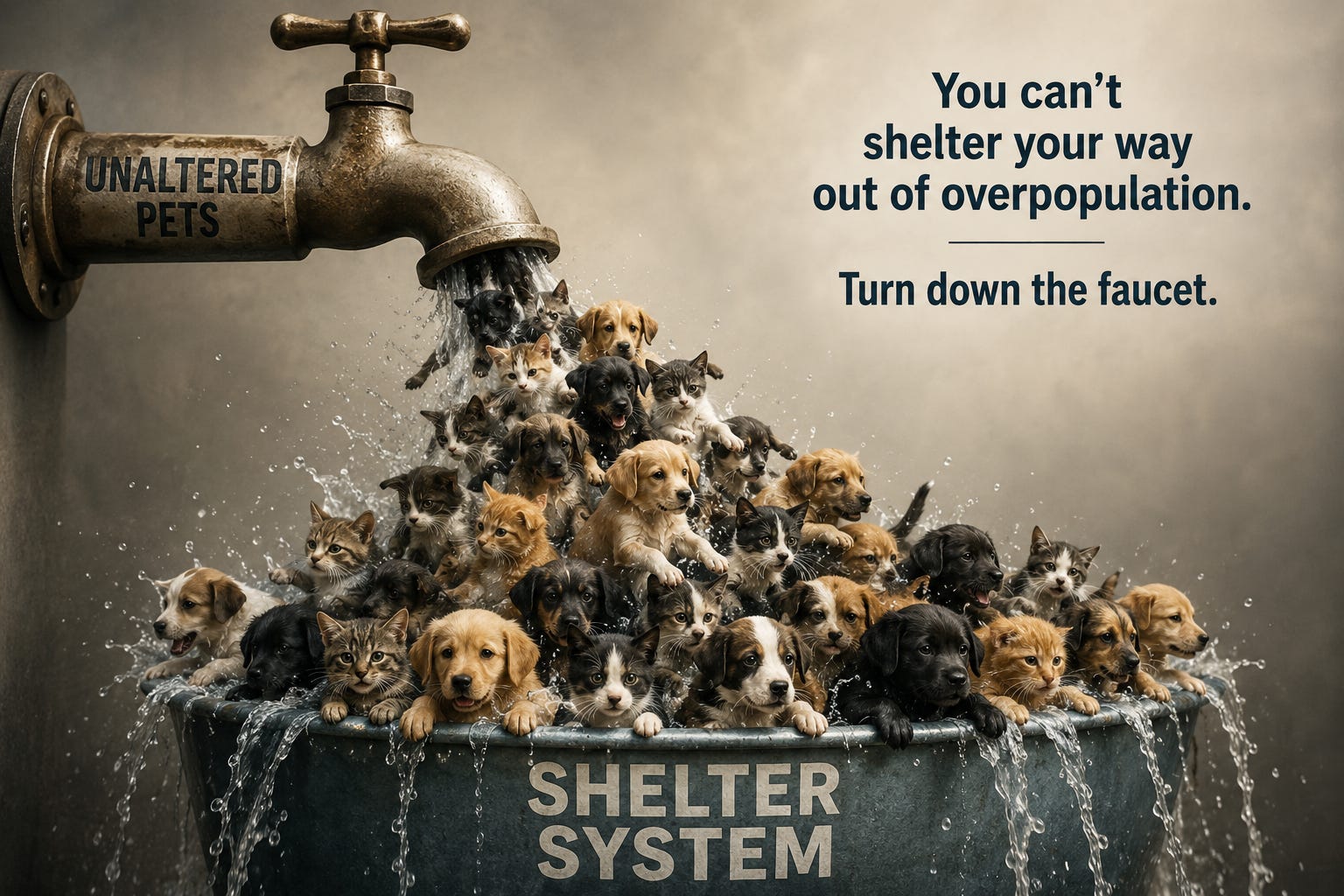
A recent online discussion about Memphis Animal Services illustrates a recurring pattern in animal welfare: when shelters struggle, attention quickly turns to what is happening inside the building rather than to what is driving animals into shelters in the first place. A shelter faces overcrowding. A critical staff position sits vacant. The community demands action.
It begins with a clear concern. The shelter does not currently have a full time staff veterinarian. The position has reportedly been shifted from employee to independent contractor status, making recruitment more difficult and limiting continuity of care.
The post then connects that staffing gap to a visible consequence. Animals waiting longer for spay and neuter surgeries. A shelter already under pressure. Overcrowding that never seems to fully resolve.
It also points to a deeper issue that most communities recognize. Years of unaltered animals reproducing in the community, producing steady intake pressure that never quite lets up.
The conclusion is straightforward. Hire a full time veterinarian. Restore capacity. Fix the bottleneck. Restore stability.
The urgency is real. Veterinary staffing matters. Shelter medical care matters. Operational strain matters.
But the question raised by this kind of post is not only about Memphis. It is about how animal welfare systems increasingly define both the problem and the solution.
When every crisis is framed through shelter capacity, the conversation naturally shifts toward what is missing inside the building. Staff. Space. Surgery. Throughput.
Less visible is what produces the intake in the first place.
That is where this week’s question begins.

“Memphis Animal Services follows the HASS (Human/Animal Support Services) and Best Friends’ models. Neither seems to prioritize spay and neuter. Is this the newest trend in animal welfare?” - B.F.
The question matters because it reaches beyond Memphis.
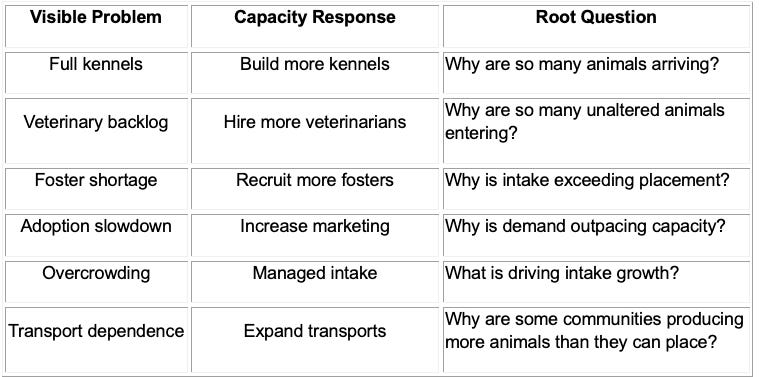
Across the country, shelters are struggling with overcrowding, staffing shortages, veterinary backlogs, foster shortages, and rising costs.
Yet many of the proposed solutions focus on moving animals through the system more efficiently rather than reducing the number of animals in need of sheltering.
Are we solving the problem, or are we becoming better at managing its consequences?
To answer that question, it helps to separate two issues that are often treated as though they are the same.
One is what the shelter looks like when it is under pressure.
The other is what is producing that pressure.
Shelters are built to respond to animals that have already arrived. They are designed for intake, care, and placement. When intake rises faster than placement, the system naturally turns inward. It focuses on flow, staffing, space, and speed.
More kennel capacity. More foster homes. More transport. Faster adoptions. Better shelter medicine. Improved internal logistics.
These are capacity solutions. They determine how well a shelter handles what is already in front of it.
They do not necessarily change how many animals arrive.
They address the source of intake before animals ever reach a shelter.
Targeted spay/neuter access in high-intake areas. Prevention that reduces shelter dependency.
These do not always create immediate visible relief. But over time they shape intake itself.
The difference is simple but important.
Capacity determines how well we manage demand.
Population strategies determine how much demand exists.
When shelters are overwhelmed, the most visible problems are inside the building.
You can see overcrowded kennels.
You can see medical backlogs.
You can see staffing shortages.
You can see animals waiting.
You cannot see the animals that were never born.
You cannot see the intake that never happened.
That visibility gap shapes public attention and policy response. It is natural for communities to focus on what is in front of them.
So the system expands what it can see and manage. It builds capacity. It improves throughput. It invests in operational solutions.
Over time, this can shift the center of gravity away from prevention and toward management.
A simple way to test any proposed solution is this:
If we solved this problem tomorrow, would intake decline next year?
Hiring a veterinarian improves medical throughput. Intake remains largely unchanged.
Expanding foster capacity improves housing options. Intake remains largely unchanged.
Increasing transport moves animals between regions. Intake remains unchanged.
Expanding spay and neuter access reduces future intake. Over time, intake changes.
This is not about choosing one strategy over another. It is about understanding what each strategy actually changes.
If we solved this problem tomorrow, would intake decline next year?
Animal shelters have always faced pressure to improve capacity. What appears to be changing is the balance between capacity and prevention. Increasingly, success is measured by how effectively shelters manage intake rather than whether communities reduce the need for shelters.
From roughly 1990 through 2010, many communities invested heavily in spay and neuter programs to reduce intake. During that period, national shelter intake and euthanasia declined dramatically as prevention became a central strategy. In recent years, more attention has shifted toward managing animals already entering the system through transports, foster networks, managed intake, diversion programs, and other operational strategies.
These approaches can save lives and relieve pressure. The question is whether they are being used alongside prevention or in place of it.
The post that sparked this question reflects a real and important issue. Veterinary staffing affects shelter operations. Delays in spay and neuter affect flow. Administrative structure affects hiring.
But the deeper question is whether solving that bottleneck would meaningfully change the intake curve.
If the underlying community pattern remains the same…
The shelter may become more efficient.
It may save more animals.
But it may not become less full.
That is the distinction that often gets lost when crisis is defined only by what is happening inside the shelter.
Animal welfare systems are not failing because they focus on capacity.
They are strained because capacity solutions often become substitutes for population solutions rather than partners to them.
One approach improves how the system handles animals already in care.
The other reduces how many animals need care in the first place.
Both matter.
But they are not the same.
And communities that confuse the two often find themselves improving the system without ever reducing the pressure on it.
The difference is simple.
One approach turns down the faucet.
The other enlarges the basin.
Communities that understand the difference are often the ones that make the most durable progress.

Ed Boks is the former executive director of animal care and control agencies in New York City, Los Angeles, and Maricopa County, and a past board member of the National Animal Control Association. His work has appeared in the Los Angeles Times, New York Times, Newsweek, Real Clear Policy, Sentient Media, and now on Animal Politics, a lively community spanning 49 states and 73 countries.
Animal Politics is reader-supported. If this reporting matters to you, a paid subscription is the most direct way to keep it going.
No posts
Comments
Nothing yet. Say the first thing.
Sign in to join the conversation.