
City leaders call the new $14 million LA Animal Services deal historic. It is. But this moment is about more than generosity. It marks an expansion of private influence inside a public shelter system the City has failed to fully fund.
On July 2, the Los Angeles City Council approved a $14 million initiative for LA Animal Services backed by the ASPCA and Best Friends Animal Society. The agreement funds more than 20 positions and embeds outside advisers inside the department to help shape training, programs, implementation, and data management.
Those operational details received far less attention than the size of the grant, yet they may prove more consequential than the grant itself.
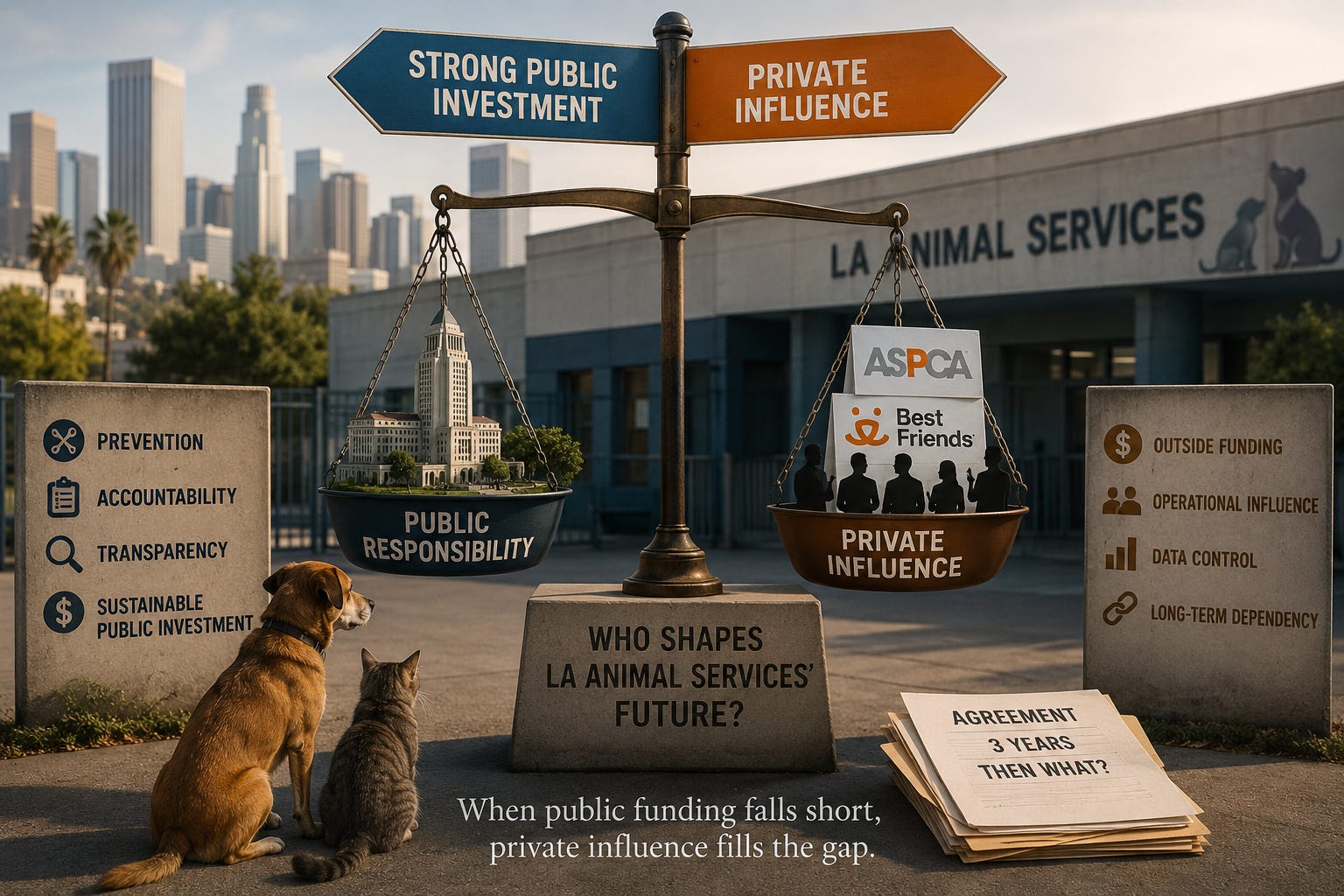
The headlines focus on the money. The real story is the structure. The plan pays for more than 20 staff positions and places four outside advisers inside LA Animal Services shelters to help with training, program development, implementation, and data management.
When outside organizations pay for employees who help shape training, programs, and data systems, they naturally gain influence over how the department operates, even if city employees remain in charge.
That should concern anyone who cares about public accountability. Animal sheltering is a public responsibility. When private organizations begin paying for core jobs and helping shape daily operations, the line between public service and private influence begins to blur.
The budget picture makes this harder to ignore. LA Animal Services asked for $31.8 million for the 2026–27 fiscal year, but the Mayor’s budget gave it about $29 million. Earlier reporting also showed the department operating below its 2023–24 funding level while carrying a $1 million reduction in positions and operating expenses.
So this “gift” is being laid on top of an underfunded operating budget. The City is not building on a strong foundation. It is using donor money to patch a weak one. It may bring short-term relief, but it also hides a basic truth: City Hall is not paying the full cost of running its own shelter system.
Another problem receives far less attention. The public rollout talks a great deal about adoptions, foster care, reunions with owners, training, and smoother shelter operations. It also refers generally to preventing unnecessary intake through community engagement. Yet the rollout identifies no measurable targets for sterilization surgeries, no goals for reducing births in high-intake neighborhoods, and no benchmarks for lowering shelter dependency over time.
That matters because prevention is the real fix. If fewer animals are born into crisis, fewer end up crowded into shelters. A plan that mostly helps animals move through the system faster may ease pressure for a while, but it does not solve the source of the problem. A shelter cannot adopt its way out of a population problem.
Then comes the unavoidable question: what happens in year four? The ASPCA and Best Friends will fund this initiative for three years. After that, LA Animal Services is expected to make a good-faith effort to keep key positions and programs going for three more years.
With what money? If the City is already underfunding the department now, this deal may simply delay the real bill. Today’s celebration can become tomorrow’s budget balloon, with taxpayers asked to take over costs that private groups introduced and public officials did not fully plan to sustain.
There is also the issue Animal Politics has been pressing for months: data. Our reporting found that Best Friends’ Shelter Pet Data Alliance collects data from more than 6,400 organizations and that LA Animal Services had been supplying data to that platform for at least five years. The reporting also found that city staff did not fully understand the relationship when it came to light.
Now Best Friends is moving even closer to LA Animal Services through a deal that expressly includes work tied to data management. That does not prove misuse by itself. But it does raise serious questions about access, oversight, and whether public shelter information is feeding a larger private system that supports planning, advocacy, and fundraising.
Public data belongs to the public. Whenever outside organizations help manage, interpret, or build systems around that data, the public deserves clear rules about ownership, access, oversight, and transparency.
The initiative also creates clear institutional benefits for ASPCA and Best Friends. It gives both organizations a highly visible role inside one of the country’s largest municipal shelter systems, strengthening their public profile while expanding their influence over how shelter success is defined.
This is also why prevention matters. Systems built primarily around responding to crisis naturally reinforce the organizations best positioned to manage that crisis. As long as prevention remains secondary, the demand for rescue continues, along with the visibility and fundraising opportunities that follow.
To be fair, some animals may benefit right away. More staff, better training, stronger foster support, and better reunification efforts can help. But policy should not be judged only by what it promises this month. It should also be judged by what it locks in for years to come.
Charity is at its best when it strengthens public institutions. It becomes problematic when it quietly substitute for public policy.
Los Angeles did not solve its shelter crisis on July 2. It chose instead to rely on private organizations to support a public responsibility it did not fully fund. Unless the City commits to prevention and sustainable public investment, this agreement risks making outside influence a permanent feature of municipal animal sheltering, with policy shaped more by national organizations rather than local elected officials and the taxpayers they serve.
The real test of this agreement will not be this month’s headlines. It will be what the public sees in the data, the budget, and the shelters over the next three years.
Will LA Animal Services publish measurable goals for targeted spay/neuter in high-intake neighborhoods, along with annual progress reports? If intake remains high while adoptions increase, the underlying problem has not been solved.
Do performance reports continue to focus primarily on live release rates, adoptions, and transfers, or do they also track prevention metrics such as sterilization rates, intake per capita, and shelter dependency?
Does the City increase its own investment in LA Animal Services, or does it become more dependent on outside funding to maintain core operations once the grant expires?
Does the City absorb the grant-funded positions into its budget, or are services reduced when outside funding ends?
Are major operational decisions increasingly driven through public hearings and City leadership, or do outside organizations become the primary source of new initiatives and strategic direction?
What data are shared with outside organizations? Who owns it? How is it used? Are there clear public policies governing access, analysis, and transparency?
Is the number of animals entering LA shelters actually falling over time, particularly in neighborhoods with the highest intake? Lower shelter dependency is one of the clearest signs that prevention is working.
Three years from now, are ASPCA and Best Friends stepping back because the City has rebuilt its own capacity, or have they become a permanent part of how LA Animal Services operates?
The ultimate question is not whether this grant helps animals today. It is whether, three years from now, Los Angeles has a stronger public shelter system or a more dependent one.
Ed Boks is the former executive director of animal care and control agencies in New York City, Los Angeles, and Maricopa County, and a past board member of the National Animal Control Association. His work has appeared in the Los Angeles Times, New York Times, Newsweek, Real Clear Policy, Sentient Media, and now on Animal Politics, a lively community spanning 49 states and 73 countries.
Animal Politics is reader-supported. If this reporting matters to you, a paid subscription is the most direct way to keep it going.
No posts
Comments
Nothing yet. Say the first thing.
Sign in to join the conversation.