

Elizabeth Báthory was a Calvinist noblewoman on Hungary's war-torn frontier long before the blood-bath legend. Here is the world, name, and marriage that made her.
In this Podcast Episode, we will discuss:
Was Elizabeth Báthory really the Blood Countess, or is the blood-bathing a myth?
Who was Elizabeth Báthory’s husband, Ferenc Nádasdy, and why was he called the Black Bey?
What was Elizabeth Báthory’s family and early life actually like?
Why is the number of Elizabeth Báthory’s victims disputed?
How did Hungarian law let nobles punish their servants in the 1500s?
Why did Ferenc Nádasdy take the Báthory name when they married?
It is the frontier of Royal Hungary, near the end of the sixteenth century. The land between two empires. To the south, the Ottomans. To the west, the Habsburgs. And in the middle, a country that has been at war for so long that no one alive remembers a peace.
A rider comes down out of the hills. His armor is dark. The Turks who fight him have a name for him, and they say it the way you say the name of a storm. The Black Bey.
He has taken castles back from the Ottomans. Esztergom. Visegrád. Győr. He has done things to his prisoners that men still whisper about a hundred years later. And when he rides home, he rides to a wife.
She is younger than he is. She is better read than he is. She speaks Latin and German, and she runs his estates while he is away killing. Her name is older than his, older than almost anyone’s in the kingdom, and it opens every door in Hungary.
Her name is Báthory.
This is the story of the world that made a monster. Before the cellars. Before the trial. Before the legend. This is the beginning.
You have heard her name. Most people have. Elizabeth Báthory. The Blood Countess. The woman who is said to have bathed in the blood of young girls to keep herself young. She turns up in vampire films. She turns up in heavy metal. She turns up on lists of history’s worst killers, usually at the top, usually with a number attached. Six hundred victims. Six hundred and fifty.
Hold on to your doubts about that number. We are going to earn them, over three episodes, together. Because the truth of Elizabeth Báthory is stranger and colder than the legend, and the legend has done its best to bury it.
Here is what I want to do tonight. I do not want to show you the killing. Not yet. I want to show you the world she was born into, and the family that gave her a name no one could touch, and the man they married her to, and the kind of power a woman like her held over the people who served her. I want you to understand the machine before we watch it run.
Because the horror of this story is not that a woman went mad in a castle. The horror is how much of what she is accused of was ordinary. How much of it was legal. How much of it was simply what the powerful did to the powerless in a country soaked in war.
We start with the name. Then the man, and the war that made him. Then the power. And we end in the winter of 1604, at the moment the last thing holding her in place is taken away.
Let me tell you about the Báthorys.
The Báthory family was old. Not old the way a wealthy family is old. Old the way a mountain is old.
They came out of a medieval clan, and by the time Elizabeth was born they had branched into two great houses. One branch, the Somlyó line, produced her mother, Anna. The other branch, the Ecsed line, produced her father, George. And here is the first thing to understand about the world she came from. Her mother and her father were relations. Cousins. This was not scandal. This was strategy. Great families married inside themselves to keep the land from leaking out, to keep the blood concentrated and the estates whole. Do it once and it is a marriage. Do it for generations and it becomes a habit, and the habit has a cost. Hold that thought. We will need it.
The Báthory name did not just carry land. It carried crowns. One of Elizabeth’s own relatives, Stephen Báthory, was not merely a great lord. He was elected King of Poland and Grand Duke of Lithuania. Sit with that. Not a prince of some small territory. A king, ruling one of the largest realms in Europe, and he shared her name. Another Báthory sat as Prince of Transylvania. The family had produced voivodes, war-leaders, princes of the church. When people in that part of the world heard the name Báthory, they did not hear a family. They heard a power that stood level with kings and sometimes above them.
Understand what that does to a child born inside it. It means the ground does not apply to you the way it applies to other people. It means the law is a thing that happens to other families. A Báthory did not fear the local magistrate. The local magistrate feared the Báthorys. From the moment she could understand anything, Elizabeth understood that she stood near the top of the only ladder that mattered, and that the people below her were of a different and lesser kind. Not cruelty. Just arithmetic. The arithmetic of rank, taught to a small girl as plainly as her letters.
She was born on the seventh of August, 1560, on the family’s eastern estates, and she was raised a Calvinist Protestant. That matters, and it will matter more later, so file it away. In a region the Catholic Habsburgs were trying to pull back under Rome, the Báthorys were a great Protestant house. Faith, in that world, was not a private thing between you and God. It was a side. It was a banner. It marked who your friends were and who your enemies would be.
And enemies, in that country, were never far. Elizabeth grew up on the eastern edge of a broken kingdom, in the years after the Ottomans had torn the old Hungary in half. The border with the Turk was not a line on a map. It was a real place, close enough to feel, where raiders came and villages burned and people were carried off and did not come back. A noble child was kept safe behind thick walls and armed men. But she grew up breathing the knowledge of what happened to the people who had no walls and no men. Violence was not an idea to her. It was the weather. It was the thing the adults spoke about in low voices, and prepared for, and expected. She learned, young, that the world was divided into those who could do harm and those to whom harm was done. And she learned which side of that wall her cradle sat on.
She was, by every account, intelligent. She was taught by private tutors, which is how the children of the nobility learned, and she learned well. Hungarian. Latin. German. Possibly Greek. Possibly some Ottoman Turkish, which would make sense, living where she lived, with the Ottoman border a hard day’s ride away. She could read. She could write. She could keep accounts and draft the kind of letters that moved money and settled disputes across an estate the size of a county.
Now. You will read, in a great many places, that Elizabeth Báthory was the most educated woman of her age. Set that aside. It is a lovely line and it is almost certainly an embellishment. She was well educated. She was not a miracle. Noblewomen of her rank were often literate, often multilingual, because they had to be. They ran households the size of small towns. They managed money and men and land. Her education was real, and it was useful, and it was the education her position demanded. Nothing more mystical than that. When the legend tries to make her singular even as a schoolgirl, it is already reaching for the monster it wants her to become.
And that education had a purpose. The purpose was power. A noblewoman of her rank was not schooled to be decorative. She was schooled to command. To read a contract and catch the lie folded inside it. To write to a magistrate as an equal, or a superior. To hold a household of dozens together, to feed it and clothe it and discipline it, and to run the accounts of an estate while the man whose name was on the deed was three hundred miles away at war. Every skill they gave her was a lever. By the time she was grown, Elizabeth Báthory could run a small kingdom from a writing desk. She would, in fact, do exactly that. And the people inside that small kingdom would answer to her, and to no one else.
Here is where the legend reaches hardest, though. Right into the nursery.
You will read that the Báthory family was riddled with madness. That the intermarriage, cousin to cousin, generation after generation, bred something rotten into the blood. And it is true, as I said, that European nobility married close relatives to keep land and power inside the family, and it is true that this can carry a real cost. It is documented that Elizabeth herself suffered, from the age of four or five, from severe seizures. Epilepsy. Violent mood swings. Blinding migraines. A sickly, high-strung little girl in a great cold house.
That much has a claim on the record.
But watch what the legend does with it. The legend is not content with a sick child. It says her family were not just unwell. They were depraved. It says an uncle was a devil-worshipper. It says an aunt taught her cruelties, taught her the old arts, walked her into the dark on purpose. And it says, in its favorite version, that when the young Elizabeth had a seizure, her family treated it by rubbing the blood of a healthy person onto her lips, or by pressing a fragment of a human skull to her mouth. And that this, this taste, is what first woke the hunger in her.
There is no evidence for any of that. None. The blood on the lips. The skull. The taste awakened in a sick little girl. The devil-worshipping uncle. It is a story told backward. It was invented later, by people who had already decided a monster stood at the end of the road, and who needed a beginning worthy of the ending. So they reached back into a childhood they knew nothing about and they planted seeds there, so the harvest would feel like fate.
The seizures were probably real. The demonic nursery was not.
So picture the girl this actually gives us. Not a small witch being fed blood in a candlelit room. A clever, sickly, aristocratic child, raised inside a family so powerful that the word “consequence” barely reached her. A Protestant girl on a violent frontier. A girl who learned languages and account books and, above all, the first lesson of her class. That there are people who matter, and people who do not, and that God Himself arranged them that way, and that she was born on the right side of the line.
She was engaged at thirteen or fourteen. In the year 1574. To a young man from another great Hungarian family. And in the spring of the next year, they held the wedding.
It was the eighth of May, 1575, at a palace called Varannó, in what is now Slovakia. Reports say some hundreds of guests came. She was fourteen years old. He was nineteen.
And here is the detail that tells you exactly where the two families stood beside each other. When they married, he took her name. He became a Báthory. In an age when a woman vanished into her husband’s name without anyone pausing to think about it, this man, from a rich and rising and powerful house of his own, set his own name down and picked up hers. Because hers was worth more. Because Báthory opened doors that his name only knocked on.
That is the girl. That is the name. Now let me tell you about the man who bowed to it, and about the war that had already made him what he was.
His name was Ferenc Nádasdy. And before he was Elizabeth Báthory’s husband, before he was a footnote to her infamy, he was one of the most feared soldiers in Hungary.
He was born in 1555. His family was wealthy, powerful, well connected, everything a Báthory marriage could want in an ally. But Ferenc was not a courtier. Ferenc was a warrior. And to understand him, you have to understand the war, because the war is the air this whole story breathes.
Hungary in these years was not a country the way we think of a country. It was a wound. A generation before Elizabeth’s birth, the Ottomans had shattered the old Hungarian kingdom, and what was left had been torn into pieces. The center was under the Sultan. To the east, Transylvania, half independent, leaning toward the Ottomans to survive. To the north and west, Royal Hungary, held by the Habsburgs. Elizabeth and Ferenc lived in that last strip, the Habsburg piece, and their castles sat close to the seams where the pieces ground against each other.
And in 1593, when Elizabeth was a young wife and mother, the grinding became an earthquake. A great war broke out between the Habsburgs and the Ottomans, and it did not stop for thirteen years. History gave it a flat name. The Long Turkish War. The Fifteen Years’ War. Names like that hide what it was. It was more than a decade of armies moving back and forth across the ground where these people lived, taking fortresses and losing them, burning what they could not hold.
Listen to what that actually meant for the people in its path. In 1599, Ottoman and Tatar riders came up into the highlands of what is now Slovakia, near towns like Prievidza and Topoľčany. Not far, in the scheme of things, from Elizabeth’s own lands. They did not just raid. They carried people off. Whole towns, roped together and marched south into slavery. That was not a battle. That was a Tuesday in this war. Villages emptied. Fields left to rot. Roads that were not safe to walk.
And the cruelty was not a byproduct. It was a tool. In 1594, to break the spirit of a Serbian uprising, an Ottoman commander had the bones of a Serbian saint, Saint Sava, dug up and burned in public on a hill above Belgrade. Burned. A saint’s relics, set alight in front of a crowd, so that everyone watching would understand exactly how small their gods were against the Sultan’s reach. That is the kind of act this war rewarded. Terror as policy. Horror performed on purpose, so the story of it would travel faster than any army.
The Christian side was no garden either. The Habsburgs paid foreign mercenaries, Walloons and others, men with no stake in the land and no mercy for it, and those men plundered and killed with a freedom that frightened even their employers. At the great battle of Mezőkeresztes, in 1596, a Christian army came within a breath of a stunning victory, and then, the story goes, the soldiers stopped fighting to loot the enemy camp, and the Ottomans turned and slaughtered them. Tens of thousands, gone in an afternoon, over the contents of some tents.
That was the shape of the whole war. Not one great clash, but a decade and more of it, a slow grinding that wore the land and the people down to something harder and colder than they had been. Armies that fed themselves off whatever ground they stood on. Fortresses that changed hands so often the people inside stopped hanging their hopes on any flag. Winters spent under siege. Summers spent watching the roads. A child born when the war began would be a grown soldier before it ended, and would know nothing else. When you live inside that long enough, a burned village stops being a horror and becomes a fact. A dead stranger stops being a person and becomes a number in a ledger, like the grain and the arrowheads. The war did not only kill people. It changed what the living were able to feel.
This is the world Ferenc Nádasdy was good at. And he was better than good.
He fought alongside a commander named Nicholas Pálffy, and together they took fortress after fortress back from the Turks. Esztergom. Waitzen. Visegrád. Székesfehérvár. Győr. These are not small things. These are the anchor-points of the whole war, changing hands in blood, and Ferenc was there for the taking of them.
The Ottomans gave him his name. They called him the Black Bey. The Black Knight of Hungary. Bey is a Turkish title, and that is the entire point. His own enemies looked at him across a battlefield and reached for a word of rank and fear and gave it to him. You do not get named by the people trying to kill you unless you have made yourself unforgettable to them.
And here is the part the wedding portraits leave out.
Ferenc Nádasdy was cruel. Not cruel in the vague way we call all hard men cruel. Specifically, documentedly cruel, in ways that turned even this brutalized age’s stomach. He was known to impale Ottoman prisoners on stakes and leave them to die slowly, over days, as a display. It is said he used the severed heads of the dead as playthings. Kicked them. Threw them to other men like a game in a courtyard.
I am not telling you this for the shock of it. I am telling you because of who he came home to. Because of the household he set the temperature for.
There is a story. And this one sits closer to the record than blood on a child’s lips. The story is that Ferenc Nádasdy, the loving husband, gave his young wife a lesson in how to run a household. That he showed her what to do with a servant who had gone idle or grown insolent. You take pieces of paper. You soak them in oil. You set them between the servant’s toes. And you light them.
A husband’s gift. A technique, passed hand to hand.
There is another account, uglier still, of what he is said to have done to a peasant man caught too close to a woman of his house. I will not walk you all the way through it. It ends with the man, and a part of the man, thrown to dogs.
Now, the same sources that record his cruelty say something that complicates the picture, and I want to give it to you straight, because it matters. They say Ferenc actually disapproved of killing servants. That he thought murder went a step too far. He believed in pain. He believed in savage, inventive, humiliating punishment. He simply drew his one line short of the grave.
Sit with that for a moment. That was the voice of restraint in that house. That was the reasonable man. A warrior who would burn the feet of a servant girl and then stop, on principle, before he would kill her. In this marriage, in this house, on this frontier, he was the moderate.
I want to be careful here. It would be easy to make Ferenc the villain and let his wife walk free, and that is not what the record supports. He was not the architect of what she is accused of. He was away for most of it, and he was dead for the worst of it. But a house takes its temperature from the top. And the top of this house, through the years that shaped her as a mistress of servants, was a man who thought burning a girl’s feet a reasonable afternoon’s work. Whatever Elizabeth became, she did not learn tenderness in that marriage. She learned that pain was a tool she was entitled to use, and that the people it was used on did not count for enough to make her stop.
They were married for twenty-nine years. And they did not have their first child, a daughter named Anna, until 1585. Ten years into the marriage. More children followed. Orsolya. Katalin. András. Pál. Elizabeth carried them, bore them, raised them.
But she did it largely alone, because Ferenc was almost never there. The war took him. For months. For seasons. For years at a stretch. And while he was gone, someone had to hold everything together. The estates. The harvests. The money. The courts. And the defense of castles that sat, quite literally, on roads an Ottoman army might take toward Vienna.
That someone was Elizabeth.
The couple’s main home was a great castle called Sárvár, in western Hungary. A pentagonal fortress with Italian bastions and a moat, rebuilt in the modern style to stand against Turkish guns. But her reach went far past its walls, because of a wedding gift. When they married, the Nádasdy family gave her the Castle of Csejte. You will hear it called Čachtice. It sits on a hill in what is now Slovakia, an old stone fortress first raised in the thirteenth century to watch a road toward Moravia. A grim Romanesque tower at its heart, shaped like a horseshoe, added onto over the centuries. And it came with seventeen villages.
Seventeen villages. Their harvests. Their quarrels. Their sons taken for soldiers, and their daughters sent up the hill to serve in the castle. All of it hers to manage. All of it hers to judge.
By the end, Elizabeth Báthory’s lands were vast. By some accounts she held more than the Habsburg king himself. Think about the shape of that. A woman, alone, at the head of an empire of fields and stone, in the most violent country in Europe, defending it against the Turks, with a husband away at war who, when he did pass through, taught her by example how to hurt the people beneath her, and drew only one faint line she was under no obligation to keep.
That is the marriage. That is the man. Now let me tell you about the power itself. Because the power is the thing the legend never bothers to explain, and it is the part that should frighten you most.
But first, allow me a moment.
If you are still with me, then this is your kind of story. Cold stone. A frontier where the ordinary rules of the world begin to thin out. Something patient waiting in the dark at the edge of a dying order. And if that is the air you like to breathe, I wrote a book for you.
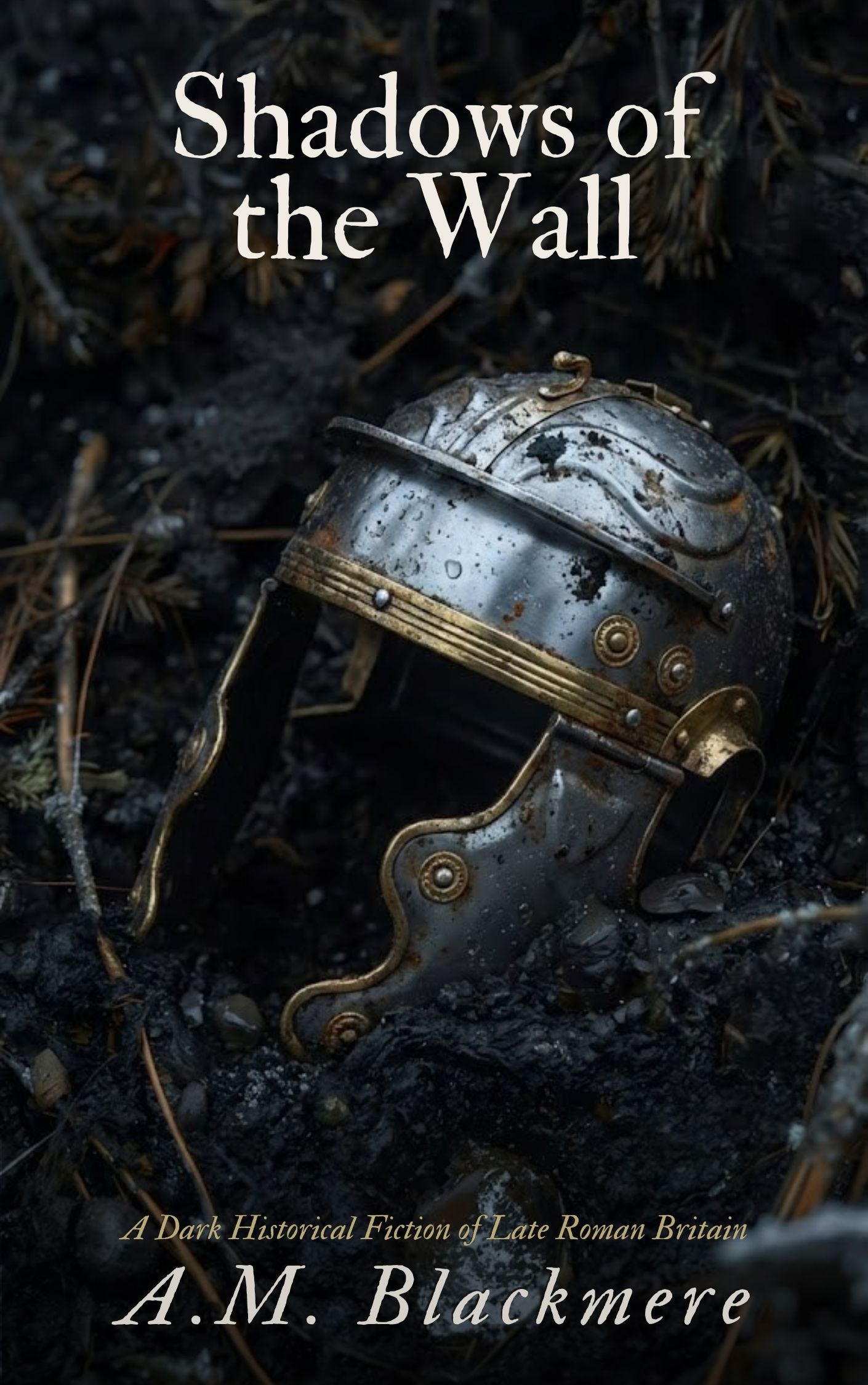
It is called Shadows of the Wall.
It stands at the far edge of the Roman world, on a wall at the top of Britain, in the years when Rome’s reach was failing and the legions were being drawn back home. A garrison that history has all but forgotten. A commander named Aelius Corven, holding a line that no longer has anything behind it. Not enough food. Not enough men. And a cold coming down out of the north that is not only weather.
Because the men on that wall begin to die. Not in battle. There are no wounds. They are found in the grey morning, frozen upright at their posts, jaws locked, faces open in a scream that made no sound. And the thing that is killing them does not come over the wall from the north. It is already inside it.
It is a story about the edge of a failing order, and about what fear does to men who have been left alone in the dark too long. The same cold, I think, that runs under the story we are telling tonight. A different empire. A different frontier. The same dread, waiting in the stone.
Shadows of the Wall is available now. If the mood of this podcast is a mood you would like to live inside for a few hundred pages, that is where you will find me.
Now. Back to the castle, and to the power.
We tell this story as though a castle full of dead girls is a supernatural event. A vampire. A curse. Something that broke through from outside the normal order of things.
It was not outside the order of things. It was the order of things, followed all the way to its end.
In the Kingdom of Hungary, the relationship between a noble and a peasant was written down in law. There was a great compilation of that law, put together in 1514, called the Tripartitum, and for centuries it was the spine of how the country worked. The Tripartitum did not leave much to the imagination. The nobility held authority over the peasantry that was close to total. A lord, or a lord’s wife standing in his place, could judge and punish the people bound to their land. Their bodies, in a real sense, belonged to the estate.
And the servants had no door to knock on. A peasant could not, in any practical way, bring a charge against a noble. The law was simply not built to hear that voice. A servant girl who broke a dish, or was suspected of theft, or who merely angered the mistress of the house on a bad afternoon, could be beaten, whipped, disciplined in ways that would today fill a courtroom for a week, and in that world filled nothing at all. Because nothing was written down. Because no magistrate was coming up the hill. Because the woman doing the beating was a Báthory, and the girl bleeding on the floor was nobody’s daughter that the law cared to count.
Now add one more piece to the machine. The great houses ran something called a gynaeceum. Families of lesser rank would send their young daughters to a powerful household to be finished. To learn languages, manners, needlework, how to carry themselves, how to run a great home of their own one day. In exchange, the girls served the lady of the house. They were, in one sense, students. They were also, in every practical sense, in her hands. Under her roof. Under her judgment. Far from their mothers.
And think about the daily shape of that power, before we even reach the question of murder. A great house ran on the labor of dozens of young women. Girls hauled water and washed linen and dressed hair and laced their mistress into her clothes and stood in cold rooms waiting to be needed. They came up from the seventeen villages, or from families a rung or two down who hoped the connection would raise them. They were fed, and housed, and worked, and they were disciplined at the sole discretion of the woman above them. There was no wage to dock as a lesser punishment. No notice to give. No leaving. A girl who displeased the mistress did not get a hard word and a second chance. She got whatever the mistress decided she got, in a house on a hill, with her family miles away and the law a hundred miles further than that. That was normal. That was Tuesday. And it was true in great houses across the kingdom, including all the ones where nothing terrible ever happened at all.
So look at what has been built, piece by piece, and none of it by magic. A woman of immense rank and near-limitless authority. A legal code that hands her power over her servants and hands those servants no recourse at all. A house that fills, season after season, with young women who cannot leave. A husband away at war, and when home, a tutor in cruelty who called murder excessive and everything short of it fair. And around all of it, a country so drenched in blood that a beaten girl or a burned foot did not register against a horizon of impaled prisoners, burning relics, and whole towns marched off in chains.
None of that required a monster. The machine was already there. Fully built. Sitting in the dark. Waiting.
All it was missing was the removal of the one restraint the house still had.
The restraint had a name. And by the turn of the century, it was dying.
For the last two years of his life, Ferenc Nádasdy, the Black Bey, the terror of the Ottoman line, was brought down by something no fortress wall could stop. An illness took hold in his legs. It spread. It worked on him slowly, the way the war never managed to. And on the fourth of January, 1604, the man who had impaled prisoners and burned the feet of servants and drawn his single strange line at murder, died in his bed.
Elizabeth Báthory was forty-three years old. And she was, for the first time in her life, answerable to no one on this earth.
Think about everything that had just been lifted off the scale. No husband. No warrior at the gate. Only a widow, at the head of more land than the king, with total legal power over hundreds of people who could not speak against her, in a country that had long since stopped being shocked by pain. The law was on her side. The name protected her. The endless war covered the noise. And the only man who had ever told her that killing went too far was in the cold ground at last.
We do not know what she felt in the winter of 1604. The record is silent on the inside of her. Her own surviving letters, and there are many, are the letters of a careful woman managing money and property and family. Ordinary. Composed. They tell us almost nothing about the dark. Which means we are left to imagine a woman alone in a great cold castle, with everything she could ever want to do, and no one left alive to tell her no.
Whatever the truth of what came next, it came after this. In the widow years. From 1604 until the winter, six years on, when it all finally caught up with her.
That is where we go next time. Up the hill, into the cellars of Csejte. To the servant girls who went up to the castle to serve and did not come back down. To the three hundred voices that were gathered against her, and the hard question of what those voices really prove. To the horror. And to how we know it.
But tonight, I wanted you to see her before any of that. Not the Blood Countess. Not the woman in the blood. A clever, sickly girl with an untouchable name, married on a war-torn frontier to a cruel man in a crueler age, handed a machine of absolute power over other human beings, and then, one January morning, left completely alone at the controls.
Remember the door closing. We will open it next time.
I am A.M. Blackmere. Thank you for listening.
Thanks for reading A.M. Blackmere! This post is public so feel free to share it.
Comments
Nothing yet. Say the first thing.
Sign in to join the conversation.