

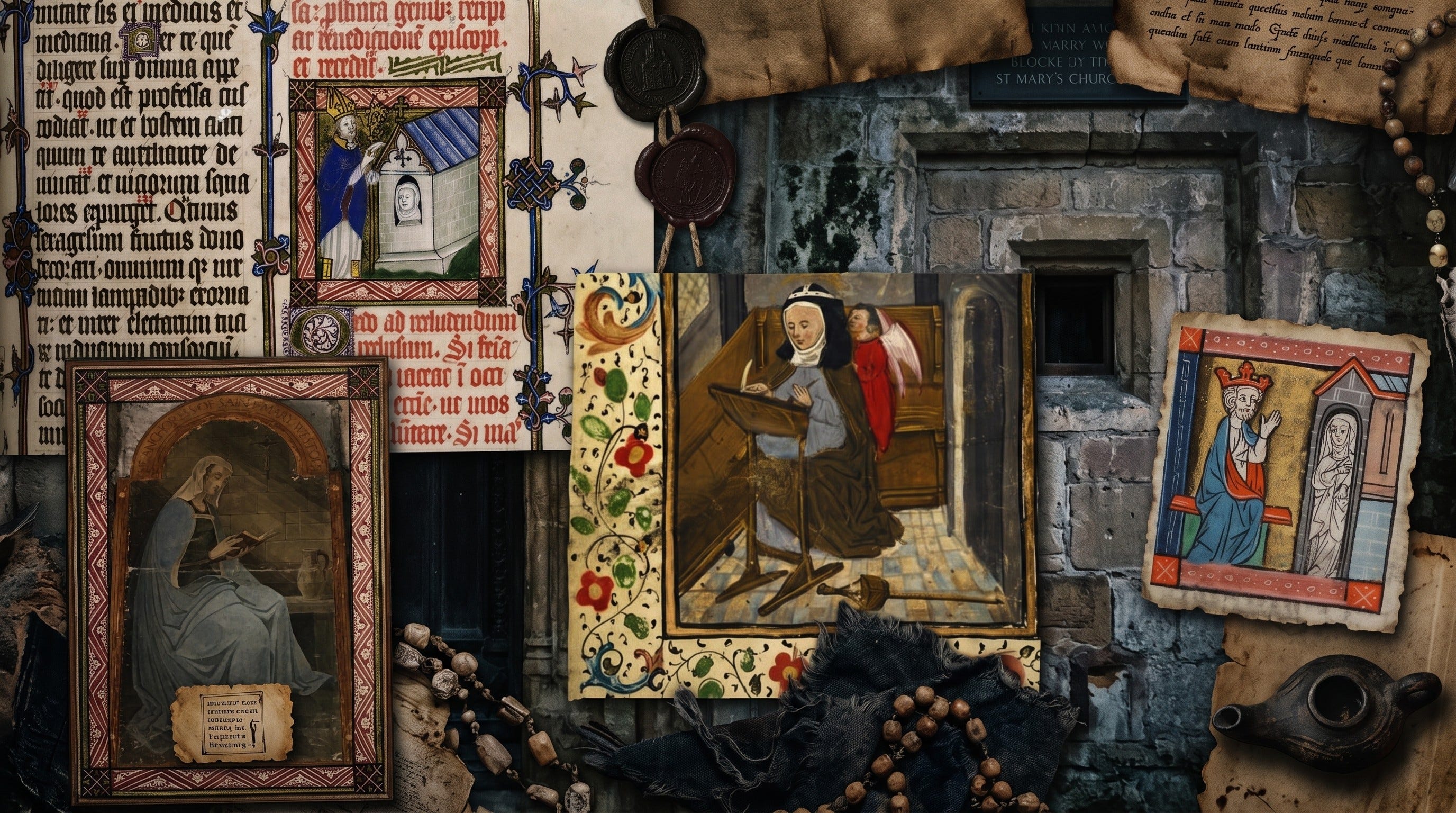
An anchoress was a woman who took a vow to live permanently sealed in a single small room, called an anchorhold, usually built against the outside wall of a parish church, and to spend the rest of her life inside it in prayer. The male equivalent was an anchorite. The vocation ran in England from roughly the eleventh century to the sixteenth, and the women far outnumbered the men. The word comes from the Greek anachōreō, “I withdraw.” Its first Christian users were the desert hermits of third and fourth century Egypt, figures like Anthony the Great, who withdrew into open wilderness. By the twelfth century in England the meaning had narrowed and hardened. Withdrawal no longer meant walking out into the desert. It meant being shut into one fixed point and never leaving it again. Church records call such a woman inclusa, “the enclosed one.”
The bishop reads the office for the dead over a woman who is still breathing. She kneels at the altar she has just been told she will never approach again. Behind her, the parish stands in the nave, and some of them are weeping, and some have brought candles. When the psalms end, she rises and walks to the low door in the north wall of the chancel, and she goes in. A mason waits there with mortar. Earth has already been sprinkled on her, the way it is sprinkled on a coffin, and the grave they mean is the room she is entering. She will pray here and sleep here. In most cases, she will also be buried here. She is perhaps twenty-five. If the parish keeps her fed, she may live inside this wall another forty years.
Four medieval vocations get flattened together in modern usage. They were distinct.
Anchoress or anchorite. A vow of stability and permanent enclosure in one cell, sealed by a bishop. Part of no religious order, and supervised directly by the local bishop.
Nun. Lived in community under an abbess and a rule, took vows of poverty, chastity, and obedience, and belonged to a recognized order. She was not enclosed alone.
Hermit. From the Greek for “desert dweller.” Bound by no vow of stability and free to move. Hermits could build roads, keep bridges, and travel between shrines.
Vowess. Usually a widow who vowed chastity before a bishop but kept her property, stayed in secular society, and was never enclosed.
The line that mattered most was enclosure. A nun lived among others. An anchoress lived alone, in a room she had agreed never to leave.
Almost, and not quite. The popular picture is a woman bricked into a blind box and forgotten. The record is stranger and more exact.
“They were bricked in and abandoned.” The cell was sealed, but it had openings. Most had a squint angled at the altar so the anchoress could watch the Mass and receive communion, a servant’s window for food and waste, and a parlor window onto the street for counsel and light. Christine Carpenter of Shere left her cell in 1332, was excommunicated, then petitioned successfully to be enclosed again. Sealed did not always mean sealed forever.
“They were poor or mad.” The enclosed life required a lifetime of food, shelter, and servants, so it favored women with money or patrons behind them. Loretta de Braose was a countess. Emma Rawghton was consulted on political prophecy by an earl. A 2024 doctoral thesis by Millicent-Rose Newis reads the guidance texts as manuals of psychological resilience, deliberate coping technique rather than the raw material of breakdown.
“They were completely cut off.” They kept servants with names. Julian of Norwich’s maids Sara and Alice appear in the records. Visitors came to the parlor window for advice. The rulebooks spend pages regulating these conversations, which would be pointless if the conversations never happened.
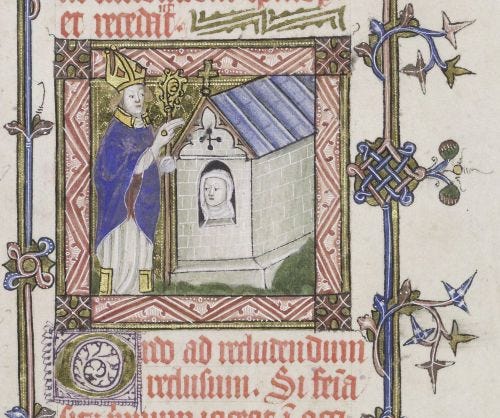
Enclosure was a liturgy, and the liturgy was a funeral. The rite, the Servicium Recludendi or Ordo ad recludendum, borrowed its bones from the burial service. Surviving twelfth-century pontificals preserve it, among them a manuscript now in the British Library, Vespasian D. xv, tied to the Exeter region, along with later examples such as the fifteenth-century pontifical of Bishop Lacy and the sixteenth-century pontifical of Archbishop Bainbridge.
The service reshaped the Mass into something for the dead. The Gloria and the Alleluia were dropped, as they were in Masses for the dead. The Kyrie gave way to the Litany of the Saints. The Veni Creator Spiritus moved to after the Gospel. An Old Testament reading stood in for the usual Epistle. The Commendatio animae, the prayer that commends a dying person’s soul, came early, so the woman heard her own soul commended while she knelt there alive. Earth was sprinkled over her as over a coffin.
By the time she crossed into the cell she had been declared, in the language of the church, dead to the world. E.A. Jones, whose Hermits and Anchorites in England 1200–1550 (2019) collects and translates these enclosure orders, is the clearest modern guide to what the words actually said. Some pontificals, Bishop Lacy’s among them, call for the door of the cell to be built up behind her. A woman walked into a room, a priest read the office of the dead over her, and a mason closed the way out. The meaning was plain to everyone in the nave.
She did not improvise. A whole literature told her how to pass her days, almost all of it written by men for women.
The earliest surviving example is the Liber confortatorius, written around 1080 by Goscelin of Saint-Bertin for a young recluse named Eva of Wilton after she left England for Angers. It is a book of consolation for separation, and it shows the genre had a tender, personal register from the very start. Around 1160 Aelred of Rievaulx wrote De Institutione Inclusarum for his own sister, a practical rule that allowed her an older companion and a maidservant.
The most famous of these guides, the Ancrene Wisse, was composed in the early thirteenth century for three well-born sisters who had chosen enclosure. Bella Millett’s scholarly edition is the standard modern text. It splits its instruction into an outer rule for daily conduct and an inner rule for the heart, and it says plainly that the inner one matters more.
Later guidance carried a real argument inside it. Richard Rolle, writing his Form of Living in the fourteenth century for Margaret Kirkby, taught that genuine spiritual progress could be felt in the body, as heat, sweetness, and song: calor, dulcor, canor. Walter Hilton, in his Scale of Perfection, pushed back, warning that a warm feeling in the chest is a poor measure of God and can mislead. Two spiritual directors, both writing for enclosed women, disagreeing in print about whether the body can be trusted to report on the soul. That argument is worth holding onto, because it tells you these women were being reasoned with, not simply shut away.
 at the top right, clear black ink calligraphy, and a red ink decorative capital letter "O" near the middle of the text.")
The day was built out of the Divine Office, the fixed hours of prayer. Matins came in the dark, near two in the morning. Then Lauds at dawn, Prime around six, Terce at mid-morning, Sext at noon, None in the afternoon, Vespers at sunset, and Compline before sleep. The set devotions alone ran to about four hours, before any private prayer and reading.
What she ate was plain by design. The Ancrene Wisse barred meat and fat and pointed her toward vegetable pottage and little to drink. She was not to eat with guests, and men were not to eat in front of her.
She could keep one animal. The Ancrene Wisse is specific: “ne schule ye habben nan beast bute cat ane,” you shall keep no animal except one cat. The allowance was practical. The cat killed mice, and that was the whole of it. An anchoress, the same text warns, should have nothing that draws her heart outward, and a herd of animals, or a business run at the window, would.
Trade was forbidden. Bargaining at the window, the Ancrene Wisse cautions, could lead a woman to “sell her soul to the peddler of Hell.” She could mend clothes for the poor and sew vestments for the church, but she was not to run a workshop through the parlor window. And she was to keep her own death in front of her. The daily practice of scraping at the earth of one’s grave, kept open inside or beside the cell, was recommended as a discipline against vanity: a woman too fond of her soft hands, the text says, should each day scrape up the earth of the grave she will rot in. The point was discipline. She was to keep her hands in the dirt of her own end.
Small. Smaller than most people picture. The surviving cells and their footprints give hard numbers. The earliest anchorholds were often makeshift timber lean-tos against a church wall, and only from the fourteenth century do solid stone cells become common, a shift Tom Licence has traced. Roberta Gilchrist, who has surveyed the archaeology, found most cells built against the cold north side of the chancel, though some female cells sat to the west.
At Compton in Surrey, among the smallest known, a cell measured roughly 2.0 by 1.3 meters, with what may have been a sleeping loft above. Kings Lynn in Norfolk is unusual, set on the south side and larger, about 5 by 3 meters, with clear signs of a medieval extension, and it survives as one of the best preserved in England. Chester-le-Street in Durham breaks the pattern the other way, a four-room anchorhouse where most cells were a single room. At Acton Burnell in Shropshire the cell keeps a window cut through the north wall to the altar. At St Mary’s in Shrewsbury a small doorway and balcony suggest the recluse watched services from above.
The key opening was the squint, also called a hagioscope, a narrow splayed slot cut through the church wall and aimed at the altar. Its angle was worked out so the anchoress could see the Host lifted at the moment of consecration. Guidance texts describe a tidy scheme of three windows, squint, servant’s window, and parlor window, but the dug evidence is messier than the books. Shrewsbury’s balcony fits no neat diagram. The three-window model is cleaner in the Ancrene Wisse than it ever was in the ground.
For all the counsel an anchoress gave, one line was drawn hard. She was not to teach men. The Ancrene Wisse is direct about it: do not preach to any man, it instructs, advise women only. She could be a spiritual authority at her window, a fixed point of counsel for a whole parish, and still be told that her authority stopped at the edge of her own sex. Elizabeth Robertson, in Early English Devotional Prose and the Female Audience (1990), reads the whole tone of the Ancrene Wisse as shaped by its male author’s assumptions about what a woman’s spiritual life could safely be.
So picture the pressure on that line. A woman has trained for years in prayer and discernment. She knows the liturgy by heart. People come to her window in trouble. And the rule says that if the person in trouble is a man, she is to hold her tongue.
Now imagine the rule meeting an emergency it never planned for. A priest dead. A child at the church door with no one in orders to baptize it. A dying man on the far side of the squint asking for words only a priest is supposed to say. The whole architecture of the enclosed life, the sealed door, the narrow slot, the ban on advising men, was built to keep the anchoress in her place. It said nothing about what she should do when the parish outside her wall began to die faster than the church could bury it.
The rule was clear. She was not to touch the sacraments. Then the sacraments came to her window, and there was no one else.

The Anchoress of Coldwell begins where the history leaves off. Avice has kept her vow for twelve years behind the squint of a plague-emptied parish. When the priest dies and an unbaptized child is carried to the wall, she does the forbidden thing. She baptizes through the slot, and she speaks an absolution she was never given the power to give. Then, from the empty chancel where no living mouth should be, a voice begins answering her Office. It knows her sister’s name. It knows what she confessed as a child. The history in this article is the ground the novella stands on. Every rule above is one Avice will have to weigh against the dead.
Julian of Norwich is the name people know. She was enclosed at St Julian’s in Norwich and wrote Revelations of Divine Love, based on visions she experienced in May 1373, the first book in English known to have been written by a woman. Margery Kempe came to her window for counsel and wrote down the visit. But Julian was one among hundreds, and the others are worth naming.
Christine Carpenter, enclosed at Shere in Surrey in 1329, left her cell, was excommunicated, and successfully petitioned Rome to be sealed back in, her case preserved in her bishop’s registers and in a 1332 letter from Avignon. Loretta de Braose, a countess and a widow, became an anchoress at Hackington in Kent. Emma Rawghton, enclosed at All Saints in North Street, York, in the 1420s and 1430s, had visions of the Virgin and was consulted on political matters by Richard de Beauchamp, Earl of Warwick. Katherine Manne, anchored at a Norwich friary, received an illegal English Bible from the reformer Thomas Bilney in 1531, the year before he was burned for heresy.
There were men too, though fewer. Wulfric of Haselbury in Somerset lived enclosed for twenty-nine years, was sought out for prophecy and healing, and gave counsel to Henry I and King Stephen. His life was written up soon after his death in 1154. Christina of Markyate belongs here as well: she fled an arranged marriage, lived as a recluse under the protection of an abbot and an archbishop, and later led a community of nuns, and her surviving Vita reads in places like a thriller.
They shared the vocation and little else. Some came from title and land, some from ordinary households, and the reasons they chose the wall rarely survive in the record.
Someone had to. An anchoress produced no income and was forbidden to trade, so the enclosed life ran entirely on patronage, and the records of that patronage are unusually concrete. Money and goods come down to us by name and by sum. Thomas Beaufort, Duke of Exeter, left twenty shillings to an anchoress called Dame Joan around 1426. Back in 1228, a canon named Richard de Elmham willed two fur coats and a white vestment to an anchorite at St Katherine Coleman. Kings gave pensions: Henry III settled an enclosure on Maud Malet in 1267, and in 1449 Henry VI granted four pennies a day to two enclosed women at St Peter upon Cornhill. Six London anchorholds were tied directly to hospitals.
The reason patrons paid is the heart of the whole institution. An anchoress prayed without stopping, for the living and for the dead, and medieval Christians believed those prayers had real purchase. In the economy of salvation, an enclosed woman’s unbroken prayer could shorten a patron’s time in purgatory. Cate Gunn sets this practice against the Fourth Lateran Council of 1215 and its new pressure on confession and communion. To fund an anchoress was to buy a permanent intercessor at your own parish wall.
There is a deeper reading of the cell itself. Liz Herbert McAvoy and Mari Hughes-Edwards describe the anchorhold as tomb and womb at once, a grave the woman had been buried in and a womb she was spiritually reborn from. She was dead to the world and, by the same act, more alive to God. Julian’s cell produced the first book by an Englishwoman. In the theology, the grave was also a place of birth.
From two kinds of evidence, documentary and physical, and it is worth being honest about which is which. The documents are the backbone. Bishops’ registers record enclosures, excommunications, and re-enclosures. Wills record the money. The pontificals preserve the rite word for word. The single most important modern synthesis is Ann K. Warren’s Anchorites and Their Patrons in Medieval England (1985), which counted at least 780 recorded recluses across 601 sites between 1100 and the Dissolution, and found anchorholds in all but four English counties.
The physical evidence is thinner and more precious. Cells survive at Compton, at Kings Lynn, and at Shere. Bodies almost never do. Only two burials in England are confirmed as anchoresses, one at St Anne’s in Lewes and one uncovered at a lost church in York whose bones carried the marks of long illness. That scarcity is why every surviving cell matters.
The field is still moving. E.A. Jones at the University of Exeter is currently revising Rotha Mary Clay’s century-old lists from 1914, and for three counties alone the count has already climbed from twenty-four solitaries to fifty, which means the real total keeps rising. What ended the tradition was Henry VIII. The Dissolution of the Monasteries, from 1536 to 1539, closed the whole vocation down for good.
Were anchoresses walled in alive?
Sealed into a cell, yes, and given a funeral rite to mark it. But the cell had windows, and at least one anchoress, Christine Carpenter, left hers and was later re-enclosed.
Did anchoresses ever leave their cells?
They were vowed not to, and most never did. The documented exceptions, like Christine Carpenter’s in 1332, were treated as serious breaches requiring penance.
What did anchoresses eat?
Plain food by rule. The Ancrene Wisse forbade meat and fat and pointed toward vegetable pottage and little drink, with strict rules against eating with guests.
How did an anchoress manage sanitation?
Through the servant’s window, the same opening used for food and provisions. A maidservant living outside the cell handled whatever had to be carried away.
What happened when an anchoress died?
She was often buried in the cell itself, in the grave she may have kept open for years, though later practice moved burials to the churchyard.
How many anchoresses were there?
Ann K. Warren documented at least 780 recluses across 601 English sites, with numbers peaking in the thirteenth century, and ongoing research suggests the true figure was higher.
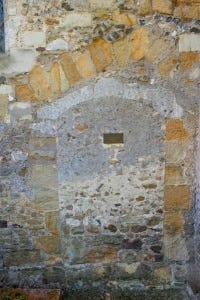
Go into an old English church today and you may find, low in the chancel wall, a blocked doorway or a narrow slanted slot that seems to lead nowhere. That is what is left. A woman knelt at that slot for the sight of the raised Host. She passed food and words through those openings for years. Stand at Kings Lynn or Compton or Shere, put your eye to the gap, and you are looking through the one aperture a walled-in woman was allowed, at the altar she gave up the world to see. The room behind it was a grave she agreed to live in. In a few of these churches, somewhere in that stone, she is still there.
A.M. Blackmere writes medieval horror grounded in the real record. The Anchoress of Coldwell is available for pre-order now, arriving on 07/30/2026.
Comments
Nothing yet. Say the first thing.
Sign in to join the conversation.