

The Roman testudo, or “tortoise,” is one of the most famous military formations in ancient history—yet popular culture continually misrepresents its true function. This comprehensive guide dismantles pervasive myths surrounding the testudo, revealing it as a highly specialized siege-approach and emergency-defensive tool rather than a general-purpose battle formation. By examining historical accounts and archaeological evidence from Parthia, the Teutoburg Forest, and Caledonia, this article explains why the testudo was effective in Eastern campaigns but practically useless in the waterlogged bogs and dense forests of the North. Furthermore, it explores the gritty realities of Roman frontier warfare, debunking the idea that northern tribes defeated the legions using stolen Roman drill tactics, and clarifying the logistical and economic truths behind Rome’s ultimate withdrawal from modern-day Scotland.
Key Topics & Takeaways
The True Function of the Testudo: Discover why this iconic shield wall was strictly a siege and emergency formation, incapable of maneuvering or charging in open battle.
The Myth of the Bog Battle: Understand the physics of the Roman scutum (shield) and hobnailed boots to see why the testudo was never deployed in the muddy terrains of Germania and Caledonia.
Physical Limitations: Learn about the grueling demands of the formation, which could typically only be sustained for 15 to 20 minutes before soldiers’ arms gave out.
Arminius and the Teutoburg Forest: Uncover the archaeological evidence proving that Germanic tribes relied on terrain-based ambushes, not replicated Roman parade-ground drills.
The Sound of Ancient Warfare: Contrast the disciplined signals of the Roman tuba and cornu with the terrifying, psychological warfare of the Celtic carnyx and Germanic barritus.
The Economics of Empire: Explore how astronomical logistical costs and a lack of taxable infrastructure—not battlefield defeats—ultimately forced Rome to abandon its northernmost frontiers.
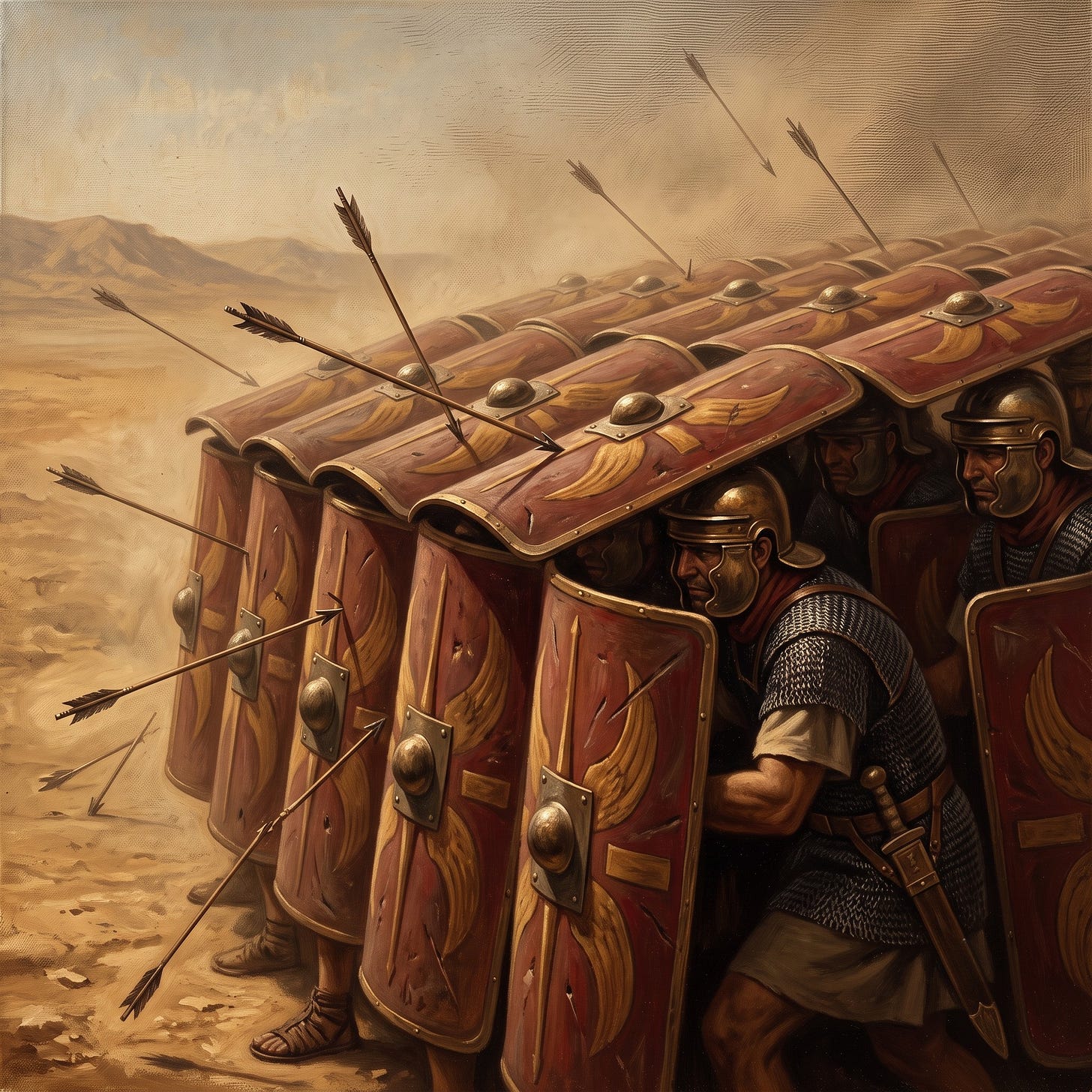
A dramatic depiction of Roman legionaries locked in a testudo (tortoise) formation, utilizing their overlapping scuta to deflect enemy projectiles. First documented in the late Republic (1st century BCE) and utilized through the peak of the Empire into the Byzantine era, this specialized defensive tactic was famously deployed by Roman forces across roughly six centuries of siege and frontier warfare.
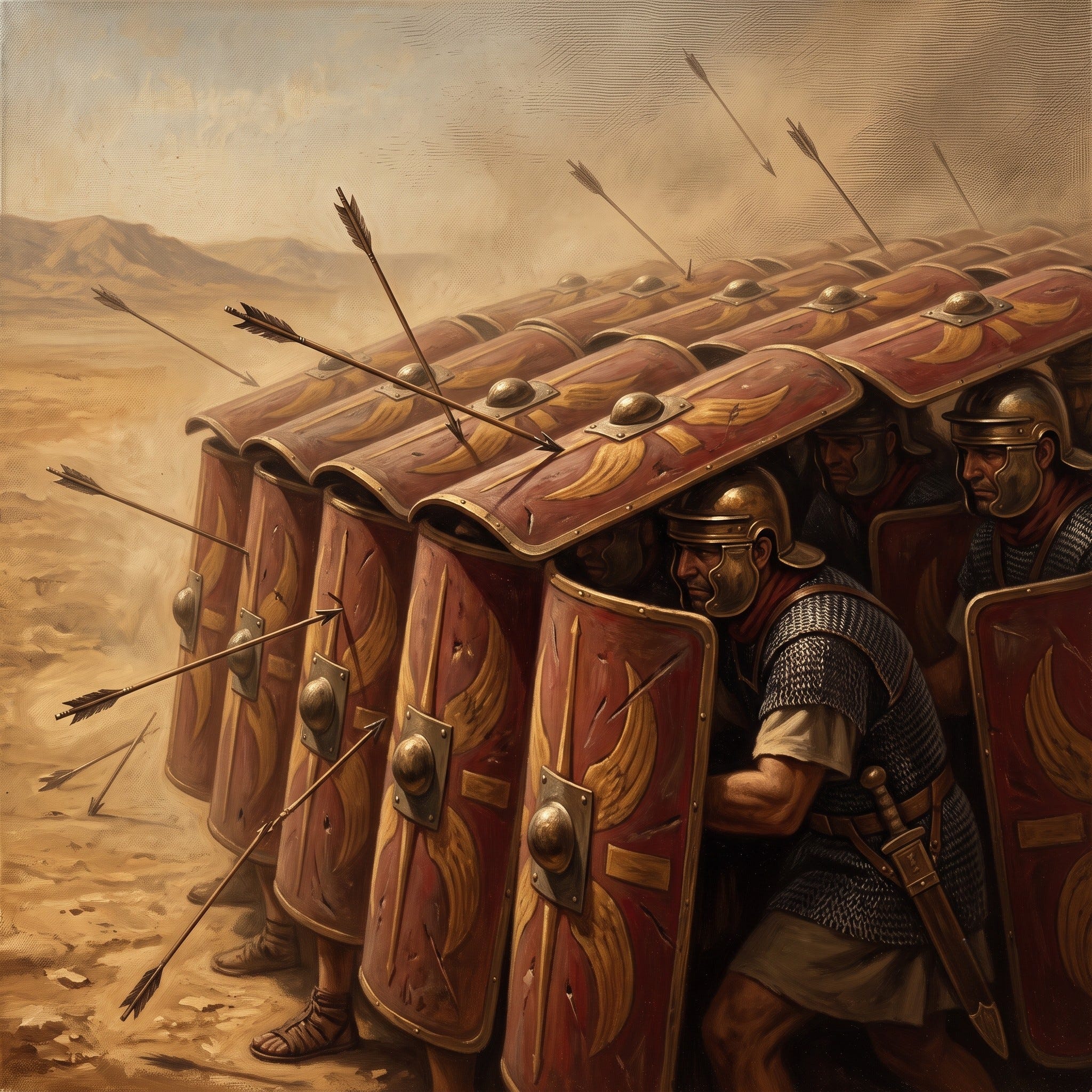
Mesopotamia, 36 BCE. The arrows come down like a hard rain, and the column of Mark Antony’s legionaries answers the only way it knows how. Shields snap upward and lock. The front rank braces its curved boards into a wall; the men behind raise theirs overhead until the unit wears a roof of wood and iron, each shield overlapping the next like roof tiles. Parthian shafts strike the shell and skitter off. Inside, the air is close and dark and smells of sweat and dust. The men cannot see the enemy. They can hear him, and they can hear the centurion, and they shuffle forward step by short step under a weight that grows heavier with every minute. This is the tortoise. This is the testudo working exactly as designed.
Now turn that picture north, to the bogs of Caledonia and the forests of Germania, and ask where the famous testudo battle is. The honest answer surprises most people who love Roman history: it is largely not there. The tortoise that everyone pictures crawling through a Scottish marsh under a hail of Pictish spears is mostly a modern invention. The real formation was a specialist tool, built for a specific problem, and the places it actually failed were not the ones the legend remembers.
The testudo (Latin for “tortoise”) was a close-order Roman infantry formation in which legionaries interlocked their large shields, the scuta, into a continuous shell against missile fire. The front rank held shields forward as a wall, interior ranks raised theirs overhead in an overlapping tile pattern, and the flanks angled outward. Its purpose was narrow and well understood by the men who used it: cross open ground toward a fortified wall, or shield a trapped column, while arrows, slingshot, and thrown stones came down.
It was primarily a siege-approach formation, with a second life as an emergency defensive measure when a unit was surrounded. It was slow, nearly blind on the inside, and almost impossible to maneuver. It was never a general-purpose battle formation, and the best ancient description of it places it in Parthia, in the East, not in the rain-soaked north where popular history likes to set it. Understanding that one fact dissolves most of the myths that have grown up around the tortoise.
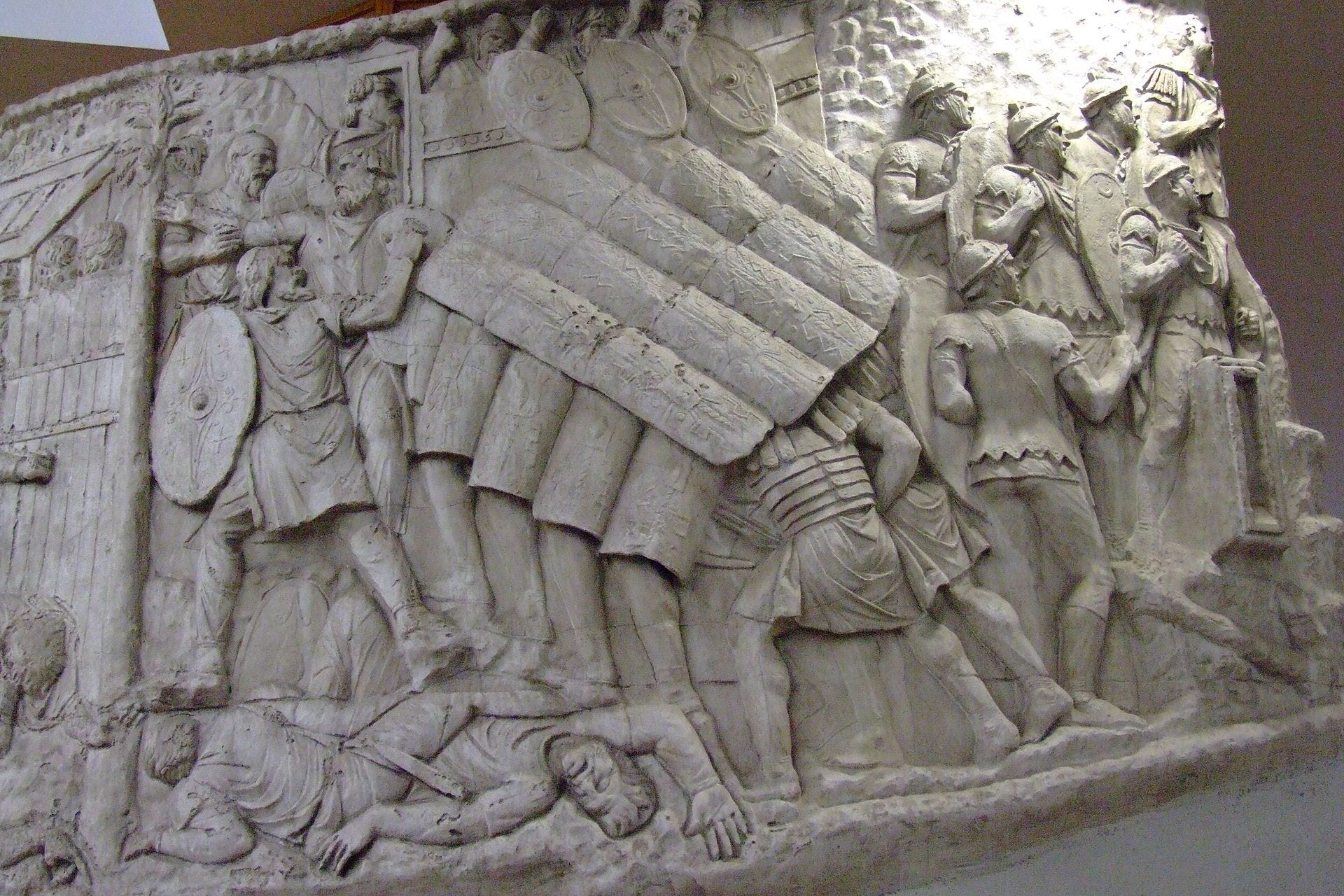
Before the field guide proper, here is the quick correction list, the part most worth bookmarking.
1. The testudo was a battle formation. It was a siege-approach and emergency-defensive formation. It could not wheel, charge, or respond to a flank attack. Adrian Goldsworthy, in The Roman Army at War (1996), argues its function was always principally siege-related, and that view is now broadly accepted. Soldiers fought open battles in looser order, not under a shield roof.
2. Crassus used it at Carrhae. The most detailed ancient account of the testudo, in Cassius Dio’s Roman History 49.29-30, describes Mark Antony’s Parthian retreat of 36 BCE, not the disaster at Carrhae in 53 BCE. The two get conflated in popular retellings. Plutarch’s Life of Antony 45 backs up Dio, comparing the cover to a roof of tiles.
3. Legionaries crept through northern forests in testudo. There is no direct primary-source attestation of the testudo being used in the campaigns in northern Britain or Germania. Its documented use is eastern (Parthia) and Dacian. In bog and forest the formation would have been close to useless, which is precisely why the sources do not put it there.
4. Northern warriors fought in eerie silence. This is pure invention. The Caledonians and Britons used the carnyx, a tall war-horn with an animal-head bell, and Germanic warriors used the barritus, a battle chant that began low and rose against the shields into a roar. Northern war was loud and meant to terrify.
5. Returned hostages trained barbarians to fight like Romans. No primary source or excavation supports this. Hostages such as Arminius absorbed Roman politics, language, and elite manners, not a transferable program of formation drill. The knowledge they carried home was strategic and psychological, not tactical.
6. Mons Graupius proved Roman discipline failed in the north. Mons Graupius (83 CE) was a Roman victory. Rome withdrew from Scotland anyway, for reasons of cost and logistics rather than defeat. The formations held; the budget did not.
Start with the shield, because everything else follows from it. The Imperial scutum was a large curved rectangle, roughly 100 cm tall and 60 to 65 cm wide. The single most important surviving example is the shield excavated at Dura-Europos in Syria in the 1930s, a third-century find that remains the physical basis for almost every modern reconstruction of how these boards fit together. Estimates of its weight cluster between about 5.5 and 10 kg depending on construction, heavy enough that holding one overhead at full extension becomes its own slow agony.
The geometry demanded close order. Each man stood shoulder to shoulder so that shield edges touched or overlapped. The front rank presented a frontal wall; the interior ranks lifted their shields flat overhead, each board overlapping the one in front like tiling a roof; the outer files angled their shields to close the sides. The result was a sealed shell that turned arrows and stones. The cost was mobility and sight. Interior soldiers were effectively blind, dependent entirely on the front rank and on shouted command for any sense of where the enemy was.
That shell had a clock running against it. Reenactment groups who have tested the formation under load, including Britain’s Ermine Street Guard and the Legio XX Valeria Victrix society, report that the overhead position becomes unsustainable after roughly 15 to 20 minutes of sustained effort, as the shoulders and upper back give out. This is experimental inference rather than something an ancient writer recorded, but it matches the logic of the sources. The testudo was a sprint, not a marathon: form it, cross the killing ground, reach the wall or weather the volley, then break it before the arms fail.
Its vulnerabilities were equally specific. Cassius Dio notes that Parthian heavy cavalry could break into the formation by charging it directly, and that riders could grab a shield and haul a man bodily out of the shell, opening a gap. Maces and heavy weapons could shatter or drive in the boards. In a narrow defile, an enemy who got alongside could peel the flanks away. The tortoise was armored against one thing, falling missiles, and was dangerously exposed to almost everything else. It was one tool in a kit that also held the orbis, the defensive circle, and the cuneus, the attacking wedge. No Roman commander mistook it for a universal answer.
This scene is from THE EAGLE (2011), depicting a testudo formation being used upon Picts in the Britannia Province.
A formation like this is only possible if every man does the same thing at the same instant, which is why the testudo is really a story about Roman drill. The army ran on a layered system of sound. The tuba, a straight bronze trumpet, carried general orders such as advance and retreat. The cornu, a great G-shaped horn, regulated movements under the standards. Above the noise, the signa, the unit standards, gave soldiers a visual anchor: the eagle for the legion, the century’s own signum carried by the signifer in the front ranks. Polybius and the later manual of Vegetius both describe this apparatus, and the specialist musicians who worked it held recognized rank.
Behind the signals stood the training. Recruits drilled against a wooden post, the palus, with weighted wooden swords and wicker shields heavier than the real thing, building the strength the close-order shell demanded. The campidoctor was the specialist drill instructor; the centurion enforced discipline in the line, and the optio stood at the rear of the formation specifically to stop men from drifting backward. None of the interlocking worked without standardized equipment. Shields of uniform size and curve had to fit together predictably, and weapons of standard length let men fight packed tight without fouling each other. Standardization was the hidden precondition for every synchronized move.
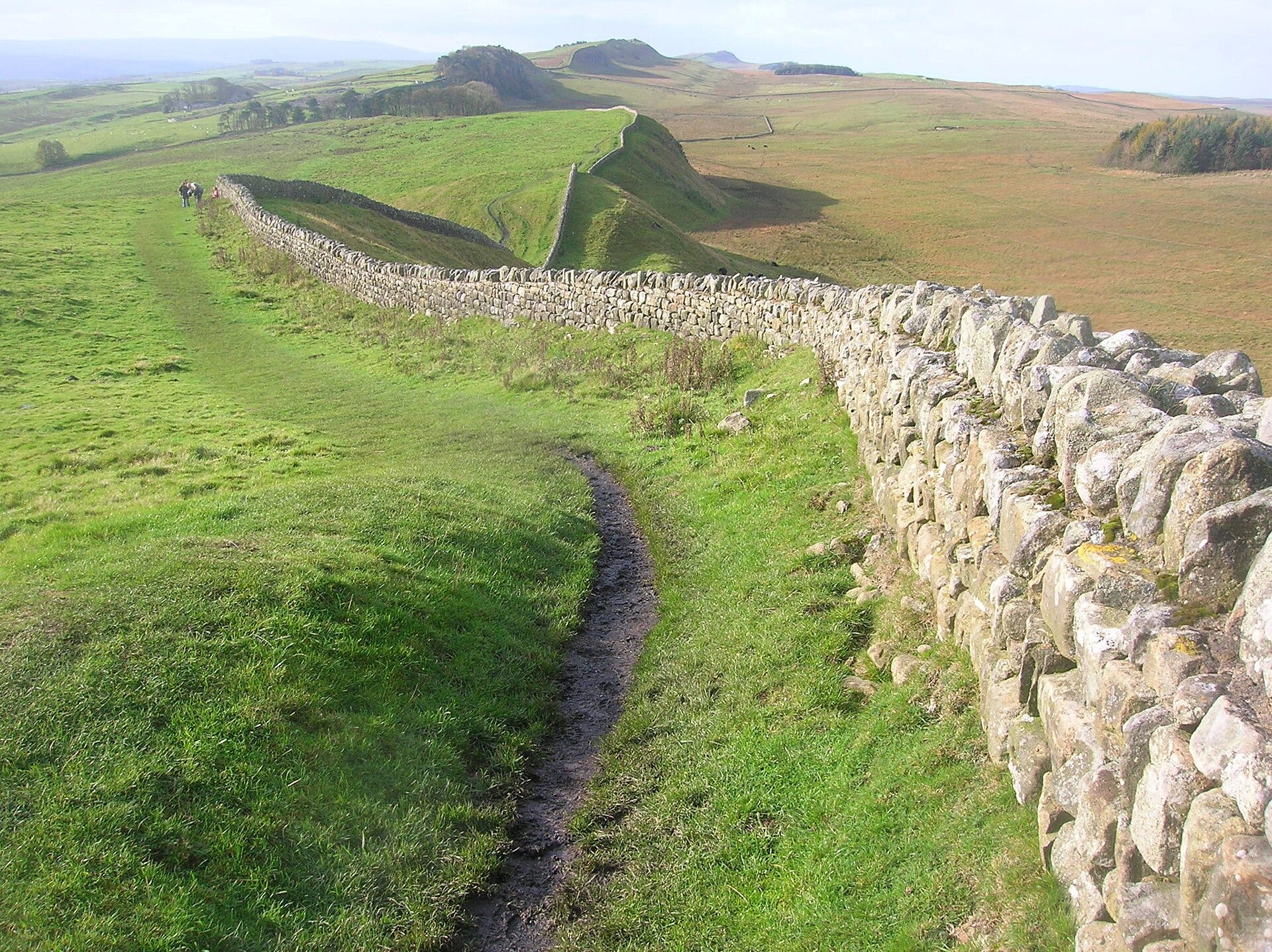
The Romans themselves treated this as something close to sacred. Discipline was personified as a minor goddess, Disciplina, and worshipped on the northern frontier. An altar to Disciplina Augusta was found at Chesters fort on Hadrian’s Wall, recorded as RIB 1978, which means that on the very edge of the empire, in the country where this article is heading, soldiers were making offerings to the idea of order itself. That is the machine the northern peoples had to face, and the question is what happened when it marched off its parade ground and into the bog.
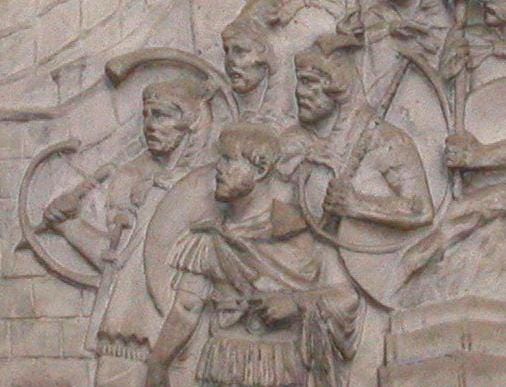
Here is the turn. If you go looking in the sources for legionaries in testudo being overwhelmed in a northern marsh, you will not find the scene. What you find instead is a different kind of catastrophe, one that had little to do with the tortoise and everything to do with ground, weather, and an enemy who refused to stand still.
The defining disaster is the Teutoburg Forest in 9 CE, where three legions under Publius Quinctilius Varus, the XVII, XVIII, and XIX, were destroyed. Cassius Dio (56.18-22) describes a column ambushed in a narrow corridor between hills and marsh. Since 1987, systematic excavation at Kalkriese near Osnabrück has confirmed the picture in extraordinary detail: a constricted defile between the Wiehengebirge hills and the Great Bog, with a turf-and-timber rampart built along the southern slope to funnel the Romans into a killing zone. More than 6,000 Roman military objects have come out of the site, including a silvered iron parade-helmet face mask and a mail fastener stamped with a soldier’s name, Marcus Aius. What the ground does not contain is any trace of Germanic warriors fighting in Roman-style formations. The Romans were not beaten by a better-drilled enemy. They were channeled into terrain where their drill could not function at all.
Britain tells a related story. During the Severan campaigns of 208 to 211 CE, Septimius Severus drove deep into Caledonia, and Cassius Dio (76.13) describes his army cutting through forest, levelling high ground, filling swamps, and bridging rivers, while the Caledonians and Maeatae simply declined open battle. They withdrew into the marshes and struck at foraging parties and stragglers. Dio reports 50,000 Roman dead, a figure almost certainly inflated, but the cause he names is telling. The killers were disease, exhaustion, and constant harassment in country that fought on the natives’ side, not glory won or lost in a pitched battle.
The physics underneath this is simple and unforgiving. Close-order formations need stable footing and precise spacing. In deep mud or waterlogged peat, footing becomes unpredictable, men cannot keep the shoulder-to-shoulder contact a shield wall requires, and lockstep movement collapses. A legionary carried perhaps 25 to 35 kg of shield, armor, helmet, and weapons, and that load drove his hobnailed boots, the caligae, deep into soft ground. Worse, hobnails are designed to bite hard surfaces; on wet peat they grip nothing and can actually unbalance the foot. The boots that made a Roman sure-footed on a road made him a stumbling target in a bog. The testudo never failed in the northern marsh because, by every indication, it was never foolish enough to be tried there.
A word of caution first, because it is the kind of honesty that separates good history from costume drama. “Barbarian” is a Roman label, not a name any of these peoples gave themselves, and almost everything we know about them comes from authors who used them as a foil for Roman virtue. Read with that filter on, the sources still tell us a great deal.
North of Hadrian’s Wall in the Severan period, Cassius Dio (76.12) names two great confederations, the Caledonians and the Maeatae. He describes peoples who lived in tents, kept herds, and went into battle lightly equipped, carrying small shields and short spears. At Mons Graupius, Tacitus has the Caledonians wielding long, blunt-tipped slashing swords and small shields, and fighting partly from chariots, a mode of war that had vanished from the Continent but survived in Britain, exactly as Julius Caesar had found a century and a half earlier when he faced British chariots under Cassivellaunus (De Bello Gallico 4.33).
And they were anything but silent. The single most stubborn myth about northern warfare is that it was quiet and ghostlike against the shouted Roman cadence. The evidence runs the other way. The carnyx, the tall Celtic war-horn topped with a boar or other animal head, is attested in writers from Diodorus to Polybius and survives in metal: the Deskford carnyx, found in northeastern Scotland and dated to roughly 80 to 250 CE, is one of the finest examples in Europe. On the Germanic side, Tacitus describes the barritus, a chant begun softly and swelled against the shields into a roar, and Ammianus Marcellinus records the same battle-cry still in use at Strasbourg in 357 CE. The real contrast was never noise against silence. It was one kind of fearsome sound, the disciplined horn and trumpet, against another, the rising animal howl of the carnyx and the barritus.
None of this means northern war was pure individual chaos. Tacitus describes Germanic warriors forming a wedge, the kinship-based cuneus, and the organized ambush at Teutoburg required real coordination. E.A. Thompson long ago argued that the cuneus implies more tactical order than the chaos stereotype allows. The fairer reading is a spectrum: these were warrior cultures that prized personal glory and the bond between a lord and his sworn followers, the comitatus, and could still form up and fight together when the moment demanded it. What they did not have, and did not want, was the cadence-driven, drilled-to-a-clock cohesion of the legion.
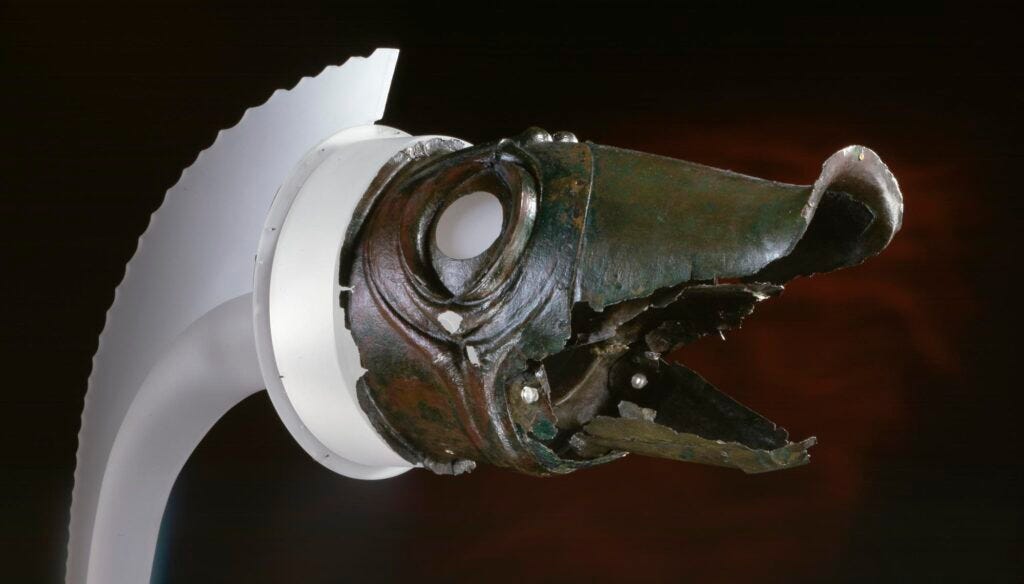
If any single figure tempts us toward the hybrid-warfare legend, it is Arminius of the Cherusci, born around 18 BCE. Taken to Rome as a young hostage, he received a Roman education, was granted Roman citizenship, and rose to equestrian rank while commanding Cheruscan auxiliary cavalry in Roman service. Velleius Paterculus, writing within living memory of the events, states plainly that Arminius had been honored with citizenship and equestrian standing. Then, in 9 CE, he engineered the annihilation of Varus’s three legions.
It is the perfect setup for the story that he taught his Germans to fight like Romans and turned the legions’ own discipline against them. The setup is wrong. Every line of evidence, the primary sources and the Kalkriese ground alike, points to ambush, not adoption. Arminius did not drill his warriors into a testudo. He did the opposite: he chose terrain where a testudo, and every other Roman formation, was impossible. He understood from the inside how a Roman army marched, how its command froze when struck at many points at once, how a strung-out column in a defile could be taken apart. He built a rampart to channel it and coordinated the assault across the line. That is the work of a man exploiting Roman rigidity, not replicating Roman drill.
The distinction is the whole argument. The transfer of knowledge from Rome to the frontier was real, but it was strategic and psychological, not a tactical handbook. Tacitus says of Maroboduus of the Marcomanni, another Rome-raised prince, that his army was trained to something approaching Roman efficiency, yet that is Tacitus’s anxious characterization of a large organized force, not a description of barbarians forming cohorts. The likelier and better-evidenced vector was humbler still: ordinary men who served twenty-five years in the auxiliaries, learned Roman ways from within, and carried that understanding home. What they brought back was insight into how Rome could be beaten, not a parade-ground program for beating them at their own game.
This is the frontier I wanted to write from the inside: not the parade ground, but the wet edge of the map where the manual stops working.
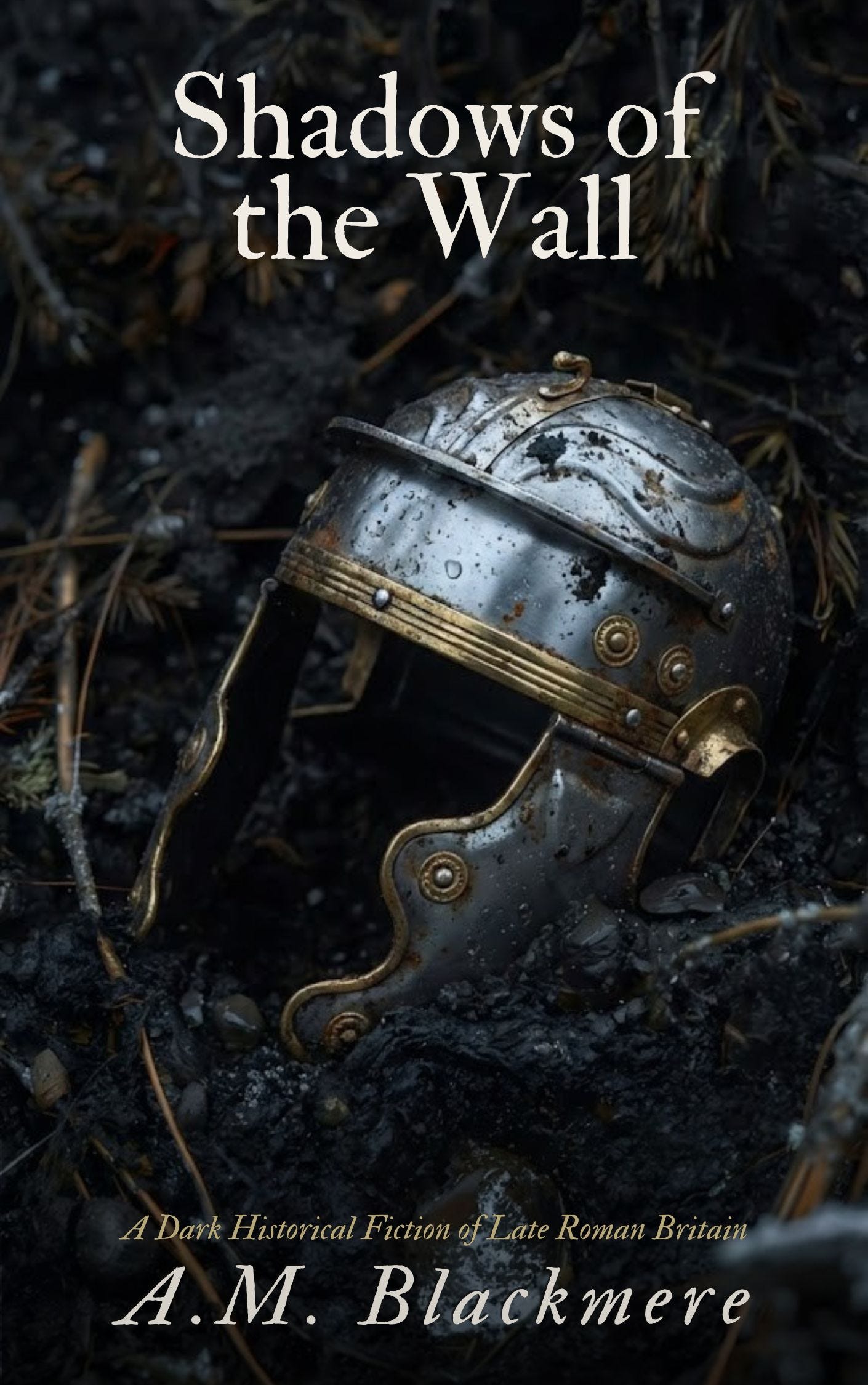
Shadows of the Wall lives in exactly this country, the rain and peat and watchfulness of Rome’s northern limit, where discipline meets a land that does not yield to it. It is historical horror grounded in the real texture of the frontier: the cold that gets into the iron, the sound that comes out of the dark and is not a Roman horn, the long unease of men holding a line they are beginning to understand they cannot keep. If the gap between the tidy formation and the untidy north is what drew you down this far, the novel is written in that gap.
History this contested is only as good as the things you can still touch, so it is worth laying out the physical evidence behind the argument. The Dura-Europos shield gives us the scutum’s real dimensions and construction. The altar to Disciplina at Chesters fort, RIB 1978, shows the cult of order living on Hadrian’s Wall itself. The Vindolanda writing tablets, the everyday letters and duty rosters of the northern garrison, quietly puncture the heroic literary version of frontier life and replace it with supply lists, leave requests, and complaints about the weather.
At Kalkriese, the turf rampart, the scatter of more than 6,000 Roman objects across the defile, the parade mask, and the named mail fitting together confirm Dio’s ambush and refute the scale of his casualty claims, a useful reminder to trust the spade over the rhetorician. The Deskford carnyx puts the sound of northern war back in our ears. And the Antonine Wall, built across the Forth-Clyde line in 142 CE and twice abandoned, stands as the monument to Rome’s real northern problem.
The evidence is also still moving, which is part of why this period rewards attention. Geoarchaeological work at Kalkriese, including optically stimulated luminescence dating of the rampart’s construction phases published in the late 2010s by Joachim Hartling and colleagues, continues to refine the sequence of that catastrophe. In Britain, Historic Environment Scotland’s 2016 review of Mons Graupius concluded that the battle’s location is still too uncertain to fix on the map, leaving one of the most famous engagements in Roman Britain quite literally unplaced. The story is not closed.
So if the testudo did not fail in the bog, and no barbarian army out-drilled the legions, what actually drove Rome back? The answer is the least dramatic one and the best supported: arithmetic. Mons Graupius was a Roman victory, and Rome still withdrew. The Antonine Wall, which needed a garrison of around 7,000 men, was given up within a generation, twice.
Scholars including David Breeze and William Hanson have made the economic logic plain. Scotland north of the narrow waist of the country had no cities, no taxable surplus, and no settled provincial economy to pay for its own occupation. Holding it cost far more than it could ever return. The dense Romanized settlement that fills the map south of Hadrian’s Wall simply has no equivalent to the north, which is the clearest material sign that the region was never worth integrating. Rome did not retreat from the north because its formations broke. It left because the ledger never balanced, and an empire, in the end, is also an accountant.
Was the testudo used in open battle?
Rarely, and never as a primary battle formation. It was a siege-approach formation and an emergency defensive measure against missile fire. It could not maneuver, charge, or respond to a flank attack, so soldiers fought open battles in looser order.
Did the Picts or Caledonians defeat the Roman army in battle?
Not in a decisive pitched battle. At Mons Graupius in 83 CE the Romans won. The Caledonians and Maeatae succeeded instead through avoidance: guerrilla harassment, ambush, and the use of bog and forest terrain that wore Roman armies down without a set-piece fight.
What weapons did the Caledonians use?
According to Tacitus, long slashing swords with blunt points and small shields, with some warriors fighting from chariots. Cassius Dio adds short spears and a generally light panoply suited to mobile warfare. They also used the carnyx, a tall animal-headed war-horn, for intimidation.
Did Arminius teach the Germans to fight like Romans?
No. Arminius, though Roman-trained and an equestrian officer, won at the Teutoburg Forest in 9 CE by ambushing the legions in constricted terrain where their formations could not function. He exploited Roman operational rigidity rather than copying Roman drill, and the archaeology at Kalkriese shows no sign of Germans fighting in Roman-style formations.
Why did Rome abandon Scotland?
Primarily for logistical and economic reasons rather than military defeat. The far north had no taxable surplus or urban infrastructure, and garrisoning a frontier there, such as the Antonine Wall and its roughly 7,000 men, cost more than the territory could ever return.
How heavy was a Roman shield?
The Imperial scutum stood about 100 cm tall and 60 to 65 cm wide and weighed roughly 5.5 to 10 kg depending on construction, based on the surviving Dura-Europos example and modern reconstructions. That weight is part of why the overhead testudo position could only be held for 15 to 20 minutes before the arms gave out.
Go back, one last time, to Antony’s men under their roof of shields, shuffling forward through the arrow-rain in the dust of Parthia. That is where the testudo belonged, and where it worked. It was a brilliant, narrow answer to a particular kind of fear, the fear of death falling out of the sky, and the legions deployed it for exactly that and little else.
The north asked a different question, and it never came in the form of a wall of arrows. It came as wet ground that swallowed a boot, as a horn-call out of the trees, as a column strung too thin in a defile, as a province that cost more than it paid. The tortoise was never going to answer any of that, and the Romans, who were rarely fools, did not ask it to. The image of the testudo failing in a Caledonian marsh is a good story. The truer one is the quieter scene at Chesters, where men so far from home that they had built an altar to Discipline itself looked north past the end of their drill, into country that would not be formed.
A.M. Blackmere writes historical horror from the wet edge of the map. Shadows of the Wall is available now. Subscribe for more dispatches from the frontier.
Thanks for reading A.M. Blackmere! This post is public so feel free to share it.
Comments
Nothing yet. Say the first thing.
Sign in to join the conversation.