
Amsterdam, 2025. Two partners, one principal, one operating partner who had spent a decade inside a flavours and ingredients P&L. Slide 18: the cost curve.
Left column: today, 21 EUR/kg. Middle: pilot, 11 EUR/kg. Right: 2029, 4.20 EUR/kg. The line between them looked like a ski slope in the Alps.
The operating partner asked a single question: “Which part of this curve is empirical?”
The founder paused. “The left bar.”
Everything else was a model.
The conversation moved in sixty seconds from upside to downside. Not because the operating partner disliked the founder, or doubted the science, or wanted to kill the deal. He had seen that ski slope forty times. He knew what “the left bar” meant.
It means the rest of the curve is hope.
I had sat on both sides of this conversation before. At Merck and at Danone, at enough European investor meetings to recognise the shape before it fully arrives. Founders who come in with the thing they have built, and leave confused about why it did not land the way they expected.
The science is real. The ambition is serious. But it is answering a question the investor is not asking.
The Amsterdam room did not end in a closed door. The partners asked for three things before the next meeting: a revised TEA built from actual batch records, a projection anchored to published literature on comparable processes, and a one-page analysis connecting each cost scenario to a realistic exit corridor.
The founder came back eight weeks later with all three. The deal closed. But he lost two months and significant credibility in the room, not because he was dishonest, but because he had not separated what he knew from what he was hoping for.
I have seen this shape across enzyme TEA decks, precision fermentation pitch books, bio-acid feasibility analyses, and cultivated protein investment memoranda.
One empirical column, a pilot column where some assumptions are real and some are extrapolated, and a commercial column that is almost entirely a model. Three columns presented with equal visual weight, in the same font, on the same slide.
The investor’s job is to find the join. Most do. The founders who close deals are the ones who find it first.
Every FoodBioTech founder believes their cost curve is credible. The fermentation yields, the media optimisation data, the downstream process rebuilt across eighteen months. It is the number they reference in board decks, the projection they have internalised as a roadmap rather than a hypothesis.
It is wrong. Not wrong in the sense that the 2029 ambition is unreasonable. Wrong in the sense that presenting a model as equivalent to empirical data signals something about the management team that no amount of science can undo: it tells the IC that the founder does not know the difference between what they know and what they are projecting.
The left bar is measurement. The right bar is hope. The founder presents them identically. The IC finds the join in the first ten minutes. The room moves from upside to downside in sixty seconds.
That gap, between measurement and projection framed as equivalent, is the most expensive mistake in precision fermentation financing. And it is entirely preventable.
Innovators – Your TEA’s empirical spine is your credibility. If today’s COGS is not built from actual batch records and invoices, every downstream projection is fiction.
Fix the spine before you defend the curve.
Founders – A TEA without a walk-away condition is a wish list. Bind each cost scenario to a real exit corridor using published M&A multiples.
That one slide separates you from every other founder in the room.
Investors – Ask “which part of this curve is empirical?” before slide 20. The answer tells you more about the management team’s diligence rigour than anything else in the deck.
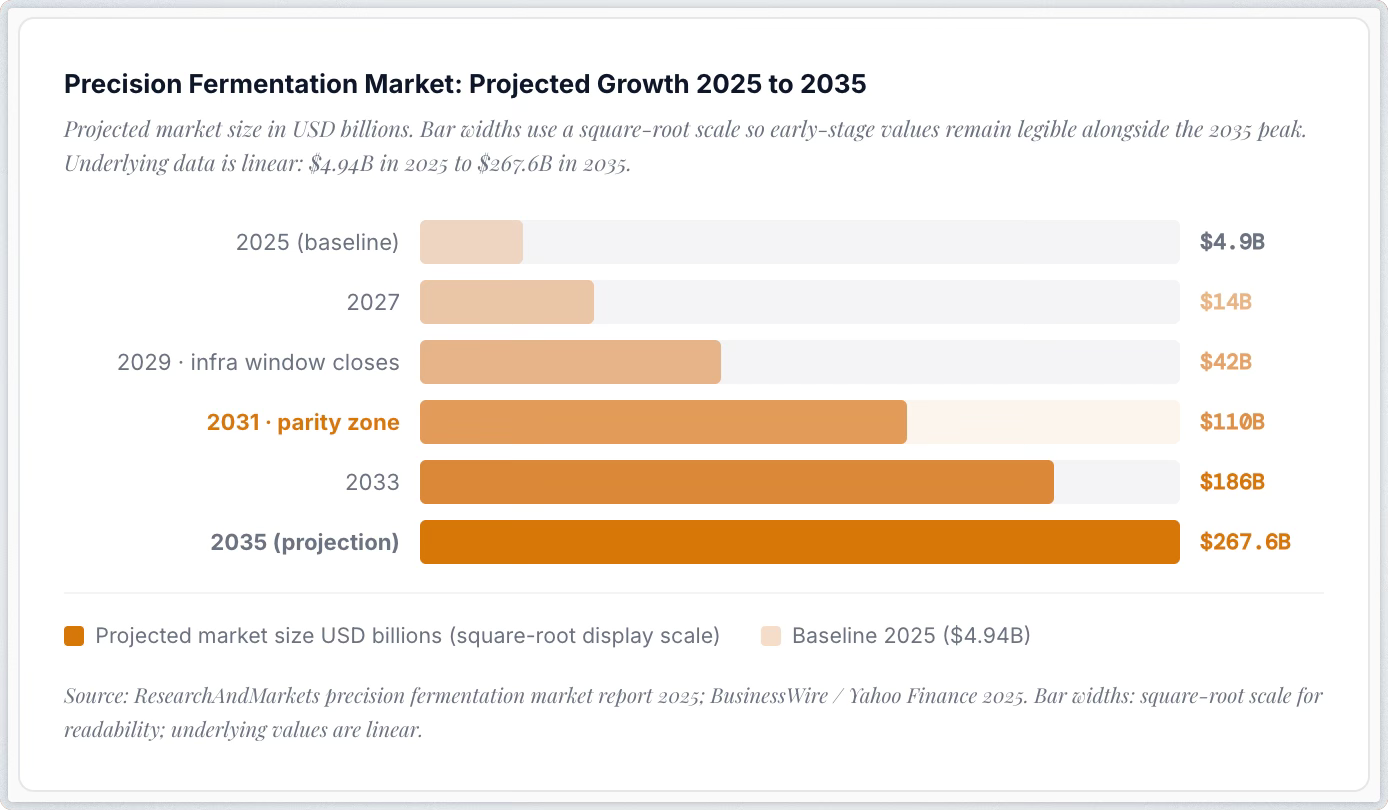
Precision fermentation is not a quiet niche. One industry report projects the global market from 4.94 billion USD in 2025 to 267.64 billion USD by 2035, a 54-fold increase at roughly 43.8 percent CAGR.
A separate forecast runs from 2.15 billion USD in 2022 to 25.54 billion USD by 2032 at 45 percent CAGR. More conservative analyses still expect the market to clear 100 billion USD by the early 2030s.
When a category is compounding that fast, investors are not short of decks. They have seen enzyme TEAs where crude industrial prep runs 75 to 120 USD/kg at commercial scale whilst highly purified enzyme lands north of 3,000 USD/kg.
They have seen 3-HP bio-acid TEAs where getting downstream process design right is the only route to beating petrochemicals at 0.55 to 0.89 USD/kg. They have seen cultivated-meat TEAs where realistic media costs and bioreactor constraints make supermarket-compatible prices structurally impossible at current scale.
“They are not pattern-matching against one bad deck.
They are pattern-matching against a decade of unanchored curves.”
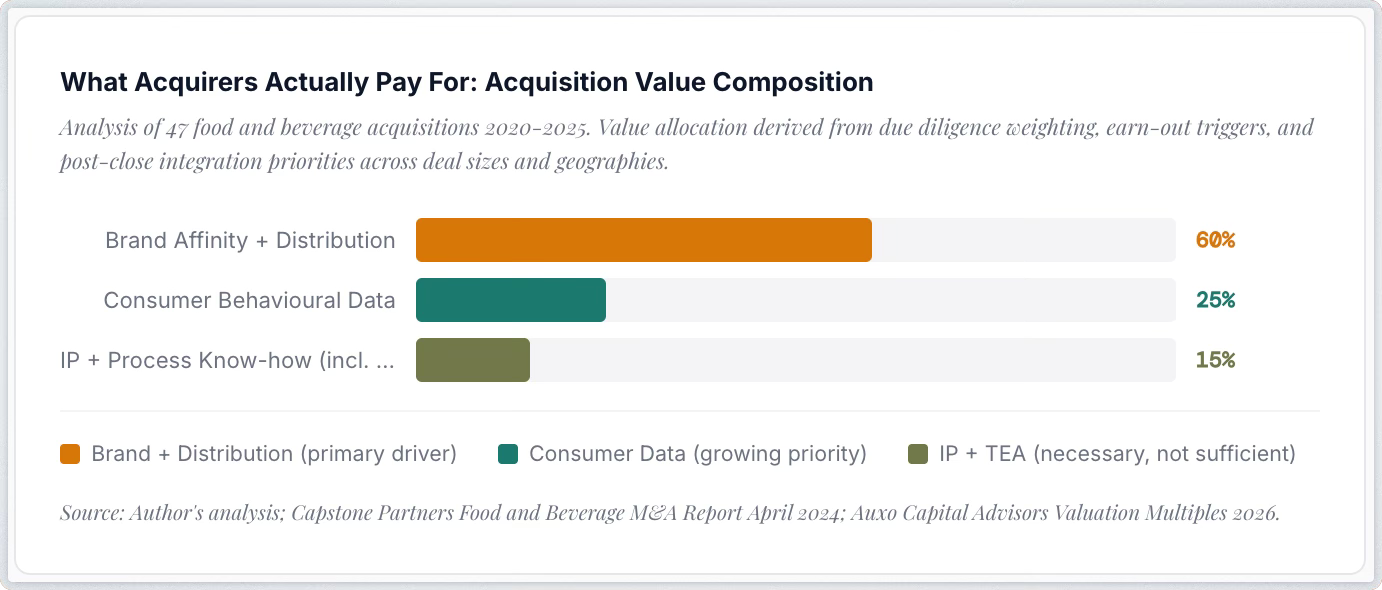
CEE founders in particular have been trained by EU grant structures to treat “more patents plus better TEA” as a proxy for exit readiness. My March 2026 IP brief broke this with analysis of 47 food and beverage acquisitions completed between 2020 and 2025.
The breakdown of what strategic acquirers demonstrably paid for, evidenced by due diligence focus areas, earn-out structures, and post-close integration priorities, was consistent across deal sizes, categories, and geographies:
Brand affinity and distribution reach: 60 percent
Consumer behavioural data and repeat purchase evidence: 25 percent
Intellectual property and process know-how: 15 percent
Techno-economic analysis lives inside that 15 percent. A strategic acquirer at Mondelez or PepsiCo already owns factories, QA labs, and DSP engineers. They are not buying your cost curve. They are buying the distribution footprint and consumer data that sit on top of a cost structure that clears a minimum viability bar.
Capstone’s 2024 Food M&A report: middle-market deals averaged 1.9 times EV/revenue and 12.6 times EV/EBITDA. Strategic buyers accounted for 65.8 percent of transactions.
That acquirer base already has a TEA team. Your job is not to convince them your science is real. Your job is to show them your cost structure is compatible with the commercial machine they already own.
Comments
Nothing yet. Say the first thing.
Sign in to join the conversation.