
It was a pitch meeting in San Francisco. The founder had been building a precision fermentation company for three years. The deck was clean. The science was real. The cost curve on slide 18 showed $4.20 per kilogram by Year 5. The investors in the room nodded.
Then one of them - a former chemical engineer who had built a bioreactor facility in Geleen, the Netherlands - asked one question.
“What are you paying per kWh?”
Silence.
He was paying 21.8 cents per kWh for industrial electricity. The highest industrial rate of any contiguous US state. 181.3% above the national average for all other states. His fermentation facility was in a Bay Area industrial unit rented at $17 to $21 per square foot annually. His sucrose feedstock was trucked in from a regional distributor. His $4.20 cost curve was not a projection. It was a fiction. And the fiction was entirely a function of the postcode on his lease.
That is the conversation nobody is having at Future Food-Tech San Francisco. That is the conversation this piece forces you to have before your next board meeting.
I have seen this pattern before. At enough European investor meetings to recognise the shape before it fully arrives. Founders who build real science, raise real capital, and then discover that the building they chose to put it in makes the unit economics structurally unfundable.
The technology is not wrong. The postcode is wrong. And the postcode is a board-level decision that most teams treat as a logistics afterthought.
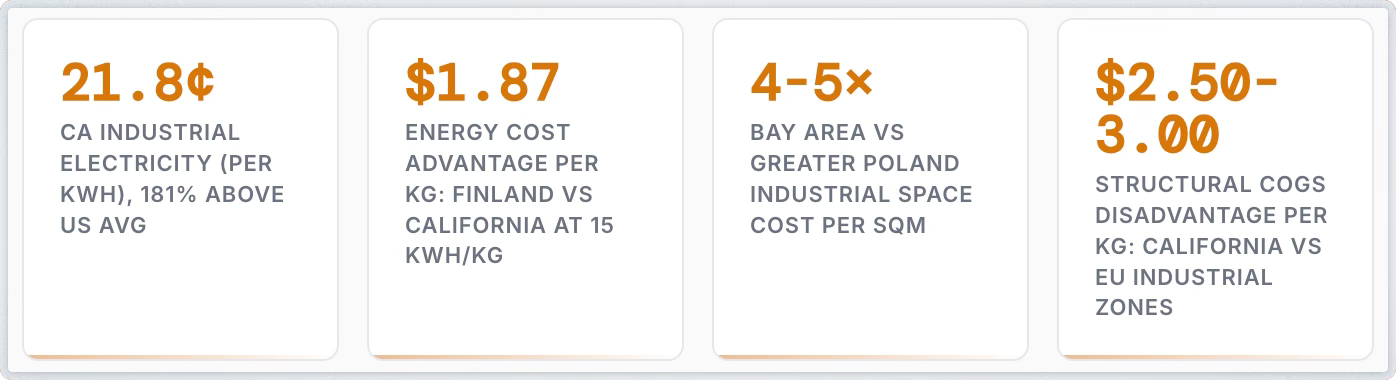
Your postcode is a cost driver. Silicon Valley gives you a demo day and a nine-dollar coffee. Finland, the Netherlands, and Greater Poland give you a cost structure that survives Series B due diligence. Those are not the same thing.
The geography-COGS breakdown every FoodBioTech founder is ignoring.
Innovators – Your technology does not live in a vacuum. It lives in a building, connected to a grid, fed by a supply chain. The geography of that building is a cost driver that your TEA model either captures or lies about.
Most published TEAs lie, not because founders are dishonest, but because they have never been forced to put the site-specific electricity tariff on the same slide as the cost curve.
Founders – You are probably incorporated where your investors are comfortable, not where your COGS are lowest. Those two things are not the same thing. For every 1 cent per kWh difference in industrial electricity, a mid-scale fermentation facility running at 100,000 litres changes its cost of production by a material amount.
Geography is not a branding decision. It is a COGS decision. Treating it as anything else is the kind of assumption that collapses a cost curve in the first ten minutes of a serious due diligence conversation.
Investors – The portfolio company you backed in San Francisco or London is paying 2x to 3x the energy costs of a structurally identical facility in Finland, Romania, or Greater Poland. The cost curve they showed you at Series A may not survive that arithmetic at Series B.
The geography question belongs in your standard diligence checklist, not as an afterthought once the term sheet is signed.
In July 2025, industrial electricity in California was running at 21.80 cents per kWh. The national US average for all other states was 7.75 cents per kWh. California’s industrial rate was 181.3% above that average.
Now compare that to where the best FoodBioTech infrastructure is actually being built.
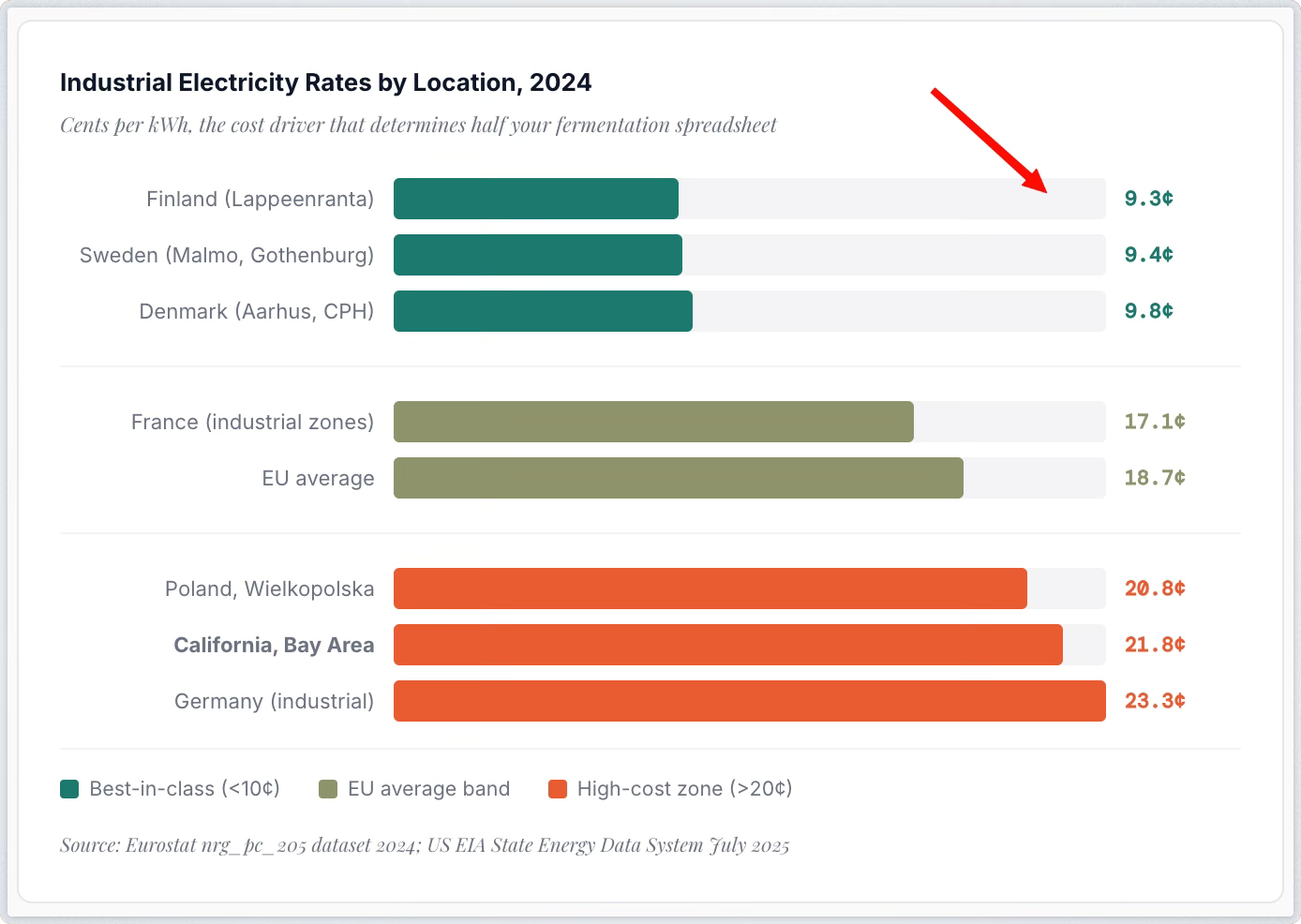
A FoodBioTech founder in the Bay Area is paying European-level energy costs with none of the European infrastructure ecosystem to compensate.
This matters enormously in fermentation. The GFI meta-analysis of published techno-economic models, released in June 2025, identified feedstocks and raw materials, facility capital costs, and process performance metrics as the three leading cost-of-production drivers in fermentation-derived ingredients. Electricity is embedded in all three of those categories: it drives fermentation running costs directly, it drives sterilisation and downstream processing, and it is the single largest variable in capital efficiency calculations for energy-intensive scale-up.
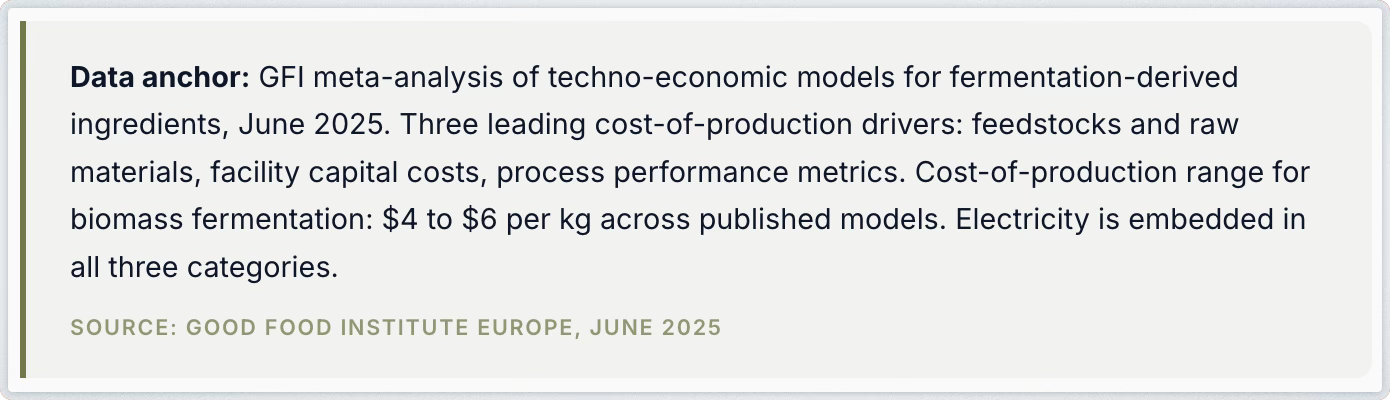
For precision fermentation specifically, the GFI data shows a cost-of-production range of $4 to $6 per kg for biomass fermentation across published techno-economic models. The difference between the top and bottom of that range is almost entirely traceable to feedstock access, energy costs, and capital efficiency.
Every published TEM shows the same structure.
Geography is not a line item in most founder pitches.
It determines half the spreadsheet.
Solar Foods, Lappeenranta, Eastern Finland (not Helsinki, not San Francisco)
Solar Foods makes Solein, a single-cell protein produced from carbon dioxide using hydrogen-oxidising bacteria. The science is genuinely novel. Factory 01, the demonstration-scale facility in Vantaa, Finland, was commissioned in 2024 and is capable of producing 160 tonnes of protein annually.
When Solar Foods evaluated locations for Factory 02, 12,800 tonnes per year design capacity, the company assessed sites across multiple countries. The final location chosen was Selkaharju in Lappeenranta, Eastern Finland. The decision criteria were explicit: renewable electricity price, infrastructure reliability, constructability, permit processes, proximity to strategic partners, workforce availability, and access to financing.
Not demo days. Not co-working spaces. Not proximity to Series A investors. Electricity price and infrastructure reliability.
The project, if fully realised across three factories (F02, F03, F04), would require up to one billion euros in private investment, supported by approximately 66 million euros from the EU IPCEI II programme. Solar Foods is applying for Business Finland funding to partially cover construction costs.
Comments
Nothing yet. Say the first thing.
Sign in to join the conversation.