
Last December, two cultivated meat companies dissolved within days of each other.
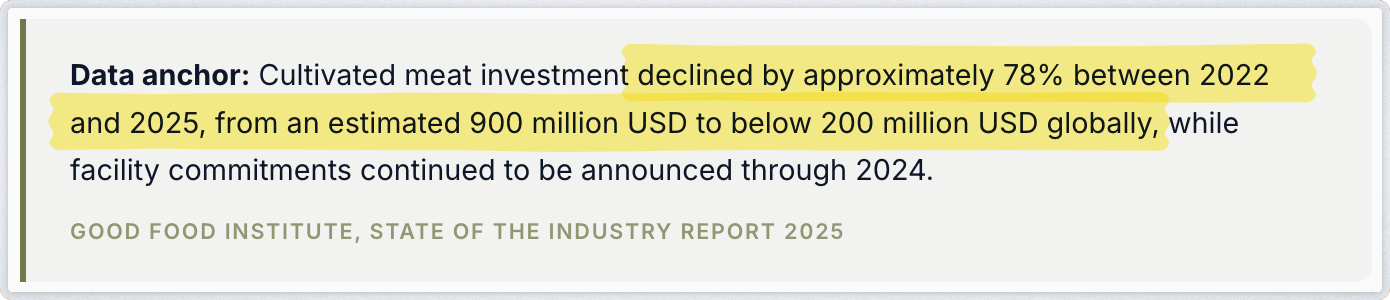
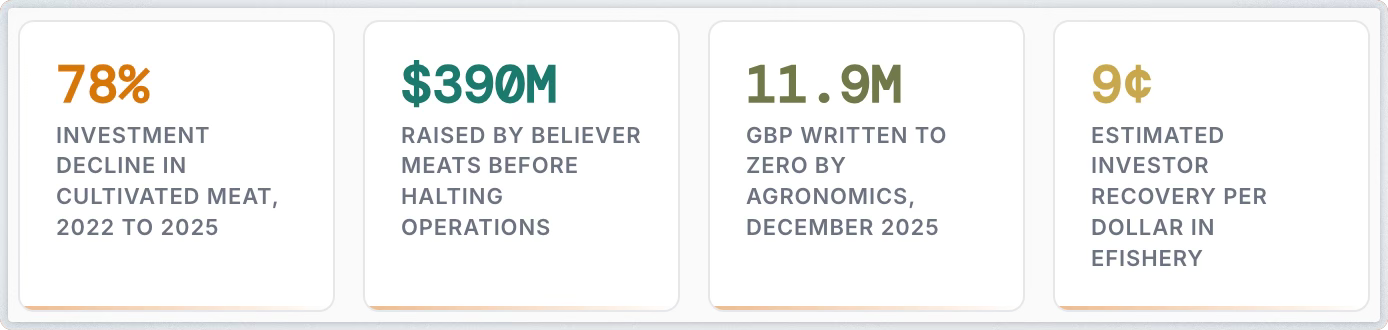
Believer Meats had FDA clearance. A factory. More than 390 million dollars raised. A hundred employees. It halted operations, sued by its construction partner for 34 million in unpaid bills, seeking a buyer for a shuttered plant.
Meatable had active partnerships. A recent acquisition. A stated strategy to become a raw material supplier for the meat industry. Its lead investor, Agronomics, wrote down 11.9 million GBP to zero. That is 8.1 percent of their entire net asset value, gone in a single December announcement.
In Indonesia, a forensic audit is unravelling what was once a celebrated aquaculture unicorn. eFishery allegedly told investors it earned 750 million USD in revenue and a 16 million USD profit across the first nine months of 2024. Internal figures show 150 million USD revenue and a 35.4 million USD loss. Investors may recover nine cents on the dollar.
Who signed off on these models? Who ran the working capital math? Who decided this level of commitment was acceptable before commercial revenue existed?
The answer is not “bad founders.” The answer is a systemic failure in decision architecture, and it is present in more FoodBioTech companies right now than anyone wants to admit.
I have seen this pattern before. The assumption that regulatory timelines were stable held until they were not. The assumption that consumer protein preferences would shift slowly over a decade underestimated what happens when cost and convenience converge at the same moment. The companies that navigated those transitions well were not the ones with the most sophisticated 15-year roadmaps. They were the ones who had built a clear gap between their narrative and their evidence, and closed it before the investor did.
The companies that did not make it were still building the story when the forensic auditors arrived.
Three companies. Three failure modes. One pattern. The narrative was always two years ahead of the evidence.
The systemic failure destroying FoodBioTech funding,
and how to audit yourself before it arrives
Innovators – R&D without a commercial-scale cost model built in from day one reproduced the exact pattern that collapsed Believer Meats and Meatable.
If your science programme assumes economics will be solved later, read this before your next investor meeting.
Founders – Your narrative may be two years ahead of your evidence. That gap is not a communications problem. It is a structural risk. Three companies dissolved because they closed that gap too late.
Run the five-criterion audit in this issue before any investor conversation this quarter.
Investors – The sector does not have a funding gap. It has a governance gap. Three collapses in December 2025 share one root cause. This issue gives you the diligence framework to identify which portfolio companies are inside the pattern before the forensic auditors do.
This is not a funding drought. It is the visible reckoning for a decade of founding decisions built on story-grade evidence rather than decision-grade evidence.
Story-grade evidence tells a compelling narrative. Decision-grade evidence survives a structured diligence question without collapsing. Most founders confuse the two until the round fails or the cash runs out.
Believer Meats did not die because it lacked regulatory clearance. It died because the construction commitment and payables schedule were built around a revenue timeline the bioprocess itself could not support. Vessel validation issues in late 2025 delayed commercial production. The cash did not wait.
Meatable operated on the thesis that strategic partnerships and acquisitions could substitute for an independently viable economic model. When funding sentiment in the sector collapsed, there was no self-funding mechanism to bridge 18 months without institutional capital. The company dissolved seven days after Believer announced it was halting operations.
New Age Eats ran the same pattern earlier in the cycle. A facility 90% complete, 80% paid, built in parallel with an unresolved regulatory pathway, financed entirely on the expectation of the next fundraising round. When that round did not materialise, the company had no revenue to slow the bleed.
The pattern across all three is identical: narrative was constructed first, economics were assumed to follow, and the regulatory and scale assumptions were never stress-tested against a scenario where the next capital raise arrives 18 months late, or not at all.
I audited a founder last year whose narrative ran exactly this pattern: two years ahead of his evidence, an 18-month regulatory promise on 30-month data, straight-line cost projections from a 200-litre pilot. We fixed it in ten business days. The difference between his outcome and Believer’s is timing. He caught the gap before the investor did.
“The biology is not the problem. The compression order is. And the compression order is your responsibility, not the investor’s.”
Failure Mode 1: The Governance Gap (eFishery)
eFishery was a climate-hero story. Aquaculture feeds, fintech for smallholder farmers, hundreds of millions raised from SoftBank, Temasek and Sequoia India. A real market. A genuine problem.
Then a forensic audit surfaced alleged dual reporting systems, nominee companies and fabricated transactions dating back to at least 2018. Device counts were also allegedly inflated: 400,000 feeding devices claimed in the field versus approximately 24,000 actual.
The governance failure was not the fraud itself. It was that the board and investor structure created conditions where aggressive growth targets and weak independent oversight could coexist for years without a forcing function. Nobody in the room whose only job was to kill the bad assumptions.
Ask yourself this week: Could an independent auditor follow your revenue and cost trail in 48 hours without surprises? One set of books, conservative metrics, a board culture where bad numbers are surfaced early rather than smoothed for the next investor update. If the answer is uncertain, you are already inside this failure mode.
Comments
Nothing yet. Say the first thing.
Sign in to join the conversation.