
It was three weeks after closing. Sofia Lindqvist had just signed the Series A term sheet, EUR 8.2 million, led by a Stockholm-based climate tech fund with food ambitions. The process had run clean at 50L in her lab in Lund for eleven months. The fermentation data was tight. Her strain produced at 28g/L. The cost curve said EUR 4.80/kg by Year 4. The investors had seen that number and nodded.
The first call to the CDMO was on a Tuesday morning. By Thursday, she had a quote and a list of questions she had not expected. Before they could accept the process package, they needed a contamination root-cause analysis from her historical runs. They needed critical process parameters with documented acceptable ranges. They needed to understand what she knew about shear sensitivity at 500L, because their reactor geometry was different from hers, and the impeller profile would change the dissolved oxygen profile at her operating RPM.
Sofia had none of it. She had the science. She had the strain. She had the titer. She did not have a transfer-grade process.
That moment, the gap between what closes a funding round and what a CDMO actually needs, has cost the FoodBioTech sector more than any single regulatory setback, supply chain disruption, or consumer adoption curve.
It happens quietly. It does not make a headline. But it has derailed more companies than the problems the sector talks about publicly.
Thanks for reading Food Edge! Subscribe for free to receive new posts and support my work.
The Myth - the bottleneck is not where the sector thinks it is
The industry still talks about FoodBioTech innovation as if the bottleneck sits in discovery. It does not.
In most serious cases, the bottleneck now sits in translation: process robustness, tech transfer, industrial talent, reproducibility at scale, contamination control, and whether pilot performance survives contact with real equipment in a building you did not build, operated by people who were not in the room with you.
The gap between the skillsets the sector glorifies and the skillsets the sector needs has been widening since 2020.
This issue argues that closing it is now the primary determinant of which FoodBioTech companies survive the current cycle.
The myth is this: once the science is right, scale is just engineering. The implication is that scale is a later chapter – something to resolve after the raise, after the team grows, after the milestone is celebrated. It is the reason so many FoodBioTech founders present a cost curve that runs to Year 4 without having run a process in a vessel with a different impeller geometry. It is the reason investors accept a titer number without asking what the downstream recovery looks like. It is the reason the sector is full of companies with excellent molecular biology and incomplete process understanding.
The science is not the problem. The transfer is.
And the reason the myth persists is structural. FoodBioTech, particularly precision fermentation and cultivated meat, formed its founding narrative around molecular biology – around strain engineering, metabolic pathway optimisation, and novel expression systems. That framing made sense for the earliest stage of the field, when the scientific question was genuinely the open one.
But the field has moved. The molecular biology is now mostly solved for the major target molecules. The open question is no longer “can we produce this?” It is “can we produce this reliably, at EUR 4/kg, in a 50,000L vessel, with a process that does not require the founding team to be present.” That question belongs to process engineers, contamination control specialists, DSP chemists, and industrial equipment manufacturers. It does not belong to the molecular biologists who wrote the grants, pitched the investors, and designed the original strain.
One-minute brief
Innovators – your reproducibility data is either transfer-grade or it is not; conference-grade is not the same thing, and CDMOs know the difference in the first ten minutes of your process package review.
Founders – the stage where most FoodBioTech value is lost is the stage you have not yet hired for; scale-up capability rented three months early is worth more than expertise hired reactively after the first bad CDMO call
Investors –the scale-up question belongs in the first meeting, not after the term sheet; if the valuation assumes pilot performance will survive transfer unchanged, that assumption needs to be priced, not assumed
What I’m seeing that others aren’t
Evidence layer 1: The quantitative reality the sector has mostly chosen not to foreground
The numbers have been in the public domain for several years. The sector has structured its funding narrative around the numbers it likes and has been slower to foreground the ones it does not.
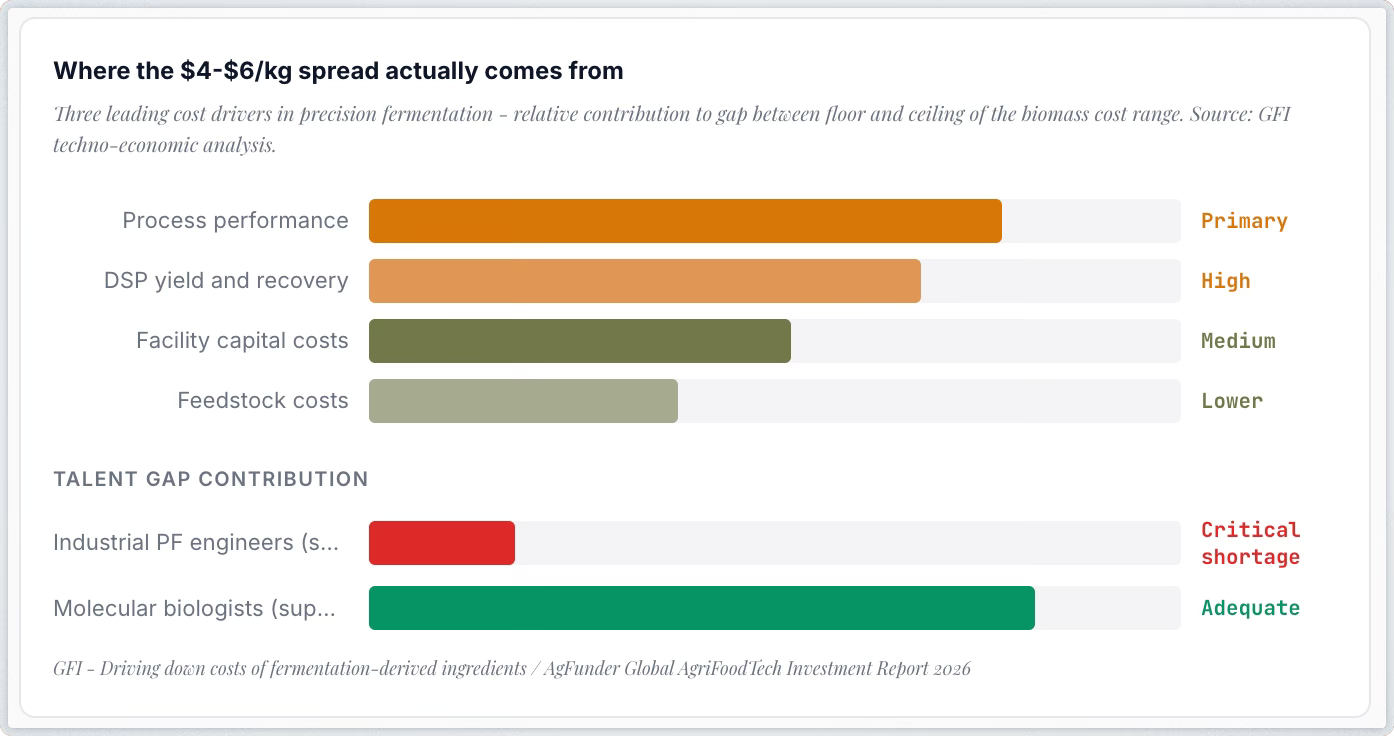
GFI’s techno-economic analysis of fermentation-derived ingredients identifies process performance as one of three leading cost drivers – alongside feedstock costs and facility capital costs. That framing matters. It means a company with excellent biology and a well-located facility can still produce an uncompetitive product if process performance at scale is not controlled. The $4–$6/kg biomass fermentation range cited in GFI’s precision fermentation cost modelling is not primarily a feedstock gap. The spread between the top and bottom of that range is largely determined by process performance variables: titer, yield, productivity, and downstream recovery efficiency. A company at the top of that range is not a bad science company. It is a company with unresolved process performance problems that are tractable, but only if they are addressed directly.
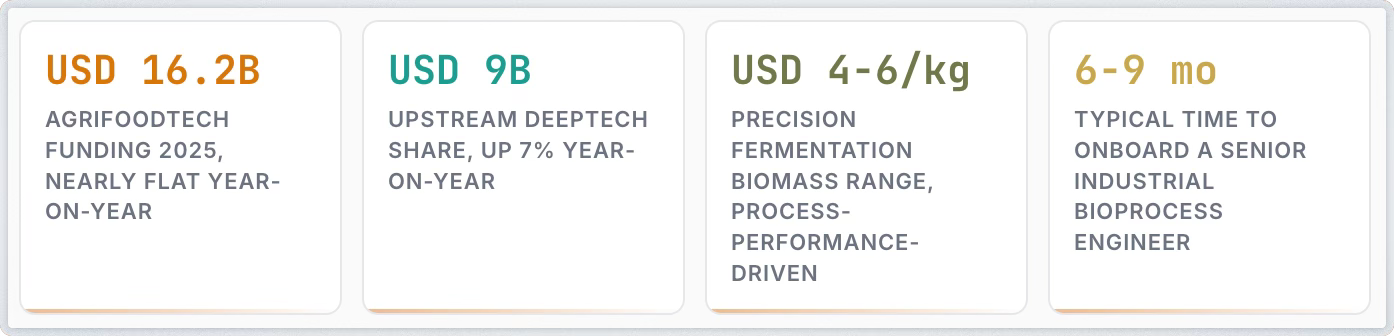
AgFunder’s 2026 global agrifoodtech investment report puts 2025 total funding at USD 16.2 billion – nearly flat year-on-year. Within that, upstream deeptech drew USD 9 billion, up 7% year-on-year, even as overall deal count fell. This is a selectivity story, not an enthusiasm story. Capital is concentrating on companies that can demonstrate commercial throughput evidence – not the science of the concept, but the demonstrated ability to produce at a rate and a cost that generates a return on the investment entering the company. The deal count decline alongside the capital increase means more money is chasing fewer, better-validated companies. The companies at the tail of the distribution are not getting a smaller piece of the pie. They are being excluded from the table.
The talent picture compounds this. Process engineers and DSP specialists with industrial fermentation experience at 10,000L and above are among the most undersupplied technical roles in European FoodBioTech right now. Companies routinely underestimate not just the cost of this talent, but the time required to find it. Six to nine months from job posting to onboarded contribution is not unusual for a senior industrial bioprocess engineer – someone who has physically operated a 10,000L fed-batch fermentation, written the batch records, managed a contamination event, and documented the process for tech transfer. That timeline sits uncomfortably against the milestone schedules most Series A decks present to investors who close in Q3 and expect a CDMO engagement by Q1.
The ratio diagnosis: the sector has more PhDs per capita in molecular biology than in process engineering. For the current stage of the industry – past proof of concept, approaching commercial relevance – that ratio is inverted relative to what the work actually requires. The hard part of the sector’s next decade is not discovering new molecules. It is making known molecules reliably, at cost, at scale, inside facilities that were not designed for them.
Evidence layer 2: Why scale-up fails - the mechanism, not just the pattern
The failures are not random. They follow a structural pattern. Listing the casualties is less useful than understanding the mechanism, because the mechanism is what allows a founder or investor to see the failure mode before it arrives.
The three-stage transfer problem. Lab to pilot to commercial is not a gradient. It is three distinct re-validation exercises, and there is almost no default performance overlap between them.
Equipment geometry changes at each step simultaneously: mass transfer coefficients, dissolved oxygen profiles, shear stress distributions, heat transfer surfaces, and mixing times all behave differently as vessel volume increases by an order of magnitude. A process that ran at 10L in a baffled shake flask is not the same process in a 200L stirred tank. A process that ran at 200L in a stirred tank is not the same process in a 10,000L reactor with a different impeller geometry, a different aspect ratio, and a different sparger design.
The organisms inside the vessel respond to all of these changes. Titer, productivity, and yield can degrade by 30–60% in a first external transfer run. That degradation is not a scientific failure. It is an expected consequence of geometry change that a team with transfer experience anticipates, documents, and corrects iteratively.
A team without transfer experience is surprised by it, and the surprise consumes the runway.
The contamination asymmetry. At lab scale, a contamination event is a Tuesday problem. A 10L vessel can be discarded and re-run within days. The costs are real but recoverable, and the lesson is available at low cost. At 10,000L, a contamination event is a production-grade crisis. The financial cost of a single batch loss at commercial scale – media, utilities, labour, vessel downtime, regulatory notification if applicable – can exceed the annual R&D budget of an early-stage company.
This asymmetry has a documentation consequence. Most lab-stage FoodBioTech companies have never written a contamination root-cause analysis, because at lab scale, the cost of root-cause documentation exceeds the cost of discarding the batch and starting again. CDMOs require it before they will accept a new process. This is not bureaucratic due diligence. It is a diagnostic filter: a team that has not tracked contamination events and traced them to root causes does not yet have process discipline, and process discipline is what a CDMO is protecting when they require it.
The contamination history is not only evidence about your process. It is evidence about your team.
DSP compression – the most consistently underweighted risk. Downstream processing is 40–70% of total production cost in most precision fermentation products. This range is not widely cited in early-stage pitch materials. Most of the cost modelling presented at seed and Series A stage focuses heavily on upstream performance metrics: titer, yield, volumetric productivity. Downstream recovery rate – the percentage of the product produced upstream that actually exits the DSP train as a saleable product – is less frequently modelled explicitly and almost never measured across multiple runs.
The arithmetic is unsparing. A titer of 30g/L means nothing if DSP recovery is 45%. The effective yield is 13.5g/L, and the cost consequences propagate through the entire model. Every cost assumption in the COGS estimate that was built on the upstream number is wrong by a factor of two. Many early-stage decks present titer data. Almost none present DSP recovery data across multiple runs, because measuring it requires having a downstream process, running it more than once, and being willing to report a number that may be inconvenient.
The talent mechanism. The people who know how to solve scale-up problems – industrial process engineers with genuine 10,000L+ fermentation experience, DSP specialists who have designed and operated continuous centrifugation and membrane filtration at production scale, contamination control engineers who have implemented sterility assurance programmes in commercial biotech facilities – were largely trained in pharmaceutical manufacturing, specialty chemicals, or legacy food fermentation.
Comments
Nothing yet. Say the first thing.
Sign in to join the conversation.