
Remilk raised USD 150 million and announced the world’s largest precision fermentation facility - 750,000 square feet, greenfield, Kalundborg, Denmark. Then the company paused the project, pivoted to contract manufacturing at an existing European facility, and launched its first product without pouring a single foundation. Jason Rosenberg, Remilk’s head of business development, said it plainly: ‘This facility we are currently producing at in Europe can expand our capacity very significantly, with a fraction of the capital investment, with a shorter timeline.’ The sunken costs of the Denmark plan, he added, were ‘very strongly offset by the cost saving in converting an existing facility.’
Remilk is not the exception. It is the pattern the sector has been slow to recognise.
Believer Meats raised USD 387 million, built a 200,000-square-foot facility in Wilson, North Carolina, and filed for bankruptcy with USD 86,000 in cash and USD 225 million in debt. The facility cost estimate ballooned from USD 138 million to USD 154 million before equipment was installed. Motif FoodWorks raised USD 345 million, built two facilities, and closed. The capital locked in physical assets could not be redirected when the market shifted underneath them.
The pattern is structural: Food Biotech startups that build infrastructure before their process is transfer-grade are converting venture capital into fixed assets before they know what the process actually costs at scale. The ones that rent first - shared facilities, CDMOs, co-location partnerships - are not making a compromise. They are making a better capital allocation decision.
This issue gives you the framework for that decision. When renting is smarter. When ownership becomes justified. And the 10-question checklist that tells you which stage you are actually in, not the stage your pitch deck describes.
Thanks for reading Food Edge! Subscribe for free to receive new posts and support my work.
The Myth. And the reality.
The myth: Owning your own fermentation plant signals seriousness, operational control, and competitive moat.
The reality: Owning steel before your process is transfer-grade is not a moat. It’s a fixed cost around an assumption.
One-minute brief
Founders – your facility timeline is either a capital allocation decision backed by transfer-grade evidence, or it is a status signal that consumes runway. The 10-question Build-vs-Rent Decision Framework in this issue produces a score that maps to one of three outputs - RENT, CO-LOCATE, or BUILD. Most Series A companies score in the single digits.
It is a diagnostic that protects your runway from the most expensive mistake in Food Biotech: building steel around a process that has not yet survived an external transfer.
Investors – if the founding team cannot name their measured DSP recovery rate, the facility that operated their process externally, and the signed offtake covering Year 1 volume, the company is in RENT territory. Any capex line item in the use-of-proceeds at that stage is venture capital being poured into concrete before the biology justifies it.
The checklist in this issue converts that assessment into a structured diligence filter.
Investors –your R&D sequence determines when you earn the right to discuss facility ownership. The priority order is: transfer-grade reproducibility, then external validation, then cost model validation.
The checklist maps these directly to the experiments and documentation tasks that move you from RENT to BUILD. The sequencing matters more than the science.
What I’m seeing that others aren’t
Evidence layer 1: Biology beats concrete as a cost lever
The strongest quantitative argument against premature infrastructure is not about discipline. It is about arithmetic.
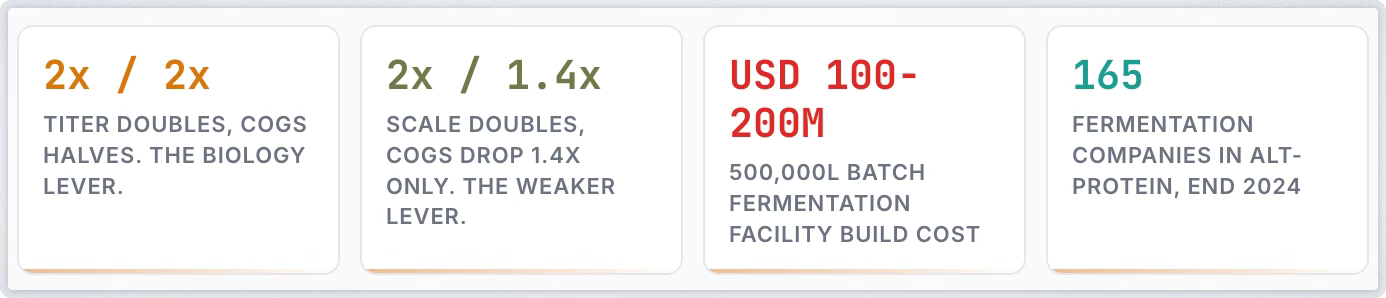
Synonym Bio’s Scaler model quantifies the relationship between scale and cost in precision fermentation. For every 2x increase in production scale, COGS decrease by a factor of 1.4x. For every 2x increase in titer - a biological improvement, not an infrastructure one - COGS decrease by a factor of 2x. The biology lever is 43% more powerful than the scale lever. Building a larger facility before optimising the biology is, by the numbers, the less efficient path to cost competitiveness.
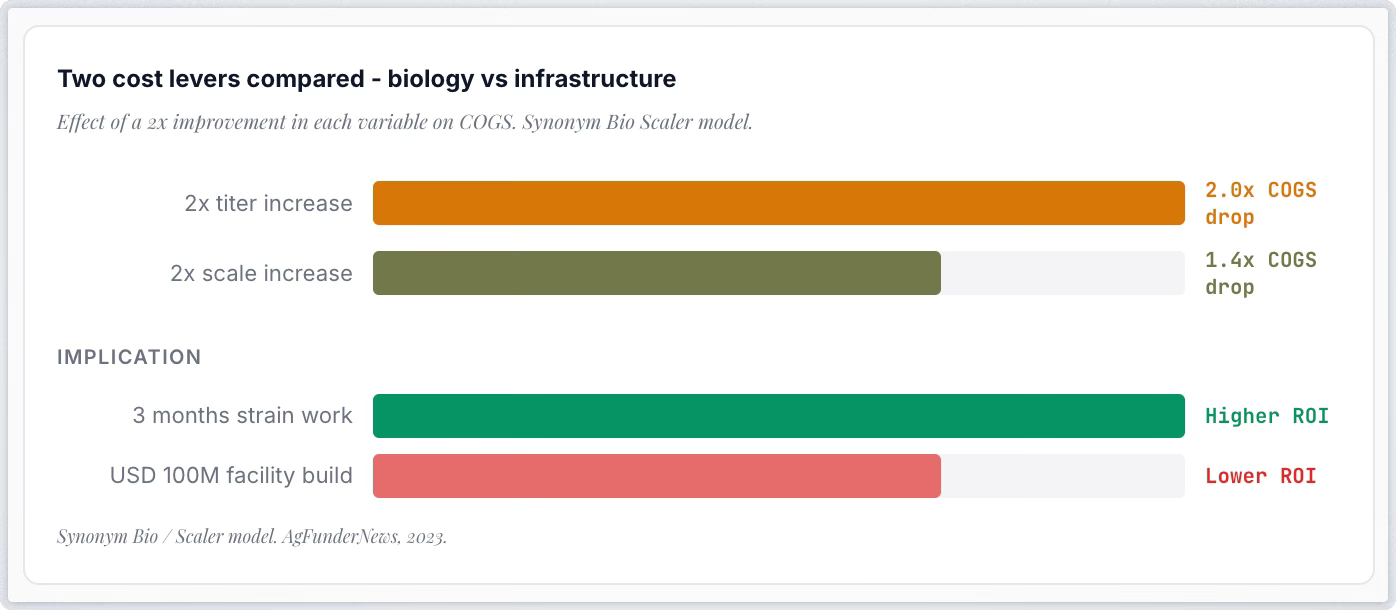
This is not a theoretical distinction. A 500,000-litre batch fermentation facility costs USD 100-200 million. A company that invests at the lower end of that range and then discovers that a titer improvement would have delivered a larger COGS reduction than the scale increase has committed capital to the weaker lever. The capital is now in steel. It cannot be reallocated to strain engineering, downstream optimisation, or process validation.
Lever VC’s scale-up cost model puts upstream process equipment at approximately USD 17 million, with total upstream capex reaching USD 59 million after engineering, installation, and construction. The model notes that the major capex variation comes from downstream processing requirements - the part of the process most founders have not yet measured at scale. A facility designed around an upstream process with an unmeasured downstream train is a building designed around an assumption. That assumption has a price tag: DSP represents 40-70% of total production cost in precision fermentation food proteins. The facility capex is committed. The largest cost driver has not been characterised.
GFI’s 2024 State of the Industry report for fermentation counts 165 companies and USD 4.8 billion in cumulative investment. At least 17 fermentation facilities were opened or announced in 2024 - but at least 5 of those were innovation hubs and R&D centres, not commercial production facilities. The sector is beginning to distinguish between de-risking infrastructure and production infrastructure. That distinction is the framework this article formalises.
The global capacity gap is real. Synonym Bio’s Capacitor database tracks 246 fermentation facilities across 40 countries with approximately 50 million litres of total capacity. Market demand may require 595 million litres - a 10x gap. Only 20 facilities globally have tanks exceeding 100,000 litres. The capacity constraint is genuine. But the response to a capacity gap is not for every Series A company to build its own plant. The response is to allocate that build to the companies whose processes are actually ready for it - and to ensure the rest have access to shared infrastructure that lets them reach readiness without burning the runway.
Evidence layer 2: The structural pattern behind premature builds
Three mechanisms drive founders toward building too early.
Comments
Nothing yet. Say the first thing.
Sign in to join the conversation.