
The CFO had a slide. It was titled “2050 Strategic Options.” Behind it sat four scenarios, each with a 25-year horizon, each rendered in the kind of pastel palette that suggests confidence without requiring it. We were in the Zuidas district, Amsterdam, a glass tower with a view of the ring road. The kind of room where big numbers feel like abstractions.
He walked through the scenarios methodically. Gradual cost reduction. Consumer acceptance curves. Regulatory maturation. All plausible. All calibrated to a world that changes slowly, steadily, on a schedule that accommodates a full budget cycle and two rounds of board sign-off.
I waited until he finished. Then I asked him to go back to slide three, the one showing the protein transition timeline. I asked him what three events he was assuming would NOT happen before 2030. He looked at the slide. He said: price parity on precision fermentation, widespread AI integration across supply chains, and a major climate-linked food shock. I told him the probability scores on all three were above 70%, with the consensus from our Delphi panel running at 8.4, 7.8, and 8.1 out of 10. STRONG consensus on all three. Not speculation. Not scenario planning. Scored probability from 45 domain experts across two rounds.
He moved his planning horizon.
I have seen this pattern before. At Merck, the assumption that regulatory timelines were stable held until they were not. At Danone, the assumption that consumer protein preferences would shift slowly over a decade underestimated what happens when cost and convenience converge at the same moment. The companies that navigated those transitions well were not the ones with the most sophisticated 15-year roadmaps. They were the ones who had already built operational capacity for the change before it arrived, because they were planning on a 36-month precision window rather than a 15-year gradient.
“The food system will be unrecognisable by 2030. Not by 2050. 3 tipping points cluster in a 36-month window. Your 2035 roadmap may already be obsolete.”
The convergence problem every food strategist is ignoring
Innovators – You have built something technically real. But infrastructure timing is everything. Read this before your next pitch.
The window for being acquired as infrastructure rather than as a consumer experiment closes before 2028.
Founders – The infrastructure window, meaning B2B, fermentation, AI supply chain, runs 2026 to 2027. Consumer adoption follows price parity, not the other way around.
The founders who exit well in 2029 to 2031 are building pipes right now, not direct-to-consumer brand equity.
Investors – The vintage question for 2026 is not which technology wins. It is which three moves are required in 74% of plausible futures. This piece answers that with 100,000 simulations. You do not need to pick the winning scenario.
You need to know which moves pay off across all of them.
The framework here is not opinion. It is a 100,000-run Monte Carlo model across 12 stochastic variables (technology adoption rates, climate shock frequency, trade policy fragmentation, consumer acceptance curves, regulatory velocity, input cost trajectories, and six others), validated against three independent scenario frameworks: BCG Blue Horizon’s four food system scenarios, Fraunhofer ISI FOX, and Synthesis Partners MENU 2035. The Delphi panel comprised 45 domain experts across two structured rounds.
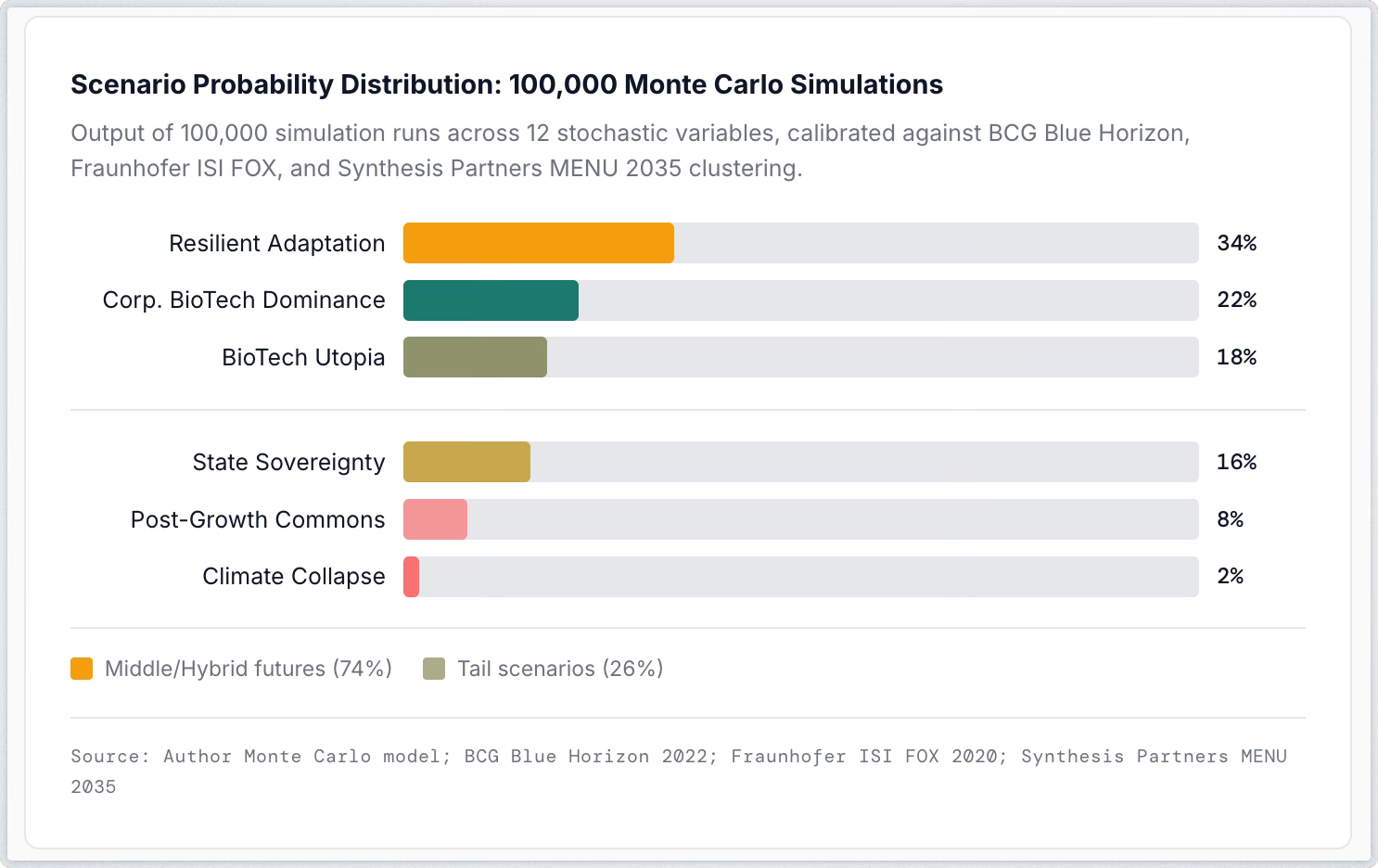
The headline finding is not which scenario wins. It is this: 74% of the probability mass, Scenarios 1, 2, and 3 combined, requires exactly the same three strategic moves. Precision fermentation infrastructure. AI-integrated supply chain. Distribution resilience across fragmented trade zones.
These are not competing bets for different political futures. They are the same bet expressed across three different political and economic contexts. In Resilient Adaptation, you need them because the system is messy and efficiency is survival. In Corporate BioTech Dominance, you need them because the consolidators will acquire the companies that already have them. In BioTech Utopia, you need them because you are the infrastructure the utopia runs on.
The remaining 26% is either a world where novel food technology collapses entirely (Post-Growth Commons, Climate Collapse) or where national fragmentation makes the market dynamics location-specific (State Sovereignty, where the moves still apply regionally). In no scenario does the “wait and see” strategy produce a positive payoff.
The precision fermentation market sits at $4.94 billion in 2025. The projected figure for 2035, from ResearchAndMarkets analysis calibrated against Wright’s Law learning curves, is $267.6 billion. That is a 54x multiple in a decade.
Wright’s Law is not a forecast. It is a mechanism. Every time cumulative production volume doubles, per-unit cost falls by approximately 30%. The cost floor for precision fermentation protein, modelled against current trajectory, arrives at approximately $3.60 per kilogram by 2035. The same mechanism produced the solar and battery cost curves that most analysts said were impossible. It is now producing the same curve in precision fermentation.
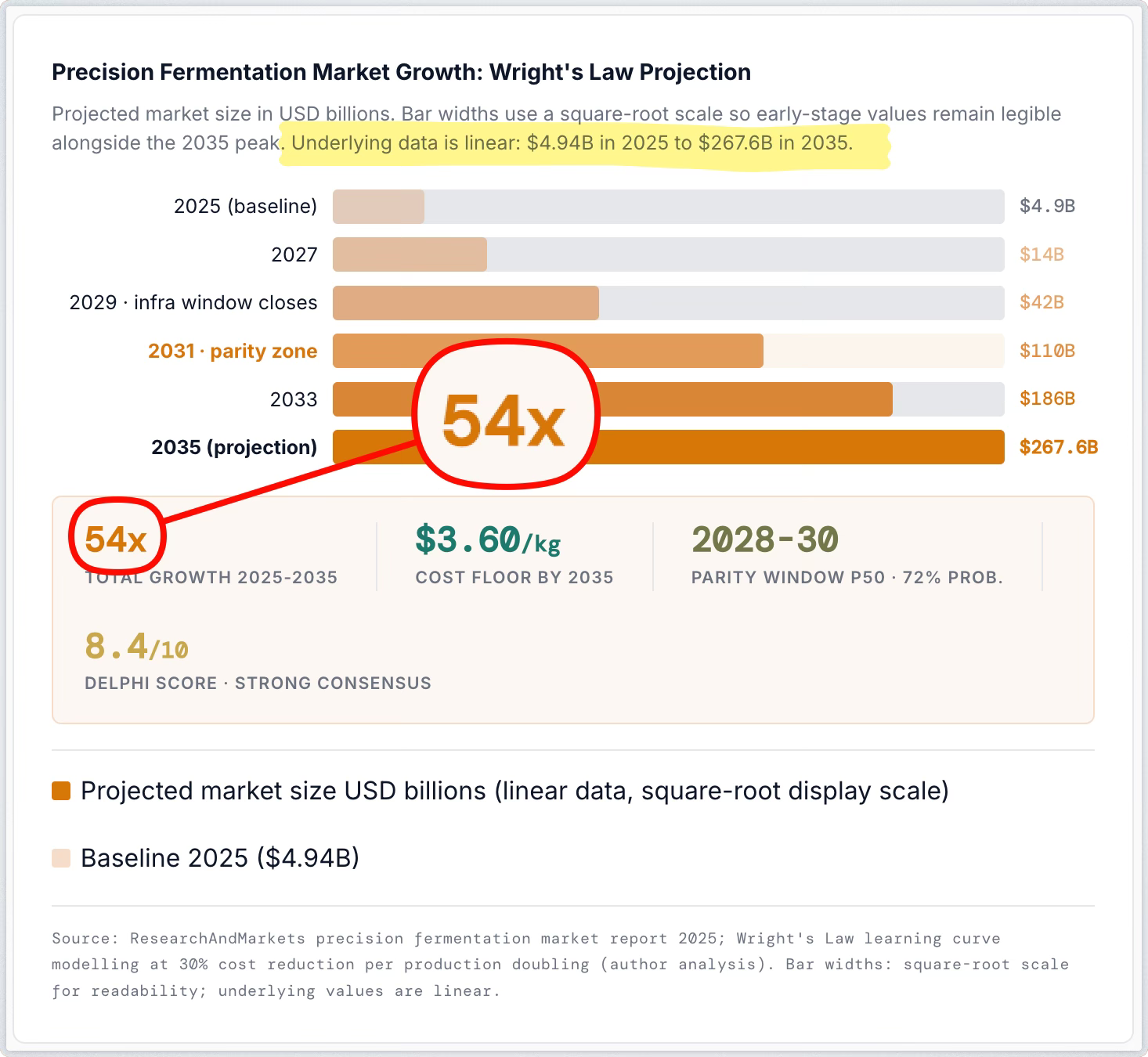
The critical date is not 2035. The critical date is 2030. The Delphi panel scored protein price parity (precision fermentation at cost equivalence with conventional animal protein) at 8.4 out of 10 with an interquartile range of 1.6. STRONG consensus. Not “possible by 2030.” Probable by 2030.
The infrastructure implication is direct. Building precision fermentation capacity, or the AI-integrated supply chain infrastructure that distributes it, takes three to five years of capital deployment, permitting, partnership development, and operational commissioning. A company that starts in 2026 arrives at the parity moment with operational infrastructure in place. A company that waits for parity to be proven as a condition of investing arrives three to five years after the window closes.
The P10 pessimistic Monte Carlo scenario still gives a fermentation market of $89 billion by 2035. The downside is robust. The floor is high. This is not a speculative bet on a best-case scenario. It is a question of whether you have infrastructure when the demand arrives.
Game theory is not complicated when the payoff matrix is clear.
BigFood has two relevant strategic choices: acquire and integrate precision fermentation and AI supply chain capability, or defend existing assets and resist transformation. FoodTech has two corresponding choices: position as B2B infrastructure and ingredient supplier, or force direct-to-consumer adoption before cost parity.
The Nash Equilibrium, the state where neither side benefits from unilaterally changing strategy, is: BigFood Acquires, FoodTech positions as B2B. The joint payoff matrix scores this at (10, 9). Highest joint value. Both sides win.
The “BigFood Defends” strategy, ignoring transformation, scores a payoff equivalent of -10 once the infrastructure transition is complete and competitors have acquired the capability they refused to build. The “FoodTech forces consumer” strategy, trying to convert consumers before price parity, reproduces the Beyond Meat trap. High customer acquisition cost. No loyalty without price equivalence. Value destruction on a five to seven year horizon.
The implications are concrete.
Founders – Build for acquisition, not for direct-to-consumer scale. Position as B2B infrastructure or premium ingredient. The relationship that produces the best exit is built before the due diligence process, not during it. Capstone Partners data shows 65.8% of food acquisitions are completed by strategic buyers.
They buy relationships and operational fit as much as technology.
Comments
Nothing yet. Say the first thing.
Sign in to join the conversation.