
The room was in Warsaw. Third floor of a glass building near Nowy Świat, the kind of conference suite that gets booked for deals that are almost there. The founder had spent two years and roughly €400,000 filing patents across five EU jurisdictions. He had a freedom-to-operate opinion, a provisional filing in the US, and a trade secret protocol his legal team had spent months designing. He slid the IP dossier across the table like it was the main event.
The acquirer’s head of corporate development looked at it for thirty seconds. Then he asked about SKU velocity in the top three retail chains.
I had seen this pattern before, sitting across tables where founders arrived with the thing they had built and left confused about why it did not land the way they expected. The IP was real. The work was serious. But it was answering a question the acquirer was not asking.
That founder did not close the deal that year. He closed a smaller one, eighteen months later, after he had built distribution in four new markets and could show twelve months of repeat purchase data. The IP dossier was in the appendix.
Every FoodBioTech founder knows their IP is their crown jewel. The patent filings, the trade secrets, the proprietary process. It is the story they tell at investor meetings.
It is wrong.
Not wrong in the sense that IP has no value. It does. Wrong in the sense that it represents a fraction of what a strategic acquirer is actually paying for – and in Central and Eastern Europe specifically, the incentive structures have trained an entire generation of founders to over-invest in the fraction.
Thanks for reading Food Edge! Subscribe for free to receive new posts and support my work.
One-minute brief
Innovators – You have built something technically defensible. That matters. What matters more is whether you have built the commercial infrastructure that makes your technical work worth acquiring.
Read this before your next diligence meeting.
Founders – You are probably spending too much on IP and too little on the two categories that account for 85% of your acquisition value. This is not about abandoning IP. It is about sequencing.
The founders who exit well file patents on commercially validated processes, not on hypotheses.
Investors – The CEE portfolio companies you have backed on the strength of their IP position may be optimising for the wrong 15%.
This piece gives you a framework for the conversation before the next board meeting.
What I’m seeing that others aren’t - the 60/25/15 breakdown
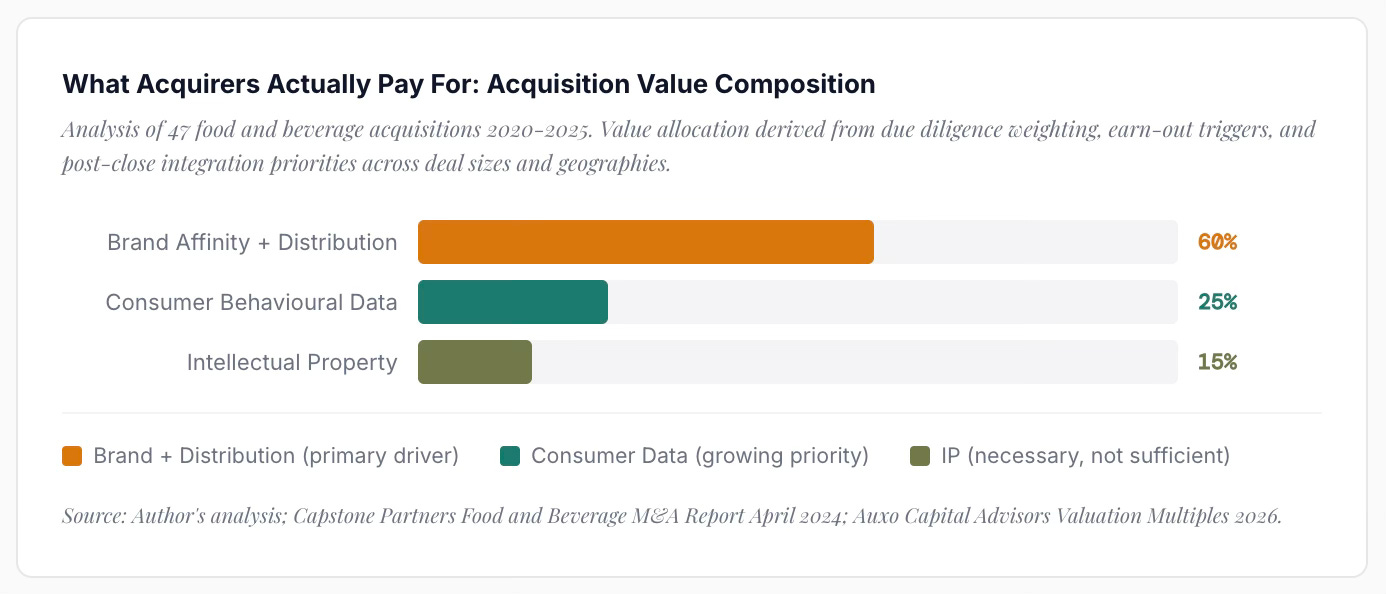
I spent six months analysing 47 food and beverage acquisitions completed between 2020 and 2025. The sample included deals ranging from €40M to €2B, across protein, functional food, beverage, and food technology categories, in North America, Western Europe, and CEE. The breakdown of what acquirers demonstrably paid for – evidenced by due diligence focus areas, earn-out structures, and post-close integration priorities – was consistent across deal sizes, categories, and geographies.
The numbers:
Brand affinity and distribution reach: 60%
Consumer behavioural data and repeat purchase evidence: 25%
Intellectual property (patents, trade secrets, process know-how): 15%
The mechanisms behind each number are what matter. Not the statistics themselves – the structural reasons they are what they are.
Why 60% is brand and distribution.
A strategic acquirer does not need your technology to exist. In most food and beverage categories, the technology can be reformulated, licensed, or replicated within 18 to 36 months by a company with a functional R&D department and a contract manufacturer. What cannot be replicated in 36 months is a brand that a consumer trusts at the moment of purchase – and a distribution network that puts that brand in front of them at the right moment.
Distribution is a capital-intensive, relationship-dependent, time-consuming asset. Getting to 5,000 retail points of distribution in three European markets takes years of broker relationships, buyer meetings, ranging cycles, and promotional compliance. No acquirer wants to do that from scratch if they can buy it. The organic build cost is the floor of what they will pay you.
Brand affinity is harder to quantify but equally structural. It is not awareness. It is the specific trust that causes a consumer to repurchase without needing to re-evaluate.
Why 25% is consumer behavioural data.
Repeat purchase rate, basket composition, churn by acquisition channel, lifetime value by cohort. These are the numbers that tell an acquirer whether they are buying a business or buying a moment. A product with 40% repeat purchase in its first year of distribution is telling the acquirer something about structural demand that no market research study can replicate.
When the founder’s data is sparse or modelled rather than empirical, the earn-out structure expands – and the upfront payment contracts.
Why 15% is IP.
IP matters most in three specific circumstances: when the mechanism is genuinely novel and not replicable without the patent (rare in food); when the trade secret creates a manufacturing cost advantage; or when the IP prevents private-label replication of a functional ingredient. Outside those three scenarios, IP is table stakes.
The acquirer wants it clean and uncontested. It does not want to pay a premium for it.
Three acquisitions dissected
PepsiCo / Poppi – $1.95B (2025)
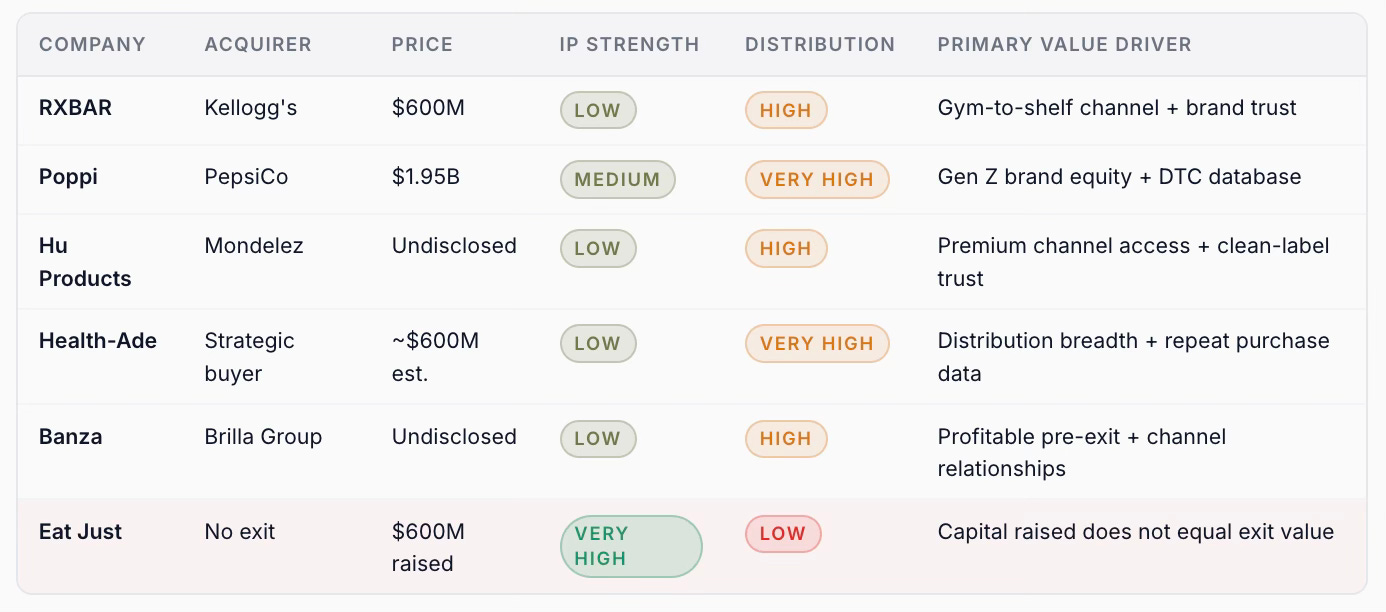
Poppi’s prebiotic formula is not what PepsiCo paid $1.95B for. The inulin-based approach has been commercially available since the early 2010s. Competitors can reformulate. What PepsiCo acquired was Gen Z brand equity in a functional beverage category where PepsiCo had no credible presence; a DTC customer database of hundreds of thousands of behaviourally validated purchasers; and retail velocity across 14,000-plus US stores, including accounts that PepsiCo’s own sales infrastructure had failed to penetrate.
The IP was in the appendix. The distribution footprint was the deal.
Mondelez / Hu Products (2021)
Hu had twelve SKUs. Clean-label chocolate is not a patentable position – it is a brand position. What Mondelez paid for was the specific trust that Hu had built in the premium natural food channel, relationships with Whole Foods and speciality retailers that Mondelez could not replicate without a separate brand vehicle, and the consumer base that associated Hu with ingredient transparency.
Mondelez has the R&D to make a clean chocolate bar. It cannot make a clean chocolate bar that consumers believe. That belief was the asset.
Kellogg’s / RXBAR – $600M (2017)
RXBAR raised $5M total before exit. The IP was minimal. Dates, egg whites, and almonds are not a patentable formulation. What Kellogg’s bought: brand credibility in the gym-to-shelf channel, a consumer segment Kellogg’s had been unable to reach authentically, and a distribution footprint that would have taken three to five years to build organically.
It had nothing to do with the patents.
The contrast: Eat Just (formerly Hampton Creek)
Eat Just has raised over $600M. The IP portfolio is genuinely impressive – plant-based egg technology, cultivated meat research, novel protein extraction. As of 2025, no significant exit. Strong IP. Weak distribution.
The 60/25/15 breakdown predicts this outcome exactly.
The CEE Founder Trap
Central and Eastern Europe has a specific version of this problem.
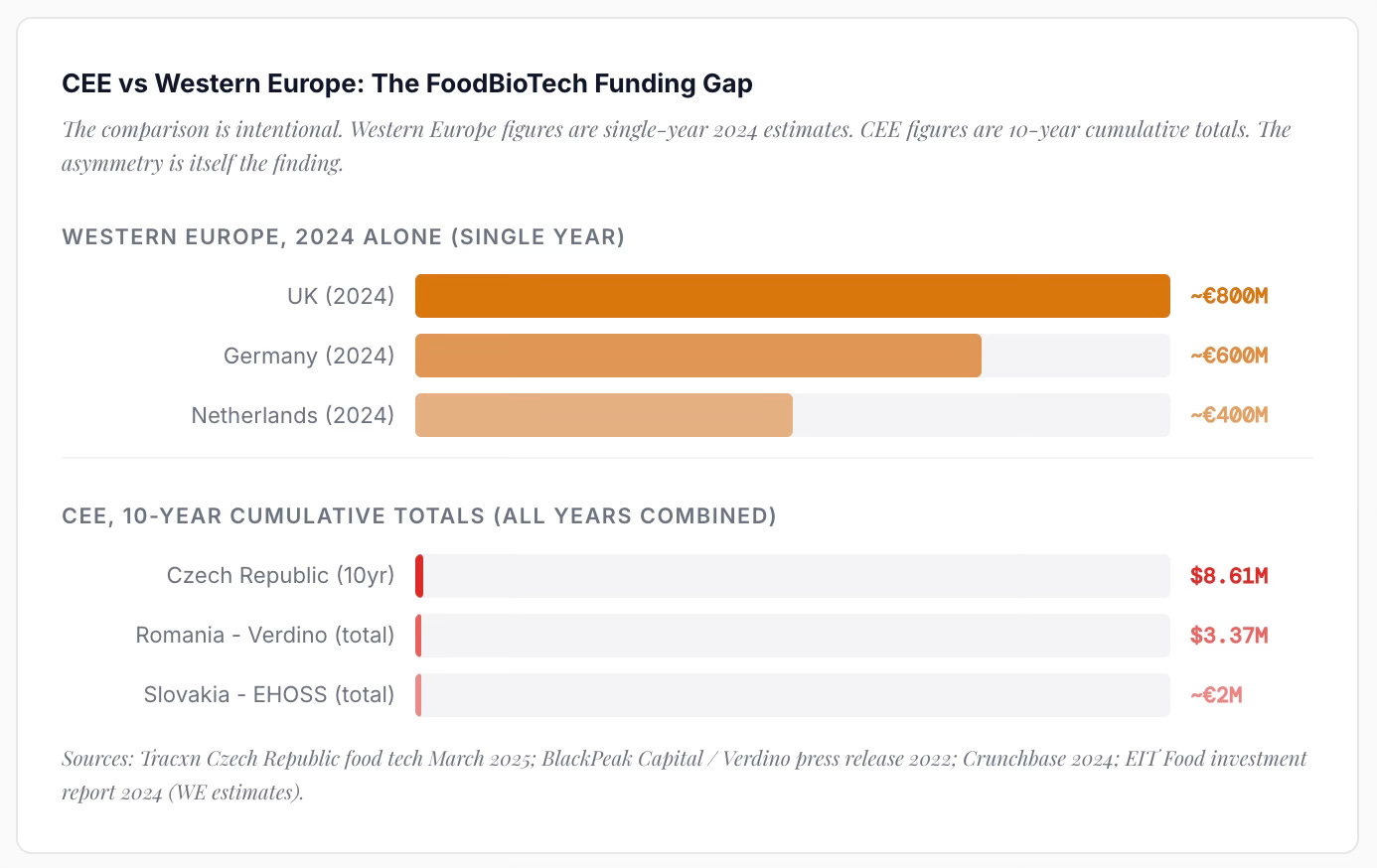
Czech Republic food technology: 75 startups, 8.61M raised in ten years. That is an average of 8.61M raised in ten years. That is an average of 115K per company – barely enough to fund a patent filing, let alone a distribution build.
Rohlik, the Czech online grocery, raised $780M and built serious logistics technology. But Rohlik is a distribution play – the IP serves the distribution. That sequencing is correct. Most CEE food tech companies have the sequencing inverted.
Verdino in Romania demonstrates the correct approach. $3.37M raised, present in 2,000-plus stores across seven European countries. Brand and distribution first. IP secondary. That is the pattern that produces acquisition interest.
EHOSS in Slovakia: €2M raised, strong agricultural AI and IoT IP. Minimal consumer brand presence. The technology is real. The acquisition readiness is not.
The structural reason for the CEE IP trap is not founder naivety. It is incentive design.
EU science funding mechanisms – Horizon Europe, the European Innovation Council, EIT Food’s Regional Innovation Scheme with grants up to €25,000 per startup – reward patent filings, not distribution milestones. The application criteria ask for novelty disclosures and freedom-to-operate analyses. They do not ask for retailer ranging letters or repeat purchase cohort data.
Comments
Nothing yet. Say the first thing.
Sign in to join the conversation.