
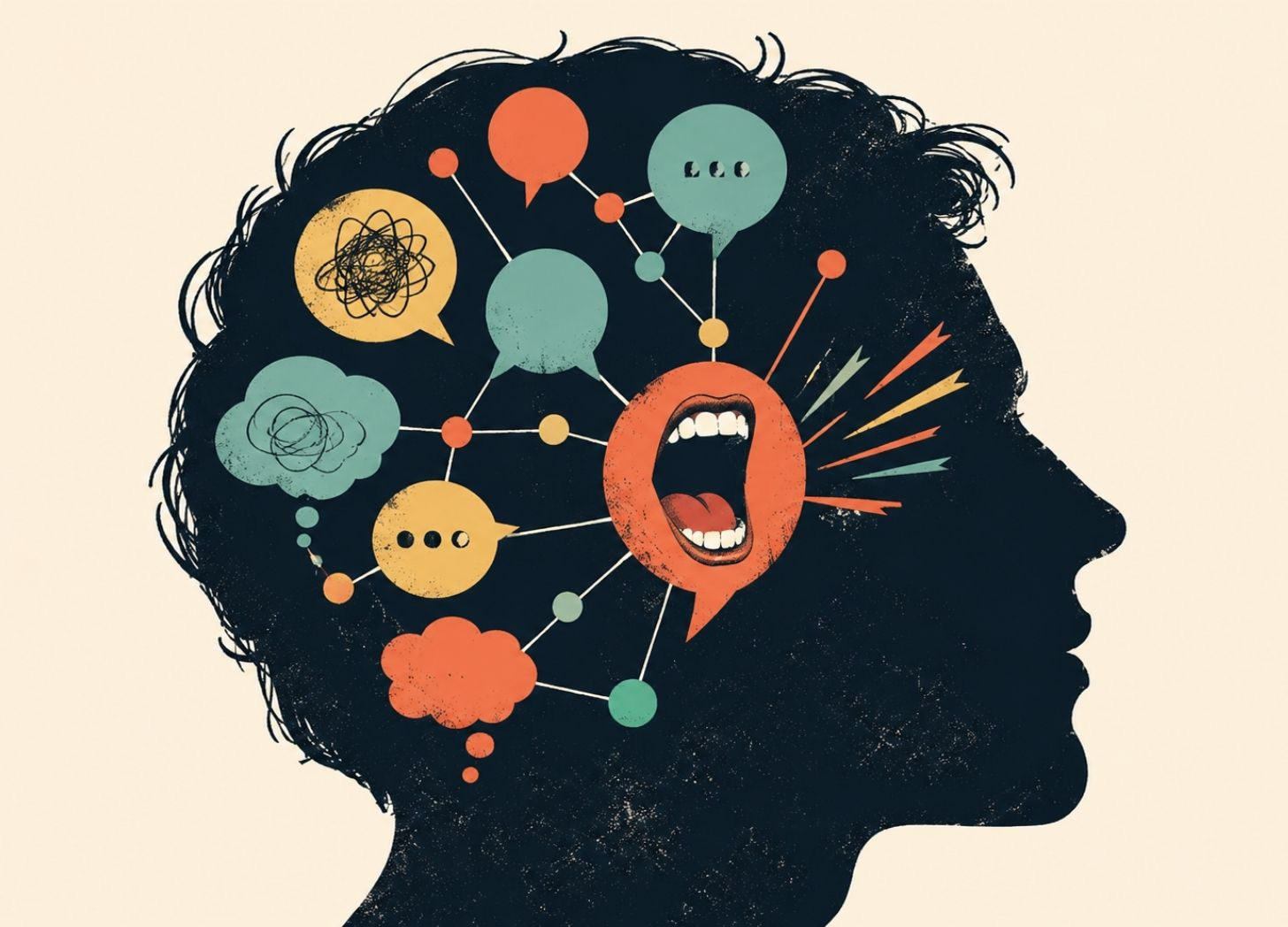
Most of us talk to ourselves.
A few words pass through our mind while we are making a decision, remembering something we need to do, or replaying a social interaction or conversation.
Sometimes it happens out loud. We hear ourselves speak when nobody else is there, and the experience can feel a little odd, not because the thought itself is unusual, but because it has crossed over from private thought into spoken language.
That is what makes self-talk so interesting. It can feel ordinary and strange at the same time.
At its simplest, self-talk is one way we use language on ourselves. We use it to prepare, remember, rehearse, correct, encourage, criticize, and make sense of what we are feeling. Sometimes it helps. Sometimes it becomes repetitive or harsh. Sometimes it’s barely noticeable. Sometimes it is hard to ignore.
As someone who talks to themselves all the time, for example, verbalizing what I might say on a call or during a meeting, or berating myself when I think I have messed up, I thought I would explore why this happens.
Why do we talk to ourselves at all? Why does it sometimes help us think more clearly? Why can it turn into worry, self-criticism, or overthinking? Why do some people describe a constant inner voice, while others say their thoughts are less verbal? And when, if ever, should talking to yourself be taken as a sign that something more serious may be going on?
Inner speech, out-loud self-talk, and the voice in your head
When people refer to self-talk, they are not always describing the same experience.
One form is inner speech. This is the experience of using words silently in the mind. You may not move your lips or make a sound, but the thought still has a verbal quality. It can feel like a sentence, a phrase, a question, or a brief instruction passing through your head.
In a 2019 article in Frontiers in Psychology, Sharon Geva and Charles Fernyhough describe inner speech as “the experience of speaking silently in one’s head.” That simple description captures why inner speech can feel so familiar. It’s not just thought in general. It is thought that has taken a verbal form.
Out-loud self-talk is different because the words are actually spoken. You may be alone, but the speech still becomes audible. This can make the thought feel more concrete. It can also make it easier to notice what you’ve just said to yourself.
Then there’s the phrase “the voice in your head.” This can be a useful everyday phrase, but it can also be misleading. For many people, the inner voice is not like hearing an actual sound. It is more like the felt presence of words, tone, or perspective within thought.
Having an inner voice does not necessarily mean hearing a voice as if someone else is speaking. It often means that some of your thinking is verbal, self-directed, and experienced from a particular point of view.
Why self-talk helps us organize our thoughts
Self-talk can be useful when it gives thought a clearer shape. It can turn a vague mental tangle into something more workable.
In a 2020 article in Frontiers in Psychology, Piotr K. Oleś, Thomas M. Brinthaupt, Rachel Dier, and Dominika Polak describe self-talk as serving several functions, including self-management, self-reinforcement, self-criticism, and social assessment. That fits with the everyday experience of using words to sort out what matters, what needs attention, and what can wait.
At its best, self-talk helps us slow thought down enough to work with it. It gives us a way to sort, label, and sequence what might otherwise remain a blur.
Talking yourself through tasks, decisions, and everyday problems
Self-talk often becomes most visible when we are trying to get something done.
This might be a practical task, a choice that needs weighing up, or a problem that has multiple issues and potential solutions. In these moments, talking ourselves through what we are doing can make the first course of action easier to identify.
Self-talk in this context is often plain and functional, consisting of small phrases that help narrow attention. Instead of facing the whole problem at once, we give ourselves a manageable instruction. We move from the general pressure of “I need to sort this out” to the more useful question of what needs to happen next.
Some research on self-talk has looked at performance settings, especially sport. In a 2011 meta-analysis in Perspectives on Psychological Science, Antonis Hatzigeorgiadis, Nikos Zourbanos, Evangelos Galanis, and Yiannis Theodorakis found that self-talk interventions were associated with improved sport performance, with instructional self-talk especially relevant for tasks involving technique and focus.
Everyday life is not the same as sport, so that finding should not be stretched too far. But the basic idea is familiar. When a task requires attention, sequence, or control, a simple phrase can help direct the mind toward the part that matters now.
Self-talk can also help with decisions. Saying the options clearly can expose what is vague, exaggerated, or missing. A choice that feels tangled in the mind may look different when put into words.
This does not mean self-talk guarantees a better decision. We can still mislead ourselves and justify what we already want. But when it is used well, self-talk can act like a temporary guide through the next step of a task, problem, or choice.
Why we talk to ourselves when we’re stressed or emotional
Self-talk often kicks in when emotion is high.
Stress narrows attention. It can make one concern feel urgent, one mistake feel bigger than it is, or one possible outcome feel more likely simply because it feels frightening. In those moments, self-talk can become a way of trying to regain some control.
A person may tell themselves to pause, breathe, wait, or take things one step at a time. The words do not remove the emotion, but they can give the mind something steadier to hold on to. They can create a small space between the feeling and the next response.
Research on self-talk and emotion suggests that the way we address ourselves can matter. In a 2014 article in Journal of Personality and Social Psychology, Ethan Kross and colleagues found that using non-first-person self-talk, such as addressing oneself by name or using “you,” helped people regulate thoughts, feelings, and behavior under social stress.
That does not mean there is a magic phrase that works for everyone. It simply points to a useful principle. When people are distressed, self-talk can either pull them deeper into the feeling or help them step back from it slightly.
This is why emotional self-talk can go in two very different directions.
It can sound like support.
You can handle this.
Slow down.
Don’t answer yet.
It can also sound negative and threatening.
This is going to be awful.
You’ve ruined it.
Everyone will notice.
In both cases, the person is talking to themselves. But the effect is not the same. Some self-talk helps the emotion become more manageable. Some self-talk gives the emotion more material to feed on.
Why we rehearse conversations in our heads
Some self-talk is social, even when nobody else is present.
We imagine what we might say. We replay what someone else said. We think of a better answer hours later.
Did you know that the French term L’esprit de l’escalier describes the frustrating experience of thinking of the perfect witty comeback or argument after the opportunity to use it has passed.
We also prepare for a difficult conversation by running through possible versions of it in our mind.
This kind of self-talk makes sense. Conversation is uncertain. Other people can surprise us, misunderstand us, judge us, reassure us, or respond in ways we did not expect. Rehearsing a conversation can feel like a way of reducing that uncertainty before it happens, or making sense of it afterward.
Before a conversation, rehearsal can help us prepare. It can give shape to what we want to say, remind us of the point we do not want to lose, or help us avoid speaking too quickly from emotion.
After a conversation, replaying it can help us understand what happened. We may notice a detail we missed at the time, recognize why something bothered us, or think more clearly about what we want to do next.
But rehearsal can also become a loop.
In a 1997 article in Behaviour Research and Therapy, Ronald M. Rapee and Richard G. Heimberg presented a cognitive-behavioral model of anxiety in social situations that included anticipation before an event and later review of how the event went. That model is about social anxiety, so it should not be applied too broadly. But it points to something many people recognize in milder form. The mind often tries to prepare for social risk by imagining what could happen, then tries to learn from it by replaying what did happen.
The difficulty is that replaying does not always lead to learning. Sometimes it simply gives the mind another chance to criticize, predict rejection, or search for signs that something went wrong.
A useful rehearsal usually moves somewhere. It helps us clarify, prepare, or understand. An unhelpful rehearsal tends to circle the same moment without adding much.
That is why conversations can stay alive in the mind long after they are over. We are not only remembering what was said. We are trying to work out what it meant, what it says about us, and what might happen next.
Why self-talk can feel like a conversation
Self-talk does not always feel like a single voice giving instructions.
Sometimes it feels more like a back-and-forth. One part of you wants to do something. Another part hesitates. One thought says you are overreacting. Another says there may be a real problem.
This is one reason self-talk can have a conversational quality. We do not only tell ourselves what to do. We question ourselves, answer ourselves, challenge ourselves, reassure ourselves, and sometimes argue with ourselves.
A useful way to think about this comes from dialogical self theory. In a 1992 article in American Psychologist, Hubert J. M. Hermans, Harry J. G. Kempen, and Rens J. P. Van Loon described the self as involving different “I-positions” that can enter into dialogical relations with each other. Put more simply, we can experience ourselves from more than one standpoint.
That idea helps explain why self-talk sometimes feels like a conversation rather than a statement. The mind can move between perspectives. It can imagine objection, reply, warning, encouragement, and doubt.
This is not the same as hearing another person speak. More often, it’s the ordinary experience of thinking through a problem from more than one angle. Self-talk becomes conversational when those perspectives begin to answer one another.
This can help us weigh options, notice conflict, and understand why a choice feels difficult. But it can also become tiring if the conversation never settles or if one harsh and overly critical voice dominates the self-talk.
The inner critic and negative self-talk
Sometimes the voice we use with ourselves becomes sharp, impatient, or punishing. It may point out mistakes, predict failure, compare us with other people, or turn one awkward moment into a wider judgment about who we are.
There is a difference between self-correction and self-attack.
Self-correction says something went wrong and asks what can be learned from it. Self-attack turns the mistake into a verdict. It does not only say, “That didn’t go well.” It says, “You always do this,” or “There’s something wrong with you.”
That’s when self-talk can become especially painful. The problem is not simply that the words are negative. The problem is that they can start to sound final.
Psychologists have studied self-criticism alongside self-reassurance. In a 2004 article in British Journal of Clinical Psychology, Paul Gilbert, Michelle Clarke, Steven Hempel, Jeremy N. V. Miles, and Chris Irons examined forms of self-criticizing, self-attacking, and self-reassuring. In doing so, they demonstrated that the way we respond to ourselves vary a great deal. Some inner responses attack. Others steady, repair, or put the event back into proportion.
The inner critic can sometimes seem useful because it feels like a form of discipline. It promises to stop us making the same mistake again. But harshness is not the same as clarity. A cruel inner voice may make a person more alert to error, but it can also make them more fearful, defensive, or stuck.
Negative self-talk often narrows the story. A single mistake becomes evidence of a larger flaw. A difficult day becomes proof that nothing is changing. A moment of embarrassment becomes a replayed scene that seems to explain far more than it really does.
This is why the tone of self-talk matters. The mind can notice a problem without turning against the person having it. Self-talk becomes more damaging when it stops helping us understand what happened and starts using what happened as evidence against us.
Why some people talk to themselves more than others
People differ in how much self-talk they notice.
For some, an inner voice feels almost constant. Their thoughts often arrive as words, phrases, questions, imagined replies, or running commentary. For others, thinking may feel less verbal. It may involve images, bodily feelings, impressions, memories, or a sense of knowing something without hearing it in words.
That does not mean one style of thinking is better than the other.
In a 2008 article in Consciousness and Cognition, Christopher L. Heavey and Russell T. Hurlburt examined everyday inner experience and reported substantial variation in what people noticed in their own minds. Inner speaking was one common form of experience, but it was not the only one.
This helps explain why self-talk can feel so different from person to person. Some people naturally think in words more often. Some notice their self-talk mainly when they are stressed, planning, reading, writing, or preparing for a social situation. Some may talk aloud because hearing the words helps them concentrate. Others may rarely experience their thoughts as a clear inner voice at all.
Personality, habit, work, culture, and emotional state may all play a part, but caution is needed. A person who talks to themselves often is not necessarily more anxious, more reflective, or more intelligent. A person who does it less is not necessarily less thoughtful.
Self-talk varies. Some people notice it often, others notice it rarely. Some experience it as words, others in less verbal ways.
When talking to yourself may be a sign of a problem
Talking to yourself is usually not a problem on its own.
Thinking in words, speaking your thoughts aloud, or criticizing yourself, is different from feeling as if a voice is coming from outside you, controlling you, threatening you, or telling you to do things.
A key issue is whether you perceive your self-talk to be an extension of your own thought process or not.
It may be worth seeking professional support if the experience feels frightening, uncontrollable, or disconnected from reality. It may also be a concern if a person hears voices that seem to come from outside the self, sees or hears things other people do not, holds beliefs that feel absolutely certain despite strong evidence against them, or finds that their thoughts and speech are becoming confused in a way that affects daily life.
The NHS overview of psychosis describes psychosis as involving some loss of contact with reality. This can include hallucinations, delusions, and disordered thinking or speaking. That is a very different kind of experience from ordinary self-talk.
Distress and impairment are important signs to take seriously. If self-talk is making someone feel unsafe, unable to function, unable to sleep, or at risk of harming themselves or someone else, that is not something to dismiss as ordinary overthinking.
When in doubt, it is better to ask for help than to struggle alone or try to diagnose the experience privately.
A final thought
Self-talk is easy to overlook, but when we do notice it can tell us something useful.
Not everything it says is true. Not everything it says is kind. Not everything it says should be the final word.
I’d love to know about your self-talk.
When you talk to yourself, is it usually silent, out loud, supportive, critical, practical, or something else entirely?

For many psychologists and mental health practitioners, the work surrounding therapy takes up a huge amount of time, attention, and energy.
The therapy itself is only part of the job. Around it sit session notes, scheduling, billing, reports, assessments, treatment plans, telehealth, client resources, and the constant challenge of keeping track of what matters across a growing caseload.
That’s the problem Ecko Health solves.
The aim isn’t to replace clinicians with AI. Ecko reduces admin burden, supports clinicians, and strengthens rather than replaces therapeutic expertise, professional judgment, and human care.
Ecko’s Clinical Twin supports continuity of care between sessions while keeping the clinician firmly in control.
✓ Guided by your treatment plan
✓ Your voice, your approach, amplified
✓ Forever free tier
✓ No credit card required
Keep learning with All About Psychology
The All About Psychology Substack is your go-to source for all things psychology. Subscribe today and instantly receive my bestselling Psychology Student Guide right in your inbox.
Upgrade to a paid subscription and as an extra thank you, you’ll also get the eBook version of my book Psychology Q & A: Great Answers to Fascinating Psychology Questions.
Why Upgrade to Paid?
Every penny of paid subscriber support goes directly towards hosting and running costs, helping keep All-About-Psychology.com free for everyone.
Your support ensures that:
Students and educators can continue to access the most important and influential journal articles in the history of psychology, completely free.
Readers everywhere can hear directly from world-renowned psychologists, authors and leading experts in the field.
High-quality free content for students, educators, and the general public continues to be created and shared on a regular basis.
About me

I’m David Webb, a psychology educator and author who has spent over twenty-five years helping people make sense of why we think, feel, and behave the way we do.
I founded the All About Psychology website in 2008 and have been building it ever since as a place where students, educators, and curious minds can explore the many branches of psychology, learn about the field’s history and most influential pioneers, and access thousands of full-text journal articles and other quality psychology materials. Today the site is home to one of the largest and most engaged independent psychology communities online. This Substack is the latest addition to the All About Psychology platform.
My books, including Why We Are The Way We Are, are written for anyone interested in what makes us tick.
You can explore more of my work and books on my Amazon author page.
Comments
Nothing yet. Say the first thing.
Sign in to join the conversation.