

At its simplest, journaling is the practice of putting some part of your inner life into words.
That might mean recording what happened during the day, but it can also mean writing down what you felt, what you avoided, what you kept thinking about, what you were trying to understand, or what you didn’t quite know how to say out loud.
This is where journaling begins to differ from diary-writing, at least in the way the term is often used in psychology and self-reflection. A diary can be a record of events. Journaling can include that, but it usually asks a slightly different question of you. Not only “What happened?” but “What did I make of what happened?”
This distinction is important because the psychological value of journaling is not simply in keeping a record. It’s in the act of slowing experience down enough to look at it. When a feeling is vague, it can sit in the mind as a mood, a tension, or a background sense that something is wrong. Writing does not automatically solve that problem, but it can give the feeling a clearer shape.
A journal, then, is not just a notebook. It is a private place where thoughts can become more visible. Sometimes that means making sense of a difficult experience. Sometimes it means noticing a pattern. Sometimes it means getting a worry out of your head long enough to see it more clearly.
That is why journaling has such a broad. It can refer to expressive writing, gratitude lists, bullet journals, mood tracking, thought records, morning pages, or a few messy sentences written at the end of a long day. These are not all the same thing, and the research behind them is not equally strong.
This point will run throughout this article. Some forms of journaling have been studied more carefully than others. Expressive writing, for example, has a specific research tradition behind it. Everyday journaling is looser, more personal, and harder to define.
For now, a useful way to think about it is this.
Journaling is the act of taking something that would otherwise remain half-formed in the mind and giving it a place on the page.
A common barrier to journaling is the belief that it has to be done properly.
That belief can take many forms. The entry should be thoughtful. The notebook should be used consistently. The writing should be clear. The practice should feel meaningful. The result should somehow look or sound like journaling.
But those expectations can easily get in the way of the practice itself.
None of that means journaling isn’t for you. It may simply mean you’ve brought a set of rules to the page that aren’t required or necessary.
A journal doesn’t need to be beautifully written. It doesn’t need to be consistent in tone, length, style, or purpose. It doesn’t need to be profound. Some entries may be thoughtful and careful. Others may be messy, repetitive, practical, dull, confused, unfinished, or only three lines long.
That isn’t a failure of the practice. In many cases, that is the practice.
Trying to craft a polished version of journaling can easily get in the way of a useful entry. A journal that looks impressive but makes you censor yourself may be less helpful than a scruffy page where you’re honest.
The same applies to format. Some people like writing by hand because it slows them down. Others prefer typing because their thoughts move quickly and handwriting becomes frustrating. Some people use structured prompts. Others write freely. Some keep every entry. Others delete or destroy what they’ve written because privacy matters more than keeping a record.
The method matters far less than whether it helps you think, notice, reflect, or release some of the pressure that has been building up in your mind.
If you’re thinking of giving journaling a go or trying it again, always remember that the bar for starting is very low. Write badly. Write briefly. Write the obvious thing. Write one sentence and stop. The point is not to produce something worth reading later. The point is to be honest in the moment.
One reason why journaling exists in different forms is that it gives private expression to a very ordinary human impulse. We often need to find words for what we’ve experienced.
In a 2012 paper in PNAS, Diana Tamir and Jason Mitchell noted that a substantial part of everyday speech is devoted to telling other people about our own experiences. Conversation gives us one route for doing that. Journaling gives us another.
The difference is that a journal does not answer back. It does not interrupt, disagree, look bored, offer advice, change the subject, or remember what you said. For thoughts that feel too unfinished, too private, too repetitive, or too difficult to say aloud, that silence can be useful.
This helps explain why the reasons for journaling vary so much. Sometimes the motive is memory. People may want to record what happened before it disappears. Sometimes the motive is emotional pressure. A person needs to say something somewhere, even if no one else will read it. Sometimes the motive is mental clutter. There are too many loose tasks, worries, decisions, and half-finished thoughts competing for attention.
The more practical forms of journaling often begin there. A list, a few notes, or a short record of what is on your mind can be less about self-expression than relief from holding everything internally. In a 2018 study in the Journal of Experimental Psychology: General, Michael Scullin and colleagues compared people who spent five minutes writing a to-do list before bed with people who wrote about completed activities. The study was small and specific, but it points to something familiar. Unfinished tasks can take up space in the mind.
Other forms of journaling are less about clearing the mind and more about noticing it. A journal can show the same worry appearing in different situations, the same reaction following the same kind of conversation, or the same hope returning after being ignored for a while. That does not mean every entry produces insight. Often it won’t. But over time, writing can leave a trail of what the mind keeps returning to.
So people don’t journal for one reason. They journal to remember, to vent, to organize, to understand, to decide, to settle, to notice, or simply to put something somewhere other than inside their own head.
Journaling can help because writing changes the relationship we have with our thoughts.
A worry that stays in the mind can feel shapeless. It can move around, attach itself to other worries, and become difficult to examine directly. Once it’s written down, the worry becomes more specific. It may still be painful or unresolved, but it’s no longer only a feeling moving around in the background.
One useful idea here is affect labeling. This simply means putting feelings into words. In a 2007 paper in Psychological Science, Matthew Lieberman and colleagues found that labeling negative emotional images was associated with reduced activity in the amygdala, a brain region involved in threat detection, and increased activity in areas of the prefrontal cortex. The study was not about journaling, so it shouldn’t be stretched too far. But it does support a more cautious point. Naming emotion can change how emotion is processed.
That helps explain why even a simple sentence can sometimes matter. “I’m anxious” is different from simply being anxious. “I’m angry because I felt dismissed” is different again. The feeling hasn’t disappeared, but it has been given a clearer outline.
Writing may also help because it reduces the burden of holding everything in mind. In a 2001 study in the Journal of Experimental Psychology: General, Kitty Klein and Adriel Boals found that students who wrote expressively about stressful experiences showed larger gains in working memory than those who wrote about trivial topics. Again, this was expressive writing rather than ordinary diary-keeping, but the finding points to an important possibility. When unresolved thoughts occupy mental space, writing may help organize them enough to free up some attention.
There is also the matter of sequence. Thoughts often arrive all at once. Writing forces them to appear one word after another. That doesn’t guarantee insight, but it can make confusion easier to examine. A person may begin with a feeling, then notice the thought attached to it, then see the situation slightly differently by the time the entry ends.
Generally speaking then, journaling helps when it gives vague feelings clearer language, turns mental clutter into something more organized, or creates enough distance to notice a thought instead of being carried along by it.
The form of journaling with the clearest research history is expressive writing.
This isn’t the same as writing a few lines about your day. Expressive writing is much more focused. It usually involves writing about a stressful, traumatic, or emotionally significant experience for a short period of time over several sessions.
In a 1986 paper in the Journal of Abnormal Psychology, James Pennebaker and Sandra Beall asked students to write about either traumatic life events or trivial topics on four consecutive days. The study helped establish the basic expressive writing approach. The important point was not simply that people wrote. It was that some participants wrote about emotionally meaningful experiences and tried to put their thoughts and feelings about those experiences into words.
A 2005 review in Advances in Psychiatric Treatment describes the usual expressive writing method as writing for around 15 to 20 minutes on three to five occasions about traumatic, stressful, or emotional events. This essentially keeps the evidence in its proper place. The research isn’t saying that every kind of journaling works in the same way. It’s looking at a particular kind of writing, done in a particular way.
Expressive writing asks for more than a record of events. It asks people to explore what the event meant, how they felt about it, and how it connects with other parts of their life. That may be one reason it can feel very different from ordinary journaling. It’s less about keeping track and more about trying to organize an experience that still feels emotionally unfinished.
The findings are interesting, but they shouldn’t be overstated. A 1998 meta-analysis in the Journal of Consulting and Clinical Psychology found an overall benefit for written emotional expression, but later work has made the picture more cautious and more specific. Expressive writing appears to help some people in some contexts. It’s not a cure-all, and it’s not a replacement for therapy or medical care.
When people say “journaling is good for you,” they may be blending together very different practices. Expressive writing is one of the better-studied forms of writing, but it is not the whole story of journaling.
It’s better to think of expressive writing as one particular tool. Used carefully, it may help some people process difficult experiences by putting thoughts and feelings into a more organized form. Used casually, forced too soon, or treated as a universal solution, it can create expectations the evidence doesn’t justify.
Journaling isn’t automatically helpful just because private feelings are being written down.
Sometimes writing gives a feeling shape. Sometimes it gives a worry somewhere to go. But writing can also become a way of circling the same hurt, anger, fear, or regret without moving any closer to understanding it.
This is the difference between reflection and rumination. Reflection tries to look at an experience from more than one angle. Rumination keeps returning to the same emotional groove. The same complaint is repeated. The same wound is rehearsed. The same conclusion is reached again and again.
Some writing can make a mood worse, at least in the short term. In a 2015 article from the BPS Research Digest, Christian Jarrett reported on work by Natasha Odou and Jay Brinker looking at writing, rumination, and self-compassion. A 2014 paper in Self and Identity by Odou and Brinker found that self-compassionate writing predicted greater mood improvement than emotionally expressive writing. Greater rumination also limited how much people improved after writing.
It isn’t that people should avoid writing about painful experiences. That would miss the point. The more useful point is that tone matters.
A journal entry that says, “I’m useless, this always happens, I never learn,” may be honest, but it may also keep a person locked inside the same cycle of self-criticism. A slightly different entry might still be honest while creating more room to think. “I’m upset this happened. I can see why it hurt. I don’t like how I handled it, but I’m not the only person who has reacted badly under pressure.”
That second version isn’t forced positivity. It doesn’t pretend the problem has disappeared. It simply adds a little distance, kindness, and perspective.
There’s also a difference between writing about ordinary distress and trying to process severe trauma alone. The Advances in Psychiatric Treatment review linked to above notes that many people find expressive writing upsetting, even when they also find it valuable. The same review recommends that people should be able to stop writing at any time and have appropriate support available if distress arises.
That seems a sensible rule for journaling more generally. Feeling sad, unsettled, or thoughtful after writing isn’t necessarily a problem. Feeling overwhelmed, panicky, or unable to settle afterwards is different. In that case, stopping is not failure. It’s a sensible response.
Journaling is most useful when it helps you see something more clearly. If writing keeps taking you back to the same painful thought without adding any perspective, it may be time to change how you’re writing, use a more structured prompt, or talk it through with someone else.
The easiest way to start journaling is to make your first go super simple.
Don’t aim for a complete routine or a beautiful notebook with a plan for every page. Just aim for a small, repeatable moment when you write something down and then stop before the practice starts to feel like another demand in your already busy day.
That might mean writing after your first coffee, before you open your laptop, after lunch, or just before bed. Don’t worry about the exact time, just do it as and when you can. If journaling depends on waiting until you feel inspired, it’s easy for the day to end before the writing starts.
It may also help to decide in advance what kind of entry you’re going to write. Not forever. Just for now. One day it might be a few lines about what’s on your mind. Another day it might be a list of things you don’t want to forget. Another day it might be a question you’re trying to answer.
The point is to remove as many decisions as possible at the start. Where will you write? When will you write? How long will you give it? What kind of entry will count?
The answer can be very modest. Five minutes counts. A few sentences count. A list counts. A half-finished thought counts.
It’s also worth keeping the first few sessions emotionally manageable. If you’re just beginning, you don’t need to start with the hardest thing you’ve ever experienced. You can begin with something ordinary. What was memorable about today? What felt unresolved? What did you keep thinking about? What would you like to understand a little better?
That kind of beginning keeps journaling close to everyday life. It also gives the practice a chance to become familiar before you ask it to carry heavier emotional material.
A useful starting aim is not to journal deeply. It’s to make journaling easy to return to.
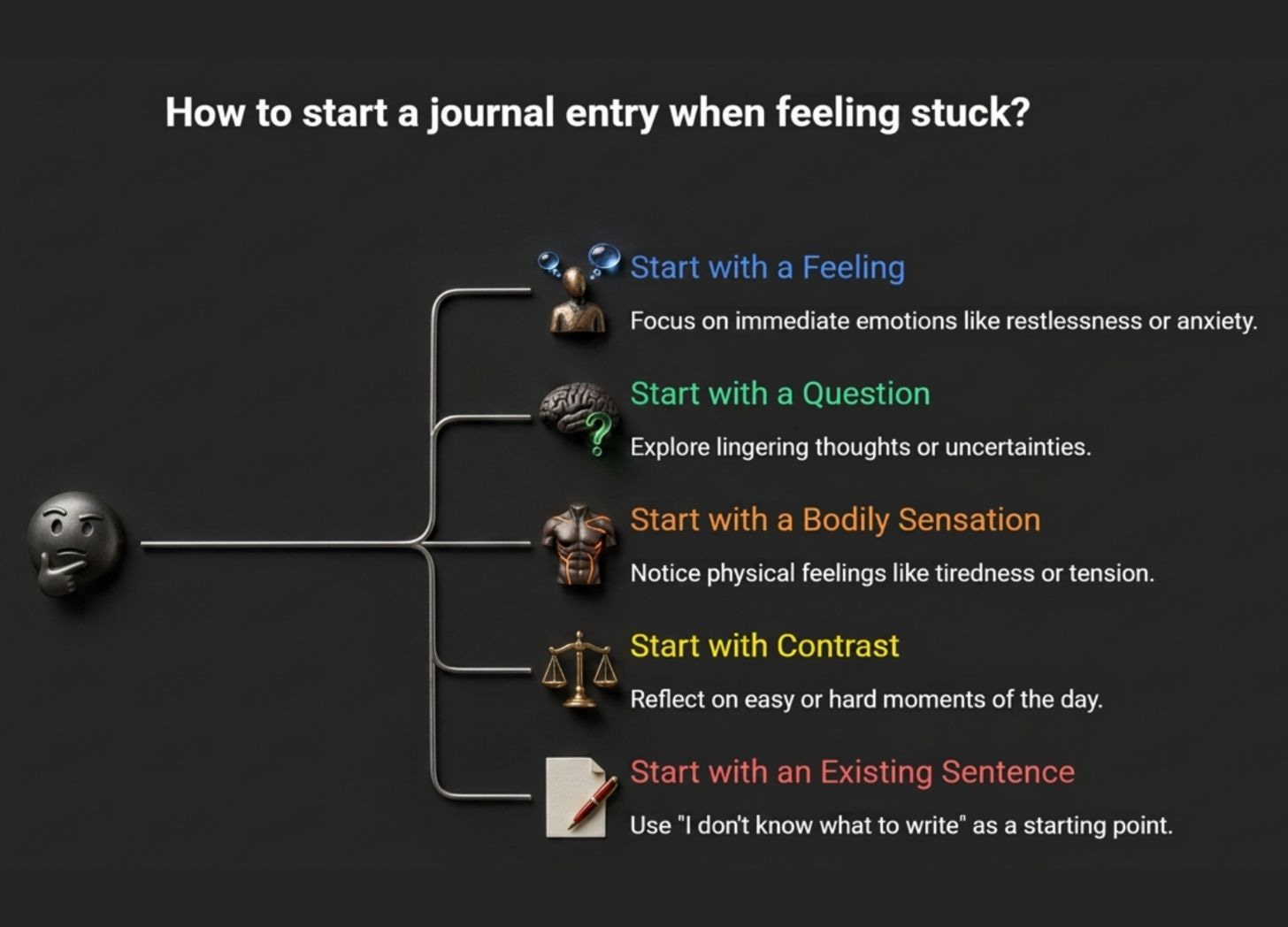
A common scenario with journaling, particularly when you’re just starting is that you know you want to write something, but nothing seems important enough to begin with. The mind suddenly goes blank, or everything feels too vague, too ordinary, or too tangled to put into words.
A useful way around this is to stop looking for the right subject and begin with what’s most available.
That might be a feeling. “I’m restless today.” It might be a question. “Why can’t I get that conversation out of my head?” It might be a repeated thought. “I keep worrying that I’ve forgotten something.” It might be a small irritation, a decision you’re avoiding, a moment you keep replaying, or something you noticed but haven’t made sense of yet.
You can also begin with bodily sensations. Tiredness, tension, heaviness, restlessness, or a knot in the stomach can all be starting points. Not because every physical sensation needs deep interpretation, but because the body often notices strain before the mind has found language for it.
Another simple starting point is contrast. What felt easier today than expected? What felt harder? What gave you energy? What drained it? What did you say yes to when you wanted to say no? What did you avoid, and what did that avoidance protect you from?
These questions work because they don’t require a dramatic event. They ask you to notice the shape of an ordinary day.
You can also write from the sentence you already have. “I don’t know what to write” is a perfectly valid beginning. Follow it for a few lines. You may discover that you don’t know what to write because you’re tired, because something feels too private, because you’re censoring yourself, or because the real subject hasn’t quite come into focus yet.
The aim isn’t to find the perfect topic. It’s to give attention somewhere to begin.
A journal entry can start with a mood, a memory, a problem, a question, a sentence you overheard, a small moment of embarrassment, a decision you’re postponing, or the simple fact that the day felt heavier than expected.
Most journaling entries don’t begin with insight. They begin with noticing.
Once journaling becomes a little more familiar, it can help to think about what you want the writing to do.
Different kinds of journaling suit different needs. That doesn’t mean you have to choose one method forever. It simply means that the form of writing should fit the issue you’re bringing to the page.
If you’re carrying something emotionally difficult, expressive writing may be the closest fit. This is the kind of writing discussed earlier. It gives you time to explore what happened, what you felt, and what the experience may have meant. It’s usually deeper and more emotionally demanding than everyday journaling, so it needs to be used with care.
If your main problem is mental clutter, a list-based journal may be more useful. That could mean a simple to-do list, a bullet journal, or a page where you write down everything competing for your attention. The aim isn’t emotional depth. It’s to stop holding every task, worry, and reminder in your head at once.
If you’re trying to understand patterns, a reflective journal may be a better fit. This kind of writing often looks back over a day, a conversation, a reaction, or a decision and asks what can be noticed from it. You might begin to see that certain situations leave you tense, certain people bring out a particular response, or certain worries return when you’re tired or under pressure.
If you want to track mood, sleep, habits, pain, energy, or symptoms, a tracking journal can be useful. This kind of journaling doesn’t need long entries. A few words, numbers, or short notes may be enough. Over time, the value is in the pattern rather than any single entry.
If you’re trying to shift attention toward what’s good, meaningful, or easy to miss, gratitude journaling may fit. This doesn’t have to mean forcing yourself to feel grateful when you don’t. It can simply mean noticing small things that might otherwise pass without attention. A kind message. A quiet hour. A meal you enjoyed. Something that made the day slightly easier.
If you’re trying to challenge a harsh or anxious thought, a thought record may be more useful than free writing. This is usually more structured. You write down the situation, the thought, the feeling, and a more balanced way of looking at it. For some people, that structure helps prevent journaling from becoming rumination.
There are also looser forms of journaling, such as morning pages, sketch journals, reading journals, travel journals, or notebooks that mix lists, memories, ideas, quotes, and observations. These may not fit neatly into a psychological category, but they can still serve a useful purpose. They give attention somewhere to collect.
The best type of journaling isn’t the one that sounds most impressive. It’s the one that fits what you need today.
Some days that may mean writing through a difficult feeling. Some days it may mean making a list. Some days it may mean noticing one good thing before bed. Some days it may mean writing nothing at all and returning tomorrow.
A journal doesn’t need one fixed identity. It can be a place for processing, planning, noticing, remembering, questioning, or simply clearing a little space in your mind.
It can be hard to begin journaling if you believe that a journal entry should look thoughtful, complete, or well written.
Most useful entries don’t need to be like that. They can be short, plain, uneven, and unfinished. In fact, many journal entries are useful because they catch a thought before it has been tidied up for anyone else.
A very simple entry might look like this.
“I felt off today and couldn’t quite work out why. I think part of it was that message I didn’t reply to. I kept thinking about it while trying to do other things. I don’t know if I’m avoiding the reply because I’m busy or because I don’t want the conversation to continue.”
That entry isn’t dramatic. It doesn’t solve the problem. But it does make the problem easier to see. A vague mood now has a few possible explanations.
A list-based entry might look different.
“Things taking up space in my head.
Reply to email.
Book dentist appointment.
Pay insurance bill.
Sort out travel dates.
Stop putting off awkward message.
Check if I’m tired or actually annoyed.”
This kind of entry doesn’t need emotional depth to be useful. Its value is in getting loose thoughts out of working memory and onto the page.
A reflective entry might be a little more exploratory.
“I noticed I was tense after that conversation. I don’t think anything terrible happened, but I felt as if I had to defend myself. Maybe I was reacting more to the tone than the actual words. I’m not sure yet, but it might explain why I kept replaying it afterwards.”
This entry is still cautious. It doesn’t rush to a conclusion. It simply opens up the possibility that the first interpretation may not be the whole story.
A more structured entry might begin with a thought and then ask for a more balanced version.
“Situation. I sent a message and didn’t get a reply.
First thought. I’ve annoyed them.
Feeling. Anxious and embarrassed.
Other possibilities. They may be busy. They may not have seen it. They may not think it needs a reply.
More balanced thought. I don’t know what their silence means yet.”
That kind of structure can be helpful when free writing keeps turning into rumination. It gives the entry a shape, and that shape can slow down the jump from event to conclusion.
None of these examples is the correct way to journal. They simply show that journaling can be ordinary. It can be a paragraph, a list, a question, or a few lines that don’t yet know where they’re going.
A journal entry doesn’t need to arrive at insight. Sometimes it just needs to make your thoughts feel less tangled than they did before you started.
It’s harder to be spontaneous and truthful in a journal if part of you is worrying about who might read it.
That doesn’t mean every journal has to be secret. Some people like keeping entries they may one day reread. Some people write with the faint possibility that someone else might read their words in the future. Others need to know that what they write will never be seen by anyone.
The important question is not whether the journal is kept, destroyed, handwritten, typed, locked away, or deleted. The important question is whether the format lets you be honest.
If you worry that someone might read what you’ve written, you may start censoring the entry. You may soften a thought before it’s fully formed. You may explain yourself to an imagined reader. You may leave out the ugliest feeling, the embarrassing worry, or the sentence that feels disloyal even though it’s true in the moment.
That kind of self-censorship is understandable. Most of us are used to adjusting what we say depending on who might hear it. But journaling sometimes needs a different kind of permission. It needs enough privacy for first thoughts to appear in writing before self-conscious ideas of politeness, fairness, or emotional tidiness start shaping them.
The first version may not be the fairest version. It may not be the version you would want to stand by later. But it can still be useful because it shows what you were genuinely thinking and feeling in the moment.
This is why the practical details matter. A notebook left open on a desk may not feel private. A password-protected document may feel safer. A notes app may work for one person and feel too exposed for another. Some people keep their journals for years. Others write something down and tear it up afterwards. For some people, deleting the entry is what makes honesty possible.
There’s no single correct choice. Keeping entries can help you notice patterns over time. Destroying entries can make the act of writing feel freer. Writing in fragments can be enough if full sentences feel too exposed.
The safest format is the one that lets you write without performing for an audience.
Many people begin journaling with good intentions and then stop.
That doesn’t necessarily mean the practice was wrong for them. It may mean that the version of journaling they started with just became too much effort to continue with.
One reason this happens is that journaling starts to feel like homework. The entry has to be meaningful. The notebook has to be kept up to date. Missed days start to feel like failure. Before long, the journal becomes another thing you’re behind on.
That can make the whole practice feel heavier than it needs to be. A missed day, week or month, is just a missed day, week or month. You can return without catching up, explaining yourself, or writing a long entry about why you stopped.
People sometimes stop because they expect too much from each entry. If journaling is supposed to produce insight every time, most entries will feel disappointing. Some days writing may help you understand something. Some days it may only show you that you’re tired, irritated, distracted, or still unsure. That can still be useful, but it may not feel satisfying in the moment.
Another reason people stop is that they choose a form of journaling that doesn’t fit what they need. Someone who feels overwhelmed by tasks may not need deep reflective writing. They may need a simple list. Someone who keeps spiralling into self-criticism may not need more unstructured venting. They may need a prompt that adds perspective. Someone who wants to notice patterns may need brief tracking rather than long entries.
Journaling can also become associated only with distress. If the notebook comes out only when life feels difficult, the practice may start to feel tough going emotionally before you’ve even written a word. For some people, it helps to include ordinary entries as well. Not every page has to begin with a problem.
There’s also the simple fact that life interrupts routines. People get busy. Work piles up. They lose interest. They forget. The journal gets put in a drawer and begins to feel like another abandoned good intention.
Once the gap is large enough, restarting may feel harder than starting. But a journal doesn’t keep score. It doesn’t know whether you wrote yesterday, last week, or six months ago.
The easiest way back is usually not to repair the whole habit. It’s to write one new entry and let that be enough.
The best way to keep journaling going is not to rely on motivation.
Motivation comes and goes. A busy day, a low mood, a late night, or a run of ordinary distractions can be enough to break the intention. This is why journaling is easier to continue when it has a clear place in the day.
That place does not need to be special. It only needs to be recognizable.
You might write after making coffee, after brushing your teeth, after closing your laptop, or just before turning out the light. The more specific the cue, the less the practice depends on remembering to feel like journaling.
Habit research supports this general idea. In a 2010 paper in the European Journal of Social Psychology, Phillippa Lally and colleagues asked people to repeat a chosen behavior in the same context each day. The study found that automaticity usually developed gradually, and that people varied widely in how long this took. The useful point for journaling is not that there is a magic number of days. It is that repeated behaviour in a stable context can make an action feel more automatic over time.
Journaling often fails when every entry requires a new decision. Should I write now? Where is the notebook? What should I write about? How long should I spend? Each question adds friction.
Reducing that friction can make the practice easier to return to. Keep the notebook somewhere easy to reach, but private enough that you still feel comfortable writing in it. Use a password-protected document if that feels safer. Use the same pen. Choose a similar time of day. Keep a short prompt nearby. Make the first step clear enough that you know exactly what to do when the time comes.
It can also help to choose a rhythm that fits your life. Daily journaling suits some people. For others, three times a week is more realistic. Some people write only when their mind feels crowded. Others use a short evening entry to close the day.
Streaks can be motivating, but they can also make journaling brittle. If the whole practice depends on never missing a day, one gap can make the habit feel broken. A more forgiving approach is to treat journaling as something you return to, not something you have to maintain perfectly.
A journal is easier to keep when it doesn’t demand the same kind of entry every time. Some days may call for reflection. Others may only need a list, a note, or a few observations from the day.
Journaling that can survive busy weeks, dull entries, uneven motivation, and gaps is more likely to become something you return to rather than something you feel you have failed to maintain.
If you want to try journaling but don’t want to invent a system from scratch, a short starter plan can help.
Think of this as testing the water rather than a fully fledged commitment. You don’t have to complete it perfectly. You don’t have to write at the same time every day. You don’t even have to like every prompt. The aim is simply to try a few different ways into the page and see which ones feel useful.
Day 1
Write down what’s currently taking up space in your mind.
This can be a list rather than a paragraph. Include tasks, worries, decisions, reminders, unfinished conversations, or anything you keep mentally returning to. Don’t organize it too much. Just get it out of your head and onto the page.
Day 2
Write about one moment from the day that stayed with you.
It doesn’t have to be important. It might be something someone said, a small irritation, a quiet moment, or a reaction you didn’t fully understand at the time. Write about what happened and why you think it stayed with you.
Day 3
Write from a feeling.
Begin with a simple sentence such as “I feel tired,” “I feel unsettled,” “I feel pleased,” or “I feel tense.” Then write a few lines about what may be connected to that feeling. You’re not trying to prove anything. You’re just giving the feeling a little more shape.
Day 4
Write a practical entry.
Make a list of what needs your attention. Then mark anything that can wait, anything that needs action, and anything that is simply occupying mental space. This kind of entry can be useful when reflection feels like too much.
Day 5
Write about something you handled better than you might have noticed.
This doesn’t need to be a major achievement. It might be a difficult conversation you got through, a task you finally started, a moment when you paused instead of reacting, or a small decision that made the day easier. The point isn’t to praise yourself artificially. It’s to notice something that might otherwise be missed.
Day 6
Write about a recurring thought.
Choose one thought that has been showing up more than once. Write it down plainly. Then ask what tends to trigger it, what it makes you feel, and whether there’s another way to understand it. If the writing starts to turn into self-criticism, add a little structure. What is the thought? What is the evidence? What else might be true?
Day 7
Write about the week of journaling itself.
Which kind of entry felt easiest? Which felt most useful? Which felt forced? Did writing help you notice anything, settle anything, or simply make your thoughts feel less tangled? You may decide to keep journaling daily, write only when you need it, or use one kind of entry more than the others.
The point of a starter plan is not to turn journaling into another obligation. It’s to give you enough structure to begin, and enough freedom to find your own way of using it.
Do I have to journal every day?
No. Daily journaling suits some people, but it’s not required. For some, writing a few times a week is more realistic. For others, journaling works best when there’s something specific to think through. Consistency can help, but the practice doesn’t have to become another rule to follow.
Is it better to write by hand or type?
Neither is automatically better. Handwriting can slow the process down, which some people find useful. Typing can be easier if your thoughts move quickly or handwriting feels tiring. The better choice is the one that makes you more likely to write and more able to be truthful with yourself.
How long should a journal entry be?
Long enough to be useful, but not so long that it becomes a burden. Some entries may be a few paragraphs. Others may be a list, a sentence, or a note you only partly finish. The length of the journal entry matters far less than whether the entry helps you notice, organize, or express something.
Should I keep old journal entries?
That depends on what helps you write most freely. Keeping entries can help you see patterns over time. Deleting or destroying entries can make writing feel safer and less self-conscious. The right choice is the one that lets you use the journal without holding too much back.
What if journaling makes me feel worse?
Stop, or change the way you’re writing. Feeling thoughtful, sad, or unsettled for a short time isn’t always a problem, especially when writing about difficult material. But if journaling leaves you feeling overwhelmed, panicky, trapped in the same thought, or unable to settle afterwards, it may need more structure or support from another person.
Does journaling have to be positive?
No. Journaling doesn’t have to be cheerful, grateful, or optimistic. It can include frustration, confusion, anger, sadness, boredom, or uncertainty. The aim is not to force a better mood. It’s to give your experience enough language that you can look at it more clearly.
Can journaling replace therapy?
No. Journaling can support reflection, emotional processing, and self-understanding, but it is not the same as therapy. If you are dealing with trauma, persistent distress, severe anxiety, depression, or mental illness, journaling should not be your only source of support.
What if I stop journaling for a while?
Then you stopped for a while. You can return with one entry, one sentence, one list, or one question.
What is the simplest way to begin?
Write one thing that is currently on your mind. Not the most important thing. Not the deepest thing. Just the thing that is easiest to notice. That’s enough to begin.
Have you ever tried journaling? If so, what was the experience like, and what made you continue or stop?

For many psychologists and mental health practitioners, the work surrounding therapy takes up a huge amount of time, attention, and energy.
The therapy itself is only part of the job. Around it sit session notes, scheduling, billing, reports, assessments, treatment plans, telehealth, client resources, and the constant challenge of keeping track of what matters across a growing caseload.
That’s the problem Ecko Health solves.
The aim isn’t to replace clinicians with AI. Ecko reduces admin burden, supports clinicians, and strengthens rather than replaces therapeutic expertise, professional judgment, and human care.
Ecko’s Clinical Twin supports continuity of care between sessions while keeping the clinician firmly in control.
✓ Guided by your treatment plan
✓ Your voice, your approach, amplified
✓ Forever free tier
✓ No credit card required
The All About Psychology Substack is your go-to source for all things psychology. Subscribe today and instantly receive my bestselling Psychology Student Guide right in your inbox.
Upgrade to a paid subscription and as an extra thank you, you’ll also get the eBook version of my book Psychology Q & A: Great Answers to Fascinating Psychology Questions.
Why Upgrade to Paid?
Every penny of paid subscriber support goes directly towards hosting and running costs, helping keep All-About-Psychology.com free for everyone.
Your support ensures that:
Students and educators can continue to access the most important and influential journal articles in the history of psychology, completely free.
Readers everywhere can hear directly from world-renowned psychologists, authors and leading experts in the field.
High-quality free content for students, educators, and the general public continues to be created and shared on a regular basis.

I’m David Webb, a psychology educator and author who has spent over twenty-five years helping people make sense of why we think, feel, and behave the way we do.
I founded the All About Psychology website in 2008 and have been building it ever since as a place where students, educators, and curious minds can explore the many branches of psychology, learn about the field’s history and most influential pioneers, and access thousands of full-text journal articles and other quality psychology materials. Today the site is home to one of the largest and most engaged independent psychology communities online. This Substack is the latest addition to the All About Psychology platform.
My books, including Why We Are The Way We Are, are written for anyone interested in what makes us tick.
You can explore more of my work and books on my Amazon author page.
Comments
Nothing yet. Say the first thing.
Sign in to join the conversation.