

Sometimes we know that a choice we’re about to make is likely to work against us, but make it anyway. The difficult conversation avoided, the plan set aside, the opportunity left until it’s gone.
Self-defeating behavior is the term for this. It describes a recurring pattern of thoughts, feelings, or actions that work against a person’s own goals or wellbeing. It isn’t an isolated mistake, but a tendency that repeats.
This article looks at what self-defeating behavior is, how it differs from self-sabotage and self-destructive behavior, where it can show up in everyday life, how to recognize the pattern, and practical steps that may help interrupt it.
Not wanting to fail, but failing anyway
The important question is why a response that works against the person’s own interests can keep returning.
Baumeister and Scher’s 1988 review in Psychological Bulletin examined self-defeating behavior across normal, non-clinical populations and found no clear evidence for primary self-destruction, the idea that people are driven by a genuine desire to suffer or fail. The evidence, they concluded, doesn’t support that picture.
In their review, Baumeister and Scher described two more useful ways of understanding these patterns. The first is a tradeoff, where a person accepts a longer-term cost in exchange for a short-term benefit, such as the relief of stepping away from an uncomfortable situation. The second is a counterproductive strategy, where a person is genuinely trying to reach a positive goal but is using an approach that interferes with reaching it. In both cases, the intent is not to fail.
What this framework offers is a way of asking not whether a person wanted to undermine themselves, but how the pattern of responding to a situation produced that result.
Self-defeating behavior, self-sabotage, and self-destructive behavior
These three terms are related, but they do not mean exactly the same thing.
The APA Dictionary of Psychology defines self-defeating behavior as repetitive actions that invite failure or misfortune and prevent a person from attaining goals or fulfilling desires.
The term most often confused with self-defeating behavior is self-sabotage.
Psychology Today’s overview of self-sabotage describes it as behavior that creates problems in daily life and interferes with long-standing goals. A useful way to separate it from the broader idea of self-defeating behavior is to think of self-sabotage as more focused on undermining a specific goal, plan, opportunity, or relationship.
Self-destructive behavior is a stronger term. The APA Dictionary of Psychology defines self-destructiveness as actions that are damaging and not in a person’s best interests, which may be repetitive and resistant to change. Where self-defeating behavior typically involves patterns that block goals, self-destructive behavior causes direct harm to a person’s physical or psychological wellbeing.
For the purposes of this article, the focus is on self-defeating behavior and the patterns that keep people from reaching what they are genuinely trying to achieve.
Common examples of self-defeating behavior
The examples below follow the same basic pattern. Each one shows what the behavior gives the person in the short term and what it costs later. Research by Sirois and Pychyl links procrastination with short-term mood repair, which helps explain why putting something off can bring immediate relief even when it creates problems later.
Relationships
Situation: A relationship is becoming more serious and emotionally close.
Self-defeating behavior: Canceling plans repeatedly or responding to messages less and less.
Short-term payoff: The person gets temporary relief from the pressure of closeness, expectation, or emotional availability.
Longer-term cost: The other person may start to lose trust, and the connection can weaken.
Situation: A disagreement comes up with a partner or close friend.
Self-defeating behavior: Agreeing in the moment to end the discussion, while the real concern stays unspoken.
Short-term payoff: The person avoids the discomfort of continuing the disagreement.
Longer-term cost: The issue remains unresolved, and the disagreement may be harder to resolve later.
Work
Situation: An important piece of work is due.
Self-defeating behavior: Spending time on smaller, easier tasks instead of the main deliverable.
Short-term payoff: The person gets the satisfaction of completing something while avoiding the harder task.
Longer-term cost: The main deliverable may suffer, and the deadline may become harder to meet.
Situation: A person disagrees with a decision made by their manager.
Self-defeating behavior: Saying nothing directly but expressing frustration to colleagues instead.
Short-term payoff: The person gets to express frustration without the discomfort of raising the concern directly.
Longer-term cost: The manager doesn’t hear the concern, and the same problem may continue.
Goals and habits
Situation: A person has been working steadily toward a personal goal, such as learning a new skill.
Self-defeating behavior: Stopping entirely after one poor session or result, rather than continuing.
Short-term payoff: The person avoids the discomfort of trying again after a disappointing result.
Longer-term cost: Progress may slow, and the goal may become harder to return to.
Situation: A task feels tedious or uncomfortable to start.
Self-defeating behavior: Putting it off in favor of something more immediately comfortable.
Short-term payoff: The person gets temporary relief from the boredom, effort, or discomfort of starting.
Longer-term cost: The task can become more demanding as time passes and the deadline draws closer.
Academic contexts
Situation: An exam or major assignment is approaching.
Self-defeating behavior: Avoiding studying until the last possible moment.
Short-term payoff: The student gets temporary relief from the discomfort of starting.
Longer-term cost: Performance may suffer, and the student has less time to understand the material properly.
Situation: A student receives critical feedback on their work.
Self-defeating behavior: Setting the feedback aside without reading it carefully.
Short-term payoff: The student avoids the discomfort of reading criticism in the moment.
Longer-term cost: The same errors may recur in future work.
Signs you may be stuck in a self-defeating pattern
The reflection points below are not a diagnostic tool. They are simply prompts for noticing whether certain patterns may be recurring.
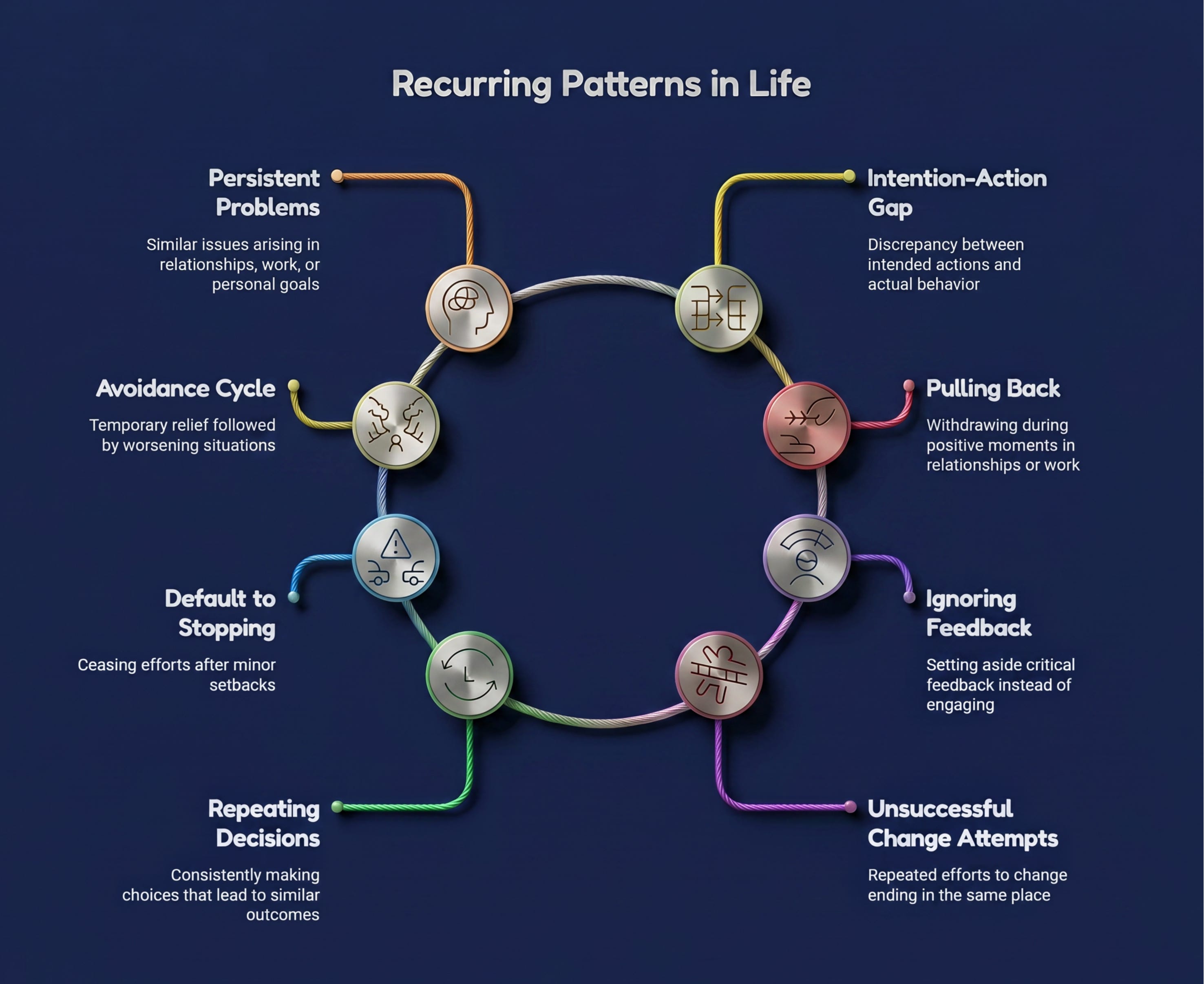
Similar problems keep coming up in the same area of life, whether in relationships, work, or personal goals, and the pattern persists across different circumstances.
There is a consistent gap between what you intend to do and what you actually do, and it tends to appear in the same kinds of situations.
Avoiding something brings relief in the moment, but the avoidance tends to make the situation harder to deal with later.
When things are going well in a relationship or at work, you notice a pattern of pulling back, delaying replies, avoiding follow-up, or becoming harder to reach.
After a setback, the default response is to stop rather than continue, even when the setback is relatively minor.
Critical feedback or a difficult response tends to get set aside rather than engaged with, and the pattern repeats across different situations.
Looking back over a period of months or years, the same kinds of decisions keep producing the same kinds of outcomes.
There is an area of life where change has been attempted more than once, and each attempt has ended in roughly the same place.
Why people engage in self-defeating behavior
The more useful question is not why a person would choose to undermine themselves, but why a pattern that produces poor outcomes keeps going once it has started.
Part of the answer lies in timing. As Baumeister and Scher’s review established, much self-defeating behavior can be understood as a tradeoff between a short-term benefit that’s immediate and concrete, and a longer-term cost that’s delayed. Stepping away from an uncomfortable situation produces relief now. The consequences arrive later. That timing helps explain why the same response can keep being chosen.
This is one reason why simply knowing that a pattern is self-defeating is rarely enough to stop it. The knowledge of the future cost doesn’t change the immediacy of the present relief. The pattern continues because the conditions that produced it, a real short-term benefit and a deferred cost, remain in place.
Research by Sirois and Pychyl offers a well-evidenced illustration of this mechanism. Their work on procrastination found that avoiding a task tends to function as a form of mood repair. The discomfort of starting is temporarily reduced, while the task and its consequences are pushed further into the future. The behavior isn’t driven by laziness or indifference to the outcome. It’s driven by the reliable effectiveness of avoidance as a short-term emotional strategy, even when the likely outcome is predictable.
The second pattern Baumeister and Scher identified, the counterproductive strategy, works somewhat differently. Here the person isn’t trading a short-term benefit for a longer-term cost. They’re pursuing a genuine goal using an approach that interferes with reaching it. This kind of pattern can be harder to recognize, because the intent is clearly positive and the effort may be real. What goes unexamined is the strategy itself. The pattern continues not because the short-term relief is appealing, but because the connection between the approach being used and the outcome being produced isn’t yet visible.
The research used in this article supports a narrower point. These patterns can persist because immediate relief is easier to respond to than a future cost.
How to stop self-defeating behavior
The research covered in this article points toward a few practical directions, rather than a single guaranteed method.
Notice the pattern before the payoff arrives
Baumeister and Scher’s framework suggests that the useful place to look isn’t only the outcome, but the moment just before the familiar response kicks in.
That means getting to know the situations that tend to produce the pattern. Not in an abstract sense, but in practical terms. What kind of task, conversation, or situation tends to be followed by a familiar avoidance or counterproductive response? Naming that sequence doesn’t stop it immediately, but it does make the pattern visible in a way that creates the possibility of a different response.
Recognize avoidance as mood repair, not a discipline problem
One of the more useful findings from Sirois and Pychyl’s research on procrastination is that avoidance tends to function as short-term mood repair. Avoidance doesn’t necessarily mean the task is unimportant. It may be avoided because starting brings discomfort that’s easier to postpone.
Recognizing this can change how a person relates to avoidance when it happens. Instead of treating it as a character flaw, it becomes possible to ask a more specific question: what’s uncomfortable about starting this, and is there a smaller version of the first step that’s less easy to avoid?
Be careful with self-criticism
Sirois’s 2014 study in Self and Identity found that across four samples, trait procrastination was associated with lower self-compassion and higher stress. The relationship is associative rather than causal, but the finding does suggest that self-compassion and procrastination tend to move in opposite directions.
This doesn’t mean self-compassion is a solution to self-defeating behavior. But it does suggest that responding to a self-defeating pattern with harsh self-criticism may not help, given that lower self-compassion tends to accompany the pattern rather than interrupt it.
Work through one example
To make this more concrete, choose one recent situation where your response worked against your own goal or longer-term interest.
Then consider:
What was the situation, and what did you do?
What did that response give you in the short term?
What did it cost you later?
Was there a point where another response was possible? What made that harder in the moment?
Is this a pattern you’ve noticed before, in this area of life or another?
What would a smaller, more manageable first step look like next time?
When to seek professional help
The practical directions in this article are a starting point, not a complete solution. For some people, self-defeating patterns are occasional and relatively easy to notice once the underlying mechanism is clear. For others, the patterns are more persistent, show up across several areas of life, or keep returning despite genuine efforts to change them.
If that’s the case, working with a therapist or counselor can offer more structured support than self-directed reading. It can provide space to examine the pattern in more detail, with support that’s tailored to the specific situation rather than general principles.
That doesn’t mean professional support is necessary for everyone who recognizes self-defeating patterns in themselves. For some people, understanding the mechanism may be enough to start making different choices. But if the patterns are causing ongoing problems in daily life, or if self-directed approaches haven’t been enough, professional support is a practical option rather than a sign that something has gone seriously wrong.
Final thoughts
Self-defeating behavior is easy to judge from the outside. It’s harder to understand when you’re in the middle of it.
The point isn’t to excuse the pattern or pretend the consequences don’t matter. It’s to look at the pattern clearly enough to see what it’s doing, what it’s costing, and where a different response might begin.
Have you noticed a self-defeating pattern in your own life, or seen one play out in someone else’s? I’d be interested to hear your thoughts in the comments.

Keep learning with All About Psychology
The All About Psychology Substack is your go-to source for all things psychology. Subscribe today and instantly receive my bestselling Psychology Student Guide right in your inbox.
Upgrade to a paid subscription and as an extra thank you, you’ll also get the eBook version of my book Psychology Q & A: Great Answers to Fascinating Psychology Questions.
Why Upgrade to Paid?
Every penny of paid subscriber support goes directly towards hosting and running costs, helping keep All-About-Psychology.com free for everyone.
Your support ensures that:
Students and educators can continue to access the most important and influential journal articles in the history of psychology, completely free.
Readers everywhere can hear directly from world-renowned psychologists, authors and leading experts in the field.
High-quality free content for students, educators, and the general public continues to be created and shared on a regular basis.
About me

I’m David Webb, a psychology educator and author who has spent over twenty-five years helping people make sense of why we think, feel, and behave the way we do.
I founded the All About Psychology website in 2008 and have been building it ever since as a place where students, educators, and curious readers can explore the many branches of psychology, learn about the field’s history and most influential pioneers, and access thousands of full-text journal articles and other quality psychology materials. Today the site is home to one of the largest and most engaged independent psychology communities online. This Substack is the latest addition to the All About Psychology platform.
My books, including Why We Are The Way We Are, are written for anyone interested in what makes us tick.
You can explore more of my work and books on my Amazon author page.
Comments
Nothing yet. Say the first thing.
Sign in to join the conversation.