
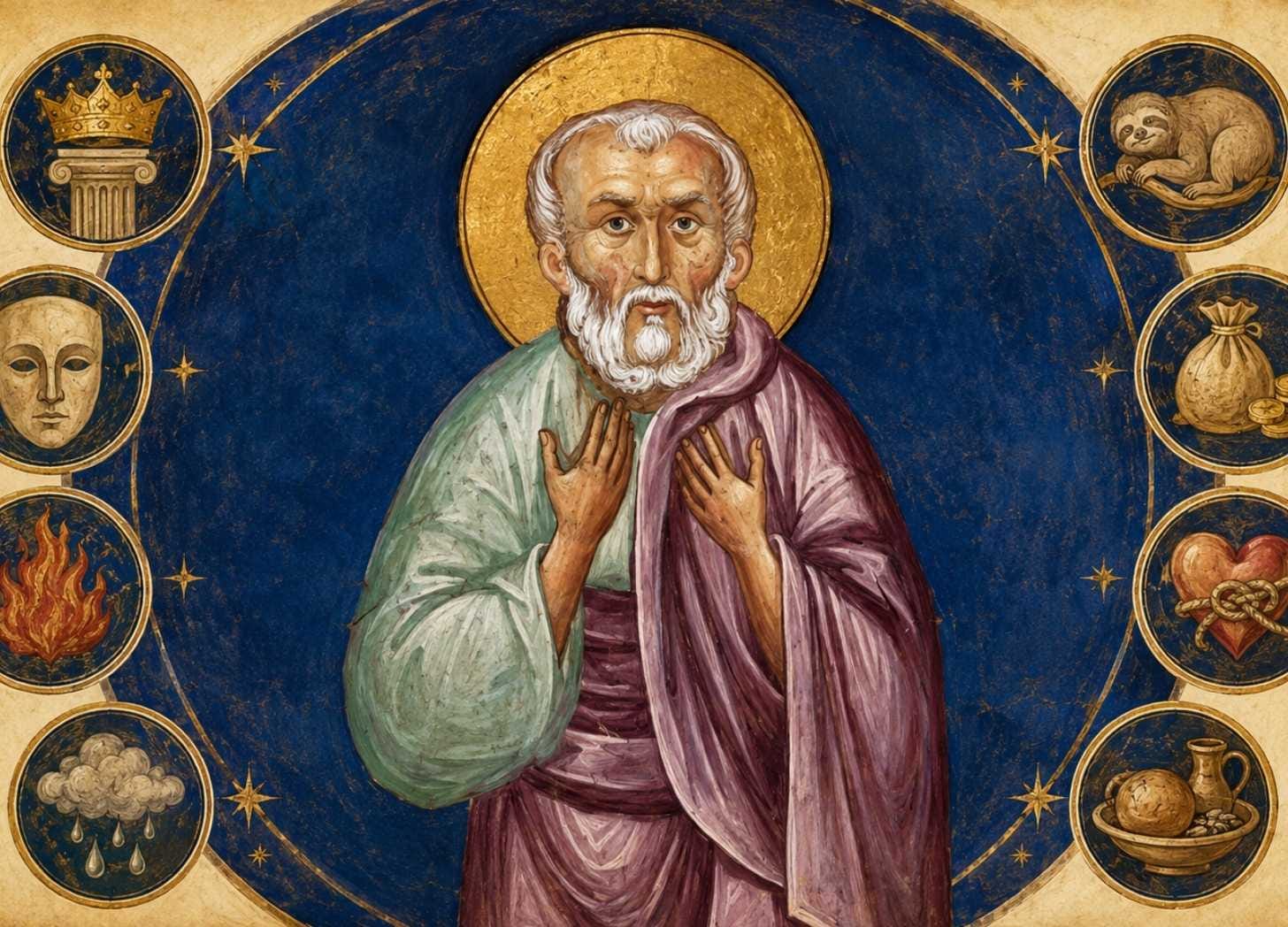
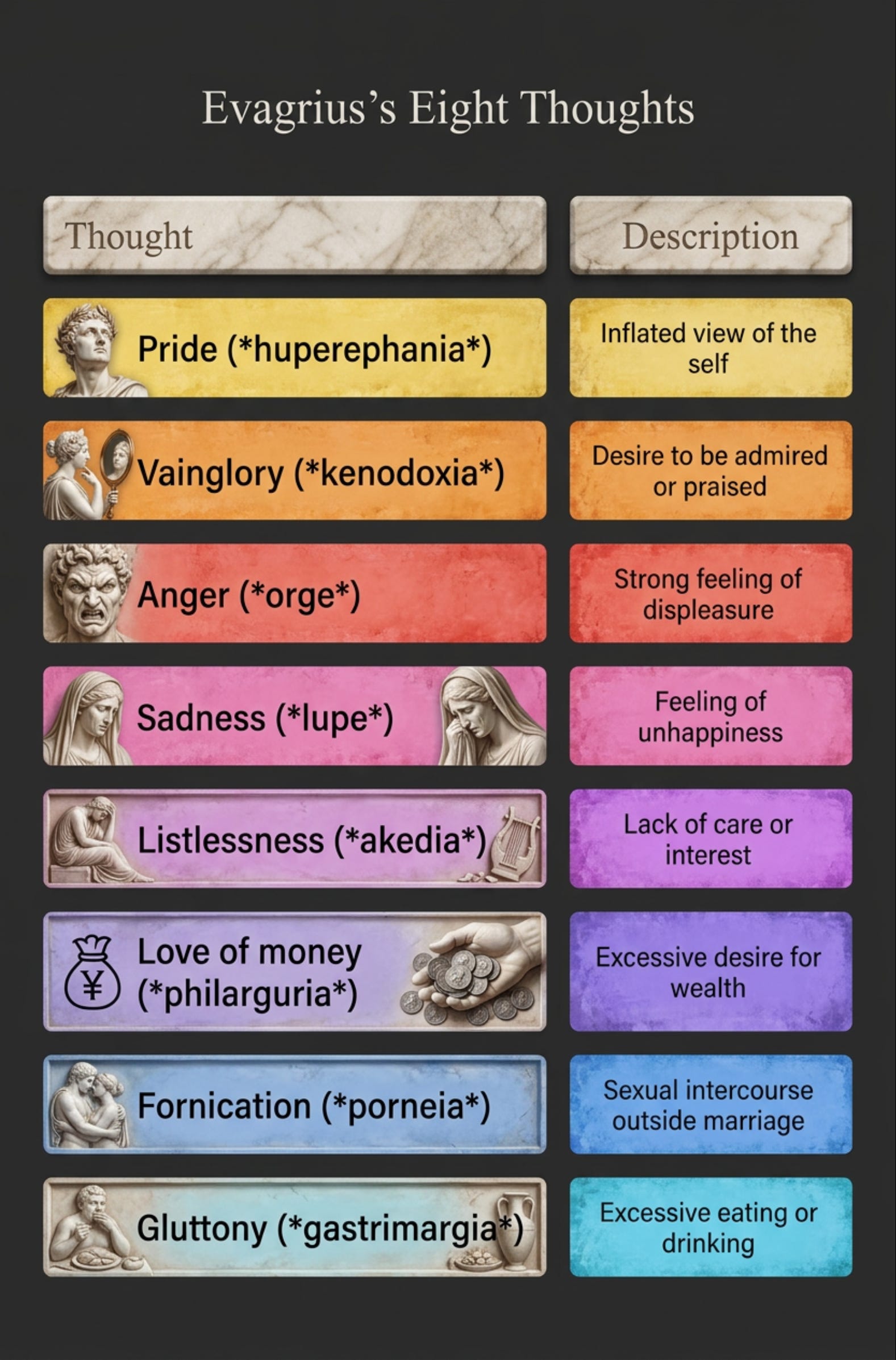
While listening to an episode of Dan Snow’s History Hit Podcast, I was fascinated to learn that, contrary to popular belief, the seven deadly sins didn’t originate in the Bible. They developed from ideas found in the writings of the fourth-century monk Evagrius Ponticus (345–399 AD), also known as Evagrius the Solitary. In an attempt to make sense of the impulses, habits, and emotional reactions that shape behavior, including his own, Evagrius pointed to eight specific thoughts:
pride, (huperephania)
vainglory, (kenodoxia)
anger (orge)
sadness (lupe)
listlessness or lack of care (akedia)
love of money (philarguria)
fornication (porneia)
gluttony (gastrimargia)
This list would eventually become the seven deadly sins. One important difference is that Evagrius treated pride and vainglory as separate thoughts. Pride referred more to an inflated sense of self, while vainglory referred more to the desire for that self to be admired by others.
From a psychological perspective, Evagrius’s original and more expansive list is useful because it captures a wider range of human experience. It includes obvious appetites and desires, but also sadness, lack of care, the wish to be admired, and the pull of self-importance.
According to Evagrius, these thoughts can be noticed before they are acted upon. They give us a chance to pause and ask ourselves what is happening.
It is not in our power to determine whether we are disturbed by these thoughts, but it is up to us to decide if they are to linger within us or not and whether or not they are to stir up our passions.
At the time, Evagrius was writing mainly for his fellow monks and he encouraged them to pay close attention to their own experience and to examine where their most difficult thoughts seemed to come from.
If there is any monk who wishes to take the measure of some of the more fierce demons so as to gain experience in his monastic art, then let him keep watch over his thoughts. Let him observe their intensity, their periods of decline, and follow them as they rise and fall. Let him note well the complexity of his thoughts, their periodicity, and the demons, which cause them, with the order of their succession and the nature of their associations.
His approach was partly strategic and partly introspective. If a thought was powerful enough to disturb the mind, it needed to be understood before it could be resisted.
One reason Evagrius’s list remains interesting is that it gives shape to experiences that can otherwise feel vague or confusing.
A person may feel irritated, restless, unhappy, defensive, or pulled toward something they know is unhelpful without immediately understanding what is going on. Being aware of this may not solve the problem, but it can create a small gap between the feeling and the response.
The more I read about Evagrius, the more I’m struck by how contemporary his thinking was and how the basic idea it promoted still feels relevant today. Emotions may arise, but we do not have to respond automatically. A reaction may begin to form, but there still exists an opportunity to decide what happens next.
This intellectual pause is captured in a well-known line often attributed to Viktor Frankl:
Between stimulus and response lies a space. In that space lie our freedom and power to choose a response. In our response lies our growth and our happiness.
The exact source of the quotation is disputed, but the point it expresses holds up. The gap between what we feel and what we do is where self-reflection becomes possible.
Evagrius was not using the language of modern psychology, mindfulness, or cognitive behavioral therapy. But he was interested in something that remains central to all three: the ability to observe an inner event without immediately being ruled by it.
Mindfulness practices often begin with learning to notice thoughts and feelings without acting on them straight away. Cognitive behavioral therapy also asks people to identify triggers, examine automatic reactions, and consider different ways of responding.
The language has changed, but the central question is still recognizable: when a thought or feeling appears, do we have to follow it, or can we pause long enough to choose a different response?
Evagrius’s work also echoes an older way of thinking. His ideal of apatheia, a state in which the mind is not ruled by destructive emotions, has clear links with Stoic philosophy, especially the Stoic emphasis on distinguishing what lies within our control from what does not.
One of the most useful parts of Evagrius’s framework is that it does not require us to treat ordinary human impulses as strange or shameful.
Anger, desire, appetite, sadness, ambition, and the wish to be valued are all part of being human. A person without any pride may struggle to speak up for themselves. A person without anger may fail to respond when something is wrong. A person without desire risks cutting themselves off from much of what gives life meaning.
The problem begins when these tendencies lose proportion.
Pride can become a refusal to listen. Anger can become a need to be right. Desire can become a failure to see the whole person. Sadness can become withdrawal. The wish to be admired can become dependence on approval.
Seen this way, the eight thoughts are not useful because they divide people into good and bad. They are useful because they help us consider when a normal human tendency begins to work against us and point to the difference between having an impulse and being governed by it.
If I had to choose the most interesting of Evagrius’s eight thoughts, I’d go for akedia, which later became associated with sloth in the seven deadly sins, because it was far more psychologically nuanced.
In everyday use, sloth usually means laziness, which makes it sound like a failure of effort. The assumption is that the slothful person does not care enough, try hard enough, or have enough discipline.
But akedia points to something more complex. It refers to listlessness, restlessness, and a loss of connection with what once mattered. It’s not simply doing nothing. It’s finding it hard to engage with things that used to feel meaningful.
Calling someone lazy often ends the conversation. It turns a state of struggle into a character flaw. Akedia asks a better question, what’s happened to this person’s capacity to care?
This older concept still has relevance today. It overlaps with experiences we might now discuss in relation to burnout, low mood, emotional exhaustion, or loss of direction. It shouldn’t be treated as identical to any one of those conditions, but it gives us a useful way of thinking about them.
What I love about Evagrius’s eight thoughts is that they are not presented as fixed labels or final judgments on character.
Whereas the seven deadly sins act as a moral warning against the dangers of pride, greed, lust, envy, gluttony, wrath, and sloth, Evagrius’s eight thoughts provide something practical. They give us a way of noticing what is happening within us before it hardens into action, habit, or identity.
The language of sin can easily become prescriptive. It can make a passing state feel like a permanent flaw. The language of thought and its sensations are flexible.
A thought can be noticed.
A feeling can be questioned.
An impulse can be understood before it is acted upon.
The point is not to ask, “What sort of sinner am I?”
It’s to ask, “What am I feeling, and where might it lead if I don’t pay attention?”
Following my recent interview with psychologist Rosie Chapple about AI in therapy, I’m delighted to share that Ecko Health is now a featured partner of All About Psychology.
I’m working with Ecko Health because the platform addresses one of the most important issues facing applied psychology and mental health practice: how can AI reduce pressure on clinicians without weakening the human relationship at the heart of therapy?
That’s the issue Rosie and I explored in our conversation: how AI can reduce admin burden, support clinicians, and strengthen rather than replace therapeutic expertise, professional judgment, and human care.
Learn more about Ecko Health here:
The All About Psychology Substack is your go-to source for all things psychology. Subscribe today and instantly receive my bestselling Psychology Student Guide right in your inbox.
Upgrade to a paid subscription and as an extra thank you, you’ll also get the eBook version of my book Psychology Q & A: Great Answers to Fascinating Psychology Questions.
Why Upgrade to Paid?
Every penny of paid subscriber support goes directly towards hosting and running costs, helping keep All-About-Psychology.com free for everyone.
Your support ensures that:
Students and educators can continue to access the most important and influential journal articles in the history of psychology, completely free.
Readers everywhere can hear directly from world-renowned psychologists, authors and leading experts in the field.
High-quality free content for students, educators, and the general public continues to be created and shared on a regular basis.

I’m David Webb, a psychology educator and author who has spent over twenty-five years helping people make sense of why we think, feel, and behave the way we do.
I founded the All About Psychology website in 2008 and have been building it ever since as a place where students, educators, and curious readers can explore the many branches of psychology, learn about the field’s history and most influential pioneers, and access thousands of full-text journal articles and other quality psychology materials. Today the site is home to one of the largest and most engaged independent psychology communities online. This Substack is the latest addition to the All About Psychology platform.
My books, including Why We Are The Way We Are, are written for anyone interested in what makes us tick.
You can explore more of my work and books on my Amazon author page.
Comments
Nothing yet. Say the first thing.
Sign in to join the conversation.