

As a postgraduate, I studied occupational psychology, also known as industrial-organizational (I-O) psychology. As a result, human behavior in the workplace is something that continues to interest me, particularly when it relates to ideas I haven’t encountered before. So when I came across the concept of bikeshedding, I decided to take a closer look.
Bikeshedding describes the human tendency to devote a disproportionate amount of time and energy to trivial matters instead of important, complex, or high-stakes issues.
It often happens in meetings. For example, a meeting agenda has two items. The first is important, a budget question, a hiring decision, a strategic call. The second is trivial, the wording of an out-of-office message, the date of the staff Christmas party. You’d expect the important item to take up more time, but it’s often the case that the more important item gets dealt with quickly while the trivial item ends up taking up most of the meeting.
I know from personal experience that bikeshedding happens outside meetings too. I’ll sit down to draft a client report, and somehow an hour later, all I’ve done is sort my inbox, answer two emails that weren’t urgent, and start browsing flights for a trip I can’t afford to take.
The term “bikeshedding” can be traced back to Cyril Northcote Parkinson, a British naval historian. His irreverent dictum that “Work expands to fill the time available for its completion,” which he referred to as the law of triviality, was illustrated by Parkinson in 1957 through the following scenario.
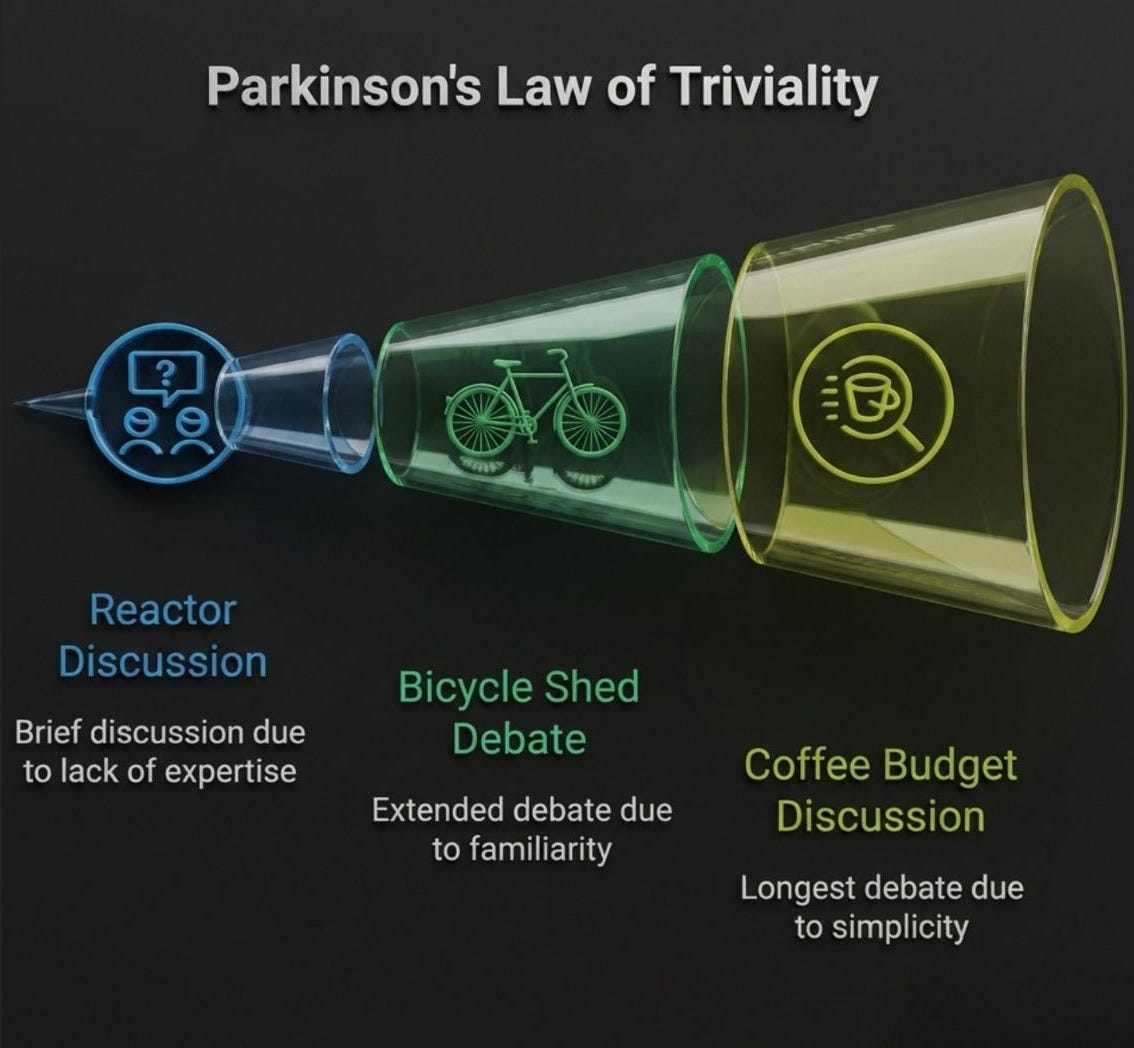
A finance committee sits down with three items on its agenda. The first is a $10,000,000 atomic reactor. The second is a $2,350 bicycle shed for the company staff. The third is the office coffee budget, $4.75 a month.
The reactor is discussed first. Of the eleven people at the table, four don’t know what a reactor is. Three more know what it is but not what it’s for. Only two have any sense of what it should cost. Just one person in the room, a man called Brickworth, actually understands nuclear reactors well enough to critique the plan. He could raise the technical objections, the cost questions, the safety concerns. He says nothing. The reactor is approved in two and a half minutes.
The bicycle shed is debated for forty-five minutes.
The coffee item is debated for an hour and a quarter.
Parkinson was being satirical, but the pattern he described was widely recognized and the phrase bikeshedding was born. (presumably because it rolls off the tongue more easily than coffeebudgeting!)
A useful explanation is cognitive fluency (or processing fluency), which is the ease or difficulty with which our brains process information. Research by Adam Alter and Daniel Oppenheimer in a 2009 review in Personality and Social Psychology Review showed that when information is easy to process, i.e., pronounceable, familiar, or simple, people typically judge it as more true, more valuable, and more worth their time. Among their findings, Alter and Oppenheimer noted that stocks with simpler-to-pronounce ticker names outperformed those with complex names by 11% on the first day of trading and 33% over the following year. Rhyming statements get rated as truer than non-rhyming statements with identical meaning, and doctors have been shown to favor diagnoses that are easier to pronounce.
When you apply the notion of cognitive fluency to Parkinson’s law of triviality, his bikeshedding example suddenly seems plausible. The bike shed debate is cognitively accessible and most people will feel comfortable commenting on it (likewise with the coffee budget). The atomic reactor is harder to think about, and forming a question about it requires technical knowledge. The cognitive fluency surrounding the bike shed and coffee budget items makes them feel easier to engage with and more deserving of attention. Easy doesn’t mean important, but our minds tend to treat things that feel easy as if they were.
If you find yourself expressing strong opinions on something, particularly in meetings, it's worth reflecting upon where the confidence is coming from. If your confidence comes mainly from the fact that a topic feels familiar and easy to discuss, rather than from genuine expertise, you're less likely to keep defaulting back to it once you recognize the pattern. Alter and Oppenheimer found that the fluency effect tends to lose its grip once people recognize it.
There’s a biological aspect at play too. The brain is metabolically expensive: it accounts for roughly 2% of body mass but consumes around 20% of the body’s energy. In a 2023 review in Current Opinion in Neurobiology, Zahid Padamsey and Nathalie Rochefort describe how the brain manages its energy budget. Thinking isn’t free. The brain runs largely on glucose, and harder mental tasks burn more of it than easier ones. Rats navigating a harder maze use more glucose in the hippocampus, the brain region most involved in spatial navigation, than rats navigating an easier one.
This is not to say categorically that we avoid hard thinking, or that bikeshedding is just the brain trying to save energy. The point is that mental effort has a real metabolic cost, and whether we actively avoid that cost in everyday life is more suggestive than proven.
Procrastination is a related but distinct phenomenon, and a useful one to look at alongside bikeshedding because it appears that they both occur for largely the same reasons. Bikeshedding is about substitution: we spend time on easy trivial things instead of the hard complex things. Procrastination is about delay: we put hard things off until later. The two often turn up together. We delay the report (procrastination), and the time we should have spent on it goes to easier tasks (bikeshedding).
Procrastination has the stronger evidence base of the two. Piers Steel’s 2007 meta-analysis in Psychological Bulletin pulled together 691 correlations from decades of research and produced a consistent picture. Procrastination correlates strongly with low conscientiousness (a correlation coefficient of −.62, large for this kind of research), high impulsiveness, and a tendency to find tasks aversive. The harder a task feels, and the more impulsive the person, the more likely it is to be put off in favor of something easier and more immediately rewarding.
Steel’s analysis also produced a fascinating counterintuitive finding. I assumed, like many people, that procrastinators are perfectionists in disguise but the data suggests otherwise. Across 24 studies and 3,884 participants, procrastinators were less likely to be perfectionists, not more (one exception is people in clinical counseling, where the perfectionism link does show up). This would imply that procrastinating on the hard thing has less to do with caring too much about the quality of the end result and more to do with the hard thing being hard, and the easy thing being right there.
If procrastination is about the hard thing being hard and the easy thing being right there, the obvious response is to try harder. The standard advice is exactly that: be more disciplined, exercise more willpower, push through. Steel's research points in a different direction. Because impulsiveness is one of the most stable traits in the personality literature, trying to be less impulsive through effort alone is unlikely to work for most people. What does seem to work is changing the conditions, so that the impulse to do the easy thing has fewer opportunities to act on itself. Closing the inbox, blocking distracting sites, leaving the phone in another room, building routines so the hard work starts without needing a fresh act of will each time. These are unglamorous and well known. They're also what the evidence supports.
What links fluency, brain energy, and procrastination is a single idea. Things that are easy to process feel right, while things that are hard get postponed. The bike shed gets debated. The reactor gets the immediate rubber stamp. The hard report gets delayed while the inbox gets sorted. Multiply that across a meeting room or a working day, and the law of triviality starts looking like a default position.
The idea that groups naturally make better decisions than individuals starts to break down when the decisions become genuinely difficult. The reason for this is the hidden profile problem, identified in a set of experiments by Stasser and Titus in 1985. In these experiments, groups were given a decision-making task where the right answer depended on combining information that was spread unevenly across members. Some pieces of information were shared by everyone in the room, but other pieces were held by only one or two people. No single group member had everything they needed. The group's job was to pool the unique pieces along with the shared ones and reach the right conclusion. However, the groups consistently failed because the shared information dominated the discussion, whereas the unique pieces, the ones that actually mattered for finding the right answer, were rarely discussed.
One interesting area within the research was to explore whether appointing a devil's advocate - someone whose job is to disagree, probe, and force the group to defend its thinking - would fix the hidden profile. Stasser and Titus tested this directly, planting conflicting information into groups to provoke real debate. The bias didn't shift. Assigned disagreement turns out not to be the same thing as a group actually pooling the unique information its members hold, and the group dynamics that worsen bikeshedding aren't really moved by a designated dissenter.
A 2012 meta-analysis in Personality and Social Psychology Review by Lu, Yuan, and McLeod involving 65 studies and 3,189 groups showed that groups facing a hidden profile, where the right answer depended on combining unique pieces, were eight times less likely to find the optimal solution than groups working from fully shared information. And the bias got worse with larger groups and higher information loads.
The same meta-analysis carries a practical implication. A meeting that asks "What should we do about the marketing campaign?" invites everyone to weigh in with their preferences, which is exactly the situation where shared information dominates. A meeting that asks "What does the data tell us about which approach worked best last quarter?" pulls the discussion toward something verifiable. Thinking carefully about how a question is framed is an effective way to push back against bikeshedding.
The problem is that bikeshedding rarely happens in isolation. Most employees don’t attend a single poorly structured meeting and then return to long stretches of uninterrupted deep work. Workplace meetings accumulate, and when they do, the cognitive consequences begin to add up too.
For most working adults, meeting load is substantial. A 2006 study by Rogelberg and colleagues in the Journal of Applied Psychology found that on average employees spend 5.6 hours a week in 4.2 meetings. For supervisors, average figures were 6.6 hours and 5.0 meetings.
Meeting load refers to the overall toll that workplace meetings take on an employee’s schedule, mental energy, and ability to get meaningful work done. It reflects how often meetings occur, how long they last, and when they happen throughout the day or week.
A heavy meeting load can leave employees with less uninterrupted time to focus, increase mental fatigue, and create the lingering exhaustion or reduced concentration that often follows back-to-back meetings, sometimes described as a “meeting hangover.”
That doesn't mean every meeting promotes triviality over usefulness. Rogelberg found that most people actually rate the meetings they attend as more effective than not. The things that make meetings meaningful are a clear agenda, starting and finishing on time, knowing what the meeting is for, and preparedness. Meetings with those things in place are less prone to bikeshedding. Meetings without them are more prone.
Bikeshedding is not only relatable but revealing. It exposes something about how our minds work. We are naturally drawn toward what feels cognitively manageable, socially safe, and psychologically rewarding, even when the important issues sit in the background requiring more effort, more expertise, and more uncertainty. The challenge isn’t eliminating that tendency entirely. It’s recognizing when a debate about a bike shed receives far more time and attention than a discussion about an atomic reactor.
What’s the most memorable example of bikeshedding you’ve encountered in a meeting or workplace setting?
If you write about psychology, mental health, or human behavior on Substack, this is a great opportunity to get your work in front of one of the largest, most established and engaged psychology audiences online.
I’m opening up a limited number of featured writer guest article slots, giving Substack writers direct access to my All About Psychology platform and audience for just $295.
Your guest article will be published on All-About-Psychology.com, a high-traffic website generating over 300,000 weekly search impressions, and promoted across the All About Psychology platform. It will be:
Shared with my 200,000+ member LinkedIn psychology community, including direct inbox delivery
Distributed across All About Psychology social media channels with a combined audience of 1M+ followers
You also get two highly valued backlinks, one to your Substack and one to a destination of your choice, whether that’s a personal website, social media channel, or elsewhere online. Search engines like Google view these links as a vote of confidence in the quality and relevance of your work, helping to increase the credibility, trustworthiness and visibility of your online presence.

I’m David Webb, a psychology educator and author who has spent over twenty-five years helping people make sense of why we think, feel, and behave the way we do.
I founded the All About Psychology website in 2008 and have been building it ever since as a place where students, educators, and curious readers can explore the many branches of psychology, learn about the field’s history and most influential pioneers, and access thousands of full-text journal articles and other quality psychology materials. Today the site is home to one of the largest and most engaged independent psychology communities online. This Substack is the latest addition to the All About Psychology platform.
My books, including Why We Are The Way We Are, are written for anyone interested in what makes us tick.
You can explore more of my work and books on my Amazon author page.
The All About Psychology Substack is your go-to source for all things psychology. Subscribe today and instantly receive my bestselling Psychology Student Guide right in your inbox.
Upgrade to a paid subscription and as an extra thank you, you’ll also get the eBook version of my book Psychology Q & A: Great Answers to Fascinating Psychology Questions.
Why Upgrade to Paid?
Every penny of paid subscriber support goes directly towards hosting and running costs, helping keep All-About-Psychology.com free for everyone.
Your support ensures that:
Students and educators can continue to access the most important and influential journal articles in the history of psychology, completely free.
Readers everywhere can hear directly from world-renowned psychologists, authors and leading experts in the field.
High-quality free content for students, educators, and the general public continues to be created and shared on a regular basis.
Comments
Nothing yet. Say the first thing.
Sign in to join the conversation.