
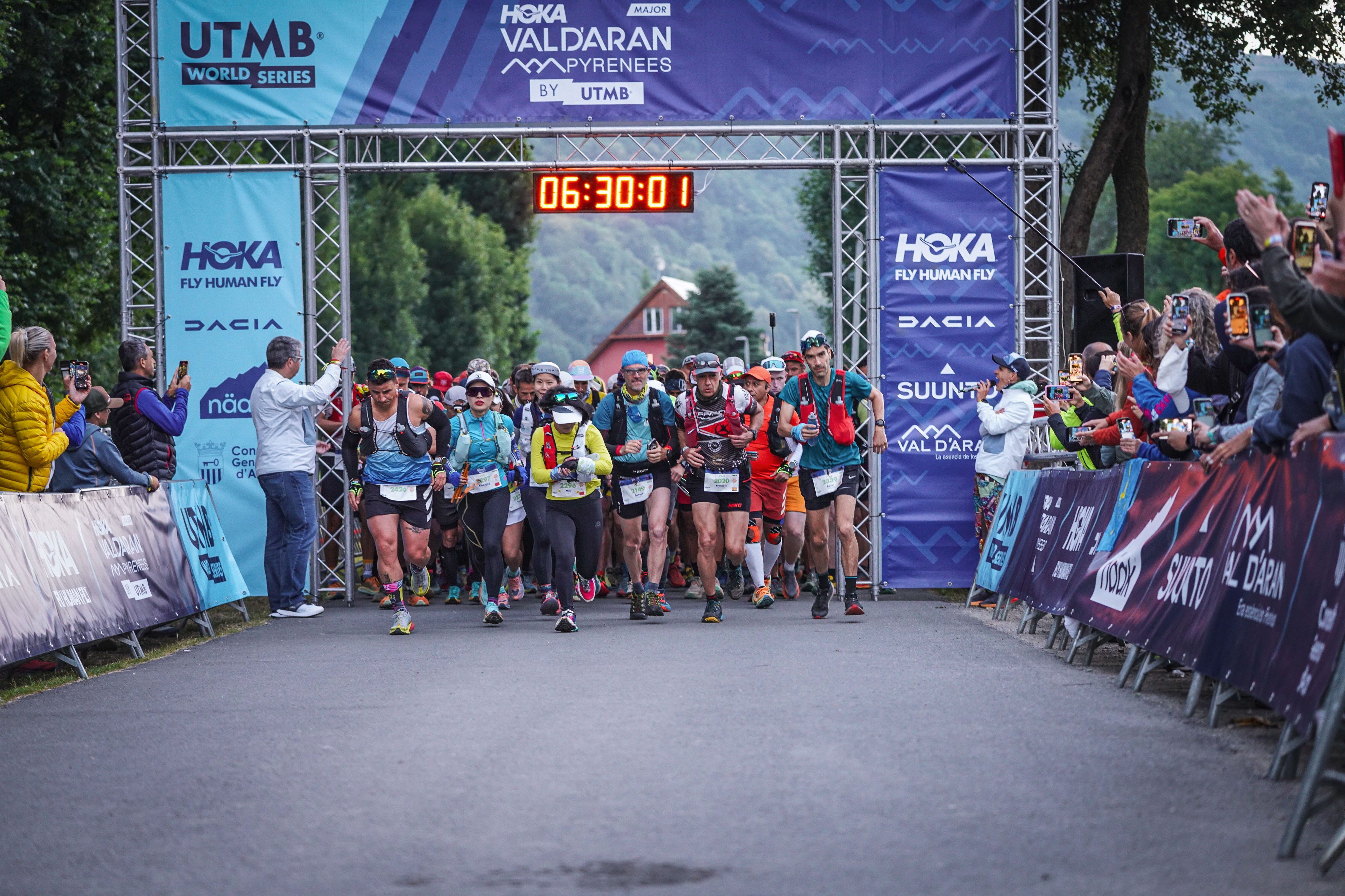
Many trail runners think they need a new training plan. In reality, they need to lose 5–10 kg first.
There is something very uncomfortable about this topic because it seems that nobody is talking about body fat and body composition in trail running.
Everyone seems to be obsessed with vert, distances, and this recent obsession with runflation. Who is running more? What races are we doing? What is the next goal?
But there is one important element that we really have to consider… who is running all these races? All the hills? It’s our body. It’s your body.
You go into Facebook groups and everyone keeps asking the same or similar questions… how long should long runs be? What are the best shoes to wear? All the “superficial” questions. They are not ‘bad’ questions it’s just I think there are more important questions we can ask if we want to improve as recreational runners.
When you speak with trail runners, a lot of them feel tired, fatigued, and exhausted, especially men over 35.
Recently I was speaking with Stephen and he was telling me how he is constantly fatigued, but he said it was okay because… you know, it’s age.
Well, it’s not okay, Stephen.
He is doing all the right things: strength training, running, hill tempo sessions. He likes to learn a lot about trail running. But one thing he is missing is the weight he is carrying with him.
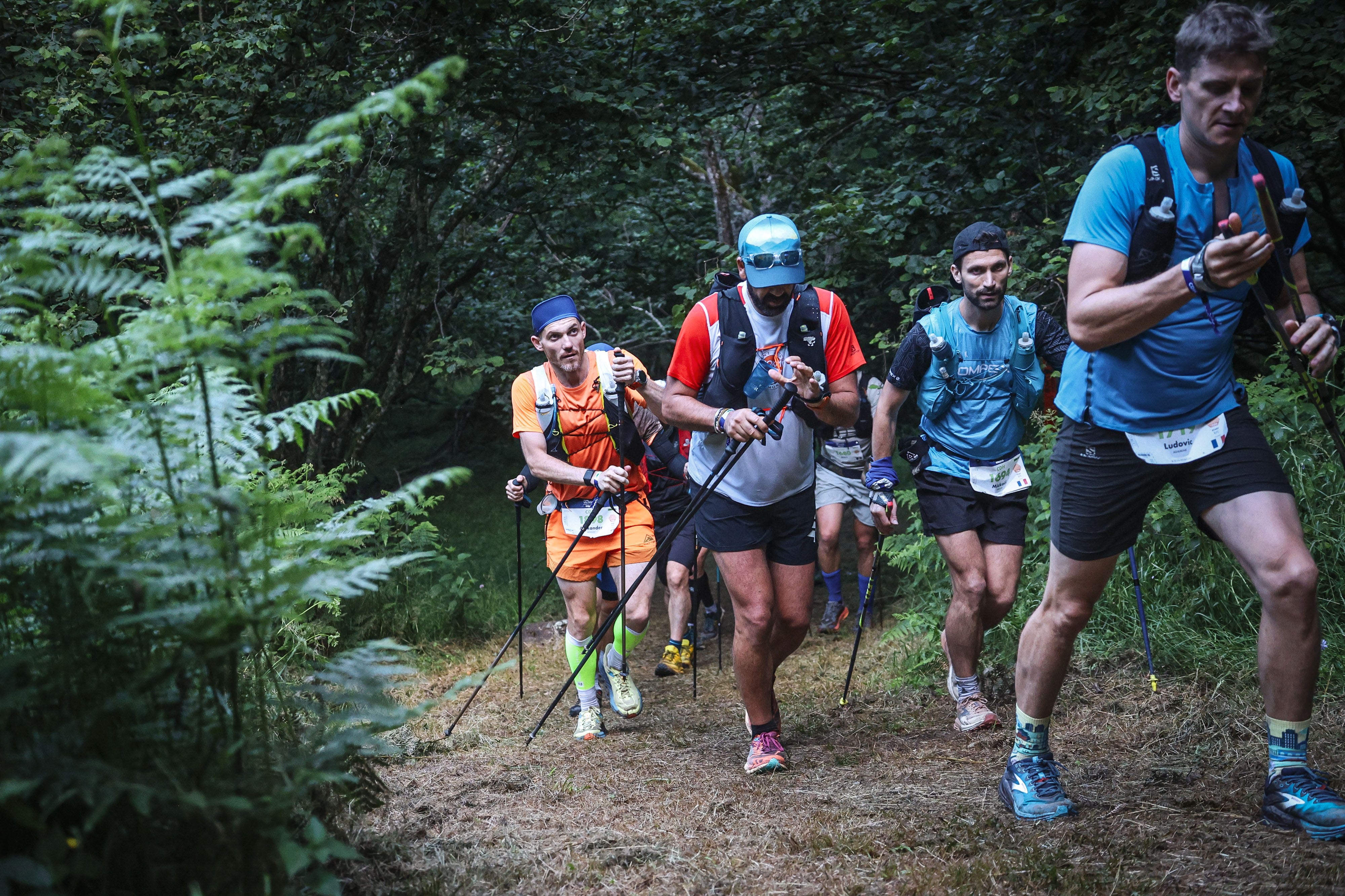
The same happens in online groups. Nobody is asking questions about what whole foods they should eat, what the best foods are after a hard session, how many calories a trail runner should consume, how many calories you should eat on your long runs, or what percentage of macros we should be consuming.
I think the reason is because most people believe their nutrition is fine and they get used to the person they see in the mirror.
Because weight loss is an identity issue.
A lot of times I think that a PT or a fitness coach can’t help someone whose identity is so tied up in their weight story.
It doesn’t matter how many workouts you are doing — if deep down you don’t see yourself leaner, you will never become lean.
But why should we lose belly fat?
Some men think it’s not important. They think it’s okay.
Well, let’s have a look at what body fat actually is.
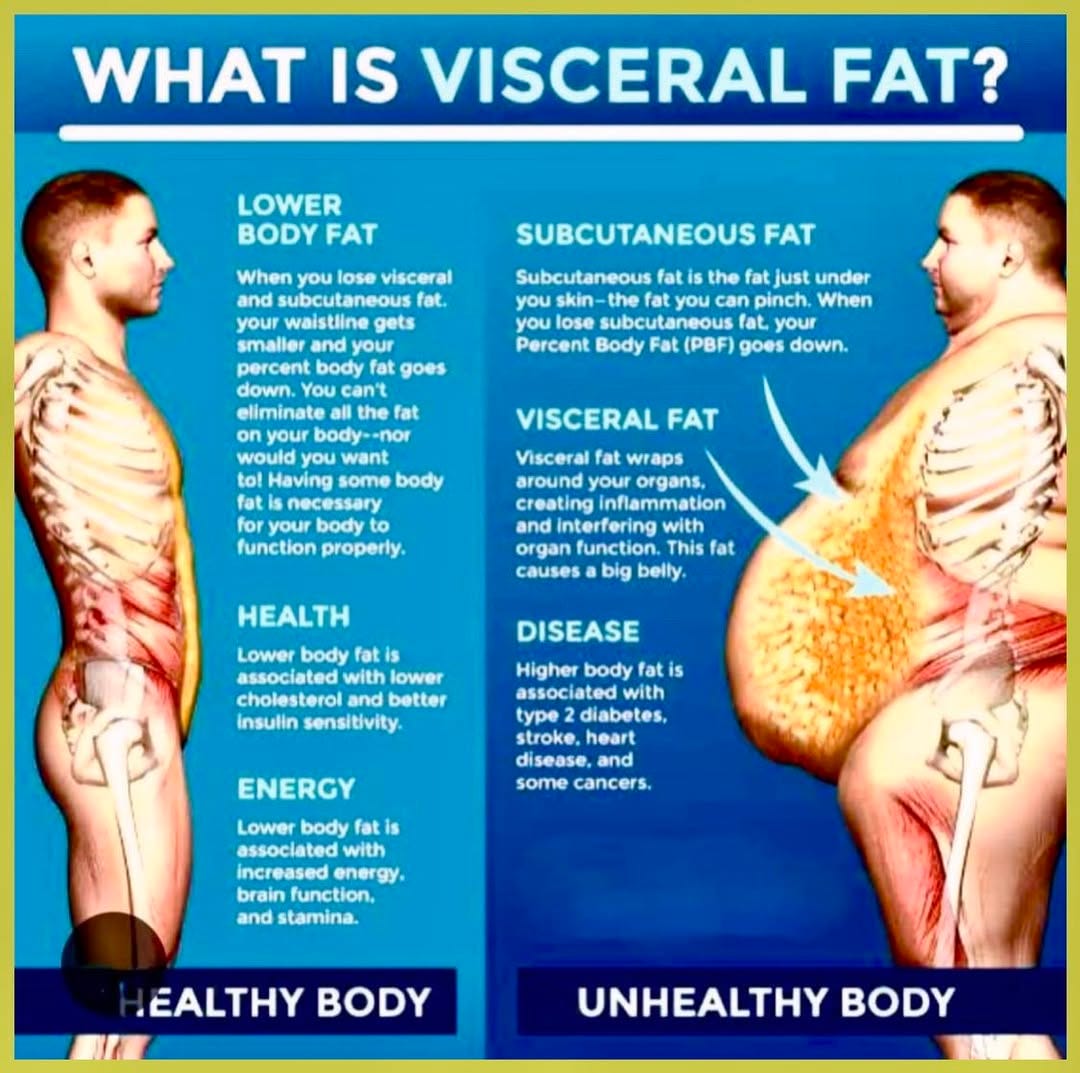
We have visceral fat and subcutaneous fat.
Visceral fat is the deep fat that wraps around your internal organs in the abdomen. This is the most dangerous type of fat because it is strongly linked to heart disease and diabetes due to inflammation.
Subcutaneous fat sits directly under your skin. It acts as energy storage and insulation, and it is usually less dangerous.
To find out what percentage of visceral fat you have, you need to do a DEXA or InBody scan.
I was blind to this myself.
I used to carry excess body fat while training for an ultra event. At the time I thought I was “okay”, but deep down I wanted to lose body fat.
I wish my coach back then had been a bit more honest and told me that I needed to lose body fat first, and then train for my London to Brighton Ultra.
I did finish the race, but I didn’t lose the weight.
After that I signed up for an Ironman. The same mindset again: let me train for this massive event and the weight will come off.
I did lose some weight, but I gained some of it back. The problem was I didn’t have the right mindset around nutrition.
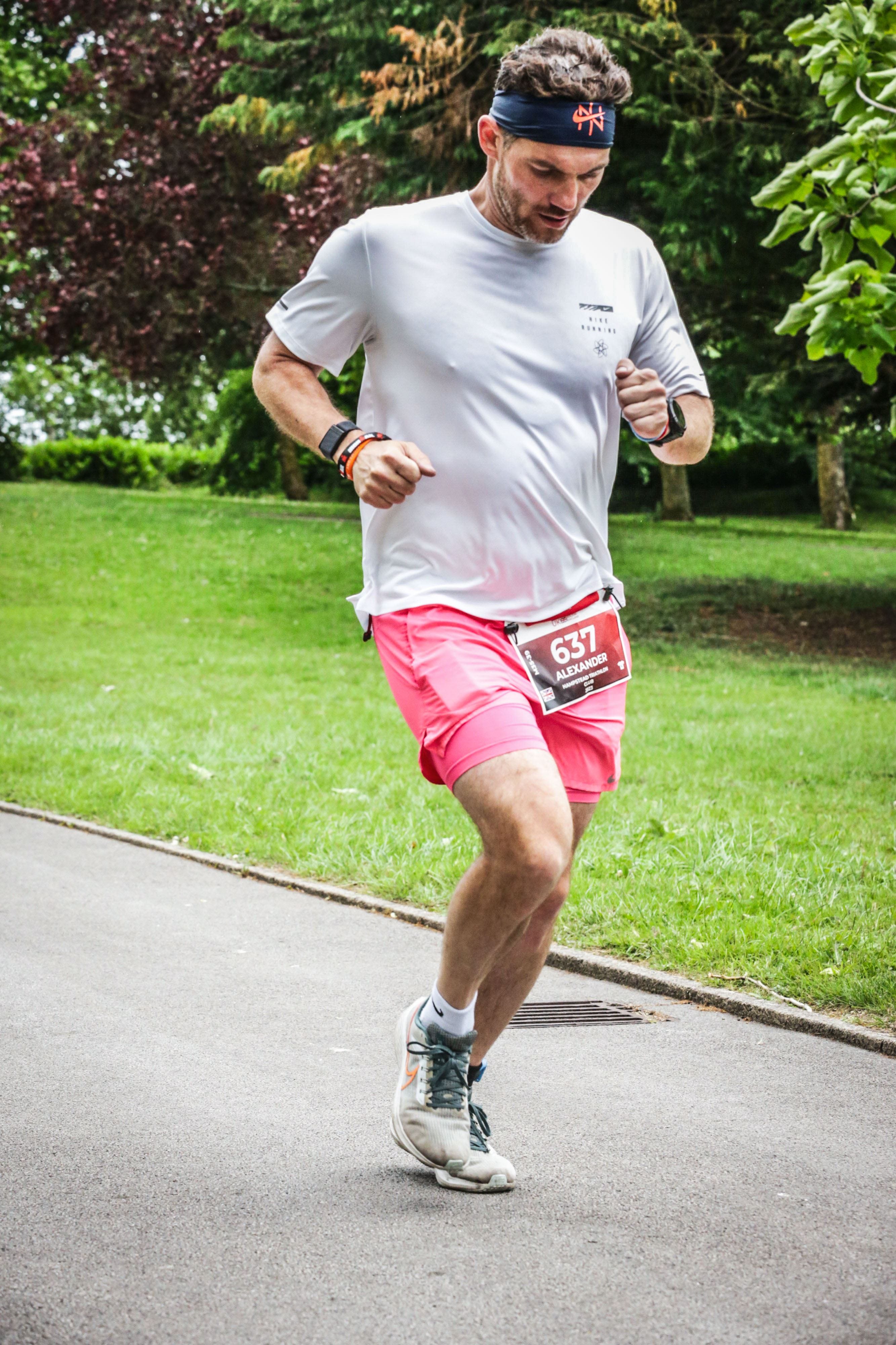
It took me years to really learn and understand the dangers of running with my belly and carrying excess body fat.
I could hide it with shirts and put it “under the rug”… but deep down I knew I could do better.
I knew that the man in the mirror could do more.
That’s when I started asking a different question: what is extra body fat actually doing to our performance in trail running?
How Does Extra Body Fat Affect Your Trail Running?
1. Mechanical Load Multiplies Over Distance
Trail running is a single-leg sport. Every time you run you put pressure on your knees.
Let’s look at some numbers, shall we?
If you run a 10 km run, you will put on average 5 to 8 times your body weight through your joints with every step.
A runner typically takes between 900 and 1250 steps per kilometre. At a pace of 6:00/km, this means a runner will take roughly 1000 steps per kilometre.
This means that in a 10 km run a runner will take around 10,000 steps.
An 80 kg runner will experience roughly 480 kg of equivalent force per step.
So over a 10 km run, a runner will experience 4,800,000 kg (4,800 tonnes) of cumulative load on the knee joint.
This doesn’t mean the knee is carrying 4,800 tonnes at once.
It means small loads repeated thousands of times, this is called cyclic loading.
Now imagine an 80 kg runner carrying 5 kg of unnecessary fat.
The impact isn’t just 5 kg.
Because every step multiplies load 5–8 times body weight, the extra load per step becomes around 30 kg (5 kg × 6).
Let’s look at an average 100 km trail race:
100,000 steps × 30 kg
= 3,000,000 kg of additional cumulative load
That’s 3,000 tonnes of extra stress your joints, tendons, and muscles must absorb.
Fat produces no power. It doesn’t help you move forward. It’s simply dead weight.
Running is a high-load repetitive sport. That’s why slower runners sometimes put more stress on their knees than faster runners.
So what does this mean?
It means that if we are carrying extra body weight, we are putting significantly more pressure on our body.
2. Relative vo2 Max Drops
Many road runners obsess over VO₂ max, and now I see trail runners doing the same with their Garmin watches.
But the reality is that Garmin cannot truly measure your VO₂ max. To know the real number you need to test in a controlled laboratory environment.
Endurance performance depends heavily on VO₂ max relative to body mass.
VO₂ max is measured as millilitres of oxygen per kilogram of body weight per minute.
Example: Runner A
Absolute VO₂ max = 4.0 L/min
Weight = 80 kg
Relative VO₂ max = 50 ml/kg/min
If he drops 5 kg of body fat while keeping the same oxygen capacity:
4.0 L/min ÷ 75 kg
= 53 ml/kg/min
That’s roughly a 6% performance improvement without training harder.
That is massive in endurance sport and it will help that trail runner massively finishing strong his race.
3. Glycogen Efficiency Improves
Extra body fat increases the energy cost per kilometre this means you burn glycogen faster.
In trail running glycogen is limited, we know that and hence there is so much conversations about how many grams of carbs we need to consume.
Rough numbers:
Glycogen stores ≈ 2,000 kcal
Ultra running energy cost ≈ 0.9–1 kcal/kg/km
An 80 kg runner uses about 80 kcal per kilometre.
Over 100 km that’s roughly 8,000 kcal of energy demand.
If the runner weighs 85 kg, the demand becomes:
85 kcal per km
= 8,500 kcal
That extra 500 kcal deficit increases the risk of bonking.
That’s one reason heavier runners tend to hit the wall earlier.

4. Thermoregulation Becomes Worse
Body fat acts as insulation, it’s very useful in cold water swimming but it’s terrible in long mountain races.
This means that more body fat:
higher core temperature
faster dehydration
higher heart rate
earlier fatigue
Heat stress is on of the biggest causes of why trail runners DNF at ultras.
5. Hormonal Stress Increases
Visceral fat is metabolically active tissue. It increases:
chronic inflammation
cortisol
insulin resistance
What does this mean? Where does this leads to? Well slower recovery, poor sleep and persistent fatigue.
What is the number one reason trail runners over 35 complain about?
Exactly this. Many think: “It’s age.” when in reality it’s often metabolic health.

6. Uphill Economy Gets Destroyed
We know that trail races are not flat. You are lifting your body weight thousands of times over vertical meters.
You work against gravity:
Work = mass x gravity x height.
So let’s say again, a trail runner is carrying 5 kg extra, he is doing a race that has 4000 m of vert. Here’s the extra work he has to do:
5 x 9.81 x 4000 = 196,000 joules. That’s energy wasted lifting fat uphill.
Like I said before, body fat does not produce power.
7. Injury Risk Increases
This is really common sense but I though to include this. Excess body fat increases risk of the following:
knee pain
IT band syndrome
plantar fasciitis
Achilles tendinopathy
stress fractures
And this is not because running is dangerous, no it’s not. It’s because load tolerance gets exceeded faster. Especially in runners who suddenly increase volume chasing bigger races.
8. Recovery Time Gets Longer
We want to recover as fast as possible so we can have higher quality sessions. But more body fat correlates with:
higher inflammatory markers
poorer mitochondrial function
slower muscle repair
So you see runners who train hard but feel constantly tired.
Again, this is not age.
This is metabolic inefficiency.
The Uncomfortable Truth
Like I mentioned, trail runners obsess about:
shoes
vert
race calendars
Strava numbers
But they ignore the engine carrying them uphill.
Your body composition is one of the largest performance levers in endurance sport.
Elite trail runners aren’t lean by accident, they are lean because physics demands it.
Don’t get me wrong, this is not about becoming shredded. Too little body fat is also bad.
Healthy ranges for male endurance athletes:
10–15% body fat → optimal performance
15–18% → recreational healthy
20%+ → performance limitations begin
Many recreational trail runners sit 20–25%+ and wonder why they struggle.
Trail running is simple physics.
The lighter the engine moving uphill, the less energy it costs.
If you are interested in building an engine that will help you finish your next BIG ultra strong, I have a free guide called How To Finish Your Big Ultra Strong, Not Destroyed.
Comments
Nothing yet. Say the first thing.
Sign in to join the conversation.