
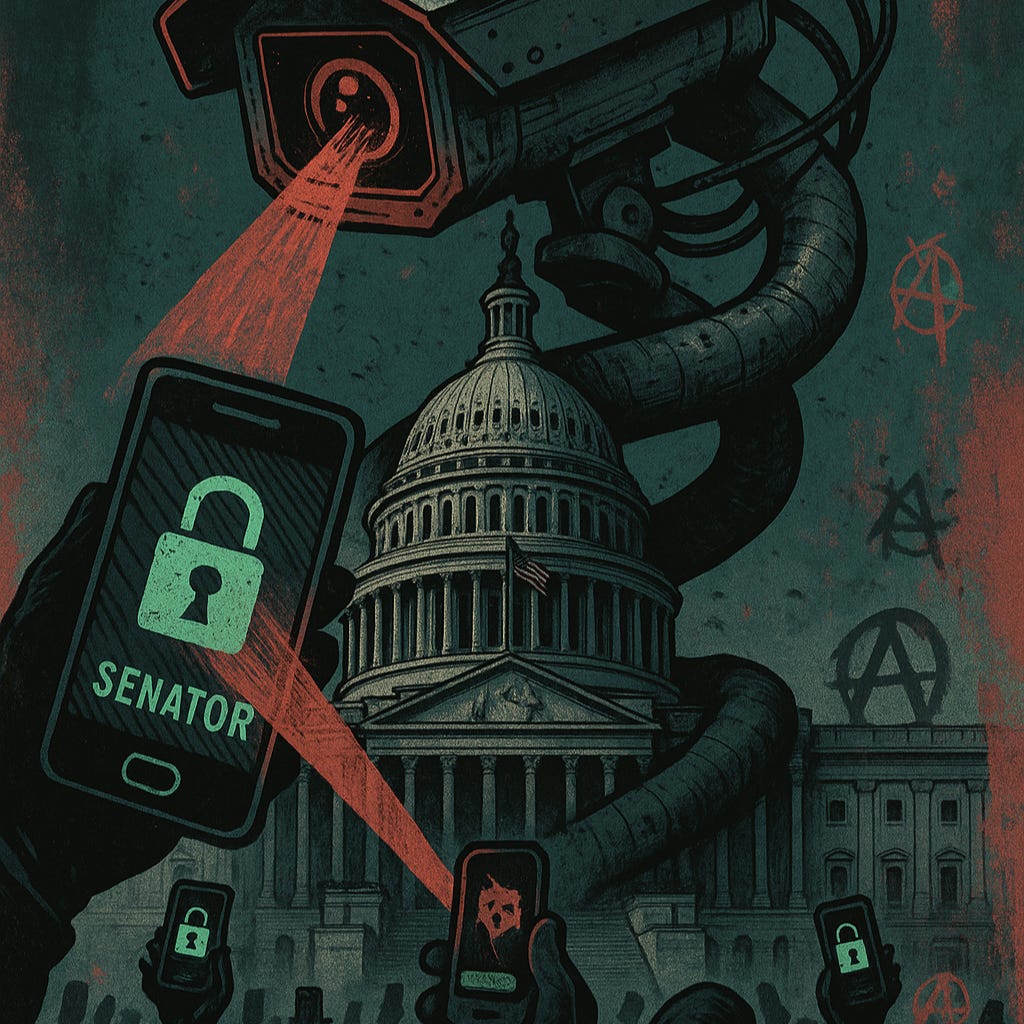
In the never-ending slapstick of the American empire, few characters commit harder to the bit than Senator Lindsey Graham. For decades, the South Carolina warhawk has sold you the surveillance state like it was freedom’s best friend, a little “necessary sacrifice” so Daddy Government can keep you safe. Now that the same machinery has scraped his phone records, he’s shrieking about tyranny, separation of powers, and Watergate-level scandal, clutching the Constitution like a prop he just found backstage.
What changed? Nothing about the system. Only the target.
Here’s the setup. As part of the FBI’s Arctic Frost investigation into January 6 and Trump-world scheming, federal agents subpoenaed phone metadata for a group of Republican lawmakers, including Lindsey Graham, as they combed through who was calling whom around the time of the Capitol riot.
Those subpoenas went to carriers like Verizon and AT&T. AT&T balked and refused to hand over certain lawmakers’ records. Verizon, on the other hand, dutifully complied and produced call logs linked to Republican senators’ numbers, including Graham’s. Every subpoena came with a gag order from Judge James Boasberg, meaning Verizon couldn’t tell Graham that his data had been collected.
Fast-forward: a quietly slipped provision in a 2025 government funding bill allowed senators whose phone records were secretly seized in Arctic Frost to sue the Department of Justice for a minimum of $500,000 in damages per violation, retroactive, naturally, to cover this exact incident.
House members, blindsided, promptly revolted and voted 426–0 to repeal the perk once reporters started calling it the “be a millionaire” clause. Even as that repeal moves, Graham is loudly promising to sue the DOJ (and likely Verizon) for far more than the guaranteed half-million, framing himself as the victim of an unprecedented constitutional crime.
The man who helped build the panopticon is furious that the cameras are pointed in his direction.
Lindsey Graham’s sudden conversion to civil libertarianism would be hilarious if it weren’t drenched in blood and data. This is a man whose career has been a Greatest Hits compilation of “Yes, you can spy on them”:
Patriot Act & NSA dragnet: After 9/11, Graham lined up with the rest of the security statists to ram through the Patriot Act and its renewals, defending bulk NSA collection of Americans’ phone records as a patriotic necessity. When the Snowden leaks exposed the government’s mass phone metadata program, Graham was unfazed, telling constituents he’d be happy to know the government was listening to his calls if it meant catching “terrorists.”
FISA Section 702 cheerleader: In 2024, as Ranking Member of the Senate Judiciary Committee, he publicly championed reauthorizing Section 702 of the Foreign Intelligence Surveillance Act, the same authority civil libertarians have documented being abused to spy on journalists, protesters, and random Americans swept up in “foreign intelligence” dragnets. He declared that “the importance of reauthorizing FISA cannot be overstated,” even as Congress rammed through a two-year extension over privacy concerns.
In Graham’s worldview, the state’s power to surveil has always been a one-way mirror. The government peers into your life “for your own good.” You, of course, are not allowed to peer back. When Muslims, immigrants, anti-war activists, or Black Lives Matter protesters get scooped up in this machinery, Graham calls it “keeping America safe.” When a senator’s call log gets a routine toll analysis, suddenly it’s the “biggest violation of separation of powers in our nation’s history.”
He’s not angry that the machine exists. He’s angry that the machine treated him like everyone else.
Graham’s recent performance has all the subtlety of a daytime soap.
In press releases and social-media blasts, he’s accused Judge Boasberg of “legal slander,” flirted with impeachment talk, and demanded a “Watergate-style investigation” into how his phone records were obtained, as if the same surveillance structures he’s spent years fortifying suddenly materialized out of nowhere for the sole purpose of persecuting him.
He’s attacked Verizon for complying with a lawful subpoena, suggesting they should have stonewalled like AT&T. He’s embraced the $500,000 minimum payout provision not as a grotesque example of lawmakers writing themselves a special shield from the laws they impose on everyone else, but as a down payment on the “justice” he’s owed.
Meanwhile, libertarian and civil liberties groups have spent years documenting exactly how the tools Graham loves, Patriot Act authorities, FISA Section 702, secret court orders, gagged subpoenas, are used to target ordinary people: dissidents, whistleblowers, reporters, and anyone who happens to stand in the way of the empire’s mood that week. But those cases never stirred this level of performative rage from Senator Surveillance.
It took his metadata getting swept up for him to rediscover the concept of limits on state power.
Don’t look at Arctic Frost and say, “Wow, the surveillance state malfunctioned.”
This is exactly what you get when you create a secretive, unaccountable intelligence apparatus and tell it to “protect the homeland” using whatever tools you hand it.
Give cops and spooks:
Broad statutory authority to collect metadata on millions of people
Secret courts to rubber-stamp warrants and subpoenas
Gag orders to keep targets in the dark
Political cover from both major parties
…and sooner or later, the net is going to catch everyone, from street activists to sitting senators.
The problem isn’t how you aim the weapon. The problem is building the weapon at all.
Lindsey Graham didn’t just vote for that weapon. He polished it, fed it, and demanded you salute it every time it shredded someone else’s rights. His outrage now is not principled. It’s proprietary. The spy state was supposed to be pointed outward, at “terrorists,” at “rioters,” at whatever bogeyman keeps the donation emails flowing, not inward at the people who sign the checks.
Graham is not an unfortunate victim of a noble system gone astray. He is the archetype of the problem:
A career politician who treats your privacy as disposable and his as sacred.
A lawmaker who weaponizes fear to expand state power, then cries foul when that power grazes the ruling class.
A man who helped normalize Big Data authoritarianism and now wants a special golden parachute labeled “Arctic Frost damages” when he gets tangled in the same nets he cast.
So no, Senator, you don’t get to reinvent yourself as a champion of civil liberties because your call log got scanned. The people whose lives have been torn apart by raids, no-fly lists, bogus terror watchlists, and “national security letters” never got a custom-written statutory payday tucked into a spending bill. They got attorneys, trauma, and a lecture about how “if you’ve done nothing wrong, you have nothing to fear.”
We remember who said that line.
There is no need to tweak oversight committees or rewrite one more “reform” bill that leaves the core machinery intact.
The Patriot Act should be repealed, not “rebalanced.”
FISA’s secret court architecture should be dismantled, not given fresh lipstick every two years.
Section 702 and mass surveillance programs should be abolished, not “reformed” while they keep scooping up your communications.
You don’t put a leash on a panopticon. You turn it off.
Lindsey Graham, if by some miracle you’re doomscrolling Substack instead of cable news and you’ve made it this far, here’s some advice:
Drop the martyr act.
Withdraw your lawsuit and publicly renounce the surveillance powers you’ve spent your career defending.
Use whatever time you’ve got left in office to dismantle the system you helped build, not just carve out bespoke immunity packages for your friends in the Senate.
We won’t hold our breath. Politicians rarely dismantle the weapons they’ve aimed at everyone else. That task falls, as it always has, to people on the outside.
The problem isn’t that the spyglass briefly glanced at Lindsey Graham.
The problem is that the spyglass exists at all.
No posts
Comments
Nothing yet. Say the first thing.
Sign in to join the conversation.