
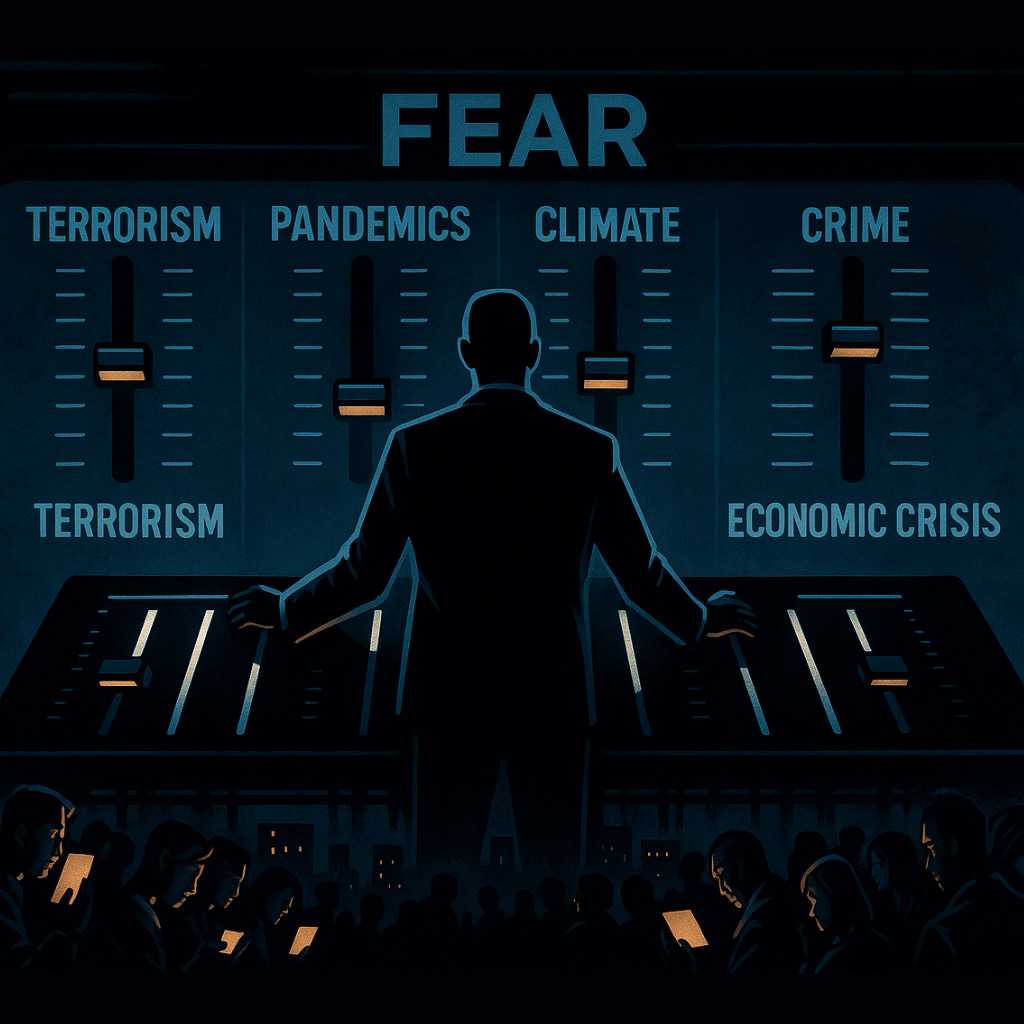
Politicians don’t stand up and shout, “Give me liberty or give me death,” anymore. Their version is closer to: “Give me your fear and I’ll rent your freedom back to you, one crisis at a time.” That’s the real slogan of modern governance, and Fearmongering 101 is the core course every aspiring ruler passes with honors.
The curriculum is simple: invent or exaggerate a crisis, declare yourself the only solution, demand more power, money, and obedience, then repeat the process until the public is too anxious and exhausted to notice the chains tightening.
This isn’t a conspiracy theory; it’s standard operating procedure. The professors are your favorite congresscritters, governors, and talking heads; tenured parasites with armed security details, guaranteed pensions, and consultants on retainer to weaponize your fear into their authority.
After 9/11, the script ran in fast-forward. On September 12, 2001, a country was grieving. By September 13, the political class was shouting, “Quick, pass the PATRIOT Act before anyone reads it!” What followed was a surveillance state on steroids: warrantless wiretaps on people who’d never left the Midwest, TSA agents pawing through your kid’s diaper “for freedom,” and a multi-trillion-dollar war tab in Iraq and Afghanistan, countries that had nothing to do with the actual attack.
But the bombs fell, the contracts flowed, and the defense industry cashed in.
Dick Cheney’s old firm, Halliburton, feasted on no-bid contracts, and the usual suspects, Raytheon, Lockheed, and the rest of the revolving-door aristocracy saw their stock prices soar. Meanwhile, working-class kids came home in flag-draped coffins. You paid in blood, in debt, and in the slow erosion of the Fourth Amendment. The lesson was clear:
Whenever any politician invokes “national security,” you should check their donor list before you check under your bed.
Then came the viral sequel. In March 2020, we were promised “two weeks to flatten the curve.” Years later, we’re still dealing with the political residue of that emergency high. Governments discovered that “public health” was a magic phrase that could justify almost anything. Australia literally locked people in their apartments. Canada froze the bank accounts of truckers whose crime was honking in protest. In the United States, the federal government tried to conscript 84 million private-sector workers into a de facto medical mandate regime until the Supreme Court finally said no.
Masks for you, photo ops for them. Lockdowns for your business, VIP exceptions for theirs.
While Gavin Newsom dined maskless at French Laundry, Lori Lightfoot got a private haircut as salons were forced shut, and AOC wore a “Tax the Rich” costume at a gala with tickets priced higher than your annual income, pharmaceutical giants like Pfizer cleared around a hundred billion dollars in revenue over the cycle.
Fear was the product; obedience was the policy; profit was the quiet reward.
Of course, no modern fear curriculum would be complete without Climate Doomsday. The sales pitch writes itself: by 2050, we’re told, the Earth becomes Venus; by 2030, we may pass 1.5°C; therefore, today you must eat bugs, give up your car, and learn to love living in a tiny pod while your betters fly private to Davos to “save the planet.”
The line is always the same: “The science is settled,” which is code for “Sit down and shut up while we ram through new taxes and controls.” Carbon taxes, ESG regimes, and regulatory throttling are all framed as emergency measures, but they always land in the same place: higher costs and lower autonomy for you, more power and profit for those designing the “solutions.” The same people lecturing you about your gas stove rack up dozens of private jet flights and live in mansions that burn more electricity in a month than your neighborhood does in a year.
The message is never that they should consume less; it’s that you should “learn to do more with less” while they deliberately do more with more and dare you to notice the hypocrisy.
If you step back from the individual panics, the pattern is almost insultingly obvious. They create or amplify a crisis, they position themselves as the indispensable managers of that crisis, they exempt themselves from the harshest rules, and you’re left footing the bill while surrendering one more slice of liberty. Armed security for them, gun control for you. Emergency powers for them, curfews for you. Climate austerity for you, yachts in Monaco and villas on the coast for them.
The system doesn’t malfunction under stress; it functions exactly as designed, centralizing authority upward while diffusing the costs downward.
The predictable response from statists is always a shrill version of the same question: “But without government, who will protect us from terrorists, pandemics, climate change, and all the other apocalypses?” The answer is inconvenient to their worldview: you will. Free, armed, and organized communities are far more effective at deterring threats than bloated surveillance agencies that are mostly good at spying on their own citizens. Voluntary mutual aid and transparent, open science can respond to disease more nimbly than monopolistic bureaucracies obsessed with press conferences and control. Truly open markets and property rights drive innovation in energy and technology faster than any five-year plan written by people who can’t even pass a balanced budget.
The state doesn’t prevent crises; it manufactures, mismanages, and monetizes them; and then demands gratitude for the mess it made.
Harry Browne said it best
“The government is good at one thing: It knows how to break your legs, hand you a crutch, and then say, ‘See, if it weren’t for the government, you wouldn’t be able to walk.’”
Start by unsubscribing, mentally and literally, from the state-approved panic porn otherwise known as the mainstream media. Turn off the feeds and channels whose business model is to keep you scared enough to swallow whatever “solution” they’re selling next.
Then, put your energy into building and supporting parallel systems: get to know your neighbors and organize real community watch and support instead of relying on distant agencies; explore mutual aid and alternative finance instead of waiting for top-down bailouts; support local growers and food networks instead of fragile, centralized supply chains that break under stress.
Finally, make mockery part of your toolkit. Fear depends on mystique; ridicule blows that apart. Memes, satire, and unapologetic laughter at the sacred cows of the political class are cheaper than protests, harder to censor, and far more contagious.
Ultimately, fear is the politician’s oldest tool. It turns free people into dependents, neighbors into informants, and temporary emergencies into permanent institutions. Every “crisis” becomes a career opportunity for someone with a flag pin and a podium. You are not obligated to play your assigned role in their theater. Refuse the script. Laugh at the boogeymen. Starve the beast of your obedience, your attention, and your belief that someone in a suit will save you from the world they helped break.
Because the only thing they should truly fear is not the crisis of the month, it’s you waking up and walking away.
No posts
Comments
Nothing yet. Say the first thing.
Sign in to join the conversation.