

I very much enjoyed last week’s piece by Derek Neal in The Republic of Letters about the art of sports writing1 as a celebration of superhuman grace – what’s there not to like about an essay that combines Roger Federer with Heinrich Von Kleist’s On The Marionette Theatre? – and I am so violently in agreement with him that what follows here can’t even be called criticism. Read his first, and think of this as an enthusiastic return of serve in the hope of delivering a good rally for the crowd.
But I do have only one thing to add to this conversation, which is my conviction that Derek might still be underselling the value of great sports writing.
Yes, Federer’s inside-out cross-court topspin backhand sits in the realm of beautiful human aesthetic achievements along with the ceiling of the Sistine Chapel and Proust’s In Search of Lost Time. Yes, these kind of spectacles of skill, often under intense pressure, are a glimpse of the sublime for many of us. But few people ever achieve such mastery, and limiting sports writing to just praising the heights of godlike grace attained by a handful of blessed mortals omits a massive aspect of its literary value.
The evocation of those brief moments of elegance makes sportspeople feel like gods, but everything else that happens on and off the field is what makes them mortal – and it’s in this contrast between the highest tiers of skill and the lowest depths of character that great sports writing lives. Albert Camus once said that everything he knew about human nature he had learned from watching the players as he kept goal for his football team, and what he understood was what all lovers of sports know, which is that there are few better stages for character in action.
The last great sports writing I read was Chad Harbach’s The Art of Fielding, a novel about baseball that I, as a British person who doesn’t even care about cricket, shouldn’t give two shits about.
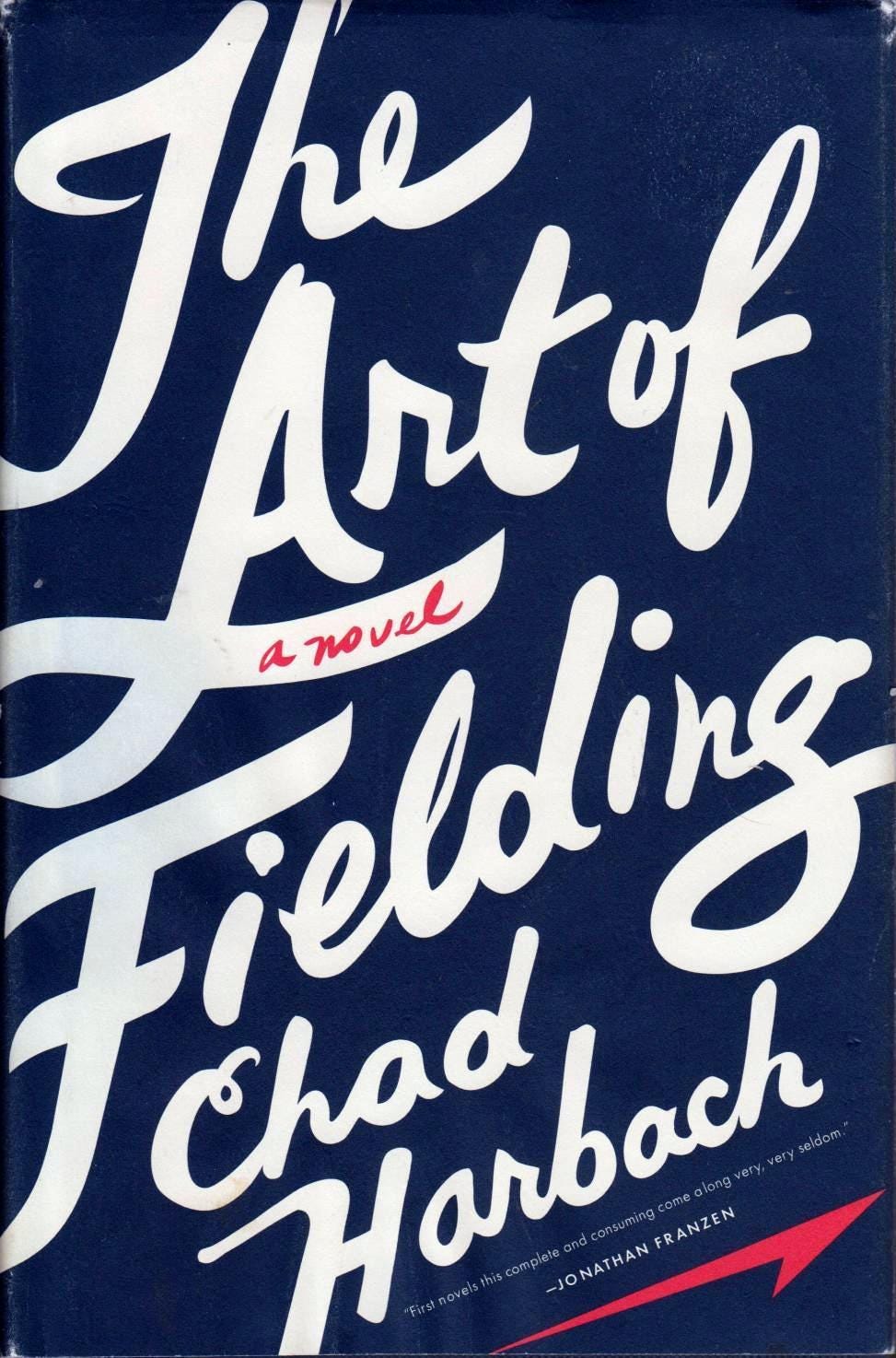
In the novel, Harbach’s main character, the young shortstop Henry Skrimshander, exhibits exactly that familiar kind of preternatural skill that sports writing so often eulogises:
The kid glided in front of the first grounder, accepted the ball into his glove with a lazy grace, pivoted, and threw to first. Though his motion was languid, the ball seemed to explode off his fingertips, to gather speed as it crossed the diamond. It smacked the pocket of the first baseman’s glove with the sound of a gun going off. The coach hit another, a bit harder: same easy grace, same gunshot report….He didn’t seem to move faster than any other decent shortstop would, and yet he arrived instantly, impeccably, as if he had some foreknowledge of where the ball was headed. Or as if time slowed down for him alone.
Henry’s natural gift and dedication make him a hot prospect, the focus of the hopes of his college community and friends. And then, one day, for reasons I will skip here for the benefit of those yet to read this novel, he loses it.
The rest of the book is an exploration of what happens when Von Kleist’s unconscious grace fails in the sporting arena, how the people who lose it try to cope, and it’s also notable for being a modern novel that treats relationships between men with great seriousness and tenderness. What this novel captures is that competitive sport is an arena and stage for human drama and drives pushed to their absolute limits of dedication and dysfunction, and this is a turf that great sports writing digs into over and over again.
For further evidence of this, I would summon ESPN’s sportswriter par excellence Wright Thompson. His book The Cost of These Dreams is not only about sports nor the people who play them, but the sort of questions that animate Robert Caro’s biographies: where does the uncommon drive for excellence and the relentless desire to win come from? What happens to those fuelled by it when there’s no-one left to beat and nothing left to win? What are the costs for those around them, and to society as a whole?
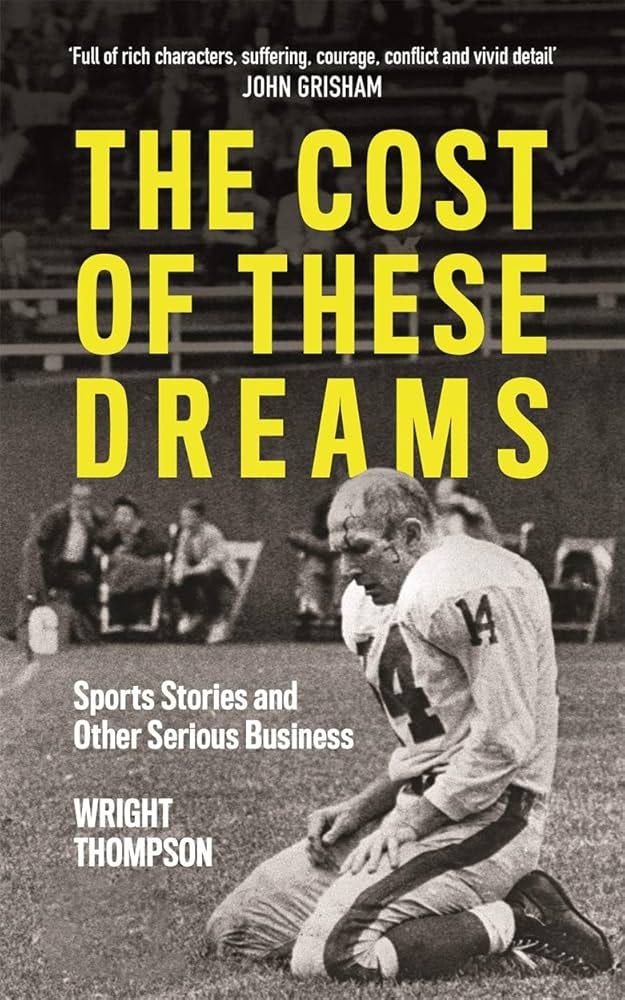
His piece The Secret History of Tiger Woods is worth the cover price alone, putting a Shakespearean lens on the father-and-son relationship behind one of sport’s most famous implosions.
Consider Tiger Woods once more, tabloids snapping grainy long-distance photos, his marriage suddenly in danger and with it the normalcy he lacked everywhere else, his body taking a terrible beating from SEAL training and aggressive weight lifting, a year after losing his father, adrift and yet still dominating all the other golfers in the world. They never were his greatest opponent, which was and always will be a combination of himself and all those expectations he never could control.
This kind of writing is about the burning rage that animates the graceful puppet, and what happens when they step off the field and are unable to achieve any close to perfection in their life, their relationships or the wider world. His piece The Greatest Hitter Who Ever Lived On, about Ted Williams, hones in on a similar story.
‘San Diego neighbours would watch Ted and his younger brother Danny, 8 and 6, sitting alone on the front porch late into the night. The anger that dominated both their lives started there, on those lonely evenings outside 4121 Utah Street, waiting for their mom to come home. May Williams never saw her son play a major league game, even though she lived through his entire career. When she died, 11 months after he hit a home run in his final at-bat, he went through her things and gathered up family photographs. He tore them into pieces and then threw them away.’
But it also flips the script to ask what it is like for his daughter to live in the aftermath of greatness, to be stuck in its orbit even when you have no choice in the matter:
‘She never asked for anything. Her dream was to attend Middlebury College in Vermont. When she didn’t get in, Ted called the governor of New Hampshire, who pulled some strings. The reconsidered acceptance letter made her weep with rage because she knew what had happened. She told Middlebury no. Her friends at Springfield College didn’t realise her father was Ted Williams until she asked some guys who played baseball to teach her to throw; the Red Sox had requested she toss out a first pitch as a surprise to her father and she didn’t want, as she told them, “to throw like a girl.” Her brother lobbed one wild, but Claudia kicked her leg and delivered a strike. Ted beamed, a reward she seldom got while he lived and craved now that he’s gone.’
These are mostly essays centred on American icons who play sports that I neither watch nor care about, and yet they affect me in just the same way that great novels about French aristocrats or Vietnamese spies or women in the Antebellum South or post-War Naples do. None of this is about grace in action, all of it is what makes sports both compelling and moving, and worth writing about. What sports, and great sports writing offers, is tests of character.
Consider now the black English footballer stepping up to take a penalty with decades of failure and racism lying heavy on their shoulders, the fighter coming back into the ring because he doesn’t know who he is if he isn’t punching someone, the young rugby player with a snapped cruciate at twenty-four who must now face the world deprived of the one thing he knows he’s good at; the ageing pitcher who is well past his peak but doesn’t know when to walk away from the mound; the Olympic swimmer deprived of the gold medal she has spent her life training for by an East German regime doping her rivals for the sake of international prestige; the Brazilian striker who is her country’s greatest ever goal-scorer but whom is never deemed worthy of a mention in the endless discussions about the selecão that animate every bar in the country, merely because of her sex. As James Salter said:
‘Well, life is an ordeal, isn’t it? You’re continually being tested. It doesn’t seem unusual to me to pick an apex or a dramatic instant of this testing. It’s a conventional device of storytelling.2’
Whether these people are chasing a ball or a personal record or a driver’s championship, sports offers them and us a vast arena and canvas for their ambitions, failings, and character to play out. Sometimes it’s a theatre of cruelty, sometimes it’s a ceremony of collective worship, and occasionally it is indeed a stage for those brief and beautiful moments of godlike sublime.
But we watch because for eighty or ninety minutes on any given Sunday or during a Saturday afternoon kickabout or in the ring for twelve rounds under hot lights in front of a crowd baying for blood on a Friday night, we see humans respond to the endless varieties of character tests that sports alone offers, and in the process we also bear witness to the best and worst of which we are capable.
All of this demands writing that aims for the highest echelons of truth, of writerly skill, for the verbal equivalent of a Roger Federer backhand - and for platforms and readers that will give this subject and its long tradition of fine writing the appreciation it deserves.
James Salter, The Paris Review, The Art of Fiction
No posts
Comments
Nothing yet. Say the first thing.
Sign in to join the conversation.