
The T-word is now the defensive trench du jour from which those anxious about AI are staging their valiant rearguard action in defence of human exceptionalism, and the result is endless takes treating it as the last bulwark against AI’s encroachment into knowledge and creative work.
It’s not that it’s wrong, but the way that taste is defined in these conversations positions it as just consumption choices - be a more discerning omnivore of cultural effluvium and you will survive the machine apocalypse. In this view, taste is entirely a reflection of what you can buy and display, which is why as a line of defence about what makes humanity special, it seems rather hollow. This worldview is savaged mercilessly in Vincenzo Latronico’s Perfection, whose main characters are described as avatars of the taste discourse:
Anna and Tom had grown up with the notion that individuality manifested itself as a set of visual differences, immediately decodable and in constant need of updating
They are people who have gone all in on the notion of taste: they consider themselves creative because they buy tasteful things, listen to edgy music, and buy achingly cool houseware. They curate their life, their milieu and their friends accordingly, but having good taste is not enough to make the characters in the novel happy or give their lives meaning.
They will find themselves wondering how long it would be before a neural network could carry out most of their work. They will find themselves wondering whether that would be such a shame. How could they ever have chosen to spend their days like that, hunched over a computer screen in their living room?
This is because the only taste worth having is taste in action, at the desk, work bench, musical instrument and computer. So as a radical proposal, let’s swap this somewhat empty t-word for a more active one that anyone can aspire to: tacit knowledge.
Tacit knowledge is the kind of internalised skill on show when you watch sports, see a musician play, or when a watchmaker puts the final touches to a work of extreme mechanical beauty. As defined by Hungarian-British scientist and philosopher Michael Polanyi, it’s best summarised in the idea that ‘we can know more than we can tell.’, and frequently found by interacting with the world through a focal object. As Polanyi says: “our body is the ultimate instrument of all our external knowledge, whether intellectual or practical1.“ Or, as the Asaro tribe of Indonesia and Papua New Guinea describe it:
“Knowledge is only a rumour until it lives in the muscle.”
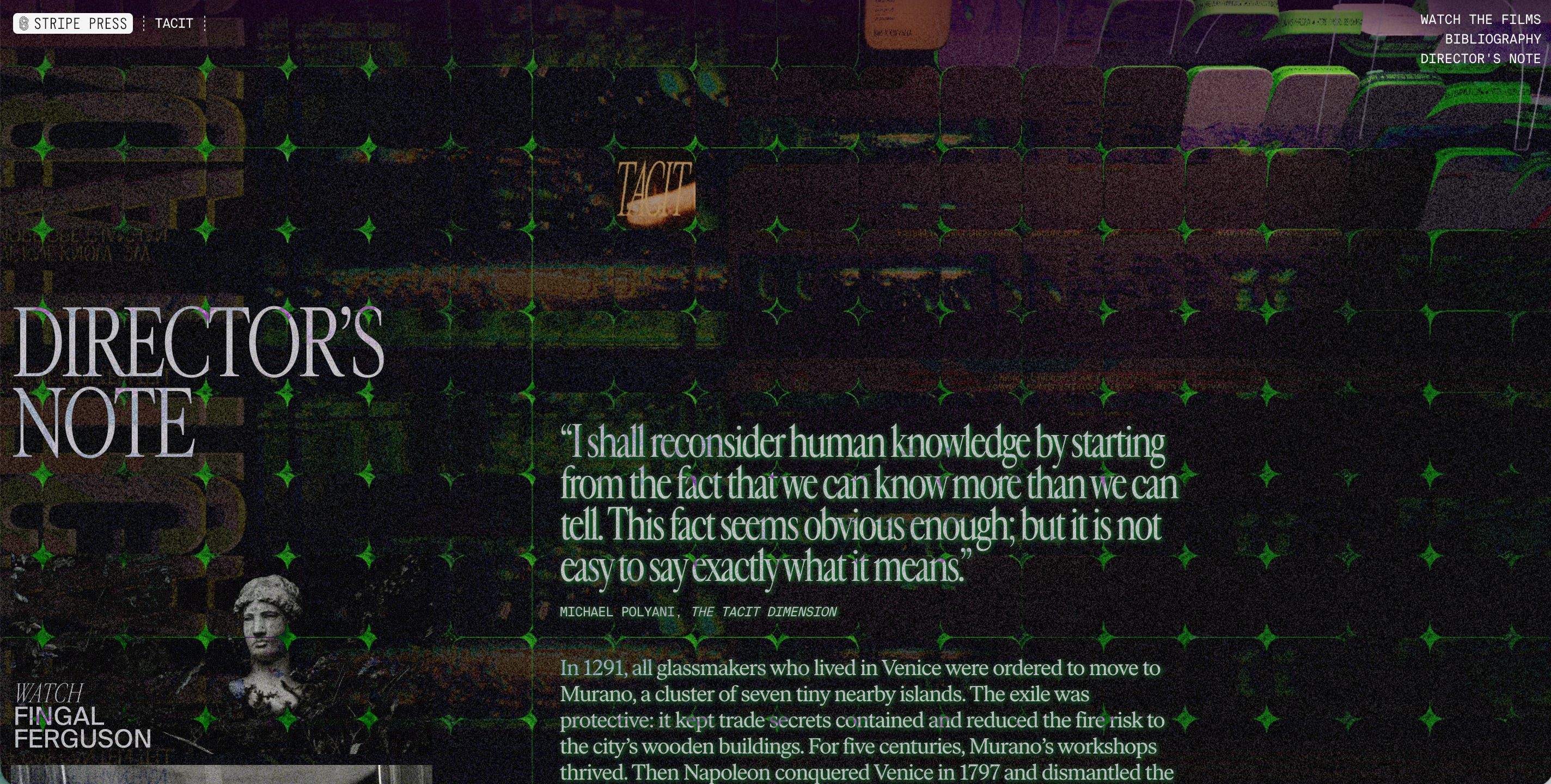
If you want to investigate this concept further, the concept now has its own beautifully-crafted website2, films and extended bibliography courtesy of Stripe Press, all of which showcase why it matters so much.
Increasingly, this kind of knowledge - time-consuming to develop, difficult to master and hard to transmit - is being positioned as the thing that will command ‘the human premium’ in a future where a great deal of other work might be supercharged or replaced by AI. William Baumol, the economist after whom The Baumol Effect is named, pointed out in 1965 that wages in the performing arts continued to grow, even though ‘the output per man-hour of a violinist playing a Schubert quartet in a standard concert hall is relatively fixed’3 in comparison to a lot of other technological progress. What the punters were paying for was the performance of a skill that it took a lifetime to master, and that kind of ability is unlikely to become irrelevant overnight, even in an era where capable AI harnesses can churn out consultancy-level research whilst you’re sleeping.
If you want to know what this belief in embodied skill looks like when you up the dramatic stakes, give it cinematic steroids and feed it millions of dollars, the answer is contained in this essay4 by Aled Maclean-Jones in The Metropolitan Review about the cinematic oeuvre of Tom Cruise - which makes a convincing argument that, in The World According To The Cruiser, people who have tacit knowledge (and can run very fast) are going to be the ones who save the human race.
But, as right as they both are, both Stripe Press and Tom Cruise are still missing a crucial part about why tacit knowledge matters.
As an enthusiastic experimenter with LLMs for a lot of things (none of them writing or creative thinking), I’ve also begun to grasp the strangely disassociated vision of work that they offer. When it’s possible to have a highly sophisticated model with intelligence too cheap to meter at your beck and call, the result is often that you feel the desire to have it grinding away in the background whatever you’re doing. But it also means that it’s never been easier to outsource your thinking into a stack of chips, model and data.
This can be an enormous boon, but as Marshall Macluhan stated, every augmentation is a form of amputation. A lot of the time, if we’re not careful, the result is not so much amplifying our thinking as a form of ‘cognitive surrender’ where we delegate it altogether. Even writers and thinkers who are enthusiastic users of AI are going back to treating ‘pen and paper’ work as the only proof of deep thinking and creativity untouched by AI inference, influence or interference. But the image of work in this AI era would have us imagine ourselves as Rick Rubin, the instrument-less maestro who never touches a creative tool but co-ordinates the entire vision, floating masterfully above it.
One criticism of this that I’ve written5 about before is that it displays a fundamental misunderstanding of where ‘thinking’ happens in creative work - it valorises vision and imagination, and ignores the vast amounts of thinking that occurs when people use their hands, minds and body to execute and craft their ideas. The infuriating thing about this worldview is not only that it mis-sells the many consequential ways that AI can and will add value to society, but it also confuses the friction of great craft with suffering, and it’s not possible to take the friction out of doing worthwhile work.
It also surrenders to the neo-Gnosticism which seems to animate much of modern techno-utopian thought which ‘regards the human spirit as residing “in” a body - as if the actual person were some sort of disembodied being who uses the body as an instrument but does not identify with it.’6
Doesn’t a world where we don’t use our bodies, our minds and our hands in unison seem a rather empty vision of what a life and its work can be? The unexamined life might not be worth living, but a disembodied one doesn’t feel that worthwhile either. And the relationship of much AI work to physical skill is about the same as that of porn to real sex.
So yes, it’s become increasingly common to argue that tacit knowledge is useful, and even economically valuable. But what about the sense of deep engagement that comes with truly losing yourself to something, however bad you are at it? What about the joy of mastery, or even competence? What about the fact that it’s pleasurable, or meaningful?
It’s common for capitalism to be characterised as brutal, faceless and inhumane - but it can also be found in the silent craftperson, head down, engaged in those thousand endless refusals of mediocrity out of which excellence, beauty and accomplishment emerge. George Saunders identifies this process of active micro-decisions as the place from which voice emerges in writing7. Great creative work is what care looks like in action, but at a certain point this isn’t just about the feeling of accomplishment that you get from the result.
As mathematician Terence Tao put it in a recent interview with regard to using AI to solve difficult maths problems: ‘these problems are like distant locations that you would hike to. And in the past, you would have to go on a journey. You can lay down trail markers that other people could follow, and you could make maps. AI tools are like taking a helicopter to drop you off at the site. You miss all the benefits of the journey itself. You just get right to the destination, which actually was only just a part of the value of solving these problems.8’
One of the evident side-effects of a digitally-dominant culture even before AI is that it’s increasingly common to find people consuming the stories and wearing the symbols of a particular realm of tacit knowledge, but who have skipped actually doing the thing: wearing outdoor-coded clothes and watching nature documentaries but never hiking or camping, racing jackets on every catwalk and soaring viewership of Drive to Survive but no-one learning to drive, etc etc. It’s never been easier to be ‘into’ something without ever practising it, because acquiring this knowledge is hard and frustrating even if it’s rewarding. The ability to tolerate difficulty and learn from it is a crucial component of true knowledge and skill acquisition, and it’s why we respect those who spend their time wrestling with it because they have skin in the game.
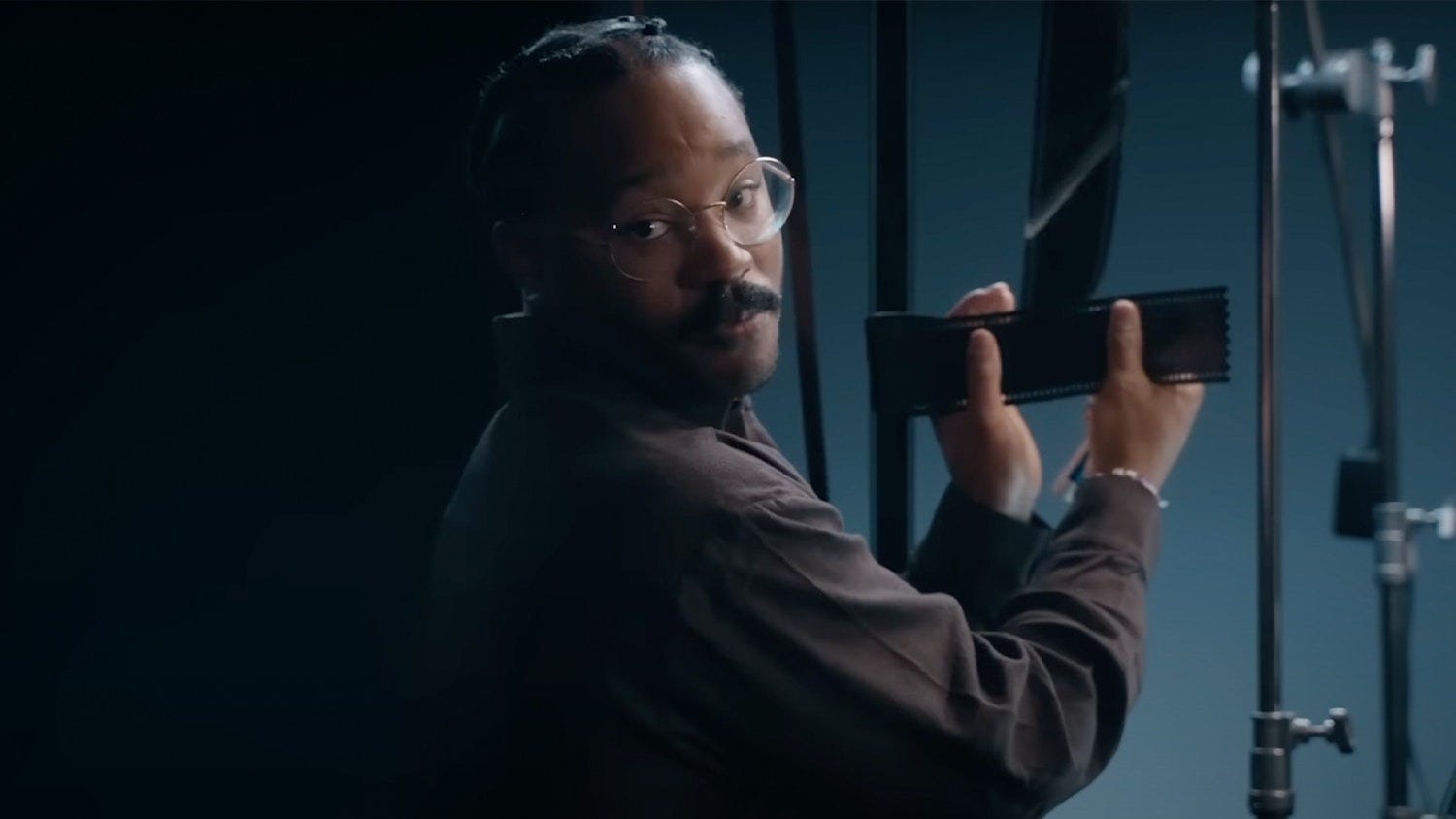
We’re already starting to see early signals of a cultural reaction to all this in the form of craft porn: material that showcases the painstaking levels of attention and effort that go into making something beautiful. This is what triggers the aesthetic awe at the cinematic nerd fodder on display when we sift through the archives of Stanley Kubrick, are dazzled by one of those Christopher Nolan craft nuggets circulating on the internet, or marvel at Ryan Coogler talking about film stock: we’re paying tribute to countless hours of frustration and a lifetime’s worth of patient study.
This kind of skill will always be societally valuable and compelling because there’s no shortcut to mastery - some people might get there quicker than others, and hours alone are no guarantee of excellence at anything, but acquiring this level of ability is fundamentally a question of what you’re prepared to devote your limited time on earth to doing and being.
And this type of knowledge is also the key to a deeper relationship with the world.
I was fortunate enough, a few weeks ago, to see a talk by the great British fashion designer Martine Rose, and one of the many nuggets that she shared during the session was her stating ‘I’m just fascinated by people, and the clothes are really only a means of me exploring that and getting to know them better.’
If you want to live more deeply and in a more engaged way, the kind of knowledge conveyed in videos, imagery and even books aren’t enough to gain a deeper understanding of the wonder and complexity of the world. Nabokov said that ‘in high art and pure science, detail is everything9’, but everything in the world around us is far more detailed than it seems, and the only way to get the measure of it is using your entire being to explore it one tool, hobby or task at a time. This is one of those universal truths which contains an endless range of sub-examples and genres, and once you grasp it even weakly, even a single human life seems too small to explore its vast array of potential applications and opportunities.
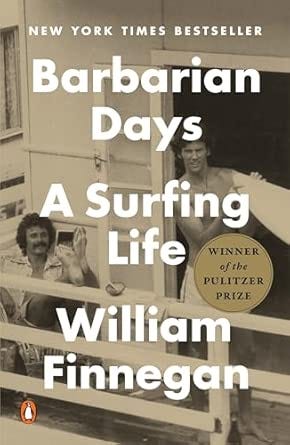
Trying to capture this tacit knowledge in action is, of course, the aim of a lot of great writing. The minute you become awake to it, you start to see it everywhere, such as in this masterful passage from William Finnegan’s surfing memoir Barbarian Days:
Nearly all of what happens in the water is ineffable—-language is no help. Wave judgment is fundamental, but how to unpack it? You’re sitting in a trough between waves, and you can’t see past the approaching swell, which will not become a wave you can catch. You start paddling upcoast and seaward. Why? If the moment were frozen, you could explain that, by your reckoning, there’s a fifty-fifty chance that the next wave will have a good takeoff spot about ten yards over and a little farther out from where you are now. This calculation is based on: your last two or three glimpses of the swells outside, each glimpse caught from the crest of a previous swell; the hundred-plus waves you have seen break in the past hour and a half; your cumulative experience of three or four hundred sessions at this spot, including fifteen or twenty days that were much like this one in terms of swell size, swell direction, wind speed, wind direction, tide, sea-son, and sandbar configuration; the way the water seems to be moving across the bottom; the surface texture and the water color; and, beneath these elements, innumerable subcortical perceptions too subtle and fleeting to express. These last factors are like the ones that the ancient Polynesian navigators relied upon when, on the open seas, they used to lower themselves into the water between the outriggers on their canoes and let their testicles tell them where in the great ocean they were. Of course, the moment can’t be frozen. And the decision whether to sprint-paddle against the current, following your hunch, or to stop and drift-gambling that the next wave will defy the odds and simply come to you, has to be made in an instant.
A lifetime in the water is compressed into a few short paragraphs here, and the book is full of these sort of nuggets.
Want more? Here’s certified motorhead Rachel Kushner10 about her son’s love of drag racing and car maintenance:
In the nostalgia scene, many work day jobs as welders or electricians, service technicians or carpenters. Brant Inglis is a gunsmith. These are all jobs that require what my father’s German motorcycle mechanic, Ziggy Dee, once referred to as Feingefühl: a fine touch. Feingefühl is receptivity and responsiveness, a kind of tact, even, a wisdom concerning one’s relation to objects: how much force to apply or not to apply, an ability to navigate nuance by feel.Those who work with their hands are constantly testing their Feingefühl. When a mechanic installs cam bearings in the motor they are rebuilding, intent on inserting them straight, they summon Feingefühl. When a pianist plays Prokofiev, they also summon Feingefühl. In many activities, not just music, there is an aural dimension to touch and tact. Talented mechanics are good listeners. They know the sound of a bad wheel bearing, or of an exhaust leak. These skills are not obsolete: there is a national shortage of automotive technicians, and companies like Ford are investing heavily in the NHRA, Brian Lohnes told me, to try to recruit young people. At Famoso, I’d met interns on Top Fuel teams from the local community college. Those students will find gainful employment as mechanics if they want it.
Others of us—myself included—do not think with our hands, and cannot respond to many of the signs emitted by the material world. Instead, our relation is passive. The world has come to invite this passivity. So much of it cannot be held or touched. It requires no refinement of our senses.
(One of the most enjoyable parts of this essay is her visible pleasure in her son’s skill at mechanical and musical work, and also his thinly-veiled contempt for his mother, one of America’s greatest writers, as a disembodied knowledge worker. All this proves to me is that no child will ever understand that their parent is cool).
Writers in particular revere this kind of mastery because specialised domains of skill offer an entire new vocabulary and lens through which to look at the world - and also because even if great writing is in itself a form of tacit knowledge, writers are often paying verbal tribute to areas of experience where words seem to fail, or at least to be inadequate. As the son of an engineer and the grandson of a mechanic and toolmaker, perhaps this essay is merely a little boy paying tribute to his father and grandfather’s ability to understand the world by taking things apart and putting them back together again.
But we feel the tacit knowledge represented by great writing not only in our minds, but as a sort of bodily ache of jealousy in the chest. And it’s not just useful for creating literature, it’s also helpful in shaping personality too.
These kind of skills might make you economically irreplaceable or calm your anxiety or make you more likely to survive the end of the world, but a life in pursuit of tacit knowledge is also a meaningful one, where you find out who you are.
Popular culture seems to sometimes offer us two key methods to self-creation: one is in therapy, where we excavate the real self by tunnelling inward to the true core of our inner being; the other is the sort of joyless grindset ubermensch self-mastery where we forswear pleasure and burn away extraneous distractions in pursuit of some grand world-changing goal, until the hard diamond centre of our actualised being is revealed.
But an expanded notion of who we are is just as likely to be found in the swing of a racket, the thud of a right cross hitting a punchbag, the pluck of a string, the stroke of a brush, as it is somewhere in the recesses of our psyche. If the self is not discovered but created, then acquiring tacit knowledge might not be the easiest way to spend your time, but it’s still a remarkably powerful route to expanding your notion of who you are. The world might be a museum of passion projects, but so is the self - or at least, a Wunderkammer stuffed full of hobbies and interests.
By this stage of the year many of the good intentions, resolutions and hobbies that people swore to stick at as part of New Year New You programmes have already been abandoned. It’s habitual to sniff at people taking up and giving up new hobbies that founder before January is out, but it’s as effective a method as growing a character as any other.
I have been, over the course of my life, a terrible poker enthusiast, a mediocre practitioner of many sports including hockey, rugby, tennis and football, a focused but technically dire film photographer, a committed but limited guitarist, and am now a persistent trainee pianist11. Learning any one of these skills is the work of a lifetime, and very few people ever taste the rarefied and pure oxygen of mastery.
But a life spent in pursuit of tacit knowledge is one where you’re unlikely to look up and wonder where the time has gone - the fruits of it will be scattered throughout your world as poorly-thrown pottery, moments of dance, and bouts where you got battered by a better fighter. Even in eluding us, it leaves as its vapour trail the sort of objects, moments and accomplishments out of which a good life is built.
The choice that we are being offered, over and over again each day, is whether we want to live a facsimile of life mediated through a handheld screen, or one where we get to be a body doing something, however badly and inefficiently. If you’re worried about the state of the world, pick up a tool, focal object or sporting equipment, and let your body do the thinking.
Michael Polanyi, The Tacit Dimension
https://www.stripe.press/tacit
https://www.economist.com/finance-and-economics/2023/05/23/what-would-humans-do-in-a-world-of-super-ai
Elaine Pagels, The Gnostic Gospels
George Saunders, A Swim In The Pond In The Rain.
Javier Marías, Written Lives
(As well as a writer whose skills you, dear reader, may judge)
No posts
Comments
Nothing yet. Say the first thing.
Sign in to join the conversation.