

Fast forward fifty-eight years, and fifteen minutes seems like quite a long time when many people struggle to pay attention for fifteen seconds. Ease of transmission is The Internet’s Darwinian Law of Natural Selection: only things flashy or interesting enough to be memed survive. Much of what dominates our attention - whether that’s art, celebrities, or politics - lives or dies by whether it’s easy to grasp, play with and share.
What if there’s another way?
For those seeking an alternative, I’d recommend picking up a copy of Antimemetics by Nadia Asparouhova1. It asks a deceptively simple question: what if some of the most interesting ideas are somehow resistant to being transmitted? Do truly influential ideas come with friction, drag and forgettability written into their DNA?
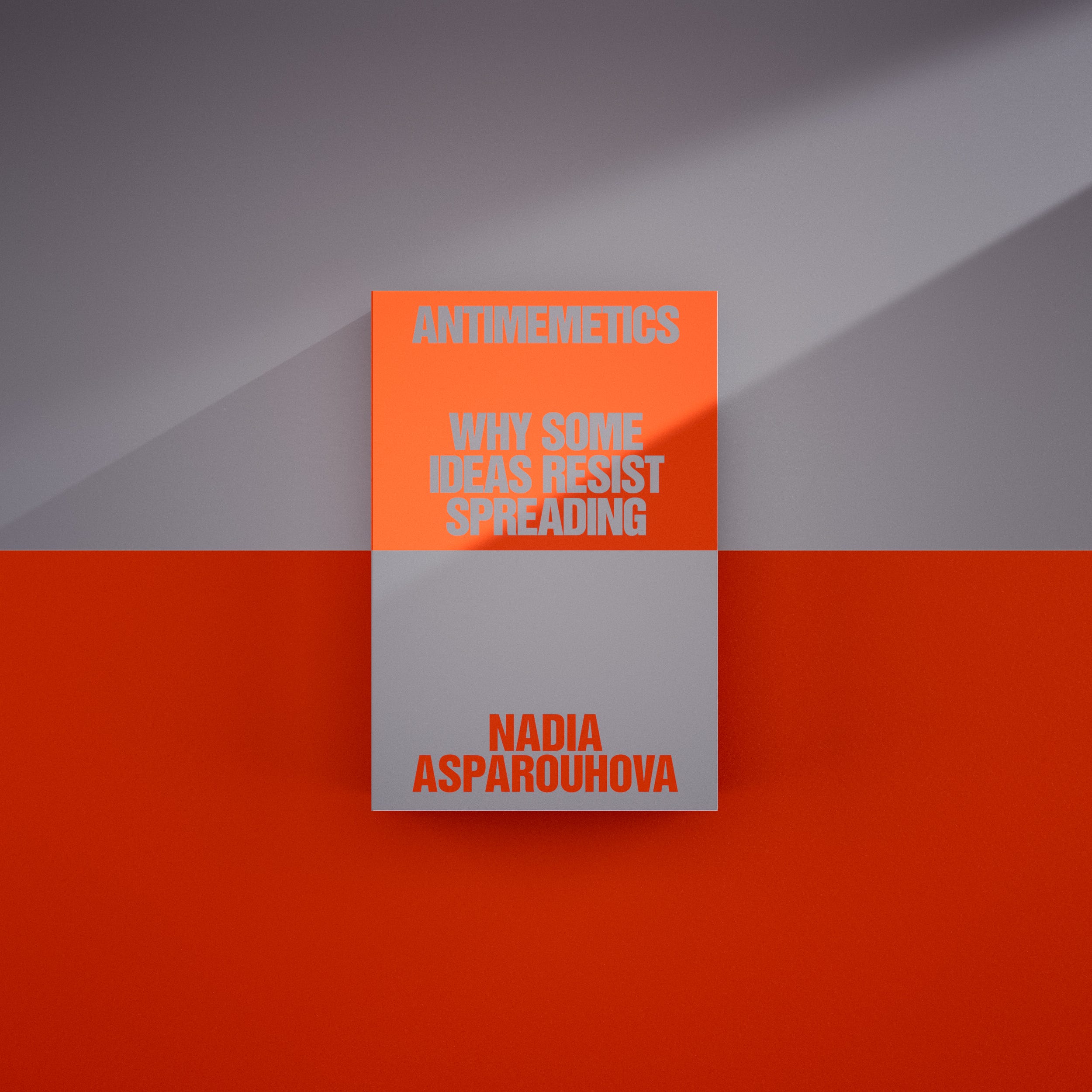
Anyone who’s spent any time online knows that, because of the way the modern web works, the sort of things that get metabolised quickly on the internet are often the intellectual equivalent of empty calories. The problem is that they suck our attention away from a far more complex and valuable strain of idea that doesn’t dominate the limelight in the same way: Asparouhova christens them Antimemes.
Antimemes are those half-formed thoughts, notions and phrases that more easily shareable things will often distract us from.
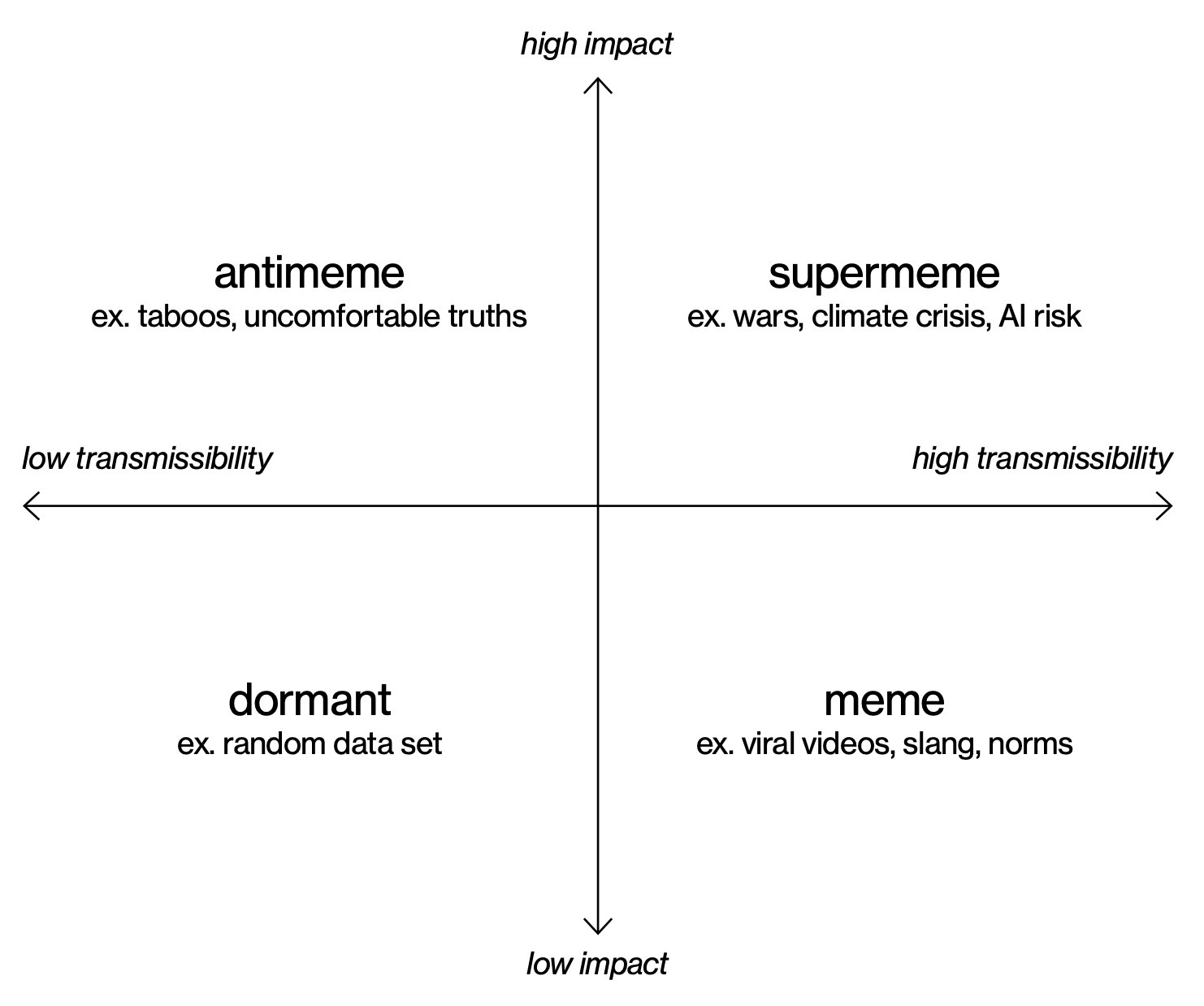
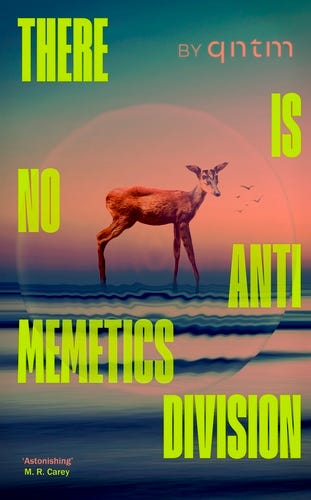
Anti-memes are often those unspoken truths, ignored insights and difficult-to-articulate notions that sit just outside our field of vision, or which people are unwilling to discuss for fear of social censure. Asparouhova has borrowed the idea from the excellent and deeply unsettling science-fiction novel There Is No Anti Memetics Division, which centres around a extra-governmental organisation that deals with ideas that humans cannot look at or know about without disturbing consequences.
Antimemes aren’t always taboo, they’re often just hard to remember or have some form of temporal forgettability or obsolescence built into them. The importance of Nuclear Power, the low adoption of handwashing and the abolition of Daylight Savings Time are all ideas that are hard to keep people engaged with.
The consolation for your idea not going viral might be that it actually requires people to think about it. Anti-memes are influential because they demand slower processing - this leaves space for nuance, intellectual exploration beyond simple binaries, and for actual discussion rather than trench warfare between factions dug very deeply into rival ideological positions.
In exploring all this, she builds off The Dark Forest Theory of The Internet, in which Yancey Strickler proposed that ‘people are in retreat from the supposedly open platforms of the internet in favour of places that offer a more forgiving space for communication than the internet at large……spaces where depressurized conversation is possible because of their non-indexed, non-optimized, and non-gamified environments. The cultures of those spaces have more in common with the physical world than the internet2.’
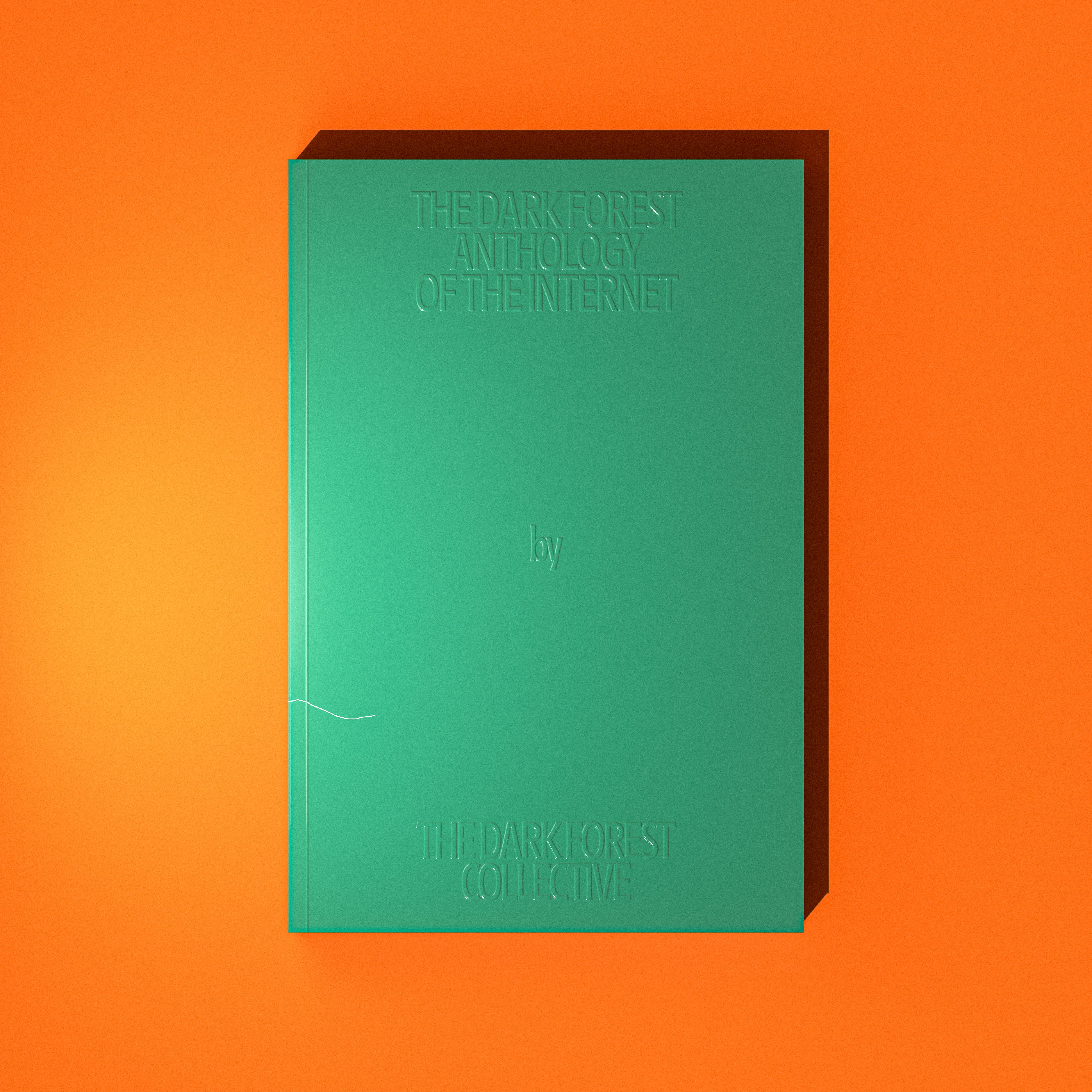
Newsletters, podcasts, Slack channels, private Instagrams, invite-only message boards and other corners of the ‘cozy web’ are all Dark Forest Spaces. The firehose of slop some people are using AI to generate is likely to accelerate the retreat into these spaces where we know exactly whom we’re talking to, and so they’re likely to be the best places to hunt for interesting antimemes. Putting antimemes into the public sphere before they’ve had a chance to develop risks compromising them.
One implication of all of this, which you might consider either depressing or simply pragmatic, is an abandonment of the trial-by-combat which has characterised liberal notions of how ideas should be tested, debated and assessed in public for hundreds of years:
Why share your thinking with anyone if tribalism means they’ll automatically be so hostile to your idea that they will never change their mind, and the only result is yet more tiresome arguments?
As an alternative, Asparouhova lays out a new playbook for influence: rather than engaging in the futile open conflict of out-shouting rival tribes to ‘win the argument’, smarter thinkers are now taking a different approach. The most influential ideas are now incubated in walled-off digital spaces where they have room to develop, spread between adjacent private groups, and emerge onto mass online platforms once they’ve germinated across multiple smaller conversations, having seemingly gained widespread acceptance.
The upside to this approach is that it offers an alternative to conflict and ragebait as the easiest routes to engagement online. The downside? If interpreted the wrong way, it just shifts us from thinking about ourselves as frontline footsoldiers in information conflict, to savvy influence operatives in The Mimetic Cold War Era. In an interview a few years ago, the head of the UK’s National Cyber Force claimed that they aimed for ‘cognitive effect’, stating that “the intent is sometimes that adversaries do not realise that the effects they are experiencing are the result of a cyber operation3,’ and a cynical mode of adopting the antimemetic approach might lead you to a similar place very fast. However, I don’t believe that’s the intent of this book, and the phenomenon that it identifies raises some other interesting questions.
If you’re interested in generating or spreading ideas, this book offers a new set of questions to assess them: is this thing a meme or anti-meme? Is it a badge of exclusivity or the online equivalent of a water-cooler moment? Do we want it to spread openly, or should people share it as if it’s a secret? Would we like people to hear about this idea on mass platforms or discover it hidden at the bottom of a comment thread? Is there a particular window of life when people might be made to care about this, and how do we build long-term consensus about it if that’s the case?
I haven’t read anything in a while that provides such a fresh set of questions to ask not only about an idea’s conceptual or intellectual character, but its outer wrapping, intended audience, and where it might best be discussed.
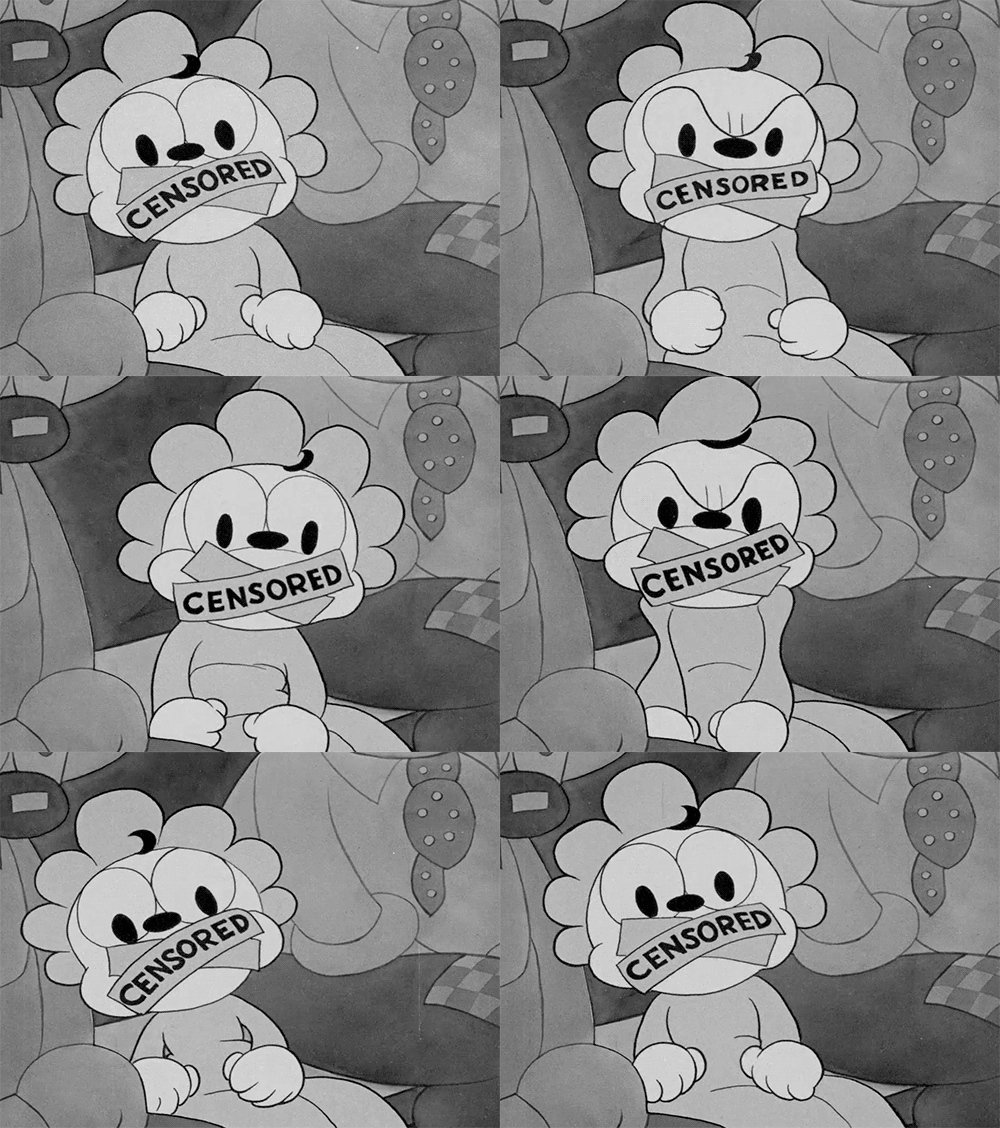
In her book ‘Anthro-Vision’ Gillian Tett explores how the conversational spaces that people deliberately ignore are often where the most important and valuable ideas lurk, and one of her key anthropological tools is to ‘listen for the silences’ in any conversation. Antimimetic ideas are likely to be those overlooked or under-discussed things that people feel unable to express publicly without social consequence, and so those of us hunting for them would do well to pay close attention to the things people can’t or won’t discuss openly. Dangerous ideas sometimes like the cover of the shadows, not the limelight.
This latest turn in online behaviour elevates the importance of a private internet to something close to sacred. If, in an age of pervasive online surveillance, privacy is now one of the ultimate luxuries for the wealthy, the ideological or creative version of that starts to look like a digital space for your ideas to be discussed without them being attacked by a hostile public.
We need privacy to think clearly, and the minute our thoughts are exposed too early in too large a forum, we risk them bent into a different shape to please the crowd and/or algorithms.
Interestingly, the anti-viral model for influence laid out in this book was echoed by MSCHF’s Gabe Whaley in his Dialectic interview with Jackson Dahl 4a month ago: viral fatigue sets in when the only possible route for an idea or thinker is to keep trying to ramp up scale and reach to bigger and bigger audiences, and eventually they have to pivot to building deeper connections with smaller audiences that might have longer staying power.
If one of the attention economy’s most artful hit factories is moving away from going viral, has it become passé or merely unsustainable?
This book also made me consider the benefits and drawbacks of being a meme or antimeme. For an example of this, consider UK politics: Boris Johnson’s absurd hair, verbal playfulness and constant tinge of absurdity mean that he an incredibly memorable and memeable politician. Keir Starmer, with his eminence grise seriousness, nasal voice and seeming unwillingness to do anything slick or show-y, is in danger of becoming a human antimeme despite being the most powerful person in the UK. You don’t want a human meme running your country, and you don’t want a political antimeme on the campaign trail.
One of the most intriguing sections in this book explores the way that important ideas can be painted in a creative veneer that discourages people from looking at them too much, which can work either to their benefit or detriment. One way is to make dangerous or provocative ideas seem acceptable by smuggling them inside more palatable metaphors: Asparouhova admits that her last book Working In Public5 explored some rather difficult questions about democracy by using an extended history of open-source software to surface them.
The inverse way of doing this is reframing promising ideas from opponents in a way that renders them conceptually toxic: Sarah Palin christening end-of-life counselling as ‘Death Panels' to stoke opposition against The Affordable Care Act is one such example.
I, personally, would have liked this section to be a whole chapter of the book, and if anyone has any I’d love to hear them.
The model this book lays out for developing ideas appears more like a fandom or community-first model, where we can experiment with and shape different ideas in partnership with a trusted group. That reduces the chance of shallowing out our ideas to increase its chances of large-scale algorithmic engagement, but it does risk making us prey to another audience effect: reinforcement bias and filter bubbles
What about the dangers that we’re just talking about our ideas to a group of like-minded people who are never going to disagree with us? What’s the ideal shape or size of audience for proper ideological discussion and debate, and where does it happen best? How do you mix the support of the cozy web with the proving grounds of the open web? When is an idea ready to migrate from the Dark Forest onto the wide open avenues of mass social media? Combining these two forums is the best way to avoid the pitfalls of both.
In an era of low attention, this book makes a clear case for the role of friction in the role of cognition, and therefore to intelligence.
If the most interesting and important ideas are in some way counter-intuitive, are often hard to define, and are buried in less obvious places, then the power to consider, shape and find them is going to coalesce amongst those able to tolerate intellectual friction. This means that many of the most important ideas that will shape our future may have a cognitive selection effect built into them, and might not easily spread beyond a particular sort of person. It’s in most people’s interest to try and be one of those people, and if you’ve made it this far, perhaps you’re one of them6.
I found this book an engaging read which reframed how I thought about the kind of ideas worth spreading and sharing. It places its author in company with Joshua Citarella, Trevor Paglen and various other people dissecting the state of internet culture and influence in a way that helps us make sense of it all, and perhaps act like citizens of the connected age rather than collateral damage in online conflicts.
Reading it, we can start to conceive of ourselves less as passive consumers of the fleeting garbage, and instead as careful cultivators of fragile notions that might not yet be ready for the limelight.
If nothing else, it’s an encouragement to think very carefully about what ideas you’re generating, incubating and transmitting in those group chats and interactions with close friends and communities. They might be private today, but tomorrow they could have a great deal more influence than you ever imagine.
This book is a great example of Metalabel acting as The Official Platform of Record for Antimemetic Ideas.
https://www.economist.com/britain/2023/04/04/cyberwarfare-is-all-in-the-mind-says-britain
https://press.stripe.com/working-in-public
Please DM me for a special prize
No posts
Comments
Nothing yet. Say the first thing.
Sign in to join the conversation.