
janv. 14, 2026
For the first time since the advent of modern search engines, the direct correlation between a brand’s visibility and traffic to its website is broken.
SEO World: Visibility = Traffic. Being seen = being clicked.
New GEO World: These two metrics are decoupling.
This is the Visibility Without Traffic paradox: “the great decoupling.”
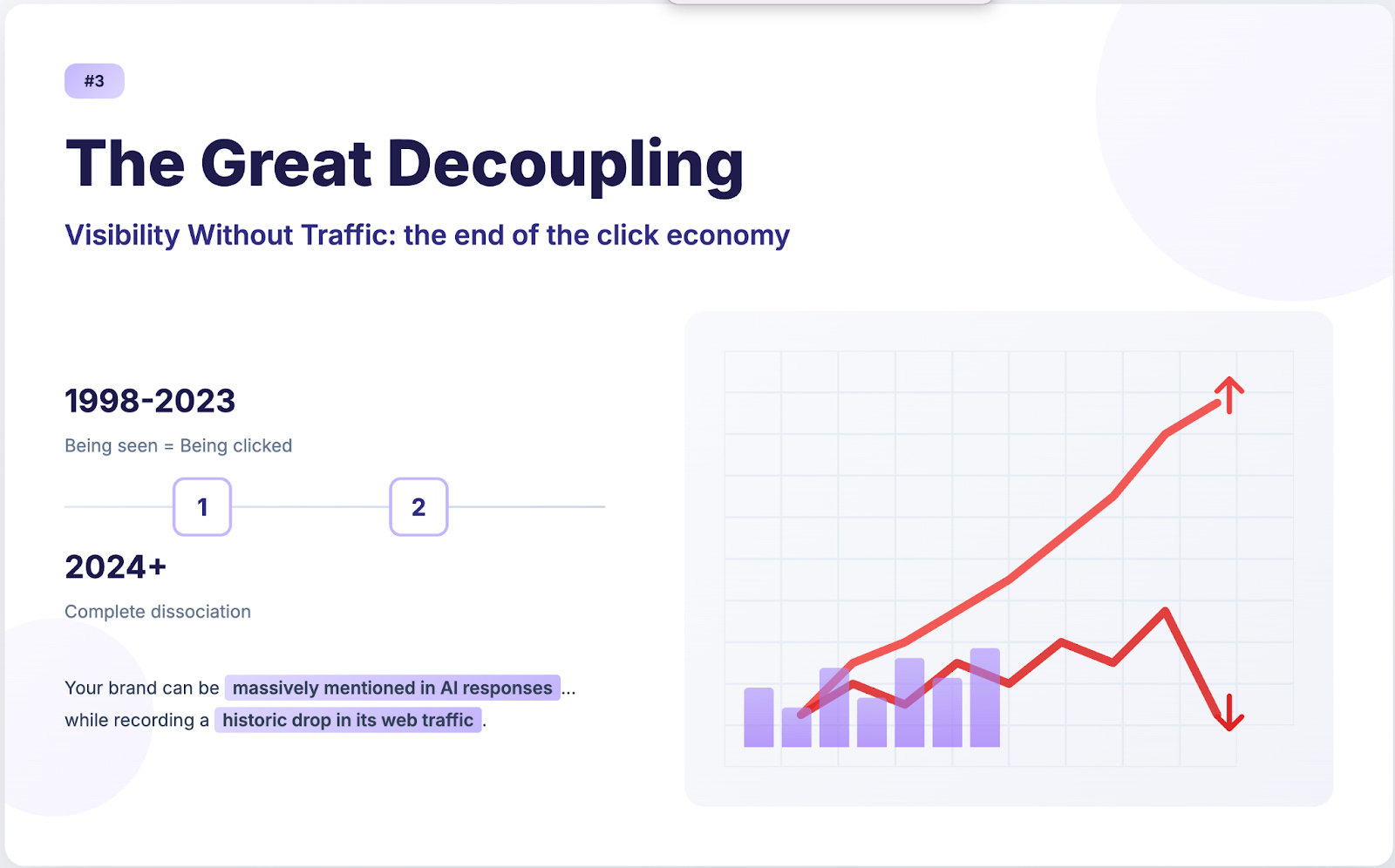
Your brand can be:
Massively mentioned in AI-generated responses (high visibility)
Synthesized and exposed to millions of users via ChatGPT, Perplexity, or Google AI Overviews
Recommended as the reference for “the best payroll software” or “the best credit card”
Cited as a source of truth in thousands of responses
... all while recording a historic drop in web traffic.
Your content serves to build the answer, satisfies the user, but generates no visits.
And you’re not even aware!
An example?
A user asks ChatGPT: “Compare HubSpot and Salesforce for an SMB.” The AI performs the analysis, compares features, evaluates pricing, recommends HubSpot, and the user closes the tab satisfied.
HubSpot won the interaction
Salesforce lost
Traffic to the sites? Zero for both
Your Analytics shows “no impact,” but reality shows a sale potentially lost or won. These are millions of micro-influence transactions now happening “out of sight,” in what we call the Invisible Funnel – a conversion tunnel that traditional attribution models are unable to measure.
The brand “won” the interaction, influence was exerted, brand preference was built, but the website remains deserted.
In other words, if you’re only measuring traffic, you’re steering your strategy in the dark.
This is the Billboard Effect.
Millions of people see your brand in the AI’s response. They don’t click, but they imprint your brand in their minds. Users treat AI responses as factual summaries. They scan the content, memorize the cited brand, but don’t click immediately.
The value has shifted: it no longer resides in the site visit (immediate conversion), but in the influence exerted upstream, at the moment of reading the response.
If you cut the budget because “clicks” are dropping, you disappear from their minds and lose the consideration battle.
The Pew Research Center reports a striking figure: while users say they’re satisfied with AI summaries, only 1% of them click on the citation links included in these summaries.
What a paradox? Traffic drops, but the quality of that traffic increases.
Data shows that visitors coming from conversational experiences (LLMs) can have conversion rates up to 6 times higher than traditional Search.
The user who arrives on your site after an AI interaction has already:
Asked their follow-up questions
Refined their need
Validated your credibility via the engine’s synthesis
Compared alternatives
They’re no longer coming to search, they’re coming to act.
The clicks that survive this filtering are no longer curiosity or discovery clicks, but high-stakes transaction or verification clicks (particularly in YMYL domains - Your Money Your Life).
Volume drops, but the intent behind each remaining click is exponentially stronger.
If you’re steering your strategy on traffic volume, you’re blind.
Your Analytics shows “no impact” while millions of micro-influence transactions are happening out of sight.
You risk cutting the budgets that build your authority while your competitors silently dominate the citation space..
This rupture isn’t theoretical. It’s happening now.
→ 12-24 month horizon: Gartner predicts a 25% drop in traditional search volume by 2026. If your business model relies on organic traffic to fuel your pipeline, you have 12 to 24 months to react before irreversible impact.
→ Explosive adoption: 52% of American adults already use LLMs. To contextualize this speed: generative AI is reaching critical mass faster than mobile. The smartphone took 10 years. ChatGPT reached 100 million users in 2 months.
→ B2B: 95% of buyers plan to use generative AI in their purchasing journey this year. This is no longer experimentation. It’s default behavior.
Your exposure depends on your model. No one is immune.
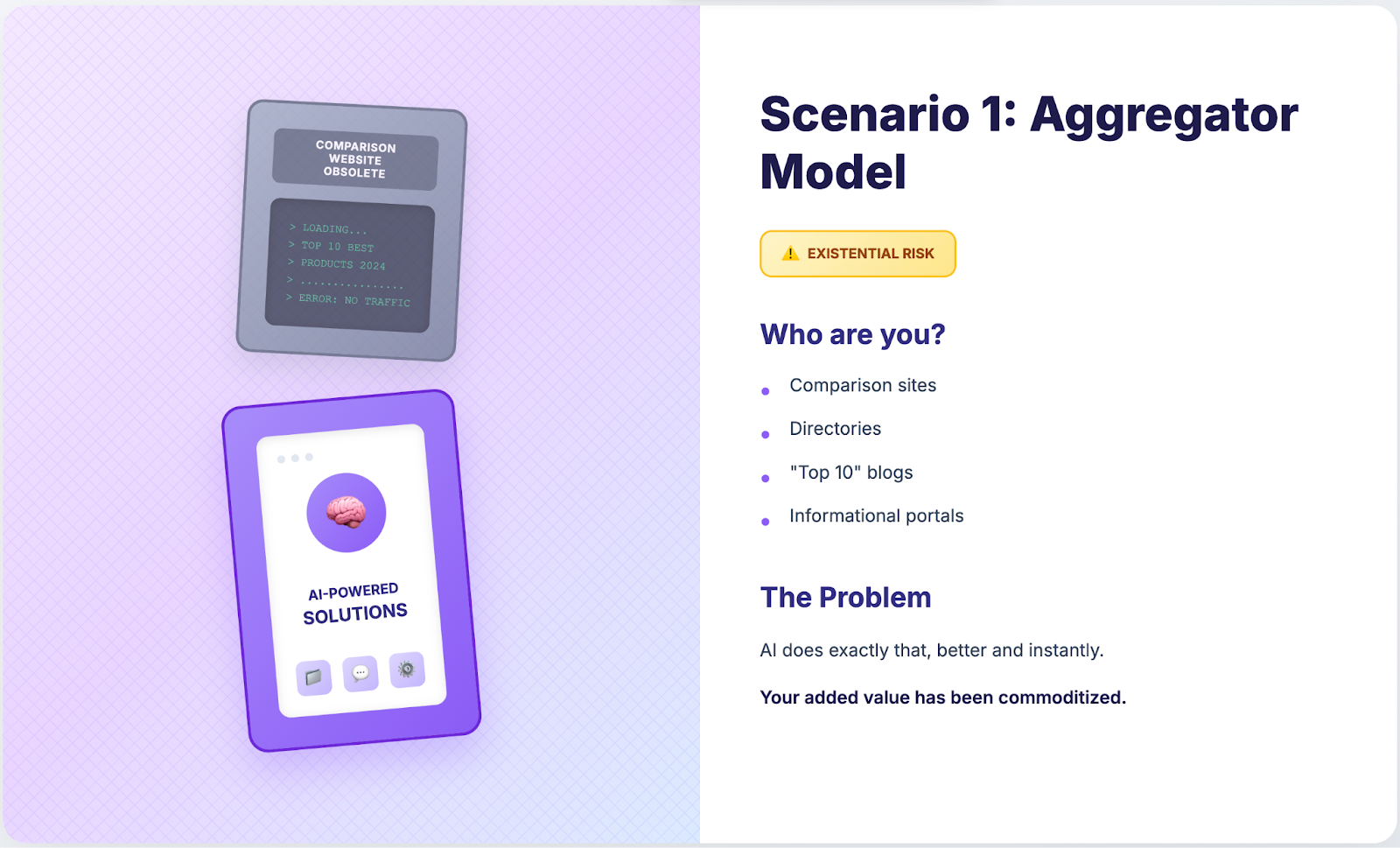
You are: Comparison sites, directories, “Top 10” blogs, informational portals living off discovery traffic.
Your historical value: Gathering scattered information and presenting it in an organized way.
The problem: AI does exactly that, instantly and better. Your added value is commoditized. Users no longer come to your site for a list. They ask the AI: “Compare the 5 best CRMs for an SMB” and get a synthesized answer in 10 seconds.
The impact: Your model relies on volume and ad impressions. A 25-40% traffic drop (already observable) collapses your revenue proportionally. You don’t have 24 months. You have 6-12 months to pivot.
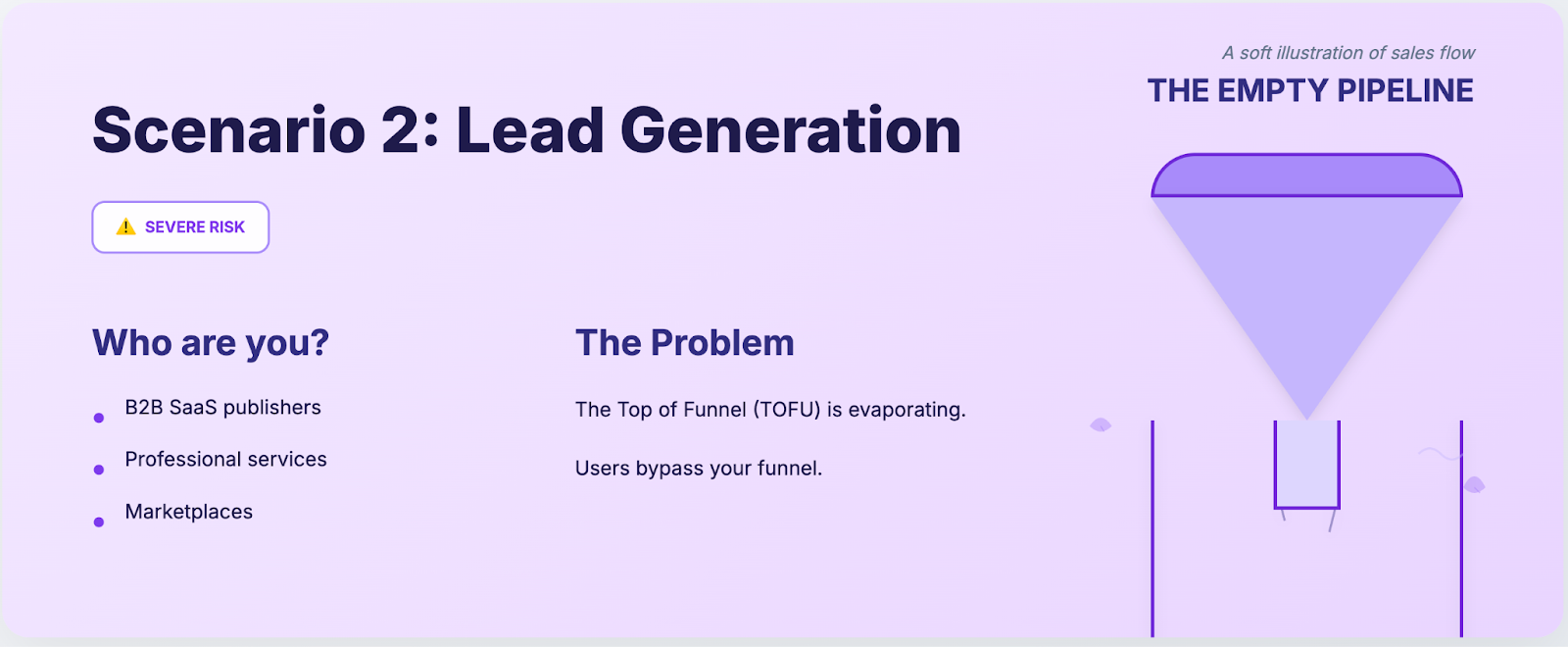
Who are you? B2B SaaS, professional services, marketplaces dependent on organic traffic to fuel the funnel.
Your historical value: Capturing attention at the top of the funnel with informational content, then converting to leads.
The problem: The Top of Funnel is evaporating. Informational queries (”What is a CRM?”) are satisfied directly in the AI interface. Users no longer enter your funnel. They bypass it.
The impact: If organic represents 40-60% of your leads, your CAC will explode. You’ll have to compensate for lost free traffic with expensive Paid. Or not compensate and watch your pipeline dry up.
The attribution trap: AI influences your prospects upstream (invisible). They arrive as “Direct” (visible). You attribute success to the wrong channel. You risk cutting budgets that work — expert content, digital PR — because they no longer generate measurable direct clicks.
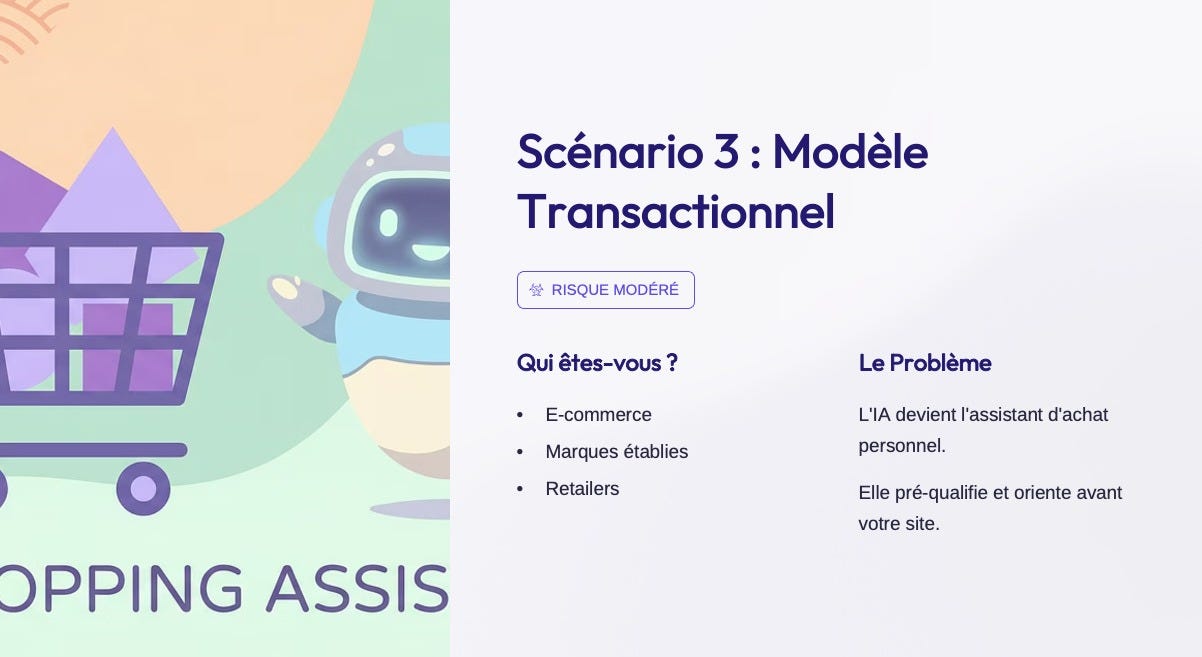
Who are you? E-commerce, established brands, retailers selling directly.
Your historical value: The final destination to buy.
The problem: AI becomes the personal shopping assistant. It pre-qualifies, compares, guides the decision before arrival on your site. If your brand isn’t cited in this initial conversation, you don’t exist in the “consideration set.”
The impact: You don’t necessarily lose total volume. You lose market share to brands that AI systematically recommends. If your competitor dominates AI citations, they capture a disproportionate share of qualified intent.
The Long Tail risk: You historically captured traffic on thousands of niche queries. AI aggregates these niches and recommends 2-3 dominant brands. If you’re not in that top 3, you disappear.
Facing these clearly identified risks today, a classic mistake:
Treating GEO as just another acquisition channel.
GEO isn’t a tactic. It’s a redesign of your marketing infrastructure.
The question to ask yourself to address one of these three risks is no longer “if” but “when” you’ll be impacted.
And above all: do you have a plan before your competitors dominate the citation space you’ve spent years building?
🟣 I’m Karine. I help you adapt your content strategy to AI Search and GEO through a masterclass and a community focused on AI marketing. The next session of my GEO masterclass in english will be in May. Want to join?
No posts
Comments
Nothing yet. Say the first thing.
Sign in to join the conversation.