
Karine Abbou June 04, 2025
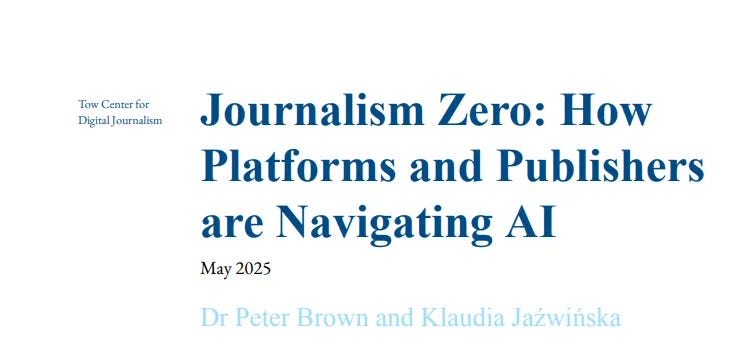
* What: The report titled “Journalism Zero: How Platforms and Publishers are Navigating AI”
By Whom: Tow Center for Digital Journalism - Dr. Peter Brown & Klaudia Jazwinska
In Brief: Report examining the evolving and often tense relationship between news publishers and tech companies, particularly in the context of generative AI’s rise. Based on 34 interviews with news leaders, former platform executives, AI company representatives, and AI experts, conducted between May and October 2024, the report assesses the current state of this relationship and explores the hopes and fears surrounding AI’s impact on journalism.
Other link to help you: I detailed quite a bit what I think of this report and especially what media could transform this (major) source of annoyance from the constant (and apparently limitless) traffic drop into opportunity in my monthly newsletter on LinkedIn.
👉 AI Marketing News Wrap-up (06-01-2025) - that is June 1st last (for the date in English).
The report acknowledges a “long and strange journey” for news leaders in their interactions with tech companies, marked by failed products, ill-advised strategies, and inadequate financial support from platforms. Publishers have learned to be wary, with a refocusing on direct relationships with their audience after “the platform affair” proved to be a distraction.
While giants like Google and Meta (Facebook) have reduced their focus and investments in news initiatives, new AI-based platforms like OpenAI and Perplexity have emerged, alongside increased involvement from Microsoft. This shift has introduced new dynamics and new challenges.
Internal Use: Newsrooms are experimenting with generative AI for tasks such as data analysis, content reformatting, translation, and draft writing. However, concerns about lack of reliability (”hallucinations”) and potential brand damage mean most are cautious about public-facing AI products.
External Threat and Opportunity: The most contentious issue is AI companies training large language models (LLMs) on vast amounts of published journalism, often without permission or compensation. Generative search products that summarize news on the platform reduce referral traffic to publishers, a major concern.
A central fear is reaching “Journalism Zero”—a point where the links between journalism and its audience are completely broken due to disintermediation by AI platforms. This could have disastrous consequences for the news industry and the information ecosystem.
This is a major battlefield. The New York Times lawsuit against OpenAI and Microsoft is a highly publicized example. Many publishers feel their content was stolen, while AI companies invoke fair use or now pursue licensing agreements.
Value Precedent: Some see agreements (e.g., OpenAI with Axel Springer, Associated Press; Perplexity with TIME) as establishing that journalism has financial value for AI.
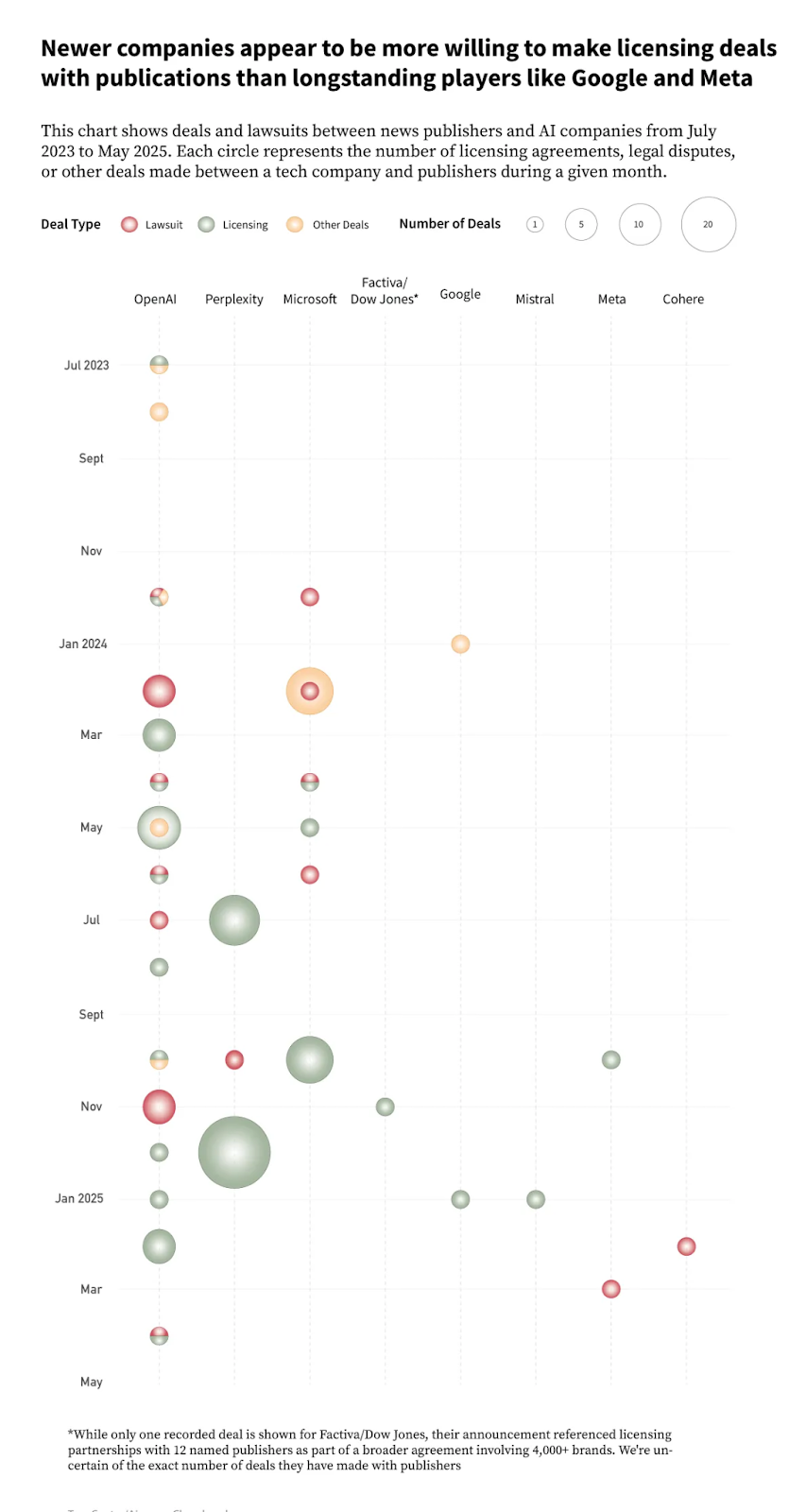
Exploitation Concerns: Others view these agreements as AI companies preying on news organizations’ precarious financial situation, offering “hush money” or “non-prosecution deals” without addressing long-term implications or fair compensation for past use. There’s a lack of transparency regarding terms.
Strategic Considerations: Agreements often involve access to archives for training and real-time content for grounding. Publishers weigh short-term money against long-term brand dilution and disintermediation.
The old model of platforms offering traffic in exchange for content is collapsing. AI summaries reduce click-through rates. Publishers demand a new value exchange that includes retrospective compensation and fair terms for continued use of their content. There’s a fundamental disagreement about journalism’s value, with tech companies often undervaluing its societal impact.
Publishers are already seeing a decline in referral traffic from traditional search and expect this to worsen with “AI Overviews” and generative search. This is an existential threat for many, pushing them to further strengthen direct relationships with their audience (e.g., newsletters, apps, subscriptions). Some even adopt a “Google Zero” mindset, planning for a future without referral traffic from search.
Many publishers are blocking AI crawlers, although the effectiveness of robots.txt is debatable, and some AI companies would bypass these measures.
Publishers need more granular audience data from AI platforms to understand impact and value, but historically, tech companies have been reluctant to share.
Past experiences have bred skepticism. Publishers fear repeating mistakes.
The rapid pace of tech development contrasts with news’s deliberative nature.
Tech’s focus on “scale” (doing more with fewer staff) clashes with journalism’s mission-driven approach.
Early signs of distrust include AI companies’ lack of transparency regarding data scraping.
Among Publishers: Many interviewees emphasized the need for news organizations to collaborate, share knowledge, negotiate collectively (if possible), and present a united front.
With AI Companies: Some hope for genuine partnerships where tech companies would help news organizations innovate, rather than simply extracting value. However, skepticism remains high.
The report concludes that the landscape is shrouded in uncertainty, depending on legal battles over copyright, government intervention, AI technology evolution, and changes in audience behavior. The concentration of information control among a few private companies poses significant risk to democracy and media plurality.
In essence, the report depicts a news industry at a critical juncture, grappling with generative AI’s disruptive power, wary following its past encounters with tech platforms, and fighting for its value and future viability in a rapidly changing information ecosystem.
The full PDF: Journalism Zero_ How Platforms and Publishers are Navigating AI_0.pdf
The article introducing it and providing detailed analysis
No posts
Comments
Nothing yet. Say the first thing.
Sign in to join the conversation.