

According to a report from The Information, OpenAI is considering advertising formats where AI models would “prioritize sponsored content” directly in generated responses, offering preferential treatment to paid information.
Internal mockups show several approaches:
Sponsored information displayed in a sidebar.
An explicit disclosure indicating that results include sponsored content.
Contextual ads appearing after the conversation starts, only when the user digs deeper into a topic (stronger intent).
Although an OpenAI spokesperson assures that any approach will “respect the trust relationship” with users, the SEO community (cited via Glenn Gabe) worries about seeing factual responses biased by commercial imperatives (”Oof...”). Nothing is set in stone, but the direction is clear: ad monetization is coming, and it could touch the very heart of response generation, not just the packaging.
✍️ Author: Barry Schwartz (Seoroundtable)
📎 ChatGPT Ads May Prioritize Sponsored Content In AI Responses
Okay, I’m literally falling off my chair here. This reminds me of the early days of Yahoo! (yes, I know, writing that doesn’t make me any younger). Remember their homepage? You’d type a query and land on a page full of links where you knew perfectly well that whoever paid the most was sitting at the top of the pile. Remember what happened next?
Google showed up, first as a white-label for Yahoo, and then... BOOM. Larry Page arrives with his PageRank and his list of “naturally” referenced links. Just because the black box algorithm deemed it the best content. No check, just relevance.
The irony of history? 20 years later, Google became the boss of the web (which it ended up monopolizing) and now the big boss of the AI-(re)generated web — being the first to scrape all the content it taught us to create for two decades.
Yes, we must give OpenAI credit for being the UFO that triggered this historic shift from one web to another. But if the future according to “Uncle Sam” (Altman) really is to inject sponsored responses into results like in the pre-Google era... then I don’t understand anything anymore.
Google is suing SerpApi for using methods described as “malicious” (cloaking, massive bot networks, fake crawler names by falsifying IP addresses to pass as human users) to bypass the search engine’s security protections. The complaint details how SerpApi circumvents “SearchGuard” with these “malicious” techniques. In essence, Google accuses the Texas-based company SerpApi of generating hundreds of millions of artificial searches to pillage its results pages. The central accusation is that SerpApi ignores website directives (like robots.txt) that Google respects, thus depriving publishers of control over their content. SerpApi is accused of retrieving and reselling content (enriched data) for which Google pays costly licenses (Knowledge Panel images, real-time data, maps), violating third-party rights.
✍️ Author: Halimah DeLaine Prado
📎 Why we’re taking legal action against SerpApi’s unlawful scraping
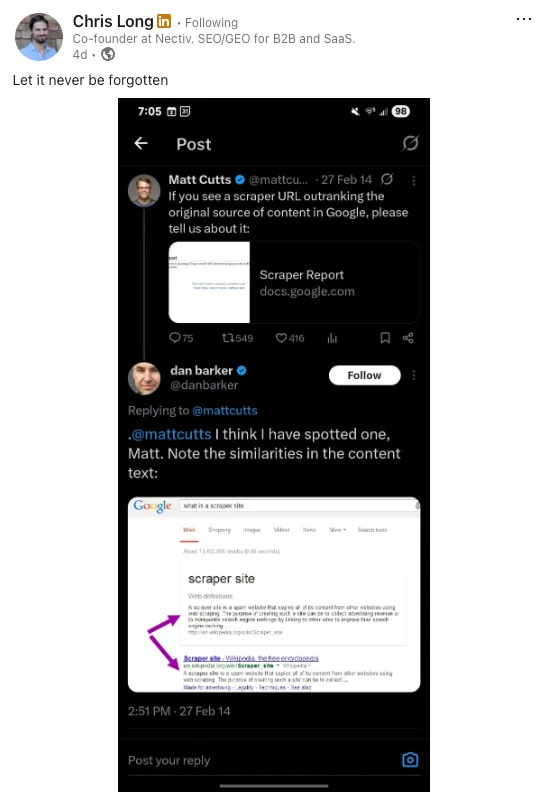
Chris Long’s Tweet and LinkedIn Post that sums it all up (with a good laugh)
This action echoes Reddit’s against the same company and generally against scraping companies, marking a coordinated offensive by platforms against actors who “resell” their infrastructure and data without permission. Google is positioning itself here as a defender of publisher rights and the integrity of its infrastructure.
Let’s dare say it: Google, the company that built a $2 trillion empire by scraping the entire global web for 20 years (often without asking publishers’ opinions), is now attacking an actor... for scraping. It’s literally the pot calling the kettle black.
Make no mistake, behind this “security defense” lies a targeted attack (a “Kill Switch”). SerpApi is the eyes of ChatGPT and Perplexity. By attacking the provider, Google is trying to blind its AI competitors who don’t have their own index and depend on it for “Grounding” (access to fresh information).
This case reveals the immense fragility of current GenAI. Without Google’s index, these models risk becoming empty shells or obsolete. They don’t own web knowledge, they rent it. If the data tap closes, it’s not just AI that suffers, but the entire MarTech and SEO ecosystem (ranking tools, SaaS) that risks immediate technical asphyxiation.
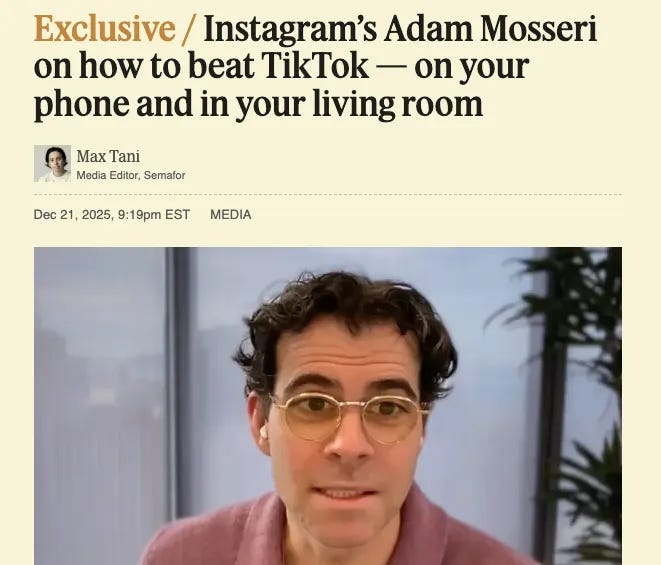
Instagram is launching an app for smart TVs (e.g., Amazon Fire), attempting to move from the “small screen” to the living room. Mosseri admits navigating by sight (”We’re going to learn a lot”) on actual usage: passive Reels consumption or collaborative experience?
Mosseri acknowledges that US regulatory pressure has slowed TikTok, allowing Meta to adjust its algorithms. He analyzes TikTok as becoming “too complicated” for Westerners by trying to copy the Chinese “Super App” model.
Unlike YouTube which pushes toward “premium” TV content, Instagram remains for now on variety and short-form. But Mosseri doesn’t rule out a radical pivot toward long-form if necessary, even if it contradicts their historical strategy.
Within 2 to 4 years, users will be able to “sculpt” their feed proactively thanks to AI (”tell it what you want”), surpassing simple passive recommendation.
Over 10 years, Mosseri envisions interactions dominated by smart glasses, posing a major challenge for a historically visual platform that will have to adapt to an “audio-first” world.
✍️ Author: Max Tani (Interview with Adam Mosseri for Semafor)
📎 Exclusive / Instagram’s Adam Mosseri on how to beat TikTok — on your phone and in your living room
The revenge of “Long Time”! Mosseri hesitates on long-form, but he shouldn’t. In the AI era, we’re seeing a comeback of dense and deep formats (anyone who’s listened to a 2-3 hour Lex Fridman podcast episode will know what I’m talking about). Consumption is becoming asynchronous and intellectual, far from the simple dopamine rush of Reels.
With the arrival of Smart Glasses, Mosseri touches on a crucial point: the future of “visual” paradoxically passes through audio. Voice interaction and listening become the primary vectors of mobile content consumption.
AI no longer just recommends, it curates. We’re moving from a suffered feed to a user-”sculpted” feed (Active Curation). Instagram is right to prepare now: if they miss the turn toward ultra-personalization and audio, they’ll remain stuck in the smartphone decade.
The debate shaking the marketing industry is worth $171 billion. Black Friday 2024 delivered a signal: major retailers received eight times more traffic via ChatGPT than in 2023. Still tiny, but the trajectory is clear.
Two camps are clashing. Benjamin Houy shut down his startup Lorelight after six months: traditional SEO best practices already work for LLMs, nothing new to invent. On the opposite side, Brian Stempeck from Evertune claims it’s over for Google. University of Virginia students are all on ChatGPT, Gemini, or TikTok.
Reality leans toward a merger of disciplines.
AEO has its specificities: massive content volume because LLMs consume more, critical recency with 50% more chances if published in the last 13 weeks, and strong emphasis on user-generated content from Reddit, Quora, and YouTube.
On the ground, Expedia succeeds with ultra-granular descriptions, Cars Commerce prefers editorial improvements that serve both, Semrush advocates returning to brand fundamentals.
The wisest conclusion comes from Expedia: if someone claims to know how it will be in two years, they’re lying. The market will reach $171 billion by 2030, but no one holds the definitive answers. The time is for intelligent experimentation, not certainties sold at gold prices.
SEO is becoming more a question of presence than position. As for Zero-Click Search, it’s increasingly becoming a marketing baseline rather than an SEO reality. There, I said it. After dissecting the latest Semrush study on AI Overviews, the finding is clear: the objective is shifting from pure ranking to thought leadership. Becoming THE cited source. Mentions replace positions and multi-platform presence (YouTube, Reddit) is no longer optional. The post-click world exists, but it no longer rewards tactical optimization, it crowns authority.
Google remains in maximum volatility and nobody knows what the algo will look like in June 2026. So don’t waste your time ranting about the end of free traffic. Focus on the only thing you truly control: your business. The strategy now comes down to two words: GET KNOWN. Build your brand. Do everything so people know who you are.
✍️ Author: Patrick Coffee, Wall Street Journal
📎 A Billion-Dollar Question Hangs Over the New AI Search Marketing Industry
🟣 I’m Karine. I help you adapt your content strategy to AI Search and GEO through a masterclass and a community focused on AI marketing. The next session of my GEO masterclass in english will be in May.
→ 90 minutes to master the impact of AI Search and GEO on your marketing and content strategy in 2026: understand the ongoing transformations and effectively reallocate your marketing, content, and SEO budgets.
No posts
Comments
Nothing yet. Say the first thing.
Sign in to join the conversation.