
Karine Abbou I September 02, 2025
HELLO!!!
So? How’s that first day back at work going? Full of joy and good vibes… 😩😬.
To help you make sense of the (yet another) flood of Google innovations from this summer, AI and marketing, here’s a Special Edition. This time, I spent a good ten hours gathering, reading, and sorting through all my curation to bring you only the essentials. This time I waited until the month was really over to encompass everything up to yesterday, Sunday, August 31st, the very last day. Last month, I’d barely hit “publish” when Google released the video version of Notebook LLM (#Heavy).
Before I dive in, I’m also giving you my big picture vision - where Google wants to take us with this flow of AI products and innovations, and what message they want to convey:
Transform and train: We’re all transitioning from content creator to vibe coder.
Loud and clear: AI Mode is truly the future of Google Search. It’s here, really here, and here to stay.
On the menu for this back-to-school season:
🤖 AI Overviews & AI Mode
🛠️ Google AI Tools & Gemini
📈 SEO & Publisher Relations

I’m Karine. I help you adapt your content strategy to AI Search and GEO through a masterclass and a community focused on AI marketing. The next session of my GEO masterclass in english will be in May. Check it out and join me!
🤖 AI Overviews, AI Search and AI Mode
🟣 AI Mode is now accessible in 180 countries and regions
Geographic expansion: Since August 21st, AI Mode is now accessible in 180 countries and regions. This is a massive increase compared to its previous availability, which was limited to the United States, United Kingdom, and India. Note that the feature remains, for now, only in English. As of that date, it was still not available in France but…
🟣 Google is testing AI Mode in the European Union
…A few days ago, Radu Oncescu shared on X that, in his opinion, Google was preparing the launch of AI Mode in the European Union.
📎 Google is preparing the launch of Google AI Mode in the European Union
🟣 Google is testing AI Mode to send more traffic to publisher websites
Google, through Robby Stein, announced tests to evolve its AI Mode. The main objective is to encourage clicks and send more traffic to publisher websites, particularly by making these links more visible and useful within its AI responses to better support the web ecosystem and content creators. The three major changes being tested are:
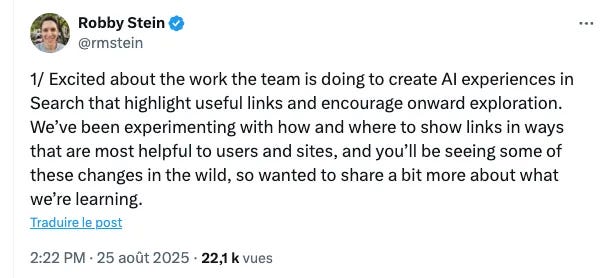
Integrated Link Carousels: Link galleries will be directly inserted into AI responses, a feature already launched on desktop and coming soon to mobile.
Improved Inline Links: Google will optimize the display of links placed directly in the text of AI responses, with the intention of showing more in the future.
Web Guide Extension: This experimental feature, which organizes the most relevant web links, will be tested on the main search tab (”All”) and not just on the “Web” tab. I talked about this in the July special edition.
📎 Post by Robby Stein, VP Product @Google Search on X. Spotted by Barry Schwartz.
🟣 Click collapse: true for content publishers - but false for Google
Google claims that the impact of AI Overviews is neutral on website traffic, declaring it “relatively stable” and of better quality. However, this claim has been sharply criticized for its lack of evidence: Google indeed provides no numerical data and, most importantly, offers no filter in Search Console to allow publishers to verify this impact themselves.
I’ve already written this several times: the novelty here is the introduction of a “click quality” criterion, a concept that Sundar Pichai (who is nevertheless the champion at conducting 2+ hour interviews without really making any actual announcements) had clearly mentioned in this interview that I identified as essential this year.
📎 Liz Reid’s article or storm in SEO land
🟣 Google presents its advertising offering for AI Mode
Google has begun actively presenting its advertising offering for AI Mode to advertisers, signaling an imminent broader rollout (probably before Q4 2025). Key takeaways:
Ad Formats: Ads in AI Mode will primarily be text ads and Shopping ads, integrated via Search, Shopping, and Performance Max (PMax) campaigns.
Targeting: Ads will be targeted based on the user’s query but also on the content of the AI-generated response, which represents a new approach.
Advertiser Requirements: Google emphasizes the importance of “feed hygiene,” meaning the need for brands to maintain perfectly up-to-date product catalogs.
📎 How Google is pitching new AI Mode search ads to marketers
🟣 New AI Catch up feature
Google is testing a new feature named “AI Catch Up,” specifically for search results related to sports matches. Similar to AI audio overviews, this option offers an audio summary of match highlights directly in search results. Users can choose to listen to the summary in English or their local language, and can also share it via a dedicated button.
📎 SEO Roundtable, Barry Schwartz: Google AI Catch Up
🟣 Google launches Preferred Sources in the US
Google has launched “Preferred Sources,” a new feature that allows US and Indian users to choose their favorite publishers for news. The idea is simple: when you search for a news topic, you can select sources you like. After that, these sites will appear more often in “Top Stories” or in a dedicated section. The results you see aren’t personalized, but you can always refine your search to find even more information.
📎 How to select your preferred sources in Top Stories in Search
📎 What’s News on Search - Publisher Center Help
🟣 Google launches specialized Search
AI-powered Search has a major characteristic that’s been taking shape for 24 months: Search is micro-fragmenting and Google is - still - leading the dance on this trend.
Google is launching Flight Deals, a new AI-powered feature in Google Flights. This new tool uses a conversational chat interface to help travelers save money on their flights. The feature launches next week in the United States, Canada, and India.
📎 Flight Deals is our new, AI-powered flight search tool
They’re also testing a new version of Google Finance, powered by AI. Google Finance is being redesigned with AI at its core. New features include the ability to ask complex financial questions and get detailed AI-generated answers, access to advanced graphical tools for data visualization, and receiving real-time market data and news. This new version will be rolled out gradually in the United States at google.com/finance, with an option to switch between the old and new interface. As of August 27, 2025, it’s accessible via Search Labs in the United States.
📎 We’re testing a new, AI-powered Google Finance.
🟣 ChatGPT allegedly uses Google SERP data for its answers
According to a report, ChatGPT (OpenAI) uses the services of a startup named SerpApi to scrape Google search results. This method is primarily used to provide answers on current topics. The article from The Information media is based on the fact that SerpApi has listed OpenAI as a client in the past. Other AI services, like Perplexity, allegedly use a similar technique.
📎 The Information article “OpenAI is challenging Google - While using its Search data“. Since then, the media has investigated further into SerpApi.
🛠️ Google AI Tools & Gemini
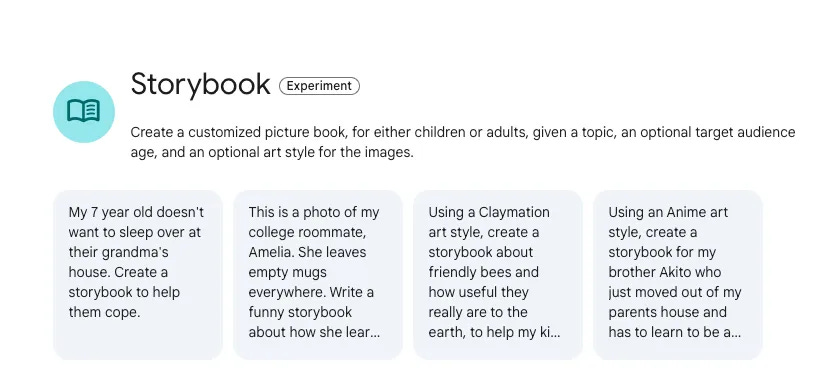
🟣 Gemini’s Storybook mode transforms presentations into captivating narratives
Storybook is a revolutionary Gemini feature that automatically converts technical presentations into narrative stories.
📎 Marie Haynes tested it, and she loved it.
📎 You can access it directly through Gemini Drops
🟣 New AI-based instant translation and language learning tools in Google Translate
Google Translate introduces new features powered by cutting-edge AI, such as Gemini. The app now offers enhanced instant translation that enables seamless bidirectional conversations in over 70 languages, intelligently detecting pauses and intonations. Additionally, a new experimental function offers personalized conversation practice sessions that adapt to the user’s level, which is ideal for people learning Spanish, French, or English.
📎 New AI-powered live translation and language learning tools in Google Translate
🟣 NotebookLLM and audio and video mode…
NotebookLLM is THE amazing Google product that’s your AI-based research assistant, and it can’t hallucinate because it’s only trained on the data you provide it (but it can also search the web if you ask it to). In my opinion, it’s the best tool from these past two incredible years. It can do almost everything in terms of content creation and lets you juggle multimodality effortlessly. Until now, you could create written, visual, and audio content with 1 click. The announcement made on July 29th (but I had already published my “round up” of announcements for July so I didn’t include it) adds the ability to transform all that into video!!
📎 What’s new in NotebookLM: Video Overviews and an upgraded Studio
🟣 … and since August 25th, now available in 80 languages (no longer just English)
Until August 24th, you could only make videos in English even if the notebook content was in French. For the past few days, you can also do it in French and in 79 other languages 🥳.
📎 NotebookLM’s Video Overviews are now available in 80 languages
🟣 Google Notebook LLM Enterprise Agent
Google has launched several agents to help us automate a lot of things. My favorite being Notebook LLM, I’m sharing info about Notebook LLM Enterprise with you.
NotebookLLM is an AI-based research and writing tool that helps summarize and extract information from various sources. It acts as a virtual research assistant, allowing you to get analyses, brainstorm, and summarize facts from your documents.
Difference between regular Notebook LLM and Notebook LLM Enterprise: Basically, the normal version of NotebookLLM is for individuals. The “Enterprise” version has all the same functions, but additionally, it’s made for businesses. That means it has enhanced security options, so data stays within the company: the data isn’t used to train the AI model, and the company maintains full control over who can access what.
📎 What is NotebookLLM Enterprise?
🟣 Google DeepMind released URL Context
Heavy stuff! URL Context from Google DeepMind allows extracting content from 20 URLs simultaneously via a prompt, shaking up comparative analysis and data extraction quite a bit. You can now extract content from any web page, PDF, or image just by pasting a URL. It pulls live data from up to 20 links per query! No setup needed. Just pass the links in your prompt. Use case ideas: Compare reports, PDFs, or articles; extract data (names, prices, highlights…); analyze codebases, GitHub repos, or docs or even summarize multiple sources at once.
📎 URL context | Gemini API | Google AI for Developers
📎 Discovered by Charly Wargnier
🟣 Nano Banana: the image editing tool that’s crushing it and could knock out Photoshop
New Google tool NANOBANANA that’s buzzing because it excels at prompt-based image editing, surpassing ChatGPT in precision and preservation of non-targeted elements, a game-changer for photo editing. No Photoshop skills needed. It changes and alters elements in images that you can command by prompt. And it doesn’t touch any other part of the image that you didn’t want to change (ChatGPT, I’m looking at you!)
📎 The announcement post on the Mideast blog Nano Banana: Image editing in Google Gemini gets a major upgrade and the one on The Keyword.
📎 Gemini AI image generator — text to image & editing with Nano Banana
🟣 New features in AI Mode
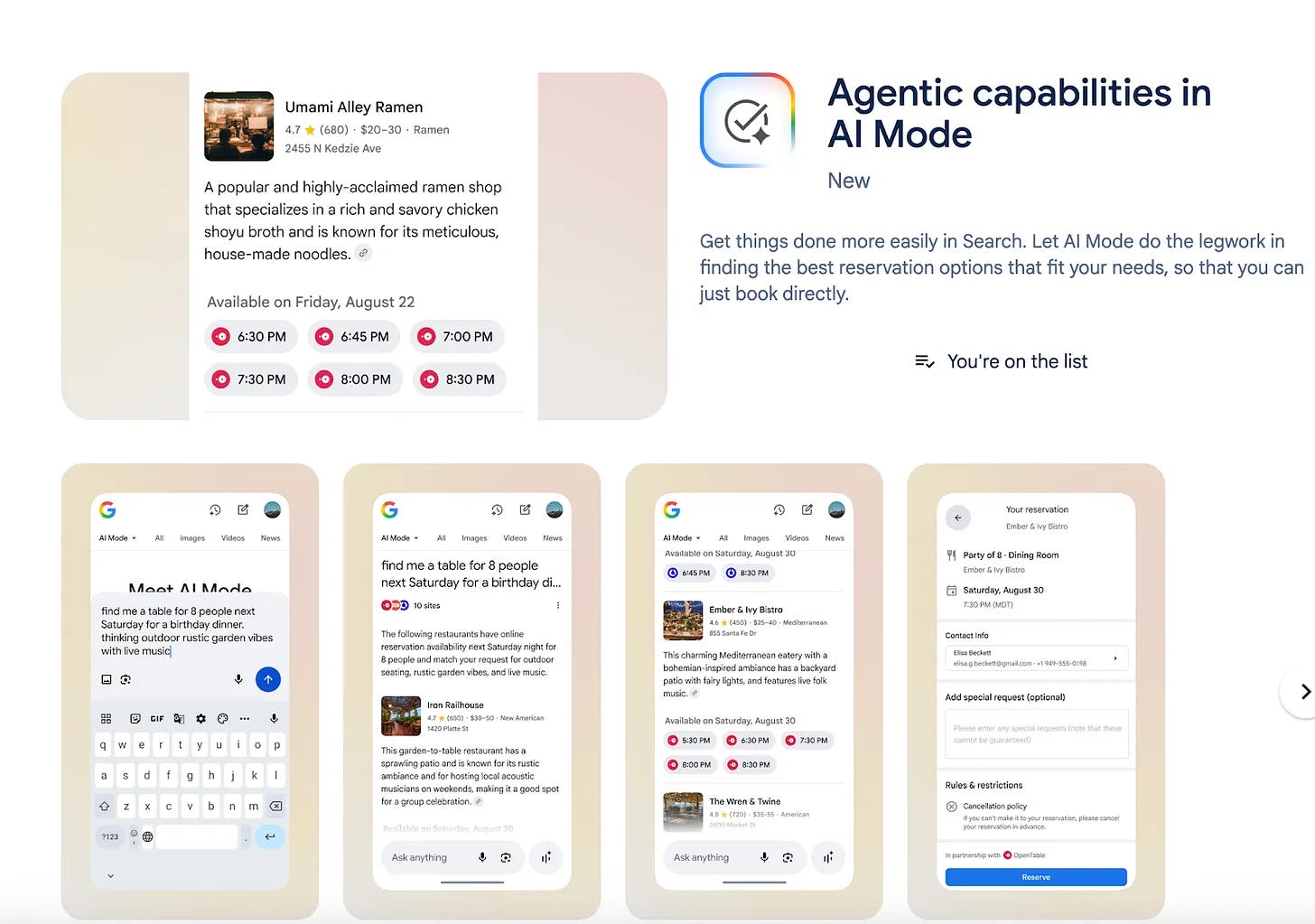
Google announces testing of new agentic capabilities for AI Mode as well as two other improvements.
Agentic capabilities: AI is now able to perform more complex tasks and take more initiative to help users. This new agentic experience is rolling out for Google AI Ultra subscribers in the United States through the “Agentic capabilities in AI Mode” experience in Labs for the modest sum of $124.99 USD/month.
Personalization: Google also announces a new test for Americans who have opted into the AI Mode experience in Labs who will see results adapted to their personal preferences and interests; starting with restaurant-related topics, helping discover new restaurants and cafes that match users’ unique tastes. This confirms one of the big announcements from Google I/O last May: AI Mode responses will only become more personalized and tailored to each user’s interests.
Easy sharing: A new option to share AI responses has been introduced.
📈 SEO, AI Search and Publisher Relations
🟣 Danny Sullivan leaves Google…
Danny Sullivan, the iconic figure who held the position of “Search Liaison” at Google for over seven years, has officially left this role. He remains at Google but will dedicate himself to new projects within the search team, in a role that promises to be less public. The “Search Liaison” role, which served as a bridge between Google and the SEO community, has therefore been eliminated. The official X account @searchliaison has been deactivated. From now on, Google’s official communication with site owners will happen exclusively through the usual Google Search Central channels. This news is not a surprise to the industry, given the decline in Danny Sullivan’s public activity in recent months.
📎 Danny Sullivan is no longer the Google Search Liaison
🟣 … Since then, Google has been looking for a new “Search Liaison”
Initially, a new job posting at Google for a communications position was spotted by Lily Ray. This announcement quickly sparked debates in the SEO community, with many thinking it’s the position meant to replace the former “Search Liaison,” Danny Sullivan. Others, like Barry Schwartz, think the position is clearly attached to the public relations (PR) team, whereas the former Search Liaison wasn’t part of it, and the official account has been deactivated.
📎 Official announcement on Google’s site “External Communications Manager, Search” (the job all SEO pros would dream of having without ever admitting it).
VIdéo manquante
🟣 How Google sees AI, SEO and AI Mode
During an interview in Japan, Gary Illyes from Google shared several important pieces of information about Google’s vision regarding AI and SEO. Here are the essential points to remember:
How Google’s AI works: AI features (AI Mode, AI Overviews) use a customized Gemini model. The AI relies exclusively on Google’s search index for its answers; it doesn’t explore the web in real-time. Webmasters can prevent their content from being used by Gemini via the Google-Extended directive in the robots.txt file.
AI-generated content: Google accepts this type of content provided it’s high quality and there’s human editorial oversight. The risk of AIs training on other AIs’ content is not currently considered a problem for Google Search.
Other key SEO points: Illyes reaffirmed that Google Search doesn’t use social signals (shares, likes) as a ranking factor. He confirmed that ads will soon arrive in AI responses. New, more precise crawl controls are being studied with the IETF.
🟣 AI, AEO, GEO, LLMO, etc.: beware of spam and scams
John Mueller from Google issued a warning against the proliferation of new AI-related acronyms in the SEO sector, such as GEO (Generative Engine Optimization), AIO (AI Optimization), etc. According to him, strong marketing pressure to impose new terms is often a sign that actors are trying to sell services resembling spam or scams.
This warning responds to the trend of some declaring SEO “dead” to replace it with these new disciplines and try to create a term that will make them famous (in the fashion of Hubspot which created the term inbound marketing… to both sell its software and name a new marketing trend - not everyone is Darmesh Shah…).
So? Real semantic debate marking a fundamental change or just another marketing stunt? Too early to say. Some like Profound, which I’ve already told you about, might well succeed in qualifying SEO in the AI era, AEO. That said, in most cases, you need to be careful about all these new acronyms because they could simply mask low-quality service offerings.
📎 Google’s John Mueller warns AI SEO acronyms signal spam tactics
🟣 Reddit CEO’s bold statement about Google: “Anyone using Google will end up on Reddit”
Reddit is killing it. Success confirmed by their latest Earning Call. During recent earning calls, Reddit’s CEO, Steven Huffman, didn’t miss displaying his pride, particularly when he recalled the central place of his platform in the search ecosystem: “practically anyone using Google [...] will end up on Reddit at some point,” emphasizing that “Reddit” is one of the most searched terms on Google.
He did have the honesty to recall that despite this particular visibility in SERPs and AI Overviews, traffic from Google is variable and constituted a “headwind” (had a negative impact) during the second quarter. These statements are part of Reddit’s strategy to position itself as a search engine in its own right, where users come to find authentic answers.
Honestly, I don’t really understand the “I’m showing off”… it’s great to be cited all the time by Google, but it also seems to me to be a pretty big risk to be so dependent on it, right? Well, the whole internet is aware that when Google pulls out a Kleenex, the entire web catches Covid!! AKA: the slightest little change in its algorithm and Google undoes in a few hours what Reddit takes pride in today and what took years to build.
📎 Reddit wants to be a search engine now | The Verge
🟣 Google is preparing to give first access to its new Google Trends API
It had been announced a month ago. It’s already starting to be implemented and apparently, it’s already pleasing people a lot. According to Daniel Waisberg from Google, the onboarding process for the first testers will begin around mid-September 2025.
However, Google warned that selection will be very strict at the beginning, with a “very small” number of participants. For those who won’t be selected in this first wave, the wait could last several months. Google had initially stated that SEO professionals wouldn’t be prioritized. The reason given by John Mueller from Google is that Google Trends is used by many types of organizations (major media, data analysts, companies, etc.), which will probably be prioritized.
📎 I already talked about it in July
📎 See Daniel Waisberg’s post
🟣 Google offers completely free AI courses
No prerequisites, no prior technical skills, no fees: truly accessible to everyone. I’m only sharing those I thought interesting from a marketing + content perspective.
🔗 Introduction to Generative AI: Simple and quick course on generative AI. Shows how to develop AI apps with Google tools.
🔗 Introduction to Large Language Models (LLMs): Course to understand LLMs… and present their applications. Basically, you learn how to create apps with AI
🔗 Introduction to Image Generation: Course that presents diffusion models, a promising category in machine learning applied to imagery.
🔗 The Attention Mechanism: Introduction to the attention mechanism, which allows neural networks to focus on certain parts of an input sequence.
🟣 I’m Karine. I help you adapt your content strategy to AI Search and GEO through a masterclass and a community focused on AI marketing. The next session of my GEO masterclass in english will be in May. Check it out and join us!
Comments
Nothing yet. Say the first thing.
Sign in to join the conversation.