
If you are living with a serious illness, disability or complex care needs in the United States today, it’s likely that the lynchpin of your healthcare team is unpaid, has received little to no training, and works around the clock. In many cases, the person coordinating medications, tracking symptoms, relaying information between doctors and making decisions in moments of crisis is not a clinician, but a family member.
In the first two weeks of this series, The Aging Almanac looked at how America’s long-term care system is built on unpaid family labor, and how that burden often consolidates around a single person. This week’s question is practical: once you are that person, how do you do it well? What does it actually mean to advocate effectively for someone in a fragmented and fast-moving healthcare system?
Patients move between primary care doctors, specialists, hospitals, rehabilitation facilities and home care providers, but their information does not always travel with them. Meanwhile, brief encounters with the healthcare system - appointments, procedures, hospital stays - are often separated by long stretches when patients’ conditions must be managed at home. In addition to taking on basic daily care needs and coordinating a web of services, caregivers also take on responsibilities that resemble those of nurses or case managers: managing medications, keeping track of test results and translating medical instructions into daily routines.
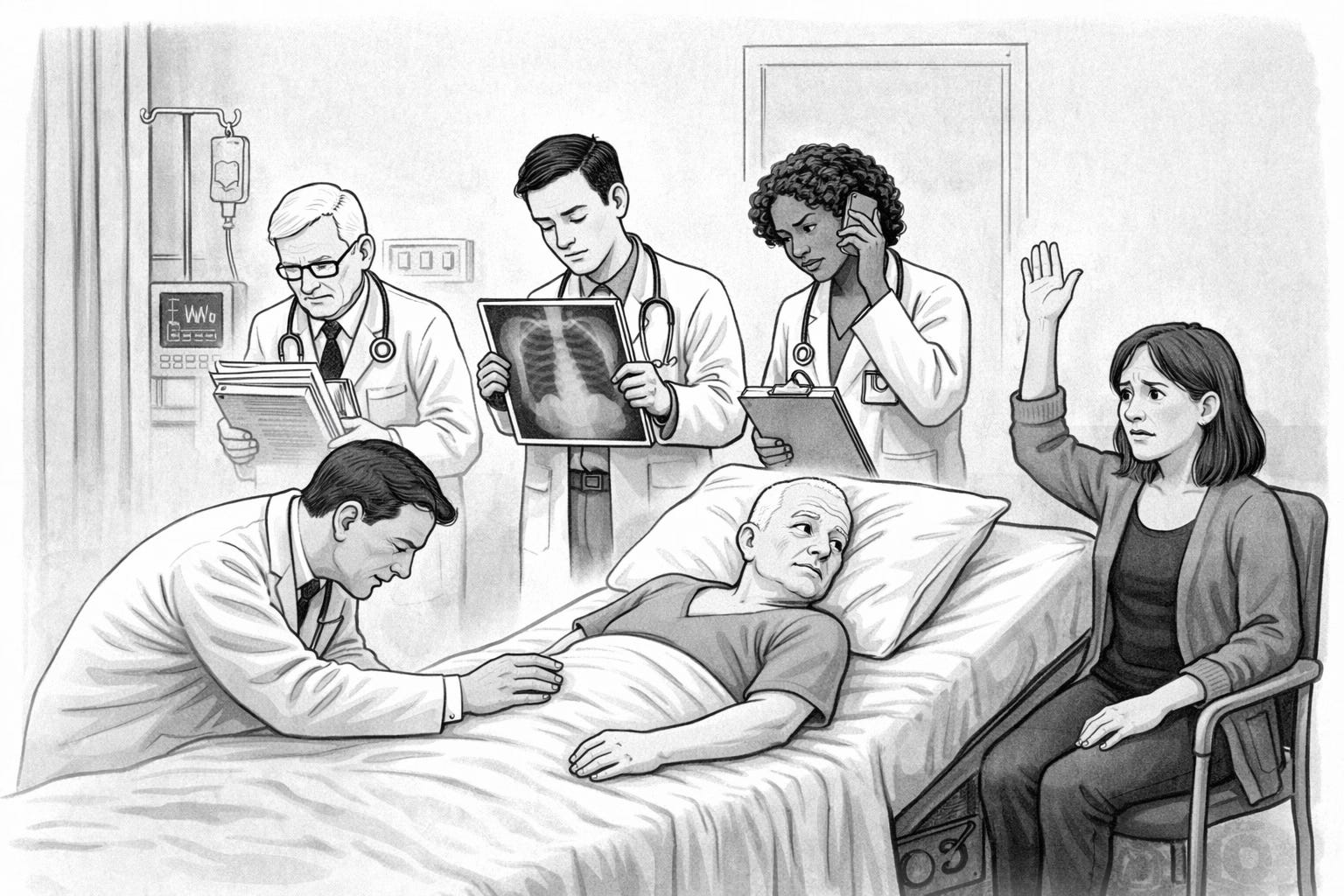
Many caregivers perform clinical tasks that were once handled exclusively by healthcare professionals, from administering injections, to wound care and managing catheters. According to a survey from AARP and the National Alliance for Caregiving, 55 per cent of caregivers perform these tasks, but only 22 per cent receive any training. And when patients are hospitalized or too ill to speak for themselves, caregivers become the primary advocate in the room: asking questions, clarifying treatment options and ensuring that discharge instructions are understood and carried out.
Effective advocacy is a skill that can be learned, and knowing what to do can make an enormous difference.
The critical importance of this advocacy is not an abstraction. When my mother-in-law was admitted to hospital with advanced cancer, she was too weak after surgery to leave her bed or speak for herself, and her oncologist had already concluded that chemotherapy was not an option unless there was a dramatic turn-around. Yet at two o’clock in the morning, a radiology technician arrived to take her for scans to plan a separate course of radiation treatment that she would never be well enough to receive. Nobody had told radiology. Oncology, gastroenterology, neurology, and radiology were each doing their jobs in isolation. Nobody was looking at the whole person in the bed. That was left to us.
The good news is that effective advocacy is a skill that can be learned, and knowing what to do can make an enormous difference for both caregivers and their care partners.
That means understanding their diagnoses and the expected progression, typical symptoms, and the warning signs that should prompt a call to the doctor. It also means keeping an accurate list of medications: including the name of each drug, the dosage, and why it was prescribed. Medication errors and over-prescribing are a common source of complications for older patients, especially when multiple doctors are involved. More than 40 per cent of Americans over the age of 65 take five or more prescription drugs, creating a significant risk of interactions, side effects and confusion about dosing.(1)
Clinicians often meet patients during a moment of crisis and may not know what is normal for them. Caregivers can provide crucial context for their loved one’s normal mobility, cognitive function, and personality. Was your care partner walking independently two weeks ago? Were they managing their own finances or cooking meals? Clear descriptions of recent changes can help doctors distinguish between long-standing limitations and new medical problems.
Keeping this information organized and accessible is harder than it sounds.
We’ve developed a simple tool to help: the Almanac Care Record lets you build and update a comprehensive health profile for your care recipient, ready to bring to any appointment, share with other caregivers or emergency providers.
Read more about The Almanac Care Record here
One practical tip from a long-time caregiver is to take an occasional video of your loved one. If your 92-year old cognitively-impaired mother develops a fever and delirium from a urinary tract infection, your recent footage of her on the exercise bike will help the ER physician understand that your mother has plenty of life left to live.

One of a caregiver’s most essential roles is to preserve the patient’s identity, according to clinical psychologist Dr. Allison Applebaum, director of the Steven S. Elbaum Family Center for Caregiving at the Mount Sinai Health System in New York. Without someone in the room who can say who this person is, what they value, and what their life looks like outside the hospital, Applebaum says that clinical teams tend to fill the gaps with assumptions based on age, diagnosis and current appearance. The caregiver is the one person who can correct that picture.
Caregivers are often asked to make medical decisions during crises, when there is little time to reflect. Early conversations with your care partner can clarify what matters most to them: how aggressively they want to pursue treatment, whether hospitalization is always desired, and what quality of life means in practical terms. These preferences should be documented with an advance directive, made known to the healthcare proxy, and added to the patient’s record so that doctors and family members can follow them if the patient cannot speak for themselves. These conversations can be challenging for families, but clear guidance reduces uncertainty when difficult decisions arise.
Request that your name and phone number be listed in the medical record as the primary caregiver or emergency contact, and ask to be included in the list of people authorized to receive medical information. This requires your care partner’s consent, but without it, clinicians are legally limited in what they can share. While your role as caregiver may be clear to everyone, in practice hospitals and clinics may not formally record you as the caregiver unless you ask.
Advocacy means asking clear questions and making sure important details are not overlooked: What changed? What should we watch for at home? What would indicate that we should call you or return to the hospital? In a busy health care system, caregivers who speak up, ask for and provide precise information can significantly improve the quality and continuity of care. Taking notes (more so than simply recording) is a strong visual cue that can prompt busy clinicians to slow down and make sure that instructions are clear and fully understood.
Much of the care that once took place in hospitals is now handled at home. As a result, family caregivers are often asked to perform tasks that can feel more like nursing than caregiving: managing medications, changing dressings, monitoring wounds, administering injections, operating oxygen equipment, or caring for feeding tubes and catheters. The instructions may be explained quickly during discharge, but they are difficult to absorb in a stressful moment.
Before leaving the hospital or clinic, ask clinicians to demonstrate each task step by step, and then perform it yourself while they observe. Practicing in front of a nurse or therapist allows them to correct mistakes and answer questions before you are responsible for the task at home.
Under the CARE Act, hospitals in 42 states are required to identify a family caregiver, notify them before discharge, and provide instruction on the medical tasks that will be needed afterward. Many caregivers are unaware that this support exists. Asking for training and repeating the demonstration if necessary can make the transition home safer and less intimidating.
Older patients sometimes receive less thorough evaluation when symptoms are dismissed as simply part of aging. Ageism can take the form of a doctor questioning whether a procedure is “worth it” for someone in their 90s, or staff using infantilizing language, “honey” or “sweetie,” or a high-pitched tone that makes communication harder. Without a caregiver present to speak up, such moments can pass unchallenged. If something seems wrong, ask direct questions: Is this expected for someone with this condition, or should it be investigated further? Clear, respectful advocacy can ensure that new symptoms are taken seriously and that treatment decisions are not limited by assumptions about age.
In next week’s Aging Almanac, we turn to how to care for the caregivers themselves. We’ll hear from Dr. Allison Applebaum, Director of the Steven S. Elbaum Family Center for Caregiving at the Mount Sinai Health System, about the psychosocial needs of caregivers: their emotional lives, their mental health, and what it means to sustain someone through illness without losing yourself.
Comments
Nothing yet. Say the first thing.
Sign in to join the conversation.