
The majority of America’s elder care rests on the shoulders of a single family member.
Caregiving often begins with a crisis like a hospital stay, sudden diagnosis, or fall. Our family’s caregiving journey took off at full speed with two crises at once: my mother-in-law with a diagnosis of advanced cancer, my father-in-law with a massive hemorrhagic stroke, and my husband thrown into the crucible. Just as often, if less dramatic, the role emerges from a slow accumulation of needs. A loved one may have a growing calendar of medical appointments, stacks of insurance paperwork, bills that need attention, and routine household tasks that have become harder to tackle. In many families, one person steps in to manage these demands, and gradually becomes the person responsible for holding everything together. Sociologist and disabilities-studies scholar Laura Mauldin describes this role simply as “The One.”
Last week’s Aging Almanac looked at the scale of America’s caregiving crisis, the tens of millions of families filling the gap left by a threadbare public system. This week’s question is more personal: when caregiving lands on one person in a family, as it so often does, what can be done to share the load?

“The One” is more than a coordinator. In her recent book “In Sickness and in Health,” Mauldin describes this person as “the person on the floor with their loved one when they cannot get up, the person who gives up sleeping through the night, who struggles against their guilt when they can’t be there.” For many caregivers, the trauma of visits to the emergency room, hospitalizations and high-pressure medical decisions are not interruptions to ordinary life, but the rhythm of it.
The responsibility often falls to the eldest daughter, though it may also be a spouse, partner or a friend who has become chosen family. The primary caregiver is rarely appointed in any formal way. The role tends to emerge through proximity, personality, circumstance or family expectation. Mauldin sensitively explores how spouses and partners become “The One” by default, and the impact that this has on their love stories.
The consequences for caregivers are measurable: caring for a loved one can exact a heavy physical, emotional and financial toll. Surveys from AARP and the National Alliance for Caregiving find that nearly a quarter of caregivers report their own health has declined because of the demands of care, while studies have linked caregiving to higher rates of depression, financial strain and reduced participation in the workforce.
“Family caregivers are a backbone of our health and long-term care systems—often providing complex care with little or no training, sacrificing their financial future and their own health, and too often doing it alone,” said AARP CEO Myechia Minter-Jordan.
Experts say that families are better served when caregiving is treated as a team effort as early as possible, even though one person is still very likely to be the central coordinator. One family of three adult sisters that spoke to the Aging Almanac has made a great success of this in caring for their aging parents through a series of health crises. Katherine has been the central point of contact, but her two sisters are meaningfully involved - one tackles the financial and insurance needs, while the other handles the appointment schedule, transportation and medication management. They say the experience has brought them closer to each other and to their parents.
Caregiving can expose and exacerbate complicated family dynamics.
It’s important to acknowledge that in many families, however, this is easier said than done. Caregiving can expose and exacerbate complicated family dynamics: strained sibling or parent-child relationships, unhappy marriages, relatives who live far away or rarely visit, disagreements about housing, money or medical decisions, or simply different levels of emotional comfort with illness and aging.
“People don’t change much, even when it comes to everyday or emergency care for your aging parent,” says Laura Tamblyn Watts, chief executive of CanAge, a Canadian advocacy organization, and author of Let’s Talk About Aging Parents. “If your macho brother was always too busy to help around the house, chances are he’s not going to be volunteering to scrub your mum’s kitchen.”
Julia, who coordinates care for her 91 year-old mother, has experienced these tensions firsthand. Her mother, who has cognitive impairment and osteoporosis, lives independently in a multi-story home she does not wish to leave and she firmly refuses all in-home help. Julia - who lives several hours away and respects her mother’s desire to age in place - manages nearly all of the logistics: medical decisions, finances, appointments, meal delivery and tackling a steady stream of practical problems. This has included crisis management after two serious falls, and a severe infection that required hospitalization. Julia’s sister feels strongly that their mother should move to a more supportive living situation, but is otherwise not very engaged with her mother’s care. Although she lives much closer to their mother, she only helps when Julia asks directly. “I have to call and make a specific request,” she explained. “It doesn’t tend to happen on its own.”
Julia has tried to create more stable roles - asking her sister to check in regularly by phone or take responsibility for specific tasks - but the arrangements quickly drift back to old patterns. Julia says she is perplexed by her sister’s failure to step up, but suspects that part of the difficulty may be emotional. Her sister is deeply uncomfortable discussing illness or death, while as a doctor, Julia is more accustomed to confronting these realities directly.
The Aging Almanac also spoke with caregivers who described completely absent relatives, the strain of caring for an abusive or manipulative parent, and several cases of siblings who offered strong opinions but little help. In all these situations, caregivers lamented that it is often easier to handle everything alone than to waste time and emotional energy on trying to change the status quo, however difficult and disappointing the situation may be.
If your family dynamics will support a conversation about sharing the care of a loved one, have it early.
That said, families should not be too quick to give up. If your family dynamics will support a conversation about sharing the care of a loved one, have it early - when you first start to notice that your loved one’s needs are accumulating, there is a new acute health issue, or one person is starting to feel burdened. Family conflicts often resurface when the stakes are higher, particularly if fatigue, stress and isolation are weighing on the lead caregiver. If conflict seems likely, consider inviting a family therapist to help mediate. While caregiving responsibilities rarely divide evenly, making the work visible and assigning clear roles early can help prevent misunderstandings and burnout. The guidelines below can help families organize a “family summit” and make a plan, which the group should then be prepared to review and update as circumstances change.
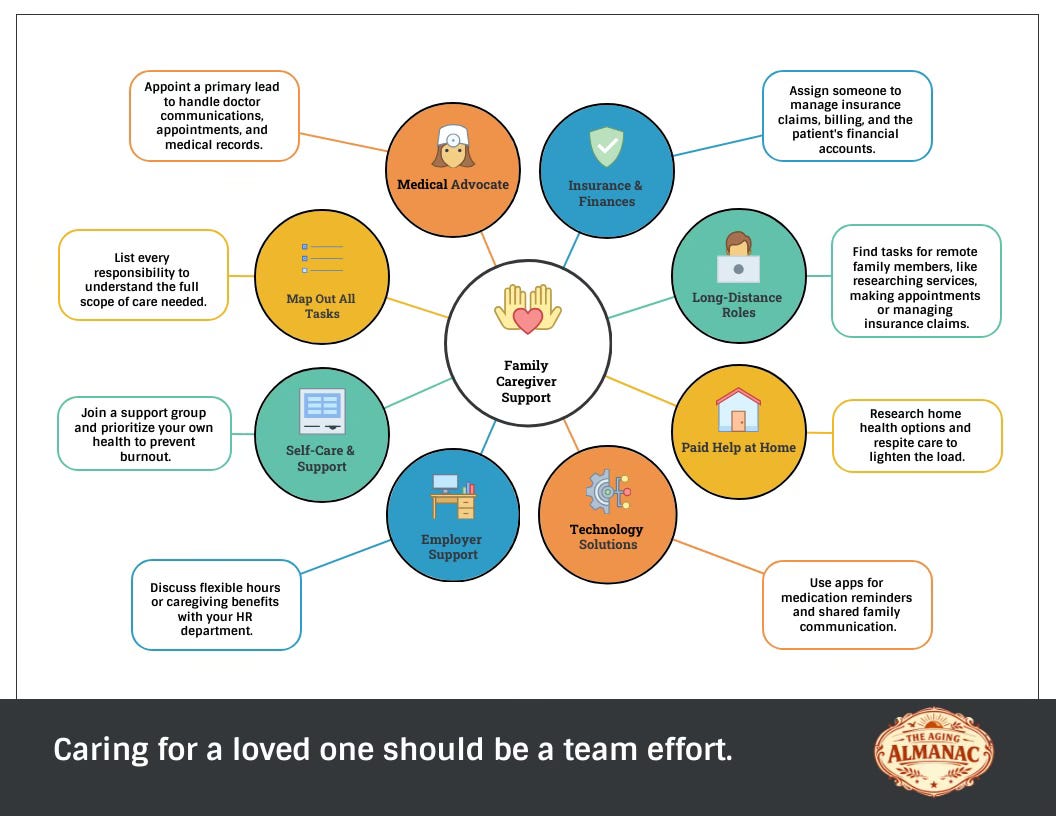
Caregivers become the central coordinator of a complicated system, and the list of tasks is usually longer than families expect. It may include medical appointments, medication management, transportation, insurance paperwork, meal preparation, household tasks, home modifications, financial management, and regular check-ins with doctors and home care providers. The list should also include regular visits and phone calls to provide emotional support for your loved one, and most importantly, consideration for emergencies. This mapping will help spark conversations about what caregiving tasks each family member may be most comfortable doing and best suited for, and allow the primary caregiver to think about how to delegate and respond to new needs.
Hospitals and medical practices often prefer to have one person coordinating information. That person can attend appointments when possible, advocate for their loved one, relay updates to the rest of the family and keep track of changes in medications or treatment plans. In many families this person also acts as the healthcare proxy, the individual legally authorized to make decisions when the patient cannot.
Someone must keep track of medical bills, insurance claims, prescription costs, and other expenses associated with care. This is also likely to be the best person to assess eligibility for government benefits like Medicaid, and to lead the application process, which can be lengthy and cumbersome. In some families this will naturally fall to the person who already manages finances; in others it may require handing off access to bank accounts or insurance portals. This role will also require a Durable Power of Attorney, and HIPAA releases, without which caregivers can struggle to pay bills or speak to institutions.
Caregiving does not have to be limited to the person who lives closest. Family members who live far away can still play a meaningful role by researching services, coordinating appointments, managing online paperwork, and handling insurance appeals.
Many caregivers delay this conversation until they are already overwhelmed, because their care partners are resistant to having someone in the home, or because paid help feels out of reach financially. However, even a few hours of assistance each week — with transportation, personal care, or household tasks — can make the situation more manageable. For more complex care plans, care managers can also provide valuable logistical support. Research on home and community-based services suggests that assistance with daily activities and medical needs can help older adults remain in their homes and delay moves to nursing facilities. States that have invested most heavily in these programs tend to show lower rates of nursing home use. (2)
Families should research the options for home health support in their area, and determine whether their loved one would qualify for Medicaid, the primary public program that pays for long-term care. Know what your state’s Medicaid waivers for home and community-based services cover. In most states, eligible individuals can receive personal care, adult day services, and in some cases respite care for family caregivers, without entering a nursing home. Waiting lists are long and enrollment processes bureaucratic, but the services can provide essential relief. A geriatric care manager or social worker at a local Area Agency on Aging can help navigate eligibility.
Ideally, this research should be completed before an urgent need arises: it’s very hard to navigate these issues under pressure, while having options ready will provide just-in-time support when you need it most.
Caregivers can use technology to monitor daily routines and reduce risk. Medication reminders, wearable alert devices (also known as PERS) and discreet home sensors or cameras can help track adherence to prescriptions, detect falls and provide reassurance that a loved one is safe without requiring constant in-person supervision. One caregiver suggested that using AI can be a helpful way to maintain health summaries and prepare questions for important appointments, but beware that ChatGPT and other AI models are NOT a substitute for professional medical advice - they make too many mistakes to trust with your loved one’s health.
There are also a variety of apps to help caregivers coordinate the care of a loved one with family members and or home health aides. These can include calendars for appointments, task delegation, rotas for meals and visits, financial management, document storage and a daily log for the care recipient’s vitals, symptoms and care tasks. The free versions of these apps typically have very few features, unfortunately, while paid subscriptions can be in the order of $150/year or more. If budget is an issue, many families manage very well with free online tools such as Google Calendar or WhatsApp - the important thing is to have a system that supports a schedule for the care team that includes rest breaks!
The New York Times’ WireCutter section recently reviewed a series of apps and smart devices to support caregiver organization: readers may find their recommendations helpful, though beware that many of these apps can be hard for older adults to adapt to. (Please note that while WireCutter is not paid for reviews, they do receive compensation through affiliate links, meaning that if you buy something after clicking on their link, they will receive a small commission. The Aging Almanac has not vetted these products.)
Employed caregivers should document their caregiving responsibilities and understand what support they are entitled to, either through their employer or through state and federal family leave programs. Some companies have introduced flexible scheduling, caregiver employee resource groups, and access to backup care programs to reduce turnover among mid-career employees. Workers in states with paid family leave programs - now 14 states and the District of Columbia - often do not claim benefits they have earned. The federal Family and Medical Leave Act guarantees 12 weeks of unpaid, job-protected leave per year to eligible workers caring for a parent with a serious health condition. Unfortunately only 60 per cent of workers are eligible and it can be hard to go without income replacement for many families.
Caregiving is demanding work. Fatigue, grief, anxiety, and a creeping sense of isolation are common responses to an extraordinarily difficult role. The research is consistent: caregivers who neglect their own health and emotional needs are more likely to burn out, and less able to provide the care their loved ones need. Seeking professional support for yourself is part of successful caregiving. In a forthcoming issue of The Aging Almanac, we will be speaking with Dr. Allison Applebaum, director of the Steven S. Elbaum Family Center for Caregiving at the Mount Sinai Health System in New York, about the psychosocial needs of caregivers and what it actually looks like to find and accept meaningful support.
In next week’s Aging Almanac, we will examine how caregivers can prepare to be effective medical advocates for their care partners in a fragmented health system.
Comments
Nothing yet. Say the first thing.
Sign in to join the conversation.