
On good weather days, Renee Levine sits on her front porch to enjoy visits with neighbors who have known her for decades, and distribute treats to the local dogs. She runs simple errands in the neighborhood, cleans her own kitchen and bathroom, and when there is laundry to do, she carries it herself down a narrow staircase to the basement and back up again. She is, by her own account, perfectly fine.
Not everyone would agree. Renee is 91, lives alone, and is cognitively impaired. She has had two serious falls in the four story home she has lived in for 55 years, a home that has steep stairs to every room she needs and a bathtub she has to climb in and out of. She has trouble following conversations, forgets her medications and cannot keep track of her keys. She frequently calls a neighbor to help find them. After one of her falls, her daughters installed a stair lift, but Renee refuses to use it - the seat currently serves as a stand for a favorite painting. Grab bars and a shower chair in the bathroom received similar treatment. Any paid help is out of the question, though she has accepted an automatic medication dispenser and occasional meal deliveries from another neighbor. Renee’s family has been supportive of her choice to age in place, but it’s clear that Renee won’t have it any other way. She values her independence, her space, her community, and her home, and she is not interested in being managed.
Across the United States, there are millions of older adults in situations that rhyme with Renee’s - living in homes that are poorly suited to their changing bodies, and in communities that offer them few good alternatives. The houses are too big, or too vertical, or too far from services, or too expensive to modify. But they are also homes with familiar routines, decades of precious memories and neighbors who know where the keys are. Familiar surroundings do work as long as they are safe: a known environment means a layout learned by muscle memory and cues that prompt routine, supporting daily function in ways an unfamiliar setting does not. The effect is most pronounced for older adults with cognitive impairment: for whom relocation is associated with measurable declines in orientation and self-care. [1]
Between 75 and 90 per cent of older Americans say they want to stay in their homes for as long as possible as they age, depending on the survey. (2) For many, there is simply nowhere better to go.
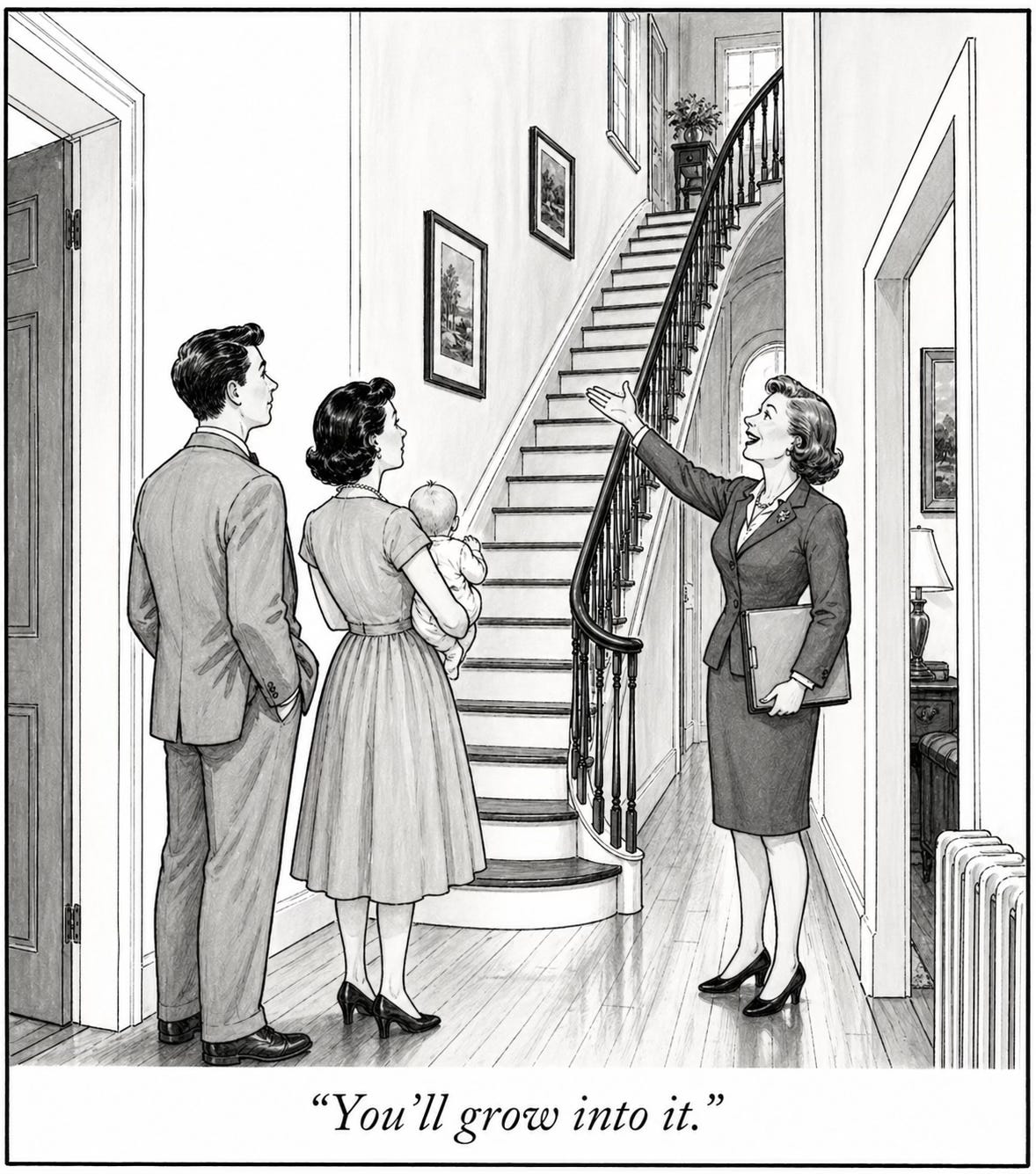
Most older Americans live in single-family homes constructed decades before accessibility was a design consideration. The dominant housing forms of the post-war decades were built for young families with stairs, bedrooms and bathrooms on the upper level, narrow hallways, step-up entries, and bathtubs requiring a leg-over entry. Now that the Baby Boomers are aging, the supply of accessible alternatives has not kept pace with a demographic shift that was entirely foreseeable. A 2023 Census Bureau report on age-ready homes found that only about 40 per cent of American homes have the most basic accessibility features: a step-free entryway and a bedroom and full bathroom on the first floor. (3) The three features that researchers consider the real baseline for accessible living — single-floor circulation, a no-step entrance, and wide hallways and doorways — are present in fewer than four per cent of American homes. (4)
Falls are the leading cause of both fatal and nonfatal injury among adults over 65 , and most of them happen at home.
All types of disabilities increase with age - almost half of those over the age of 75 report at least one (5) - and living in a home not designed for aging bodies can have serious consequences. Falls are the leading cause of both fatal and nonfatal injury among adults over 65 , and most of them happen at home: in bathrooms, on staircases, at thresholds between rooms, and on the way from a bedroom to a bathroom in the middle of the night. (6, 7)
For older adults who want or need to remain in their homes, the obvious solution is to make age-friendly modifications that could reduce the risk of an accident. The problem for many older adults living on fixed incomes is cost. According to home improvement cost data from Fixr, a basic package of modifications such as grab bars, improved lighting, non-slip surfaces, raised toilet seats and lever-style door handles might cost between $1,000 and $3,000 depending on the choices made. A more meaningful renovation that addresses the bathroom comprehensively, adds a ramp, and widens doorways for walker or wheelchair access could cost $15,000 to $40,000 or more, depending on the scope and the market. A stair lift installation costs between $3,000 and $5,000 on average, more for a curved staircase. These costs are almost never covered by standard health insurance or Medicare, though there are some States with modest Medicaid coverage for medically necessary home modifications.
For homeowners, the intuitive response is to tap home equity to fund the modifications, and for some, this is a genuine option. But the broader picture is more complicated. According to the Harvard Joint Center for Housing Studies, mortgage debt among older adults has grown substantially: the share of homeowners aged 65 to 79 carrying a mortgage rose from 24 to 41 per cent between 1989 and 2022, and median mortgage balances have risen sharply over the same period. (8) For homeowners who are also carrying debt, available equity may be more constrained than it appears. And the distribution of equity is deeply unequal: older black homeowners have a median housing equity of around $123,000, compared with $251,000 for older white homeowners. (9)
For renters, the situation is more challenging still. Renters cannot modify a home they do not own without a landlord’s cooperation, which is rarely forthcoming for significant structural changes. They are also the most financially exposed group in the older adult population: nearly one in three older renters spend more than half of their monthly income on housing, leaving them stretched too thin to absorb any major additional expense. (10) For this group, home modifications that would safely support aging in place are largely out of reach without outside help.
Older adults who feel ready to make a move because the four-story house is already too much to manage, or because they are planning ahead, find that the housing market has slim pickings for their needs. Accessible, affordable housing for older adults is scarce, frequently segregated from the multi-generational community life that most people want to remain part of, and often designed for people who are already quite ill.
Market incentives for real estate developers do not encourage building to meet this urgent social need.
Part of the problem is that market incentives for real estate developers do not encourage building to meet this urgent social need. New accessible construction costs more than standard building, but without commanding higher rents. Wider doorways, no step entries, elevators and roll-in showers all add expense because they require additional square footage and materials. Affordable housing projects are also burdened by permitting and restrictive zoning laws in much of the country. Zoning in most American communities still favors single-family detached housing at the expense of the smaller, more adaptable forms that tend to work better for older adults. Meanwhile, developers say ground-floor apartments, attached housing, and mixed-use buildings near services rarely generate the margins to make them attractive investments. The result is that when older adults want to move into more manageable housing without leaving their friends, neighbors and religious communities, they often cannot find what they need.
The demand gap is significant and growing. The population of Americans aged 65 and older is projected to reach 80 million by 2040, and the first Baby Boomers will turn 80 this year. The National Investment Center (NIC) reports that in 2024, the rate at which older adults moved into available senior housing units rose by 40 per cent, a signal that demand is accelerating. (11)
“The rising occupancies and low inventory growth is going to lead to some real-life challenges for older adults and their families in certain markets”
On the supply side, NIC estimates that the United States will need an additional 600,000 senior housing units by 2030, but in 2024, only 14,000 new units came online. Developers are breaking ground on new senior housing at the slowest rate in a decade, and they would need to start on roughly twice as many projects just to keep pace with the number of Americans entering their eighties. (12) The supply pipeline is simply nowhere near sufficient to close the gap.
“The rising occupancies and low inventory growth is going to lead to some real-life challenges for older adults and their families in certain markets,” says Lisa McCracken, NIC’s head of research and analytics.
What does exist in the senior housing market is largely concentrated at the high end, as a direct result of high development and operating costs for developers. The supply of independent living apartments, assisted living, memory care, and continuing care retirement communities has expanded significantly over the past decade, particularly pre-pandemic, but they are at a price that most families cannot sustain. In 2025, the median cost of assisted living in the United States exceeded $74,400 a year, and in high-cost metropolitan areas it was significantly higher. In New York City, for example, the median cost of a year in assisted living was $113,400 in 2025. (13)
At the other end of the market, older adults with very low incomes feel the strain of housing costs most intensely, but federally-subsidized housing for this population still falls far short of need. For these low income seniors, a financial shock such as a medical bill, death of a spouse or rent increase can remove the last financial buffer between stability and crisis. The US Department of Housing and Urban Development (HUD) estimates that there are more than two million older adult households that qualify for its Section 202 housing program for low income seniors, and are spending more than half of their very low incomes on rent, but who are receiving no assistance. (14) Waitlists for subsidized senior housing routinely run into years. For some older adults, the result is homelessness: older adults are now the fastest-growing segment of the unhoused population in the United States.
Between the private market and the subsidized floor sits the largest and least-served group, what researchers call “the forgotten middle.” These are middle-income older adults with too many assets to qualify for public programs and too few to sustain private senior housing for long. Researchers at NORC at the University of Chicago estimate that by 2033, roughly 16 million Americans aged 75 and older will fall into this category, representing around 45 per cent of all older adult households. Out of this group, current projections suggest that nearly three-quarters will not have sufficient income and savings to cover the cost of assisted living, even before accounting for medical expenses. (15)
Responses to the senior housing crisis have emerged at the margins. Naturally Occurring Retirement Communities are buildings or neighborhoods where enough older adults have organically concentrated that support services can be brought to them rather than moving them to institutional settings. New York State has been a pioneer: more than 60 NORCs operate in New York City with funding from the NYC Department of Aging. Village networks, modeled on Boston’s Beacon Hill Village, take a different approach: membership organizations where older adults pool resources to access transportation, home repair, and social programming that allow them to remain in their own homes and neighborhoods. There are now several hundred such villages across the country, with varying levels of service and loosely coordinated through the Village to Village Network.
Organizations like 2Life Communities in Boston have spent decades developing affordable housing designed for older adults, subsidized by Federal Section 8 public housing vouchers. Home-sharing programs — which match older homeowners with younger renters, sometimes in exchange for reduced rent or a degree of informal household help — address affordability and isolation simultaneously at very low public cost; the National Shared Housing Resource Center maintains a directory of programs by state. And a small number of nonprofit operators are experimenting with middle-market assisted living, seeking to thread the needle between what Medicaid covers and what private pay requires. Unfortunately, none of these approaches are close to operating at the scale of the problem.
The result is that staying put in the home that isn’t quite right, on the street where the neighbors know you, becomes both the preferred option and the only one. For many older adults, there is no meaningful alternative that they can afford in their community. Renee Levine, who has rejected the stair lift, the shower chair, and any paid help, is in one sense an outlier — her resistance to change is unusually resolute. The housing crisis she is living inside is one she shares with millions of others.
Next week’s Aging Almanac will examine what older adults can do to age in place safely: the home modifications that work, the programs that could help pay for them, and the importance of finding support to avoid a crisis.
Comments
Nothing yet. Say the first thing.
Sign in to join the conversation.