
The wish is nearly universal. Survey after survey finds that roughly nine in ten older Americans want to stay in their own homes as they age. (1) The preference is so consistent that it has become a kind of baseline assumption, both in families and in housing policy: that whatever else we do, most people are going to try to “age in place.” But staying put is not the passive choice it sounds like. It requires knowing where the risks are and doing something about them before they become a crisis.
One in four older Americans falls each year. Older adults are particularly vulnerable to falls for reasons that accumulate with age. Muscle mass declines, which reduces the strength needed to recover from a stumble. Balance and reaction time deteriorate, so the automatic micro-adjustments that prevent a younger person from going down simply do not happen fast enough. Vision dims and proprioception - the body’s sense of its own position in space- becomes less reliable. Blood pressure can drop too quickly when standing up, causing momentary dizziness. Many older adults are also managing multiple medications simultaneously, and a significant number of common drug classes such as sedatives, antidepressants, and blood pressure medications have side effects that increase fall risk. Older bodies simply have less margin for error, and they are often navigating environments full of the exact hazards they are least equipped to handle.
Falls happen most often at home, particularly in the bathroom, the staircase, the threshold between rooms, and the path from bedroom to bathroom. Part of the problem — as the Aging Almanac reported in the first article in this series — is that most American homes were not designed for aging bodies. Fewer than four per cent of homes have the three features researchers consider basic for accessibility: a no-step entrance, single-floor living, and hallways and doorways that can accommodate a wheelchair or walker. (2)
The result is that falls are the leading cause of both fatal and nonfatal injury among adults 65 and older. (3). More than 3 million people in this age group visit the emergency department visit for fall-related injuries every year and 1 million are hospitalized (4). In 2023 more than 41,000 older adults died as a result of a fall (5). The death rate from falls for this population has increased steadily in recent years, and for adults over 85, it has more than doubled since 2003. (6) Researchers point to several likely drivers: more older adults living alone in homes that are not age-friendly, higher rates of medication combinations that affect balance, and reduced physical activity.
After a serious hip fracture, roughly one in four older adults does not survive the year, and of those who do, fewer than half fully recover their previous level of function.
Hip fractures and traumatic brain injuries are among the most common and serious consequences of a fall. Nearly 319,000 older adults are hospitalized for broken hips each year, and falls are the cause in more than 80 per cent of cases. (7) After a serious hip fracture, roughly one in four older adults does not survive the year, and of those who do, fewer than half fully recover their previous level of function - which can harbor the end of living independently. (8)
Renee Levine, the 91-year-old we met in the first article of this series, has already had two serious falls in the four-story home she refuses to leave. She is representative of a dangerous dynamic: older adults who have fallen once are two to three times more likely to fall again, and for some, the fear of falling can lead to a self-reinforcing withdrawal from physical activity that increases risk further. This phenomenon is so common that physicians have coined a term for it: “post-fall syndrome.” (9)
What makes this particularly important from a housing perspective is that many falls are preventable, and many of the interventions that prevent them are changes to the home environment.
The evidence that home-based intervention works is well-established. The CAPABLE program, which was developed at Johns Hopkins and is now operating at dozens of sites across the country, pairs an occupational therapist, a registered nurse, and a handy person with a budget of around $1,300 for repairs and modifications. In trials, three-quarters of participants improved their ability to manage daily self-care within five months, with significant reductions in fall risk, depression scores, and limitations in daily activities. The estimated return on the program’s roughly $3,000 per-participant cost runs to around $30,000 in reduced medical spending, driven largely by fewer hospitalizations. Falls, in other words, are not an inevitable feature of aging. They are, in many cases, the product of a mismatch between an aging body and the home.
🎙️ Want to hear more? The Stanford Center on Longevity’s Century Lives podcast produced an excellent episode on housing and aging in place, including the CAPABLE model.
There is a concept in rehabilitation medicine and disability studies that reframes what ‘disability’ means: disability, on this view, is not simply about a person’s impairments, but it is the product of an interaction between that person and their environment. Someone who walks with a cane is not disabled in a single-story home with wide hallways and good lighting, for example, but they may be effectively disabled in a home with a step at every entrance, a bedroom on the second floor, and a bathroom too narrow for a walker.
Disability is the product of an interaction between a person and their environment.
The implication of this is that the same person can be more or less functionally capable depending entirely on whether their home is designed to support their current needs. Meet Deborah, a 75 year old woman with severe arthritis. Deborah lives with her husband in a three story home with a narrow switchback staircase. After years of relying on a stall shower because she could not climb in and out of a bath tub, they installed a beautiful accessible bathroom, with a walk-in tub and motorized seat to lower her into the water. Bliss, but with one big problem: the accessible bathroom is at the top of the staircase. When Deborah took a fall while on vacation and broke her leg, she couldn’t get up the stairs anymore. She lived on the ground floor while she recovered: sleeping on a cot in the living room and needing help to shower in a hard-to-access downstairs shower stall. The difficulty was thankfully temporary, but illustrative of how accessible home design requires an eye to the future, not just what the resident is capable of today.
To understand the specific modifications your home may need, you can consult an occupational therapist and request a home safety assessment. The American Occupational Therapy Association maintains a directory. A full professional assessment involves a structured walk-through of every room and a functional evaluation of the resident’s specific capabilities and limitations. Home safety assessments can also be performed by a “certified aging-in-place specialist” (CAPS), a designation from the National Association of Home Builders, with the caveat that some of these specialists are contractors rather than clinicians.
For families managing a parent’s care from a distance, an assessment can be a very helpful investment for those who have the budget. A home safety assessment typically costs between $200 and $600, depending on the region and provider. For those who cannot afford a formal assessment, the good news is that the highest-value modifications are well-documented, relatively consistent across individuals, and in many cases achievable without professional help.
Home modification guides can run to dozens of items. The areas below are where the evidence for fall prevention is strongest, so this is a good place to start. One intervention, however, costs nothing and belongs at the top of the list: a medication review. Certain drug classes significantly increase fall risk and many older adults are taking several at once: sedatives, antidepressants, blood pressure medications, and antihistamines are among them. More than 40 per cent of adults over 65 use five or more prescription drugs, a threshold at which the risk of interactions and side effects rises sharply. A conversation with a pharmacist or physician about the full medication list, specifically looking at fall risk, can make a meaningful difference before a single grab bar is installed.
For physical modifications, the highest-value changes cluster around four areas: the bathroom, the entryway, circulation routes through the main living space, and stairs.
You can download a printable checklist by clicking the button below.
Bathrooms are where falls most commonly happen.
Grab bars near the toilet and in the shower dramatically reduce fall risk. They should be properly installed into wall studs, not just tiled surfaces, and at the appropriate height for the user.
A walk-in shower or a roll-in shower eliminates the step-over barrier that trips people with balance or mobility limitations.
Non-slip flooring or bath mats with grips address wet-surface risk.
A handheld shower-head and a shower chair allow someone to bathe seated, which is both safer and less exhausting for people with limited stamina.
A raised toilet seat or comfort-height toilet reduces the effort required to sit and stand, which is one of the most common moments of instability in the bathroom. Raised seats attach to the existing toilet and are very affordable, while comfort-height toilets are a somewhat more expensive replacement option.
Entryways matter because falls happen on the way in and out as much as inside.
A zero-step entrance, which can be created with a ramp, a graded pathway, or careful landscaping, removes one of the most common fall locations.
Exterior lighting on motion sensors addresses the risk of navigating a dark entrance at night.
Handrails on both sides of any steps, extending slightly beyond the top and bottom tread, give people something to hold at the moment of transition.
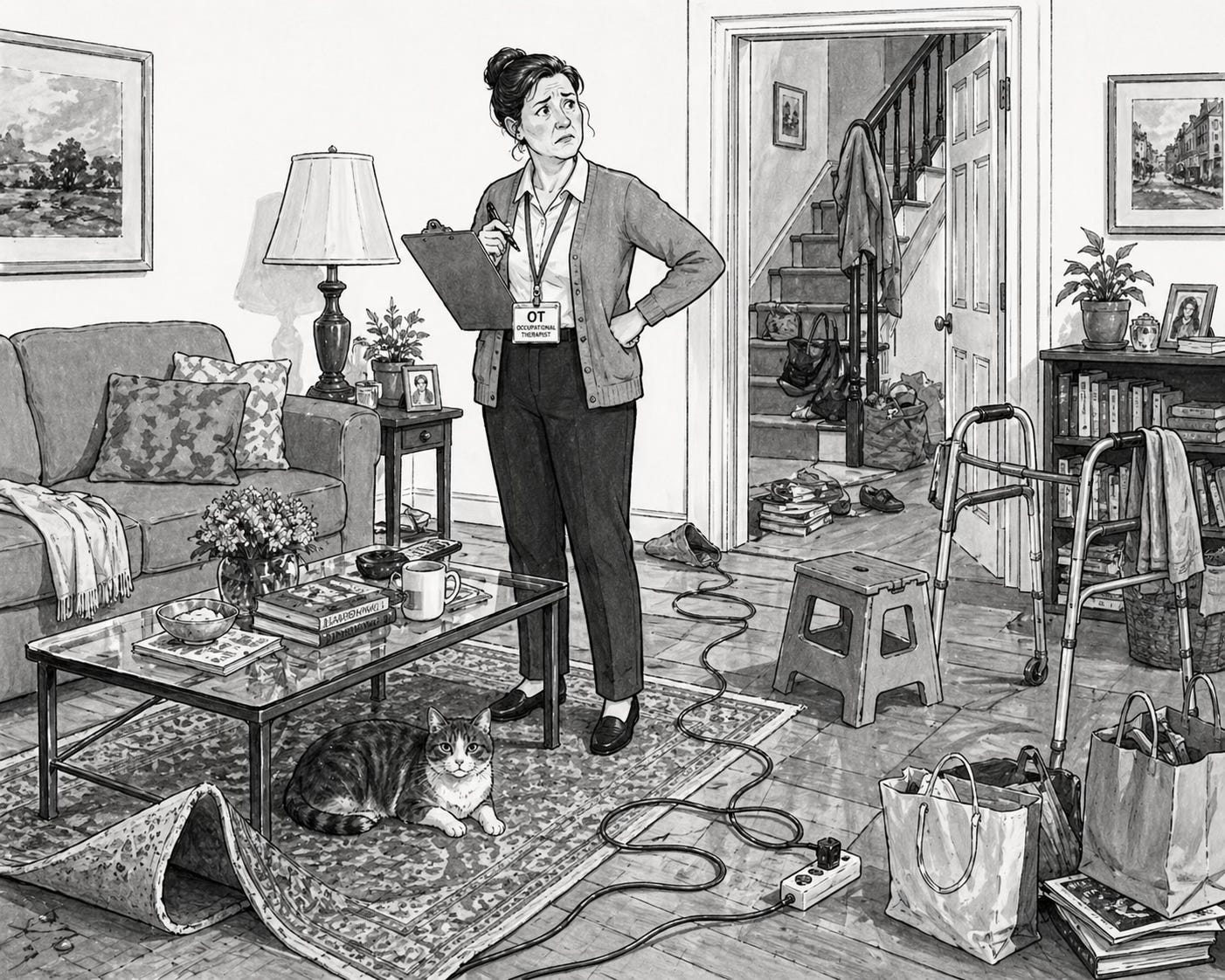
Inside the home, the priorities are lighting, clutter, and floor transitions.
Good overhead and task lighting, particularly in hallways and stairwells, reduces risk at low cost.
Removing throw rugs and loose cords eliminates common trip hazards.
Threshold strips between different flooring materials should be flush, not raised.
Night lights along the path from bedroom to bathroom address the high-risk early-morning hours. The bed should be at an appropriate height for easy sitting and standing.
Furniture arranged to allow natural resting points: a chair near the entrance, for example.
Stairs are one of the highest-risk locations in any home and for older adults with significant mobility limitations, a staircase can become a barrier to reaching a bedroom or bathroom entirely.
Handrails on both sides, running the full length and extending slightly beyond the top and bottom tread.
Non-slip treads on each step: carpet, adhesive strips, or textured material.
Good lighting with switches at both the top and bottom.
A stair lift is the most effective solution for someone with significant difficulty on stairs who wants to remain in a multi-storey home. A straight-staircase model typically costs $3,000 to $8,000 installed.
Where the layout allows, relocating the bedroom and bathroom to the ground floor eliminates the risk entirely rather than managing it.
The kitchen carries less fall risk than the bathroom or staircase, but two changes are worth treating as essentials:
(1) a non-slip mat at the sink, and
(2) a stove whose controls do not require reaching over burners.
Lever faucets, pull-out shelves, and good task lighting are lower-priority but meaningful improvements for anyone managing arthritis or limited grip strength.
Even with the best-prepared home, accidents happen. An emergency plan is as important as any physical modification: a medical alert device or fall detection wearable (PERS); a phone within reach; a named person to contact, and a realistic sense of how quickly they can get there. First responders recommend keeping a card on the refrigerator, or inside the front door, with the older adult’s medications, diagnoses, and emergency contacts. It costs nothing and can make a significant difference in a crisis.
We’ve developed a simple tool to help: the Almanac Care Record.
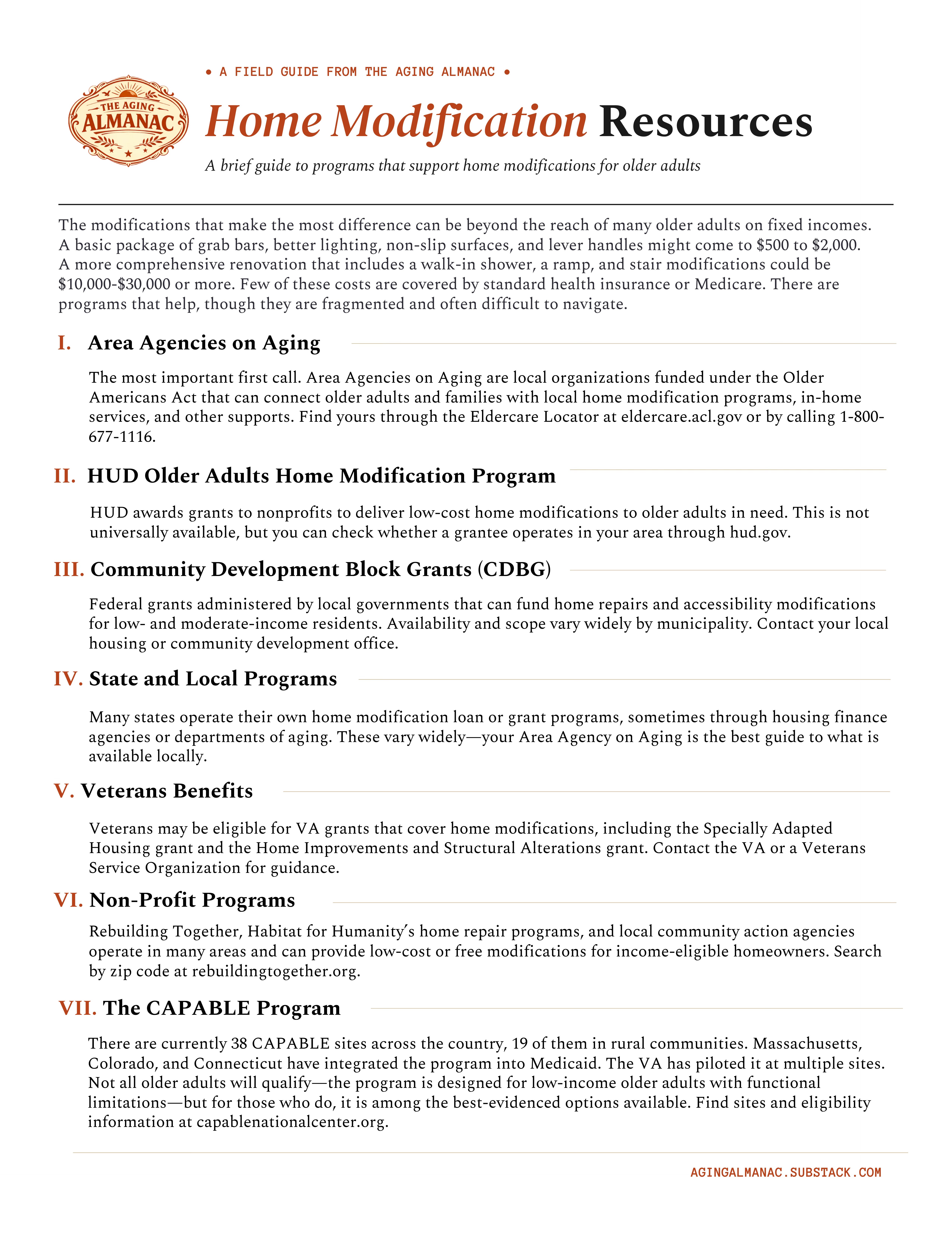
Printable Home Modification Resources
There is no bright line between manageable and unsafe, and the people closest to the situation are often the last to recognize when it has been crossed. In addition to falls, aging in place experts say that some of the warning signs worth attending to are: new or worsening confusion about time, place, or familiar people; missed medications or stockpiling; difficulty preparing food or maintaining nutrition; repeated incidents with the stove; getting lost on familiar routes; declining hygiene that suggests bathing has become difficult or is being avoided.
These signs do not mean it is time to leave home, but they may mean it is time to add support in the home, to get a proper assessment, and to have an honest conversation about what the person wants and what is realistic. The earlier that conversation happens, the more options are on the table. One of those options, increasingly, is living with family.
Next week, the Aging Almanac will look at the resurgence of multigenerational living: why more families are choosing it and how to make it work.
Comments
Nothing yet. Say the first thing.
Sign in to join the conversation.