
America’s public care system is short-staffed, underfunded, and under new federal law, about to become significantly harder to access.
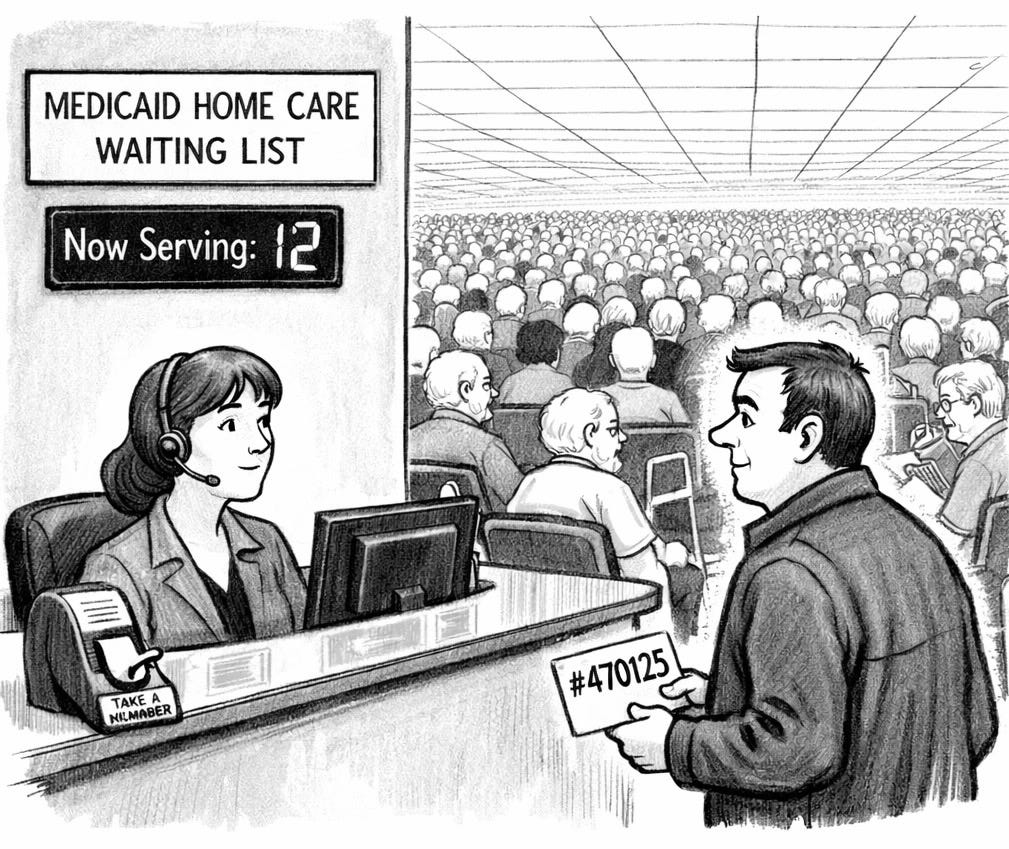
On July 4, 2025, President Trump signed into law the largest cut to Medicaid in the program’s history. The 2025 Budget Reconciliation Act strips nearly $990 billion from the federal Medicaid and CHIP budget over the next decade, which is roughly equivalent to eliminating the entire Medicaid program for a year. Separately, a recent federal crackdown on Medicaid fraud has threatened to freeze funding to states deemed non-compliant. Some of the people most directly in the path of both actions are the 5.1 million Americans receiving Medicaid-funded long-term care in their homes, and the more than 600,000 on waiting lists for that care, most of whom wait nearly three years for help they qualify for but cannot access. (1)
The message from Washington is familiar: you are largely on your own and it is going to get worse.
For families who provide the vast majority of long-term care in this country as unpaid, undertrained caregivers often while working other jobs, the message from Washington is familiar: you are largely on your own and it is going to get worse.
Previous articles in this series documented how America’s long-term care system is built on unpaid family labor, how that labor often consolidates around a single person, and how that person can learn to navigate a fragmented health system on a loved one’s behalf. But what do families find when they need more help than they can provide themselves? When they turn to private home health aides, nursing facilities, or Medicaid home care programs, the picture is one of chronic shortage, low wages, high turnover, and a safety net that is fraying faster than it is being repaired.
Home care is among the fastest-growing sectors in the American economy. According to PHI, the organization that tracks the direct care workforce most comprehensively, the number of home care workers more than doubled over the past decade to nearly 3.2 million in 2024, and the field is projected to add more new jobs over the next ten years than any other single occupation. (2) Demand is being driven by a rapidly aging population, the near-universal preference for aging at home, and the growing complexity of care needs that would have once required a hospital stay.
The system is chronically short-staffed, however. Turnover rates in home care are extraordinarily high: by some estimates, agency-wide turnover rates run at 75 to 80 per cent annually. In nursing homes, annual turnover approaches 100 per cent for nursing assistants. (3)
The human cost of that churn falls first on the people receiving care. Continuity matters enormously for someone with dementia or complex medical needs. These are people who depend on caregivers who know their routines, recognize the signs that something is wrong, and can distinguish a difficult morning from a medical emergency.
But the consequences fall equally on the family caregiver at home. When a paid aide fails to show up for a scheduled shift - a routine occurrence in an understaffed industry - someone has to cover. That is almost always the family member who arranged the help in the first place: the adult child who has to take more time off work, the spouse who cancels their own medical appointment, the person who was supposed to have a few hours of rest. A 2022 analysis of national data Norma Coe and Rachel Werner, both at the University of Pennsylvania, found that family members are also stepping in to care for loved ones in nursing homes and residential care facilities, regularly providing front-line support for their loved ones in the face of understaffing. (4) The labour simply defaults back to the family caregiver.
Direct care workers earn less than workers in all other occupations with similar or lower entry-level requirements in every state in the country.
The reason for the persistent shortage of direct care workers comes is two-fold: the work is physical and demanding, and very poorly compensated. According to PHI’s data, the median wage for direct care workers was $17.36 per hour in 2024. Given high rates of part-time work and unstable schedules, median annual earnings for direct care workers amounted to only $26,000. More than a third live in or near poverty, nearly half rely on public assistance programs like Medicaid and SNAP to make ends meet, and between 30-40 per cent of direct care workers are housing cost-burdened, meaning they spend more than 30 per cent of their income on rent. Home care workers fare the worst: median annual earnings of less than $23,000, and nearly 60 per cent rely on public assistance to survive. (5)
Earlier in this series, we documented just how much knowledge and skill effective caregiving requires: the clinical tasks, the medication management, the advocacy in hospital rooms, the ability to read a person’s condition against their individual baseline. But direct care workers earn less than workers in all other occupations with similar or lower entry-level requirements in every state in the country. A cashier, a parking attendant, a warehouse worker — all command more predictable compensation than the person providing hands-on personal and medical care to some of the most vulnerable people in the country. (6) The mismatch between the social value of this work and its market value exists because there is an assumption that the need for care, whether it is paid or unpaid, will always be filled.
Most Americans do not realize that Medicare, the federal health insurance program for people over 65, does not cover long-term care. Medicare will cover a brief rehabilitation stay after a hospitalization, but not years of custodial care at home or in a nursing home. That typically falls to Medicaid, the state-administered and means-tested insurance program for people with low incomes and very limited assets. Medicaid is the primary payer for long-term care in the United States. It pays for more than two-thirds of the long-term care delivered in home and community-based settings, representing more than 5 million Medicaid enrollees receiving care in their homes. (7)
Middle-class families in need of long-term care face excruciating financial decisions. A private-pay nursing home bed costs $110,000 a year at the median, (8) while private home care agencies charge rates that many families cannot sustain. The process of spending down savings to reach Medicaid eligibility, by selling assets and exhausting retirement accounts, often leaves families with little to fall back on.
Once families qualify for Medicaid, access to care remains far from guaranteed.
Once families qualify for Medicaid, access to care remains far from guaranteed. Nursing homes, though technically required to cover Medicaid-eligible residents, maintain strong financial incentives to limit the number of Medicaid beds they offer: private-pay residents reimburse facilities at rates roughly 30 per cent higher than Medicaid pays. (9) In home care, demand already vastly exceeds what states have chosen to fund: this is the source of the more than 600,000 people on waiting lists for home care, up 14 per cent from the prior year. (10) Low Medicaid reimbursement rates drove permanent closures of home care providers in 41 states in 2024, while workforce shortages mean that the agencies still operating are stretched too thin to meet demand from any payer. (11)
Families hoping to access Medicaid now face a wave of new challenges. The $990 billion of Medicaid cuts enshrined in the 2025 Budget Reconciliation law - also known as the One Big Beautiful Bill Act - will force the States to balance their budgets. Analysts say that the States, who share Medicaid costs with the Federal government, will bridge the gap by cutting benefits, tightening eligibility, and/or reducing provider payment rates that are already too low for many providers to accept.

“This would likely force states to reduce or eliminate coverage and services for people with the highest cost needs: older adults and people with disabilities who need long-term services and supports,” warned a consortium of more than 100 national aging and disability organizations in an open letter to Congress. (12) Medicaid enrollees who rely on long-term services and supports comprise only 6 per cent of Medicaid enrollees, but use 37 per cent of Medicaid expenditures. (13)
Home and community-based care (HCBS) will likely absorb the first and sharpest reductions. Unlike nursing home care, HCBS is mostly optional under Medicaid and at greater risk during budget tightening. During the fiscal crunch of 2010 to 2012, nearly every state reduced HCBS spending or access. (14) Research consistently shows that when federal Medicaid funding decreases, states cut optional benefits such as home and community-based services first. (15)
Families who have already spent down their savings to reach Medicaid eligibility will sometimes pay privately for help while they wait to obtain services, hoping to receive at least partial retroactive reimbursement from the program. That partial cushion has also been trimmed: the new law reduces retroactive Medicaid reimbursement from three months to one, meaning that even if families eventually receive coverage, they will be reimbursed for far less of what they spent during the wait.
Immigration policy has added a further squeeze to an already constrained supply of workers in long-term care. A third of the home care workforce is foreign-born (16), and that supply is tightening. According to a joint survey conducted by KFF and The New York Times, 13 per cent of immigrants said they or a family member avoided going to work in early 2025 because of concerns about drawing attention to their immigration status, a figure that rises to 40 per cent among people likely to be undocumented. (17)
Compounding all this is a federal crackdown on Medicaid fraud that has placed home care at the center of its scrutiny. In February, the Centers for Medicare and Medicaid Services singled out personal care and home and community-based services as areas of “unusually high spending and rapid growth” and deferred $259.5bn of federal Medicaid funding to Minnesota while opening reviews of several other states. (18) The Trump administration’s position and that of allied policy groups is that the decentralized nature of home care, meaning services delivered in private homes by loosely supervised workers, makes it particularly susceptible to abuse. (19)
“Withdrawing support for HCBS and pursuing sweeping structural changes without clear evidence of systemic fraud jeopardizes services that have become foundational to our country’s modern long-term care system.”
Health policy researchers have pushed back forcefully. Writing in the March issue of policy journal Health Affairs, scholars Jane Tavares, Alison Barkoff, Sara Rosenbaum, and Marc Cohen argue that the growth of home and community-based services reflects decades of deliberate federal policy and demographic inevitability, not systemic fraud. “Withdrawing support for HCBS and pursuing sweeping structural changes without clear evidence of systemic fraud jeopardizes services that have become foundational to our country’s modern long-term care system,” they warn. “It would undo more than 40 years of bipartisan federal policy designed to rebalance that system away from institutional care toward less restrictive care provided in the homes and communities where disabled people and older adults want—and have a civil right—to live.” (20)
Whatever the merits of the underlying debate, the practical effect of funding freezes and increased scrutiny will be reduced availability of services and longer waits for the people who need them.
For families that cannot access Medicaid services, find no agency willing to care for their loved one, or are waiting years for a place in the Medicaid program, one option remains: hiring a caregiver privately, often informally and in cash. This gray market is widespread and entirely unregulated. Workers in these arrangements have no labor protections and no recourse if injured. Families have no formal vetting mechanism, no backup if their caregiver cannot come to work, and face potential liability as informal employers. It is an arrangement that serves nobody well but for many families, it is simply the only one available.
The new law also tightens the squeeze on family caregivers who rely on Medicaid for their own health coverage. Medicaid was the primary health insurer for more than 7 million family caregivers in 2025, according to AARP (21). Beginning January 1, 2027, working age adults who receive Medicaid through the Affordable Care Act expansion must demonstrate 80 hours per month of work, education or community service to maintain their coverage. Family caregivers are nominally exempt, but the history of work requirements in the only two states that have implemented them - Arkansas and Georgia - is not encouraging. In Arkansas, more than 18,000 people, roughly one in four of those subject to the requirement, lost coverage in under a year, primarily because the reporting process was confusing or inaccessible. (21) Research on both states shows that administrative red tape caused coverage losses among people who were working and among people who should have been exempt, including those with caregiving responsibilities. (22, 23)
Against this backdrop, there is one arrangement worth paying attention to. A growing number of States allow Medicaid recipients to hire and direct their own caregivers under what are called “consumer-directed” or “self-directed” care programs, and in many of those states, the caregiver can be a family member. For adult children or spouses who have already reorganized their lives around providing care, this creates a mechanism, however modest, for receiving some Medicaid compensation for work they are doing anyway. Evidence on these programs is generally positive: participants report higher satisfaction, care is more consistent, and the model is cost-neutral. (24) The looming cuts to Medicaid and increased scrutiny over fraud will both put pressure on these programs and some may not survive intact. But for families navigating the system now, finding out whether this option exists in their state is one of the most useful steps they can take.
Get on Medicaid waiver waiting lists as early as possible — ideally before care is urgently needed, since eligibility is assessed at the time of application.
Consult an elder law attorney sooner than you think you need to: the five-year look back period on asset transfers starts running whether or not you know about it, and planning options narrow significantly once care needs become acute.
Ask your state Medicaid office or a local Area Agency on Aging whether a consumer-directed care program exists in your state and whether a family member could be paid as a caregiver.
When evaluating home care agencies, ask directly about staff turnover and whether the same aides are assigned consistently. For nursing facilities, staffing data is publicly available through Medicare’s Care Compare website and should be reviewed before any placement decision.
In next week’s Aging Almanac, we will turn our attention to housing. The overwhelming majority of Americans would like to stay in their homes as they age, but very little of America’s housing stock meets even the most basic accessibility standards. We will explore the options available for aging Americans who want to live out their years safely and affordably.
Comments
Nothing yet. Say the first thing.
Sign in to join the conversation.