
The United States almost certainly entered the war with Iran in pursuit of a regime decapitation — similar to the one that had taken place in Venezuela earlier this year — that would pave the way for a government more receptive to American interests. Yet after nearly two months of war, Donald Trump’s objectives now seem to oscillate between reopening the Strait of Hormuz — closed by Iran in retaliation for the attacks — and the far riskier economic strangulation of Iran.
Although the official narrative does not yet acknowledge it, the situation is much more bogged down than the US government anticipated. In fact, Donald Trump launched the war by framing it as a brief, surgical operation that would bring “freedom” to Iranians while providing greater peace of mind to Israel — which regards Iran as its principal existential threat — and to the Gulf states. Reality has turned out very differently.
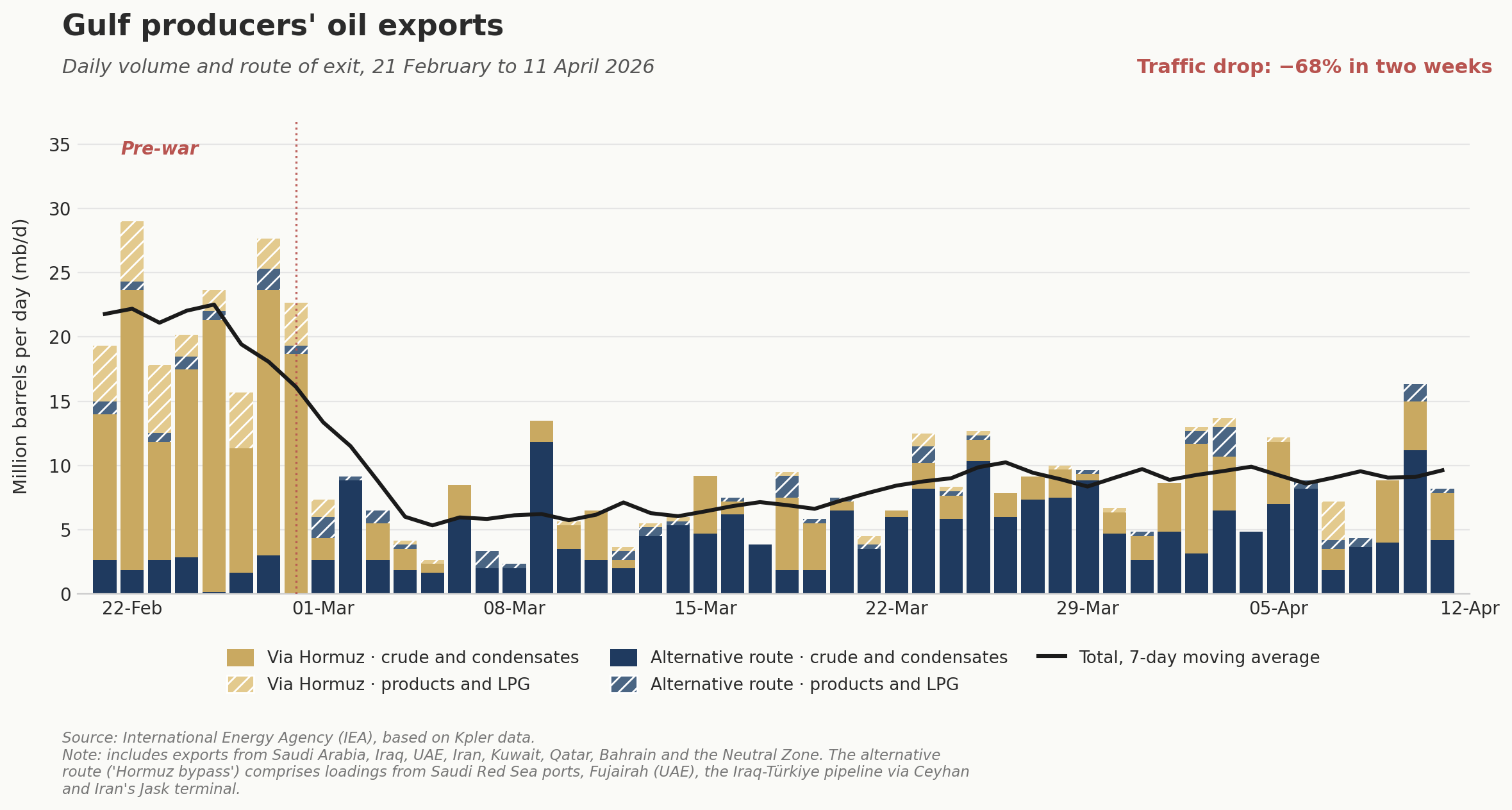
The Strait of Hormuz is a node in the metabolism of the world-economy, and it is also a chokepoint extremely vulnerable to geopolitical shocks. The impact of its closure on producer countries is very big and, according to data from the International Energy Agency, the volume of oil transiting the Strait of Hormuz has fallen to an average of 10% of pre-war levels. As the chart below shows, alternative routes — via the Red Sea, for example — have had to sustain the bulk of exports since the war began; clearly insufficient to maintain pre-war export levels.
Ecosocialist Notebook - Alberto Garzón is a reader-supported publication. To receive new posts and support my work, consider becoming a free or paid subscriber.
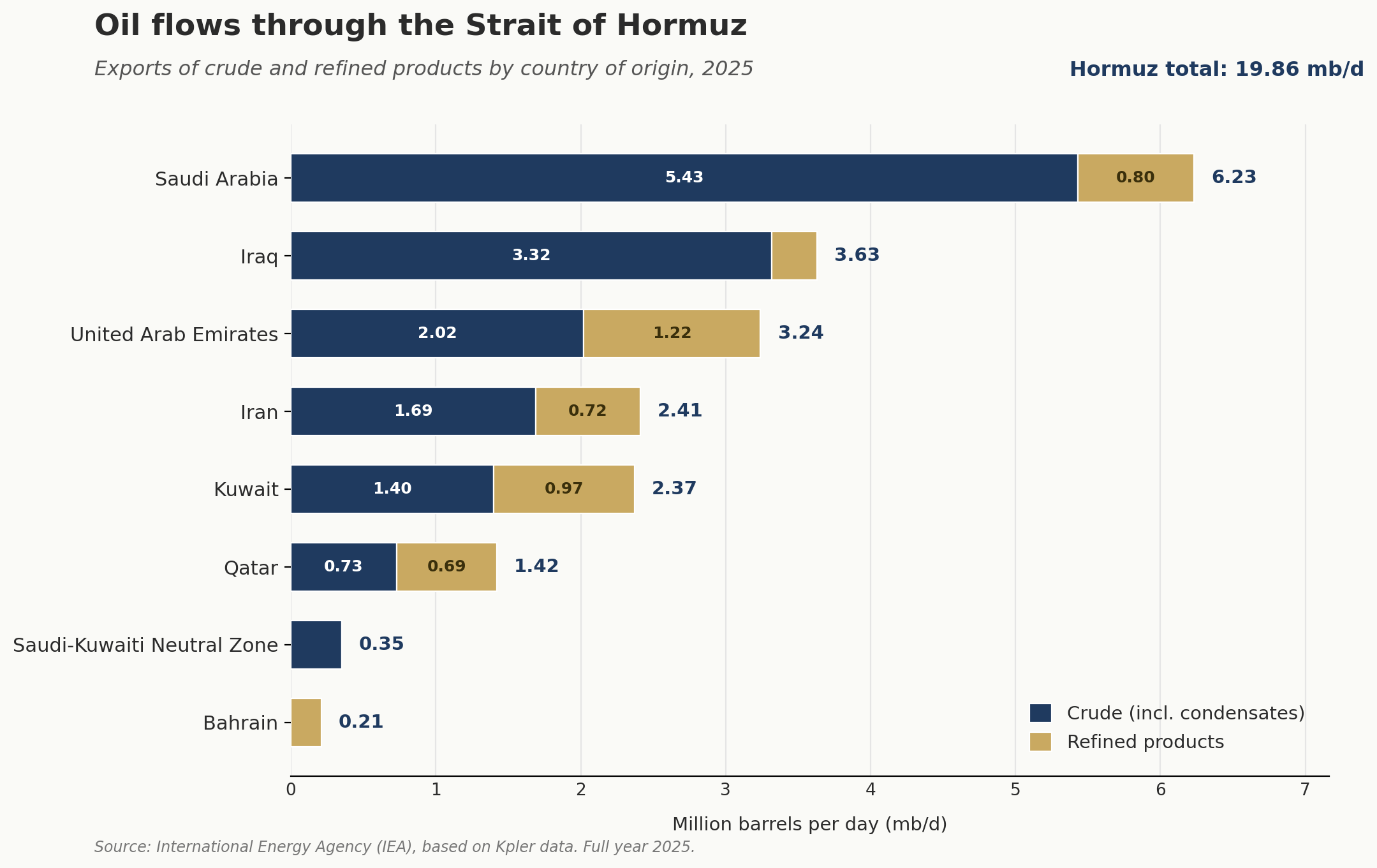
Of all the Gulf countries, the largest share of exports is held by Saudi Arabia, Iraq, and the United Arab Emirates, followed by Iran and Kuwait, as shown in the following chart. This means that, although Iran is bearing the direct costs of the war — including the majority of fatalities and the destruction of infrastructure — the aggregate economic losses fall on countries that maintain historical ties with Washington.
And it is not just about oil. Around 20% of the world’s liquefied natural gas transits through Hormuz, and Qatar is the big loser on the gas side. This particularly aggravates the situation in Asia: around 28% of the LNG that China imports comes from Qatar, and almost a third of total LNG flows to Asia depend on the strait. The global energy crisis, therefore, has two simultaneous legs — oil and gas — which reinforce one another, on top of all the industries producing goods derived from fossil fuels.
As I explained last week regarding the petrochemical sector, the Gulf states have spent decades deepening their commercial ties with Asia, particularly with China: between 2010 and 2024, this trade has practically tripled. According to estimates from the think tank Asia House, this dynamic will only intensify in the coming years.
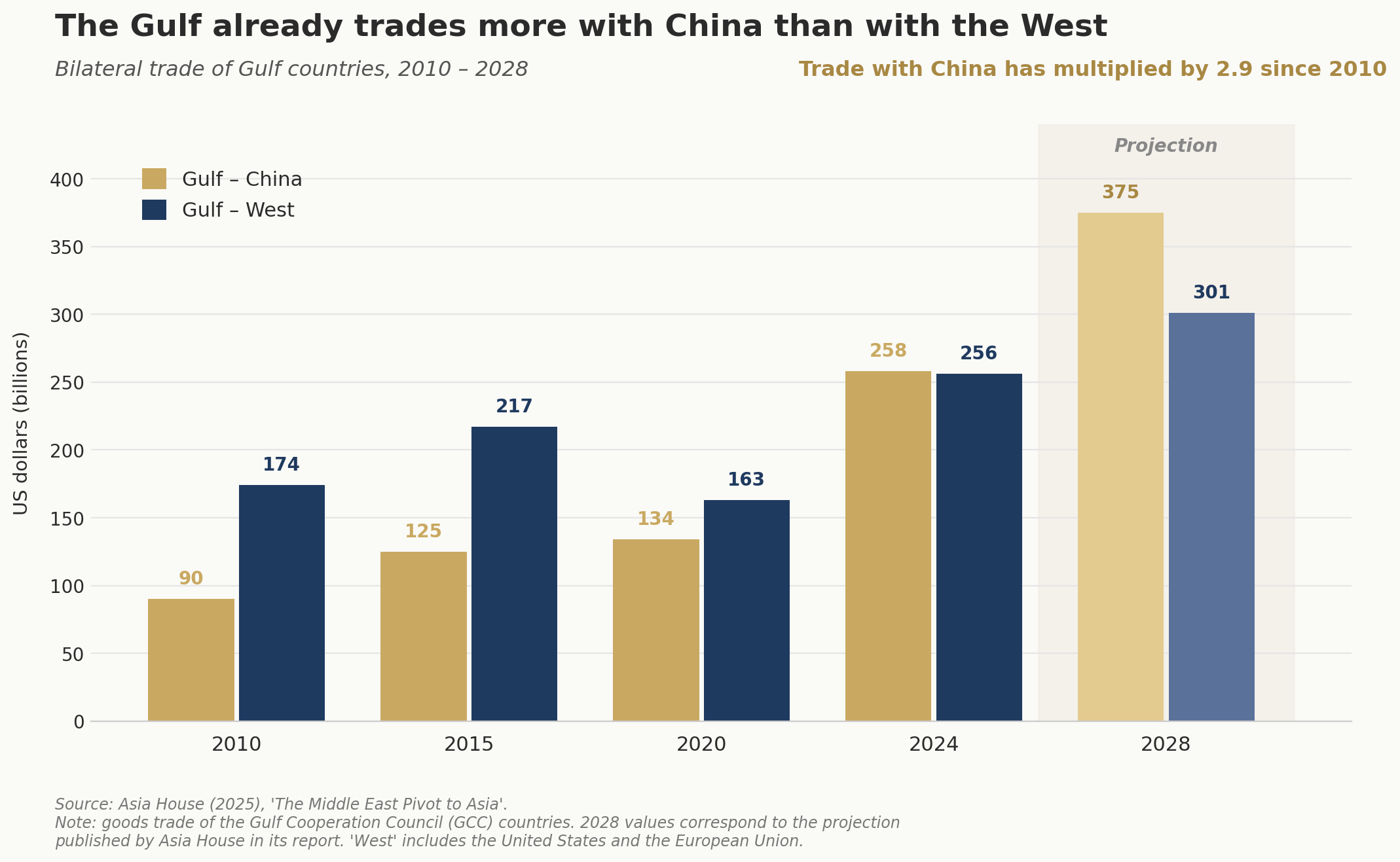
This is a delicate situation for the Gulf states, which must maintain a careful balance between their alliances with the West and their growing ties with Asia. It is worth bearing in mind that the US–China Economic and Security Review Commission, which reports to the US Congress, has declared that China, Russia, Iran and North Korea form a new “axis of autocracy” and asserts that they share the desire to challenge US global leadership. To some extent, this framing operates as a self-fulfilling prophecy: the more Washington harasses and sanctions the peripheries, the more it pushes the Gulf states to think twice before any gesture of distancing from Beijing.
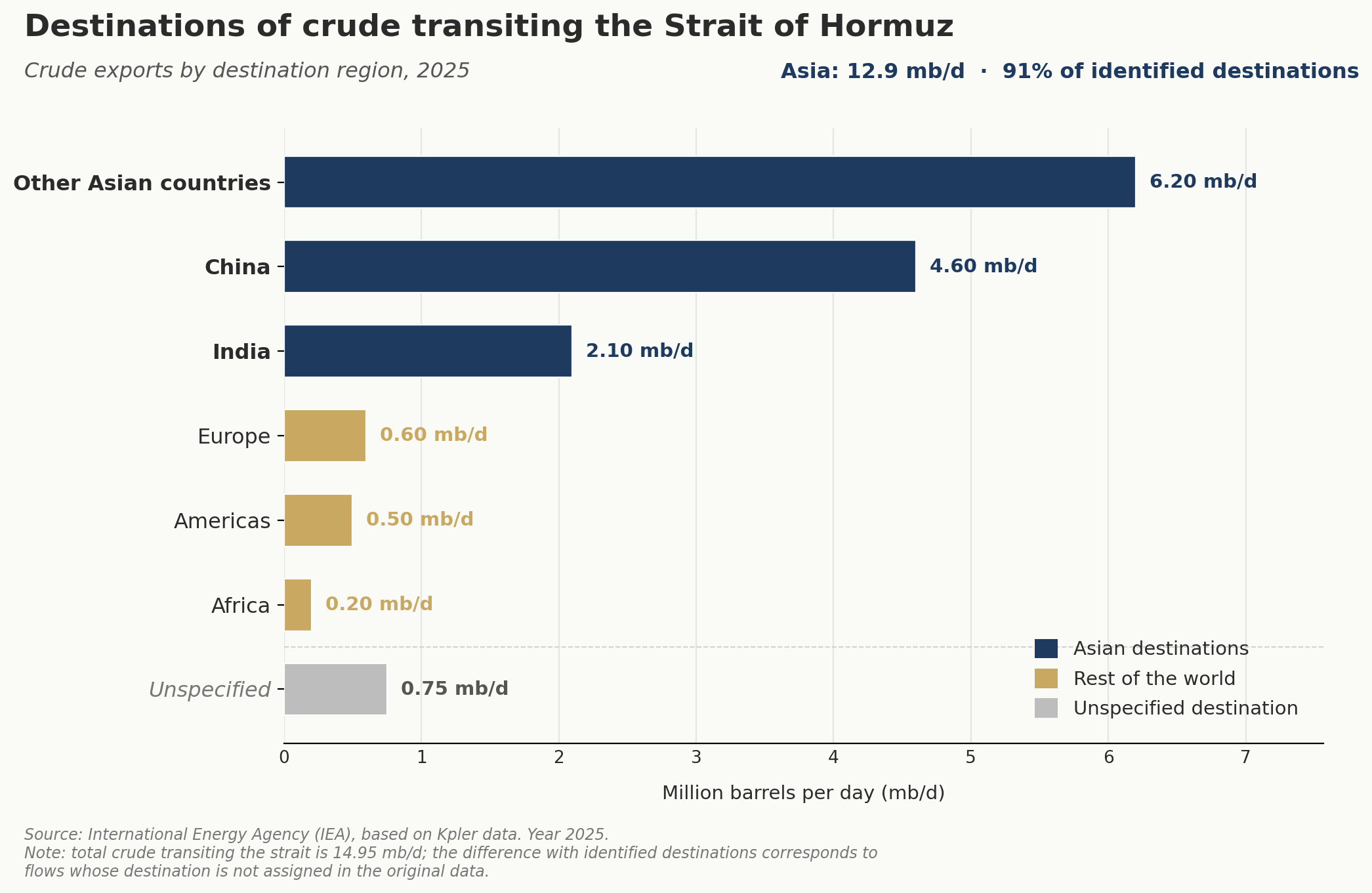
Under normal conditions, most of the crude oil leaving the Strait of Hormuz in 2025 was destined for Asian countries, as shown in the following chart. We can see that both Europe and the Americas depend only marginally on physical oil supplies from the Gulf countries. This does not mean the closure leaves them unaffected, since prices are determined globally and they do suffer the impacts of inflation — and they can also be particularly dependent on specific products, such as fertilisers. But in general, it is clear that Asia is the chief casualty of the current situation, as demonstrated by the fact that measures to reduce energy consumption — degrowth policies, we might say — have been faster and deeper there.
The interruption of trade flows has serious physical implications, not just economic ones. It is not merely that oil becomes more expensive — as is the case in Europe or the United States — but that it may simply stop arriving in sufficient quantities to meet demand. Anticipating this possibility, China has spent years building up its oil reserves, which are estimated to be sufficient to cover four months without new imports by sea; though with demand-reduction measures we could be speaking of a considerably longer period.
As the following chart shows, China is heavily dependent on oil imports from Gulf countries such as Saudi Arabia, Iraq, the Emirates, Kuwait and Oman, most of which transit the strait. But official data do not show imports from Iran or Venezuela, as both countries are subject to international sanctions. The standard practice is “rebranding” — that is, setting up complex operations to pass off sanctioned oil as imports from legally traded countries, such as Indonesia or Malaysia. The most reliable estimates indicate that, once this strategy is taken into account, nearly 50% of Chinese oil imports come from the Gulf.
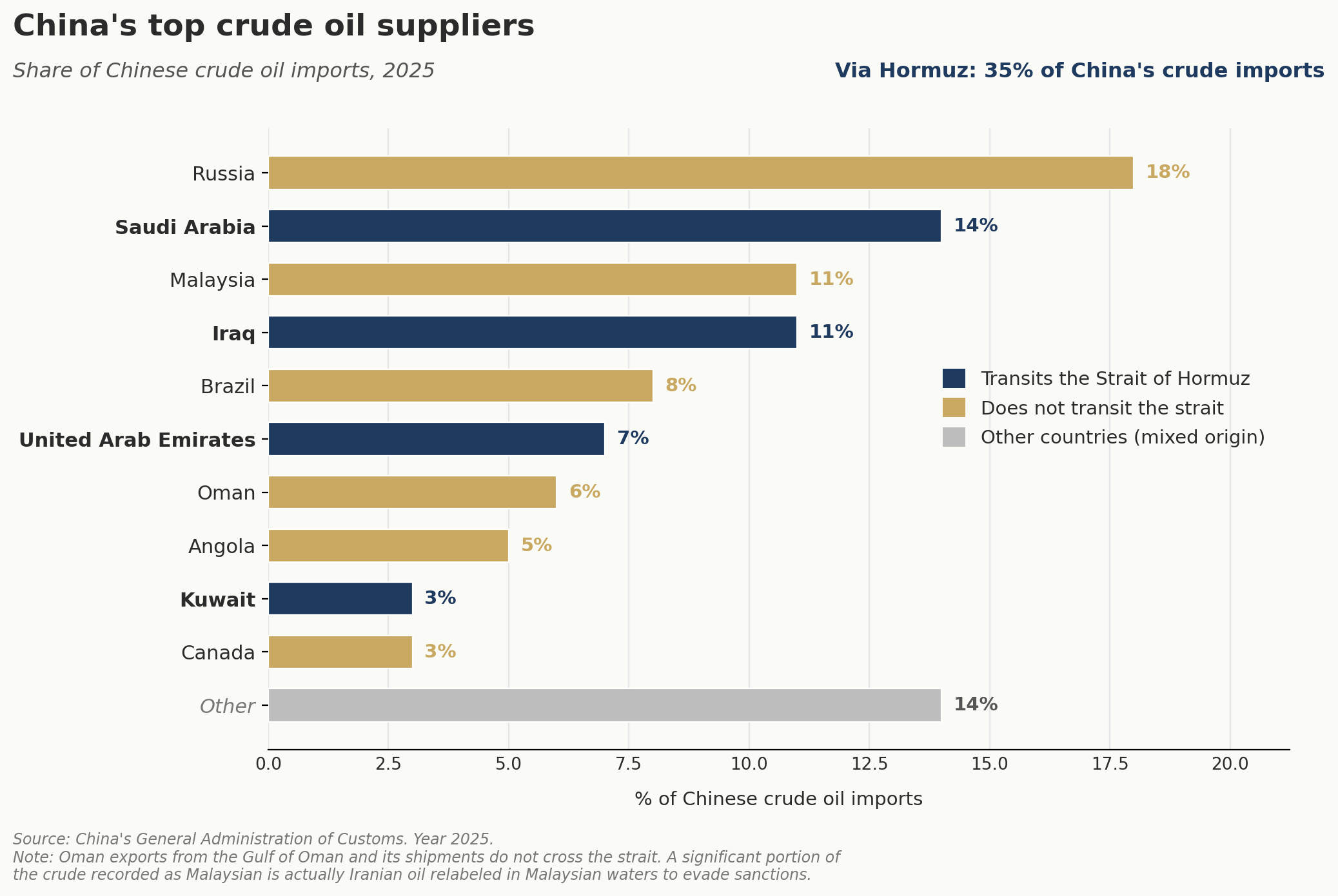
One consequence of the above is that China has turned increasingly to Russia, its major oil supplier. In fact, Russia is one of the big winners from the energy crisis, and according to International Energy Agency data, its export revenues practically doubled in March, reaching $19 billion. Contributing to this, of course, is the relief the United States has afforded it on international sanctions — just as it has with Venezuela.
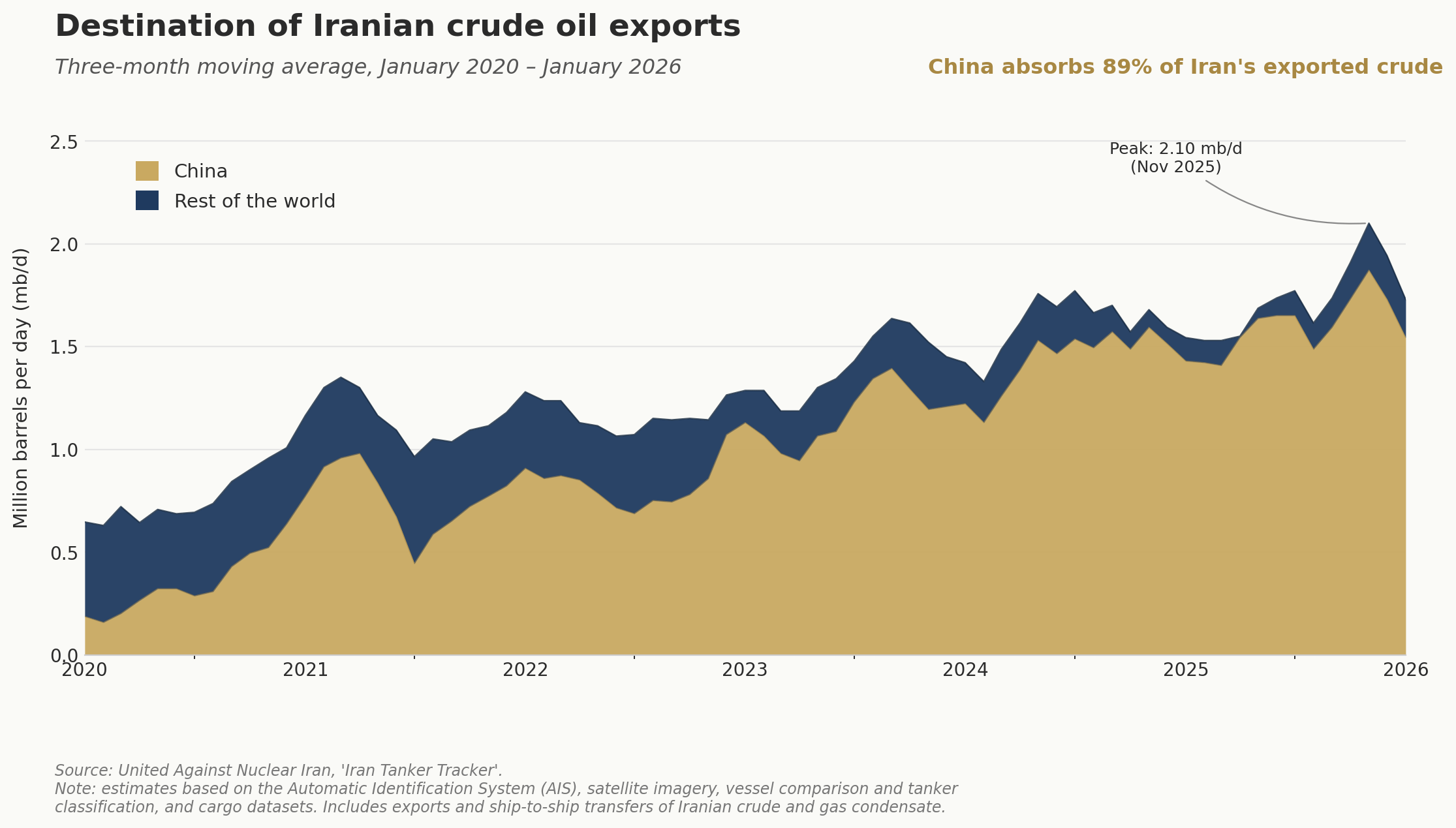
Yet if China’s dependence on oil imports is great, its inverse is even greater: the dependence of Iranian exports on China. As the following chart shows, China has, in recent years, become the customer for 90% of Iran's oil exports. The consolidation has been rapid: although China was already the main buyer in the wake of Trump’s 2018 sanctions, the leap of the last three or four years towards near-exclusivity turns Tehran into a fully-fledged energy client state of Beijing, with all that this implies in terms of negotiating asymmetry.
Today we know that Israel has entered this war mainly because it projects into the future its idea of a “Greater Israel”, in which territorial expansionism would allow it to consolidate its position as the region’s hegemonic power. We also know that Iran has found in its control over the Strait of Hormuz its principal bargaining chip, aimed, as far as possible, at securing guarantees against future attacks. The real objective of the United States is more opaque than the initial naivety of those who believed it would be a quick and easy operation. The situation has become stalemate, giving rise to a global energy crisis of considerable magnitude.
That said, crises never strike everyone equally. As I have tried to show, the main economic impact is being felt in the Gulf and Asian economies, precisely at a moment when both regions are deepening their relations and challenging Western primacy. It is not clear whether this war will weaken that prior dynamic or, on the contrary, deepen it; but what is clear is that China has sound structural reasons to push for de-escalation.
Although it is not the main party affected, the United States cannot afford for the war to drag on indefinitely. Its problems have to do with inflation, the impact on financial markets and the domestic political erosion of Donald Trump. For Europe, the situation is considerably worse: more exposed to the energy shock through prices and supply chains, with the ECB caught between imported inflation that cannot be tamed by rate hikes and a slowdown that those very hikes would aggravate. Europe’s room for manoeuvre, once again, is narrower than that of the United States.
What is being decided in the Strait of Hormuz is the energy architecture — and therefore the balance of power — of the 21st century. The chokepoint symbolises the vulnerability of the world-economy’s metabolism, but the war is also revealing the United States' inability to impose, by force, a geographic-energy order that is slipping towards Asia at an accelerating pace. When China defends peace, it knows better than anyone that its structural gains — the consolidation of the Eurasian axis, the strengthening of its ties with the Gulf, the gradual autonomy from the dollar in strategic exchanges — are incompatible with a long war. In that equation, peace suits Beijing today more than it suits Washington. And the price of that asymmetry could be measured, in the medium term, in a faster shift of the world-system’s centre of gravity towards Asia.
Ecosocialist Notebook - Alberto Garzón is a reader-supported publication. To receive new posts and support my work, consider becoming a free or paid subscriber.
Comments
Nothing yet. Say the first thing.
Sign in to join the conversation.