
The economic historian Karl Polanyi explained masterfully in The Great Transformation that the market-State dilemma — according to which we must choose one or the other to allocate resources properly — is a false one. Markets, in fact, never existed apart from the State, and were indeed deliberately created by its hand; most often through merciless violence against the popular classes — as occurred with the enclosures — and against indigenous populations, since Western institutions made their way into the world propelled by the sabres and gunpowder of imperial armies. The market is not, as liberals would have it, a natural institution.
Pulling on that thread, the historian Quinn Slobodian, in Hayek’s Bastards, sets out a very different account of the origins of neoliberalism from the usual one. Against the conventional narrative, which holds that neoliberalism was chiefly an ideological project to deregulate the market — because, supposedly, this was preferable to having the State direct the economy — Slobodian reminds us that markets are always regulated. The real motive behind neoliberalism was to insulate economic decisions from the popular will, rendering them independent so that the passions inherent in democracy would not interfere with the optimal allocation of resources that markets would secure.
The European Union of today is a product of that neoliberal historical moment, and this is most clearly expressed in the European Central Bank's anti-democratic character. Although this institution is responsible for managing monetary policy — and can, for example, influence the “price” of our mortgages — in the exercise of its functions it is independent of political power and is, in fact, prohibited by law from directly financing States, an option that was common practice among earlier central banks. The underlying logic is plain: the management of monetary policy is far too important to be left at the mercy of citizens’ wishes; far better that technocrats should be at the helm. This idea of outsourcing responsibility to an independent — though public — entity lay at the heart of the neoliberal thesis and of the spirit of Friedrich Hayek. The result was not a super-State but, as Perry Anderson put it, an infra-State: one in which institutions prevent popular interference in markets.
This tension between the wishes of the majority and the limits imposed from above has been intrinsic to the very evolution of democracy. As far back as ancient Greece, the dispute between the radical factions — Solon, Ephialtes, Pericles — and the conservative ones — Aristotle, Plato — turned on the scope of the demos and on the matters about which it could legitimately decide; institutions such as the Senate arose precisely out of the aristocratic interest in curbing popular impulses. The modern rule of law is a direct heir to that tension: a historical construct that channels, through rules — usually constitutional — what majorities may or may not decide. But not all conceptions of the rule of law are alike. Progressive authors such as Luigi Ferrajoli defend the existence of a sphere of the undecidable that shields personal liberties and social rights, understood as the necessary condition of democracy itself. Neoliberals, by contrast, prefer to remove economic decisions from the democratic sphere. The undecidable, depending on who defines it, either protects the citizen or disarms them.
Yet neoliberalism as we knew it from the 1980s up to the financial crisis of 2008 is dead. What is replacing it — as Slobodian himself has been pointing out in his most recent work — is an authoritarian populism with neoliberal roots. This is an unprecedented political formation that brings together four elements: a strong executive willing to intervene in the economy, a selective neo-mercantilist protectionism, a highly restrictive conception of human rights, and a technological oligarchy that aspires to merge with the state apparatus. It retains the neoliberal contempt for popular sovereignty but sheds its liberal façade. And there is no better place to see it than in the United States, where Donald Trump’s external neo-mercantilism has been wedded to the authoritarian liberalism of the techno-oligarchs.
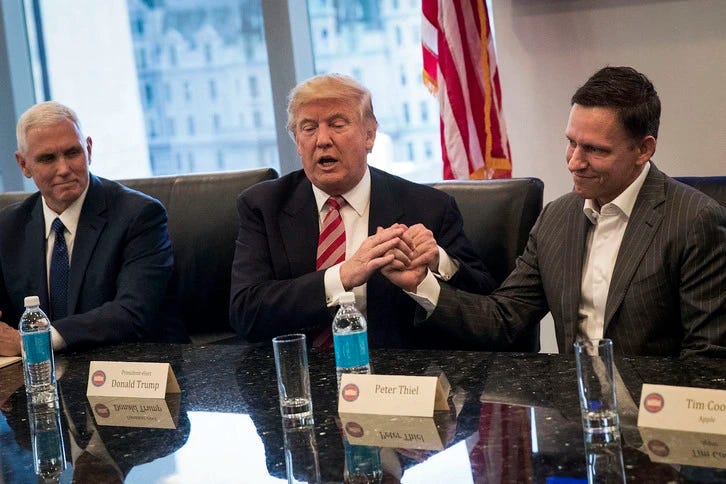
A few days ago, Palantir — a company founded by the reactionary billionaire Peter Thiel and now run by his counterpart Alex Karp — published a terrifying, if perfectly transparent, manifesto setting out its position. Palantir is a technology company and an arms manufacturer for the wars of our time — drones, digital espionage, artificial intelligence, and so on — that has for several years been winning lucrative contracts, above all from the United States government. Amnesty International has accused the company of complicity in the war crimes of the Israeli military, and its involvement in the war in Iran is a matter of public record.
This is not, however, a phenomenon confined to the United States. Palantir has signed contracts with the defence ministries of Germany, France and the United Kingdom, operates within the data infrastructure of the British National Health Service (NHS), and aspires to embed itself in the European Union's digital infrastructure. To this must be added a structural dependence on a wider handful of US corporations increasingly aligned with the political project of Trump and his techno-oligarchic allies — Peter Thiel, Palantir’s founder, gave $15 million to J.D. Vance’s Senate campaign. Technological dependence thus inevitably becomes political dependence.
Palantir’s manifesto is clear in its intentions, arguing that it should no longer be States that handle crucial elements of warfare, but technology companies. The company’s technology already underpins the automated decision to identify enemies, dispatch drones, kill targets and return to base. But what these techno-oligarchs want is to go further still, for their worldview also entails a forceful rejection of pluralism, of cultural diversity, and of any values that threaten the American way of life. In this respect, the interests of these corporate giants are perfectly aligned with those of Donald Trump and his administration. They likewise share the conviction that contemporary democracy is incompatible with such aspirations — or, as they put it, that “democracy” can only be saved if it is transformed by integrating these large technology firms into the heart of the State and by deploying more active military intervention both abroad and at home (these technologies are also being applied in the identification of undocumented migrants in the context of the United States’ anti-immigration policy).
The challenge is enormous, and yet it scarcely features in everyday political conversation. Certainly, we can say that European sovereignty is at stake, given our technological dependence on a techno-oligarchic elite based on the other side of the Atlantic and ever more closely intertwined with the American apparatus of power. But democracy as we have known it is also under threat. If Europe fails to articulate a strategic response that recovers sovereign capacity in critical sectors — energy, defence, data, digital infrastructure, artificial intelligence — and that, at the same time, reaffirms the undecidable core of rights that Ferrajoli identified as the condition of possibility of democracy itself, the danger is plain: a sustained drift toward authoritarian regimes of a new kind, no longer grounded in fascist-style terror but in pervasive algorithmic surveillance, in the automated identification of dissidents and migrants, and in an architecture of citizen control operated by private corporations whose owners openly despise pluralism.
One central point bears repeating: this does not belong to some distant dystopia. The systems are already operating in Gaza, Iran, the English Channel, and British hospitals. The tension that Polanyi and Slobodian described — between market and democracy, between popular sovereignty and technocratic insulation — thus enters a new and qualitatively more dangerous phase. Neoliberalism removed the economy from citizens’ judgment. What is coming seeks to remove the citizens themselves.
No posts
Comments
Nothing yet. Say the first thing.
Sign in to join the conversation.