
The 1920s and 1930s pitted the German chemist Hermann Staudinger against almost everyone, both within his discipline and in the political arena. A pacifist during the First World War, the son of a Social Democratic militant and married to a communist, Staudinger would end up being denounced by the philosopher Martin Heidegger with the rise of Nazism. Yet at the time of that denunciation, Staudinger was an adviser to IG Farben, the industrial giant formed in 1925 through the merger of Germany’s major chemical firms — among them BASF and Bayer — which would become a fundamental instrument of Nazi power during the Second World War. That power was derived largely from Staudinger’s own scientific discoveries; in 1953, he would receive the Nobel Prize in Chemistry for his work on macromolecules.
As early as 1920, Staudinger had argued that molecules could be joined into long chains. It took more than a decade for the scientific community to accept the idea, but today we call those macromolecules polymers (DNA, RNA, starch and proteins, for instance, are all polymers). As though it were a train, each polymer is made up of a series of subunits — the carriages — called monomers; and the way the monomers are combined determines the chemical properties of the polymer in question. We can think of them as building blocks that can be arranged in different ways, giving rise to different substances which are naturally present all around us. And which can also be created artificially.
Take the case of vulcanised rubber, a semi-synthetic product created from natural rubber, which in the 1930s was obtained 90% from Sri Lanka, India and Malaysia — a dangerous concentration from a geopolitical point of view. Rubber was indispensable militarily, used for tyres and for sealing and insulating vehicle components, so learning to create fully synthetic rubber became a central objective of the chemical industries — always backed by, when not directly run by, the state. In those turbulent times, countries sought to guarantee their self-sufficiency, which required both active control over natural resources — a driver of territorial expansionism and imperialism — and a reduction in their commercial dependencies on other countries.
From the late twenties, and above all during the thirties, discoveries of how to build synthetic polymers on a large scale cascaded one after another. PVC, synthetic rubber, polyethylene — the simplest polymer of them all — nylon… all came onto the scene. As on other occasions, the military industry became the catalyst for innovation and discovery. Indeed, the researcher Adam Hanieh argues that the Second World War can without exaggeration be labelled the ‘Polymer War’. In any case, these products transformed the world: they made goods cheaper and reproducible on a large scale, ideal for war, but also paving the way for the subsequent democratisation of consumption and the multiplication of goods. This was the deployment of the petrochemical industry, and our present-day world cannot be understood without these events — even though they scarcely feature in contemporary debate.
To understand why the current war in Iran is not merely a matter of barrels of crude, but a blow to the very heart of contemporary material production, we need to open the black box of the petrochemical industry and grasp what it is made of.
With the production of synthetic polymers, countries managed to escape their dependence on certain natural resources, freeing themselves from geographical servitudes. In reality, one form of dependency was swapped for another. The problem is that, then as now, the importance of fossil energy was underestimated: whether coal or oil, it was so abundant that it was not considered a serious constraint on the production of polymers and consumer goods. But the fact is that the entire petrochemical industry depends on these energy sources, and according to the International Energy Agency it currently accounts for 14% of global oil demand and 8% of natural gas demand. What is relevant here is that this demand is for use not only as energy but also as an input into the productive process itself.
It should be borne in mind that when crude oil is extracted from the wells, what comes out does not look much like the petrol we put into our vehicles every day. It is a mixture of hydrocarbon compounds which have to be transformed, or ‘refined’. This refining phase follows extraction, and consists of chemically separating the different components of the crude using processes involving very high temperatures. At the same refinery the qualities of the resulting products are also typically treated and upgraded — among them petrol, which represents around 45% of the barrel of crude, along with gas oil and diesel, jet fuel, and other substances used as inputs by the petrochemical industry, such as naphtha.
In a third phase, the chemical industry takes the relevant inputs from the refining process and transforms them into basic petrochemical products. Thus, what enters this phase is naphtha, ethane, propane and methane — all derived from the refining of oil and natural gas — and what comes out are products such as light olefins (ethylene and propylene) and aromatics (benzene, toluene and xylenes). All these names are wholly alien to our daily lives, yet they form the basis of 95% of all manufactured goods: few of today’s goods are not produced in one way or another by the petrochemical industry. For example, product packaging accounts for 36% of global plastic demand, followed by the synthetic textile industry, the construction industry, and consumer goods such as toys and household utensils — as well as medicines, solar panels, spectacles, bicycles, and even bulletproof vests.
The central point of this analysis is to understand that all of these manufactured products depend on the extraction and processing of fossil energy. As I have already mentioned, fossil fuels — primarily oil and natural gas — are used both as fuel and as raw materials. This explains why vertical integration is so common — that is, a single company's ownership of both the extraction and refining and petrochemical phases. It also explains the advantage the Middle East enjoys in developing the petrochemical industry: its energy costs are much lower.
As I explained in an earlier analysis, the growing importance of oil at the start of the twentieth century turned the Middle East into the central object of European imperial rivalry — with Great Britain directly or indirectly controlling everywhere from Egypt to Iran, where it acquired control of the Anglo-Persian Oil Company (APOC), today’s BP. After the Second World War, hegemony passed to US companies, but nationalist movements also emerged, culminating in episodes such as the Iranian nationalisation of APOC — by then known as Anglo-Iranian — under Mossadegh in 1951, and the subsequent Anglo-American coup d’état. As Adam Hanieh has shown in Crude Capitalism, that nationalist spirit crystallised in the creation of OPEC in 1960 and, in the heat of the Yom Kippur War, in the wave of oil nationalisations of the 1970s. Significantly, those movements to socialise companies were not reversed in the following decades when neoliberalism became the official ideology of the West.
Indeed, during the eighties and nineties, Western countries embraced the neoliberal ideology that championed the triumph of the market over the state, leading to a wave of privatisations that also reached Spain, with more than a hundred public companies privatised. The irony is that at that very moment, China was rolling out a development strategy based on state-led industrialisation, with a huge role for public and semi-public enterprises. The Gulf countries, for their part, not only retained public control of their companies but also embarked on a process of diversifying their economies to reduce dependence on oil extraction.
The Gulf states became convinced that they had to industrialise by developing new manufacturing sectors, as well as refining and petrochemicals, but they did not entrust this to the free market. On the contrary, as early as 1968 a country like Bahrain launched its first five-year plan aimed at creating an aluminium industry and shipyards; something Dubai and Oman would also do a few years later. In 1976, Saudi Arabia made the leap with the creation of the Saudi Arabia Basic Industries Corporation (SABIC), today one of the world’s leading petrochemical companies and owned principally by Aramco, the Saudi state-owned oil and gas company. Other countries, such as the UAE, have likewise used their state oil companies for decades to control the refining and petrochemical phases and, in this way, to exercise greater control over the fossil chain while partially diversifying their economies. The Gulf’s state-owned firms are not entirely public, but are also held in part by private capital, both domestic and international — which has given rise to the proliferation of a billionaire elite tied to their governments.
This energy strategy has not been confined to the region. China’s industrialisation process, and its incorporation into the world economy from 2001 onwards, required vast quantities of oil which the Gulf countries were willing to supply. Since then, relations between the Gulf and China have become so close that 2024 was the first year in which Gulf–China trade surpassed Gulf–West trade. In the case of petrochemical exports, the Asian orientation is clear: China accounts for 28% and India for 23%.
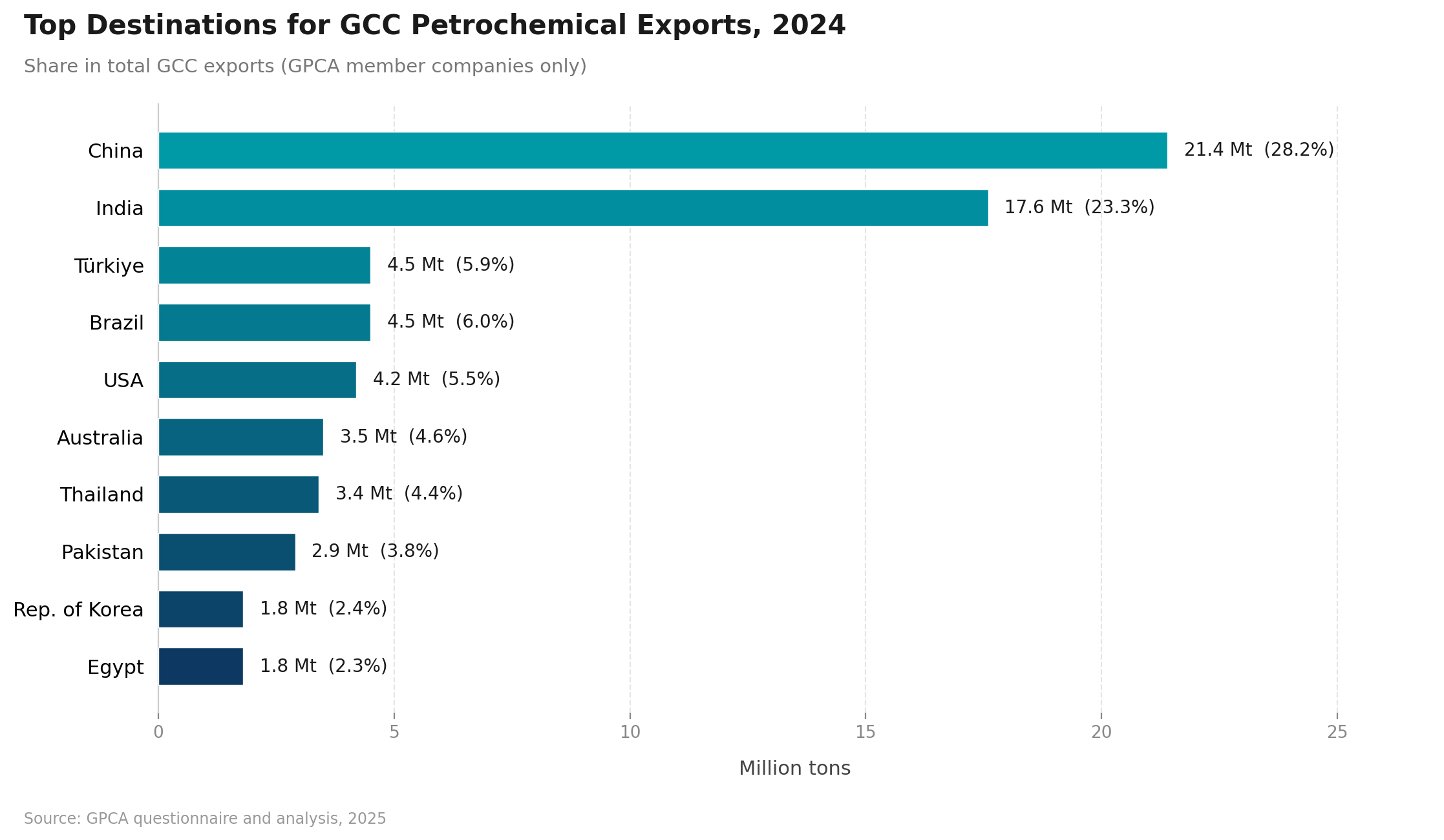
In 2024, the two world regions which grew most in petrochemical production were China (6.8%) and the Gulf countries (5.7%). The interrelation, however, has not been purely commercial but also in terms of investment, with Asian capital investing in the Gulf and Gulf capital investing in Asia. As Adam Hanieh has pointed out, between 2017 and 2021 more than 30% of China’s oil investment was directed towards the Middle East — five times more than in the previous period. The reverse is also true, with companies such as Aramco taking positions in Asian refining and petrochemical industries.
The closure of the Strait of Hormuz has not only interrupted the passage of oil but of all the trade that crossed it. And that includes fertilisers and petrochemical products. The entire industrialisation strategy of the main Gulf countries — Iraq, Iran, Kuwait, the UAE, Bahrain and Qatar — has been brought to a halt, to say nothing of the costs inflicted on the infrastructures under attack. In Saudi Arabia’s case, the impact is somewhat smaller because it still has an outlet via the Red Sea — at least so long as the situation in Yemen continues to allow it.
The consequences, however, ramify far beyond the region. The interruption of refined-product supplies directly affects East Asia’s petrochemical plants, which depend on these inputs, thereby raising the cost of producing plastics, synthetic textiles and nitrogen fertilisers, among other things. For Europe, which had already reduced its dependence on Russian gas after the war in Ukraine — albeit while increasing its reliance on liquefied natural gas from the United States — the closure of the Strait of Hormuz represents another shock to the energy and industrial supply chains. And the longer it lasts, the higher the inflationary waves will be.
On a global scale, the conflict accelerates a trend that was already underway: the bifurcation of petrochemical supply chains between a Euro-Atlantic bloc trying to retain its power and a Gulf–Asia axis deepening its integration. But this bifurcation does not resolve the underlying problem, since both blocs continue to depend on the same fossil material base — only now fragmented into tenser circuits that are more vulnerable to the next geopolitical disruption.
In that context of reconfiguration, the Qatari analyst Khalid Al-Jaber, who is linked to the Doha government, has recently suggested that the war in Iran has shown the Gulf countries the need to ‘reformulate’ the alliance with the United States. The reading is clear: Washington has proved incapable of guaranteeing the security of its Gulf allies when that objective collides with its commitment to Israel. Yet reformulation does not necessarily mean breaking. What is taking shape instead is a scenario of multiple hedging, in which the Gulf countries maintain the military alliance with the United States while deepening economic integration with China — already their main trading partner — and exploring ties with other actors such as India and Turkey. The new global scenario does not allow them to choose a side; rather, it forces them to move within a precarious, highly unstable equilibrium, aggravated by the frustration of having watched war break out without Washington taking their interests into account.
As I have argued on other occasions, we are witnessing the reordering of the international division of labour in a context of a war for hegemony. But this very fact also reveals the structural fragility of an economic system built on an extremely concentrated and finite material base. After all, we live in a world of synthetic polymers and fertilisers whose existence depends on continuous flows of oil and gas that pass through a handful of geographical bottlenecks. When those flows are interrupted, as is now happening at Hormuz, the energy supply wobbles and the social metabolism that sustains daily life in industrial economies begins to crack. The real question, then, goes beyond who controls the Persian Gulf or the Strait of Hormuz and instead points to how far it is viable to sustain, indefinitely, a civilisation based on the expansion of a global petrochemical infrastructure that, sooner or later, comes up against its own material limits. We live in a historical anomaly made possible by fossil fuels, and the necessary adaptation involves far more than a mere energy transition: it demands rethinking the material base on which the global economy is organised.
No posts
Comments
Nothing yet. Say the first thing.
Sign in to join the conversation.