
Brent crude is still trading above $100 a barrel. The cause is the war in Iran and the closure of the Strait of Hormuz, through which, in normal times, a fifth of the world’s crude oil and nearly a third of its liquefied natural gas pass. The scene reminds us of what we already knew but tend to forget: a constant throughout human history is the struggle for resources. Today, it is fossil fuels — indispensable for the metabolism of contemporary societies to reproduce themselves — to the point that without a continuous flow of coal, oil, or natural gas, any of them would collapse. In earlier times, it was gold, silver and other metals such as tin or copper — resources coveted enough to fuel wars, invasions and the massacre of entire peoples.
To understand what is happening, it is worth revisiting an idea put forward in the 1970s by the economist Herman Daly — a disciple of Nicholas Georgescu-Roegen and, together with authors such as the Spaniard Joan Martínez Alier, one of the founding figures of ecological economics. According to Daly, the economy is not an autonomous universe but a subsystem of the Earth System, and must therefore operate within its limits if its own reproduction is to be guaranteed in the medium term. For most of the industrial era, the impact of human activity was small relative to the biosphere as a whole: we lived in what Daly called an “empty world,” a world in which natural resources appeared abundant even though, by definition, they were finite. That has been the “normal” period in which modern economics took shape, and in which we naturalized the current state of affairs, with all of its infrastructure dependent on fossil fuels and the level of consumption made possible by the petrochemical industry. The problem, Daly and his colleagues warned, is that gradually — and therefore almost imperceptibly within individual lifetimes — human economic activity has continued to grow until it has overflowed the planet’s capacity. The accumulation of knowledge since then has confirmed this trend through various scientific indicators: planetary boundaries, the ecological footprint, biodiversity loss, climate change… And what was finite but abundant is starting to cease being so. We have entered what Daly called a “full world.”
Ecosocialist Notebook - Alberto Garzón is a reader-supported publication. To receive new posts and support my work, consider becoming a free or paid subscriber.
Ironically, this story of struggle over resources — so familiar to anthropology, history or sociology — has been sidelined by mainstream economics. Even though Lionel Robbins’s definition, which appears in most textbooks, describes economics as the discipline concerned with the allocation of scarce resources, in conventional economic thought natural resources in particular are conspicuous by their absence. In fact, the factors of production taught to university students are only two: capital and labor. The natural resources that once preoccupied the classical economists so much — land, for instance — do not appear in the lessons that future economists receive at university. Although more recent textbooks have incorporated the environment and natural resources, they continue to treat them as secondary variables and, above all, as highly substitutable for other factors of production — as if, when water runs out, we could simply replace it with capital.
This is not to say that economists are deliberately stupid: for a long time natural resources were extremely abundant and, as a result, extremely cheap. Consequently, they did not concern themselves with these resources when defining and specifying the models meant to represent the real world. Economists are interested in prices, and anything so abundant that its price is irrelevant — oxygen, water — tends to attract little interest. The same thing happened for decades with energy. When oil extraction began in the United States, the problem facing the major companies was that this viscous liquid was too abundant: the early strategies of American oil firms were aimed at moderating and restricting extraction in order to prop up prices. Until the 1970s the barrel was, in real terms, extraordinarily cheap; with the first oil crisis of 1973 it rose slightly above $10 nominal, and with the second it came close to $40 — the equivalent of more than $130 today. The era of cheap crude ended then, even though the economic culture built on it survives intact.
Ecological economists have for decades questioned the way conventional economics treats fossil fuels. According to standard frameworks, fossil fuels and energy in general contribute little to a country’s GDP: in accounting terms, the energy sector as a whole accounts for less than 5% of the monetary value of output. This is the same logic by which we are told that “tourism” — or any other sector — is important because it accounts for 12% of GDP. In growth accounting — the framework used by every economic institution for its forecasts — what is decisive is the contribution of capital, labor and technical progress, but not energy. Ecological economists — Robert Ayres, Reiner Kümmel, and more recently Steve Keen — have spent decades warning that this way of thinking is misleading: oxygen does not appear in GDP either, and yet without it no economic activity is possible. The same goes for energy: although its accounting weight may be small, if it is interrupted the entire economy collapses. Which is, after all, common sense.
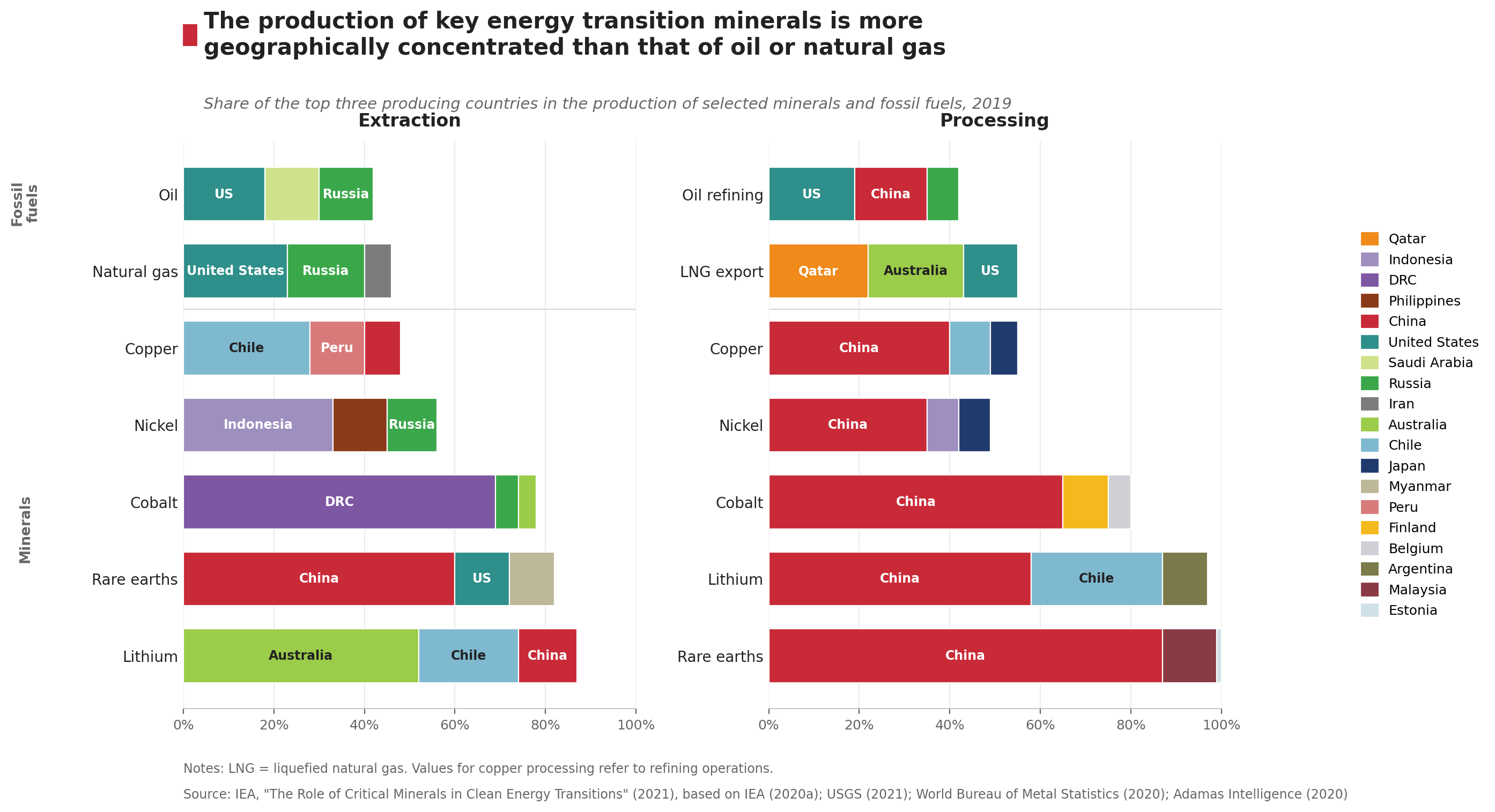
Like any living organism, all economic activity requires energy inputs and produces waste as output. Conventional economics does not conceptualize it that way, which allows it to treat the economy as a closed system, with circular flows of capital and labor but no physical inputs, no residual outputs, and little regard for the laws of thermodynamics. Reality, however, asserts itself: when energy sources are interrupted, the whole metabolism falters. And those flows are more likely to be cut off the scarcer the resource, or the more concentrated its extraction and processing. It is worth recalling just how concentrated fossil fuel production is globally: just three countries — the United States, Saudi Arabia and Russia — account for more than 40% of oil extraction, and an even higher share for natural gas, led by the United States, Russia and Iran.
If hydrocarbons are concentrated, the minerals required for the energy transition are even more so — and that is something few people are aware of. The so-called critical minerals — essential for producing renewable technologies and a large share of electronic goods — exhibit concentrations even higher than those of oil. As the chart below from the International Energy Agency shows, in the case of lithium three countries account for over 80% of extraction, while nearly 70% of cobalt is located in a single country: the Democratic Republic of the Congo. At the processing stage the picture is even sharper: China controls more than 80% of rare earths, around 70% of cobalt and close to 60% of lithium. The combination of geological chance and industrial policy has produced a scenario in which the elements crucial to the metabolism of modern societies are in the hands of very few.
The full world thus has a precise geography: a handful of countries and a handful of mines and refineries that control the physical flows on which everything else depends. And on top of that geography a major political crisis is now building. Traditional liberalism was built during this fossil-fuel anomaly, naturalizing a state of affairs in which energy was abundant and the economy seemed to have no limits. Within that framework, any country that needed energy or any other resource could in theory obtain it by turning to the international market; the key to progress, we were told, was the opening of markets. The current crisis of liberalism, therefore, has less to do with its ideas than with the loss of the material base that sustained them. In a full world, interdependence has become vulnerability: energy and resources are once again scarce and fiercely disputed. This does not happen with all of them at the same time or to the same degree; some are especially critical — hence, precisely, the name “critical minerals.”
As I have argued in La guerra por la energía: poder, imperios y crisis ecológica [The War for Energy: Power, Empires and Ecological Crisis], this is the situation that explains the return of neo-mercantilist practices, and of violence, on the part of a great power, the United States, which was hegemonic in the fossil-fuel era and now fears losing that privileged position. Making sense of the geopolitical phenomena of the contemporary world is only possible if we draw on the tools of history and ecological economics, and avoid as much as possible what we call conventional economics.
If you see an economist speaking as though we still lived in an empty world, remember that he is a zombie: someone who appears to be alive, but isn’t.
Ecosocialist Notebook - Alberto Garzón is a reader-supported publication. To receive new posts and support my work, consider becoming a free or paid subscriber.
Comments
Nothing yet. Say the first thing.
Sign in to join the conversation.