
In the space of a few months, two proposals that only a few years ago seemed outlandish have entered the international political debate. On the one hand, the mayor of New York, Zohran Mamdani, has taken a further step in his plan to create five publicly owned grocery stores — public supermarkets, in European terms— in the city, with the declared aim of bringing down the cost of the working-class shopping basket. The initiative echoes the municipal socialism of Milwaukee, an American city that had Socialist Party mayors for most of the period between 1910 and 1960 and which took many formerly private services into public ownership. As the labour sociologist Eric Blanc has recently reminded us, that historical experience is a lesson today in how to build an alternative to Democratic neoliberalism and Trumpist authoritarianism in the United States. In this case, the proposal for public supermarkets seeks to guarantee that everyone has access to the food they need.
On the other hand, last year the French National Assembly debated another proposal in a similar spirit: the creation of a food social security scheme. If healthcare, education and pensions are — in Europe — rights enshrined in the constitution and guaranteed through public provision, why should food not be one too? The proposal was never passed, owing to a boycott by conservative MPs, but it consists of a programme of some €100–150 a month for the entire population, to be spent in affiliated outlets. There are several dozen pilot projects in France, the most prominent being the one in Montpellier. Although at first sight it may look like a welfare handout, the programme goes far beyond the need to tackle hunger among the poorest families. In Spain, a debate was held recently, promoted by the Carasso Foundation, in which, alongside a discussion of the French experience, a proposal for Spain was presented (there is already a pilot project in Getafe, Madrid).
This renewed concern with the right to food coincides with the hangover from the inflationary process unleashed in 2022 after Russia’s invasion of Ukraine, and also with the war in Iran that began this February 2026. As the chart below shows, world food prices remained relatively stable through the 1990s and the early years of this century, but have been highly volatile and on an upward trend since the 2007–08 crisis. Moreover, in most countries food prices have risen far more than wages, causing a worrying deterioration in household budgets, especially among the working classes, who devote a larger share of their resources to food.
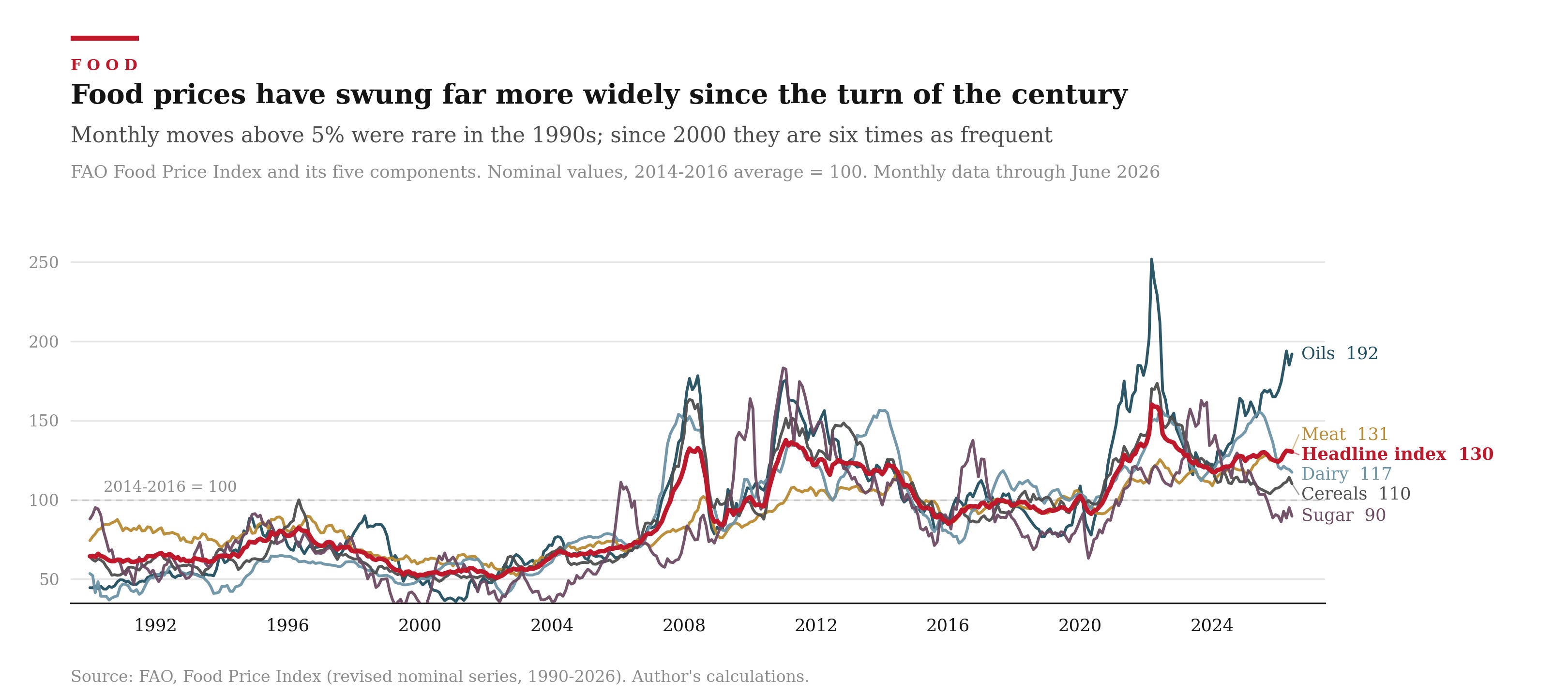
In public debate, however, it is rarely mentioned that food inflation is not only the result of short-term episodes caused by wars, geopolitical tensions or financial speculation. It is also the symptom of an agri-food system that is extremely dependent on fossil fuels, global logistics chains and increasingly scarce natural resources — all of this at a time of neo-mercantilism and protectionism. In this sense, the question of how we make food cheaper has to be joined by the question of how we ensure it can continue to be produced at all.
In any case, rising food prices have provoked political reactions in Spain too. Back in 2023 Podemos proposed the creation of a public supermarket; in February this year, 2026, Más Madrid put a proposal to the regional Assembly for a network of public supermarkets — it was rejected by the right, and the Socialist Party did not support it either; in June, at SUMAR’s initiative, Congress approved a non-binding motion urging the government to create “public infrastructure to distribute healthy, organic and locally sourced products”; and a few weeks ago Adelante Andalucía announced that it will be proposing public supermarkets as well.
At first sight, the debate seems to boil down to a choice between two instruments: creating public supermarkets or introducing a food social security scheme. In reality, though, as the political economist of food Raj Patel puts it, the two are more compatible than antagonistic, and they only make sense if they are understood as parts of a much deeper transformation of the agri-food system, which is currently facing ever more serious economic, ecological and geopolitical limits.
The first of these proposals, Mamdani’s, is to create a public supermarket. It is worth remembering that a supermarket is part of the infrastructure needed for the food produced in the countryside to reach households — which are generally concentrated in cities. Most of that infrastructure is privately owned today, so the networks of production, transport, distribution, and retailing follow the logic of profitability guided by market signals. This matters because under capitalism, producers do not produce food to feed populations, but to make money. And every agent in the chain follows that logic without exception.
What happens is that the structure of the chain is deeply unequal: a great many producers sell their output to a very small number of large distribution and retail companies, which concentrate enormous bargaining power. In Spain, for example, the five leading retail chains account for a little over half the market, and a single company, Mercadona, accounts for around 27% of food retail spending. That power is exercised throughout the chain: it conditions the prices farmers and livestock producers receive, it sets the terms of supply and it even determines which products end up on the shelves. This structure traps producers between the industrial supply of inputs (seeds, fertilisers, pesticides, diesel and so on) and the purchase of their output by the big chains.
This structure also helps explain an important part of recent food inflation. As the economist Isabella Weber has pointed out, when a supply shock occurs — as it did after the invasion of Ukraine or amid tensions in the Strait of Hormuz — firms with market power can pass on and even amplify those cost increases to protect or widen their profit margins. And these supply shocks are hitting the food channel not only through energy but also through fertilisers. The upshot is higher prices for consumers, while wages fail to keep pace.
In this context, the proposal to create public supermarkets is intended to introduce a counterweight to that private power. Not being subject to the logic of profit maximisation, a public operator could operate with lower margins and help both bring down the cost of the weekly shop and increase competition in a highly concentrated market. That is the main economic argument for the proposal, and it applies equally to the case for a public energy company, for instance.
That said, past experience reminds us that the project is anything but simple. There are precedents for public supermarkets in places private enterprise no longer reaches — so-called food deserts — or set up to compete with it directly, and many have failed. Among the main problems is scale: a handful of supermarkets is not enough to act as a real counterweight to private power, or to negotiate low wholesale prices with producers and distributors. But there is also the question of professional management, financing, the range of products on offer (Mamdani’s supermarkets will not sell meat or hot food), and medium- and long-term political viability, among others. The idea is a good and necessary one, but the best way to make a public supermarket work is to embed it in a broader, more ambitious programme genuinely capable of transforming the food system.
Before turning to that, however, it is worth underlining a blind spot in the proposal. A public supermarket is born with a very clear mandate: to sell more cheaply. Yet in order to sell cheaply you have to buy cheaply. And where do you buy cheaply today? In the industrial chain: intensive production, inputs imported from countries with cheap wages and cheap resources, large volumes and operations at scale, contracts with central purchasing bodies. In other words, precisely the conventional agri-food model. In that sense, the public supermarket is a good cost-of-living policy dressed in the clothes of food policy — but the objective ought to be bolder.
The reason is that we are living in an eco-social crisis. To use this concept is to accept that ecological degradation and the deterioration of living conditions for the majority are not two separate crises that happen to coincide in time, but two manifestations of the same process of accumulation. And, above all, that they cannot be ranked in order of priority. The usual formulation on the left is “first let’s make sure people can eat, and we’ll deal with sustainability afterwards”. But the reality is that the two timescales have converged, as Ukraine and Hormuz have shown: inflation is now eroding the budget of a working household, driven in part by the rising cost of energy and natural resources, and that rising cost foreshadows tomorrow’s biophysical constraint. These are not two problems but one. So the question cannot be only how we make food accessible to the working class, but also which foods and how they are produced.
Every time we fill the trolley, we think we are buying food, but we are also buying oil, natural gas, and an enormous quantity of fossil energy embodied in fertilisers, pesticides, transport, refrigeration, and packaging. The ecologist Howard Odum was right to say that one of the central features of industrial societies was that we had learned to eat potatoes made partly of oil. The critical point is that, if we count all the energy we spend producing, distributing and consuming food across the whole chain, it turns out to be far greater than the energy we obtain from that same food: a completely unsustainable system, because it depends on what Joan Martínez Alier and Vaclav Smil call the fossil subsidy, or fossil doping. This is part of the anomaly of the fossil fuel era, since no earlier human society was able to sustain negative net energy returns for long before collapsing.
That fossil subsidy serves, above all, to patch up a rift. Marx, reading the agricultural chemistry of his day, described a break in the exchange of matter between human beings and the earth: the city consumes the nutrients the countryside produces and does not return them, so the cycle is broken and has to be replenished from outside. John Bellamy Foster turned that insight into a concept — the metabolic rift — and Kohei Saito has placed it at the heart of the ecological reading of the late Marx. A century and a half later the description still holds; it is simply that the rift has grown in scale. First it ran between the city and its own countryside, then between one region and another, and today it runs between entire countries. In Spain this can be seen very clearly in livestock farming. Almost a quarter of the biomass eaten by our herds is produced abroad, and with that feed comes nitrogen that then stays here. Because the animal is not where the crop is, the nutrients make a one-way journey: where the feed is grown, the soil is depleted, and where the livestock is concentrated, there is a surplus of nitrogen that ends up in the aquifers, polluting rivers and soils.
All this has enormous implications, because what is at stake is not only the consumption of a non-renewable form of energy but also the fact that the whole arrangement rests on unequal ecological relations. The level of food consumption in the countries of the global North, for example, would be impossible without the quantity of food imported from the global South, whose production consumes natural resources there — above all land and water. The European Union uses an area of farmland the size of Spain in other parts of the world. Since the availability of land on the planet is obviously finite, this kind of food supply model cannot be generalised to every country.
For these reasons, in a world that aspires to live without fossil fuels, food production has to change radically. By the same token, guaranteeing universal access to food within a metabolically unsustainable system means guaranteeing access to something that will cease to exist in its current form. The objective, then, must be to transform the agri-food production model and, as we shall see in a moment, consumption patterns.
The second proposal, Food Social Security, is a public policy instrument that seeks to influence food demand through incentives. The scheme grants each citizen a set sum of money to spend at accredited outlets, which makes it possible to condition the kinds of spending it goes toward. For that reason, the various formulations of the scheme hold that the aim is not merely to inject money for buying food, but also to encourage the purchase of food with particular characteristics, such as ecological sustainability and a positive impact on consumers’ health.
The food social security scheme does not oblige citizens to consume certain kinds of food; rather, it sets up incentives to gradually change consumption patterns. On the one hand, because the scheme only applies to certain products designated in advance. On the other hand, producers find a stable demand that gives them the security they need to convert their production to agroecological methods. It is a less invasive way to steer the food system towards a sustainable and healthy level, which also makes it a tool for ecological transition. The recent study by the El Pa Sencer cooperative, for instance, calculates that the proposal would cost €76.8 billion (5.7% of Spanish GDP), but argues that the hidden health costs of current consumption patterns run to as much as almost €23.4 billion a year because of diet-related illness.
The logic of the proposal is similar to that already applied in public food procurement, which covers school canteens, hospitals, care homes, day centres, central kitchens and so on. When I was Minister for Consumer Affairs, we set in motion the drafting of new criteria for such procurement, following scientific guidance, and the current ministry, under Pablo Bustinduy, has continued that work and successfully completed several critical stages of the roadmap. The point is to mobilise a large volume of demand that can be planned several years ahead, which is precisely the signal a farmer needs.
The food social security proposal is not without difficulties, however. These range from the exact definition of an “agroecological product” to the design of its governing institutions, which aim to approach a form of participatory democracy in which the community involved decides rather than the state. There is also the fact that, for a proposal like this to succeed and go beyond short supply chains — where the producer sells almost directly — it will need the backing of infrastructure. A farmer may produce splendidly and still have nowhere to store, no way to chill, nowhere to process and no means of reaching a large buyer. It is a logistics problem. As with public supermarkets, Spain could make use of publicly owned infrastructure that already exists: the Mercas network — the wholesale markets under joint state and municipal ownership — which, together with municipal food markets, makes up a system of collection, cold storage and wholesale distribution that is already built, already paid for and already located exactly where it needs to be.
In short, if public supermarkets act on distribution and food social security acts on demand, then a third element is necessarily missing: intervening in the capacity to produce food itself.
I have already noted that the current food system is ecologically unsustainable, as well as internationally unequal and unjust. That also means it is vulnerable to geopolitical and climatic shocks insofar as its capacity to supply food may be compromised. Transforming it into a system that provides enough food while reducing its ecological impacts must be the main objective.
The problem is that fossil fuels are precisely the magic wand that has allowed farm yields to multiply, producing far more food per hectare. Without them, productive capacity is compromised. There is, however, an important debate ongoing on this point, since certain forms of agroecological production deliver equal or higher yields for certain products. There are other food products, on the other hand, whose production cannot possibly be generalised — such as meat from large industrial units heavily dependent on imported inputs, known in Spain as macrogranjas, or mega-farms.
For this reason, it is not simply a matter of turning an agri-food system based on fossil fuels into one based on agroecological practices. To meet sustainability targets, that shift also requires changes in diets or consumption patterns. I know we are entering a minefield here, because this is the famous controversy over meat consumption that pursued me so relentlessly — or that I pursued so relentlessly, depending on how you look at it — during my time in politics. But it is worth framing it properly, because it is almost always framed badly.
The costs of the current diet are not distributed at random. Diseases associated with poor eating habits, such as the high consumption of ultra-processed foods, show a social gradient that runs inversely to income: the less money you have, the more you suffer from them. Those who fare worst under the dominant food pattern are the working class. The dietary transition therefore consists precisely in lifting a burden that the poorest families have been shouldering disproportionately. And we need to clear up a misunderstanding about which diet we are talking about. The one prescribed by health professionals and traced by biophysical models — with a greater emphasis on pulses, cereals, olive oil, seasonal vegetables, and occasional, good-quality animal protein — is not an invention of urban nutritionists. It is essentially what we call the Mediterranean diet, which we export as a national brand and celebrate as part of humanity's heritage, even as it is in clear retreat.
The problem is that the current food system is deeply distorted, and transforming it is no simple matter. As the chart below shows, for example, Spain imports a great deal of grain for animal feed, which is used to feed animals whose meat is then exported: the classic model of intensive livestock farming, sustained on very serious ecological imbalances. It is a deeply entrenched dynamic, one that many economic actors live off, making transformation harder.
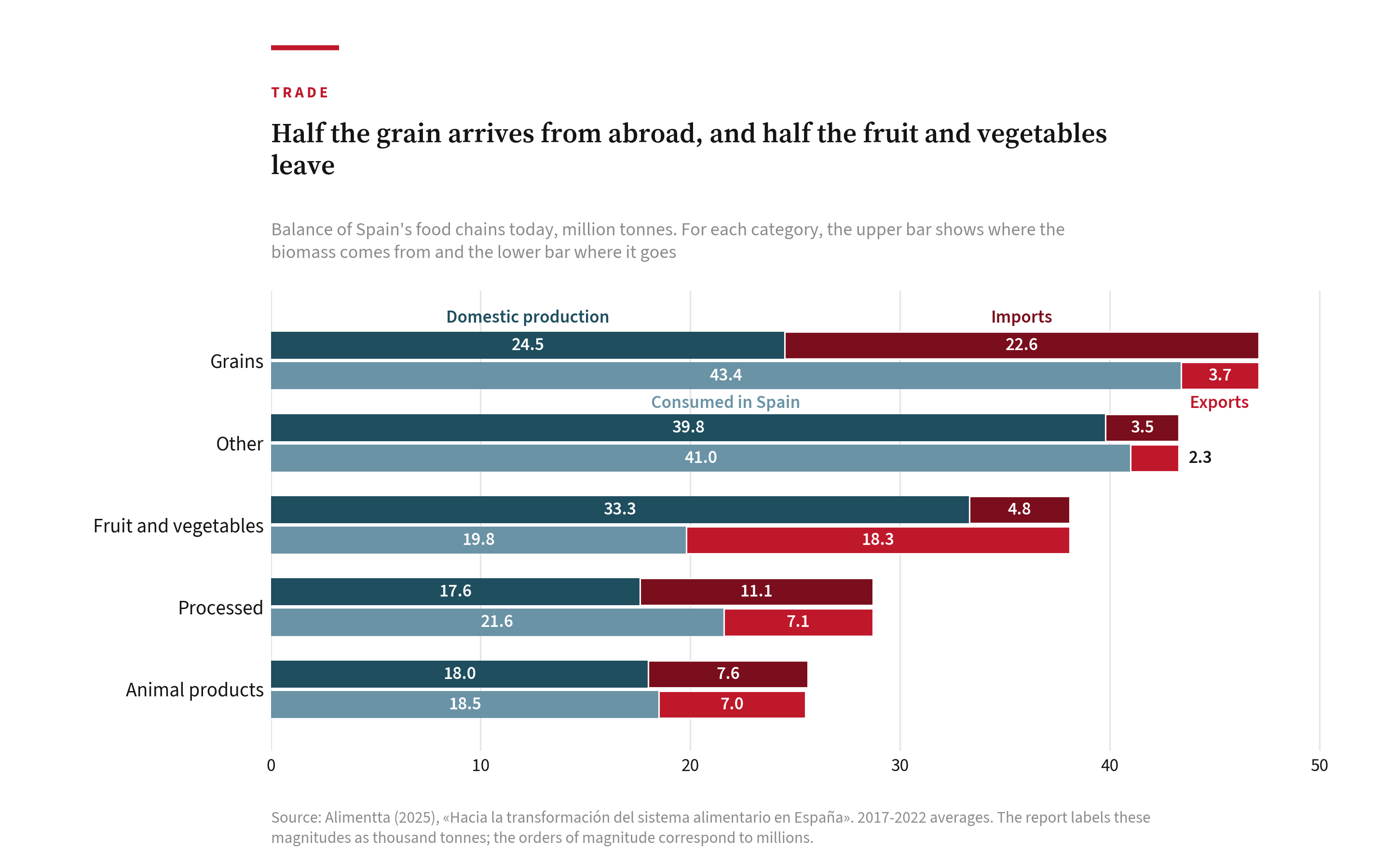
Even so, the report by the think tank Alimentta, published at Greenpeace’s request, argues that such a transformation is perfectly feasible for Spain. According to its modelling, Spain could have a fully sustainable agri-food model by 2050. At present the Spanish system emits 107 megatonnes of carbon dioxide, contributing to climate change that, as the report itself recalls, “will produce a greater reduction in domestic production” in the future. None of this is news to the sector: a few years ago COAG published its report Empieza la cuenta atrás (”The countdown begins”), assessing the impact of climate change on Spanish agriculture. According to Alimentta, ecological modelling suggests that by 2050 the Spanish food system could become a net sink — that is, not emitting carbon dioxide but absorbing 17 megatonnes a year. The conditions for achieving this are an enormous transformation in the way food is produced and consumed, ending models such as intensive livestock farming and promoting the production of foods typical of the Mediterranean diet.
As can be seen, all these elements — the public supermarket, food social security, changing the model — are deeply interrelated. Consider what would happen if, following the reorientation of demand induced by food social security, billions of euros of new demand for organic products suddenly appeared. In Spain, only 12% of cultivated land currently meets those criteria, a share wholly insufficient to supply the population. The consequence would be tremendous inflation in that market niche, which is why food social security schemes advise a gradual implementation approach.
There is another option, however: industrial policy. Insofar as the primary sector is becoming an ever more critical and vulnerable sector, direct state intervention to plan its reorientation is justified. Something similar to what is happening in industry in these new neo-mercantilist times, and particularly in the energy transition, but applied to the system that feeds us. This would entail specific programmes that might include the purchase of land, adequate aid and subsidies for agroecological production, and the creation and strengthening of new public infrastructure, supermarkets among it. All of it aimed at ensuring that sooner rather than later any given country — Spain, for example — has an ecological agri-food system with which to produce healthy food.
Let us return, then, to the question we began with: public supermarkets or food social security? The answer is that the question is wrongly posed. Not because either proposal is mistaken, but because both are necessary and, at the same time, insufficient. One acts on distribution; the other on demand, but neither can, on its own, transform the way we produce food. And that is one of the critical issues of the twenty-first century.
So if we really want to guarantee the right to food over the coming decades, we need an industrial policy capable of transforming agricultural production, public infrastructure that allows that new production to be distributed, mechanisms that steer demand towards healthy and sustainable food and, finally, instruments that ensure every family can gain access to it. Thinking about any of these pieces in isolation inevitably leads to frustration.
The central question in all of this is how to build a food system capable of feeding the whole population within the planet’s ecological limits. That is why I say that making food cheaper is not enough. The task is a rather more complex one: to guarantee that food continues to exist, that it can be produced sustainably, and that no one is excluded from it. Only then will we be able to speak, properly, of a genuine right to food.
No posts
Comments
Nothing yet. Say the first thing.
Sign in to join the conversation.