
A few days ago it was leaked to several media outlets that the Ministry of Defence has reservations about the construction in Ferrol (Galicia) of an electric vehicle plant belonging to the Chinese company SAIC, on the grounds that it risks becoming an enclave for espionage by the government of the Chinese Communist Party. A few hours later, however, the ministry clarified that it would allow the project, which also enjoys the enthusiastic backing of both the national government (PSOE-SUMAR) and the regional one (PP). What really matters in this case, though, is the economic dispute between the European Union and China, a dispute that also involves the United States.
While the EU is sceptical about Chinese foreign investment and is promoting regulatory measures to shape it, and Spain shows a clear interest in attracting it, the United States is far more hostile and fears an alignment of European interests with Chinese ones. That is the geopolitical backdrop. Right now, Spain is one of the main playing fields on which this redefinition of Western industrial policy is unfolding, in a context of clear superiority on the part of the Chinese car industry. As I shall argue in this analysis, the Ferrol case is only one episode within a larger battle that is reorganising both the car sector and the world economy as a whole.
Spain is not one of the main pieces on the board by chance. The first thing to bear in mind is that the car industry has been a pillar of the Spanish economy for many decades. With forerunners such as Hispano-Suiza, which allowed a substantial network of component manufacturers to develop in Catalonia, Spain attempted during the Second Republic to promote the production of national vehicles. The civil war frustrated the project, which was only partially resumed in the 1950s when, under the Franco regime, Seat was set up with majority Spanish capital (albeit with a stake held by Fiat, which supplied the technology). Those years also saw American multinationals enter the country, and by 1971 Spain was already exporting more vehicles than it imported, becoming an important node in the international car industry.
Over the following decades, Spain signed agreements to liberalise its economy, turning the country into an attractive location for multinationals seeking to take advantage of low Spanish wages and use it as a platform for vehicle exports. The 1980s were a time of restructuring that favoured the new multinationals and worked against those already established (Seat, for instance, was sold to Germany’s Volkswagen). After that process, Spain reinforced its importance in the international car sector, but in a secondary role and at the cost of giving up nationally owned, and even publicly owned, firms.
In reality, no single company or country manufactures a vehicle in its entirety. Modern production is far more fragmented than it was a century ago, and falling transport and communication costs have made it easier for global value chains to expand in the vehicle sector as well. What begins in research and development and product design offices continues in the mines and refineries, with the extraction and processing of the natural resources required for all the parts — from sheet metal to electronics — going on through assembly, and ends in transport, distribution, sales and after-sales tasks. Firms aim to position themselves in the higher-value segments of that chain, which are those at the beginning (R&D, design, and so on) and at the end (sales, financing, after-sales, and so on). It is well established in development economics that countries wishing to climb the development ladder must work to ensure that their firms capture the higher-value tasks and stop specialising in those that capture value only residually; a process usually referred to in technical terminology as “upgrading” (see, for example, the whole body of work by Gary Gereffi).
This distribution of different tasks along a long production chain makes it possible to speak of a hierarchy, whereby some firms (and countries) take on the tasks that capture the most value and deliver the greatest benefits to their economies, while others take on more thankless tasks, or ones that offer lower economic and social returns. Another common way of referring to this hierarchy is through the notions of core and periphery (and semi-periphery). In the car sector, for example, Petr Pavlínek, among others, has studied this at length. In his latest book, Pavlínek shows that the industry is configured in Europe so that Germany holds a clear core position, reserving for itself the tasks that capture the most value, followed by France and Italy. Spain, by contrast — and despite the fact that the car sector accounts for around 8% of total industrial weight and that exports of vehicles and vehicle parts represented 9.73% of gross exports in 2024 — falls into the semi-periphery category, mainly because of its limited control over the production process and its concentration on assembly work. The periphery, finally, would be occupied by the countries of Eastern Europe, which in recent decades have attracted large capital investments seeking to exploit their low wages and their proximity to the German core.
Historically, core countries have made considerable efforts to keep firms under the control of national capital or even to hold them directly in public ownership. As the chart below shows, Germany has the highest level of national ownership in the sector (79%), whereas in Spain the figure is 29% (defined as control of more than 50% of share capital). This is precisely one of the features that the literature identifies as distinguishing core from peripheral countries, since it allows the former to control firms’ decisions. Nor is it a general trait of the Spanish economy, but a characteristic specific to this sector: national control stands at 73% for industry as a whole and at only 29% in the car industry.
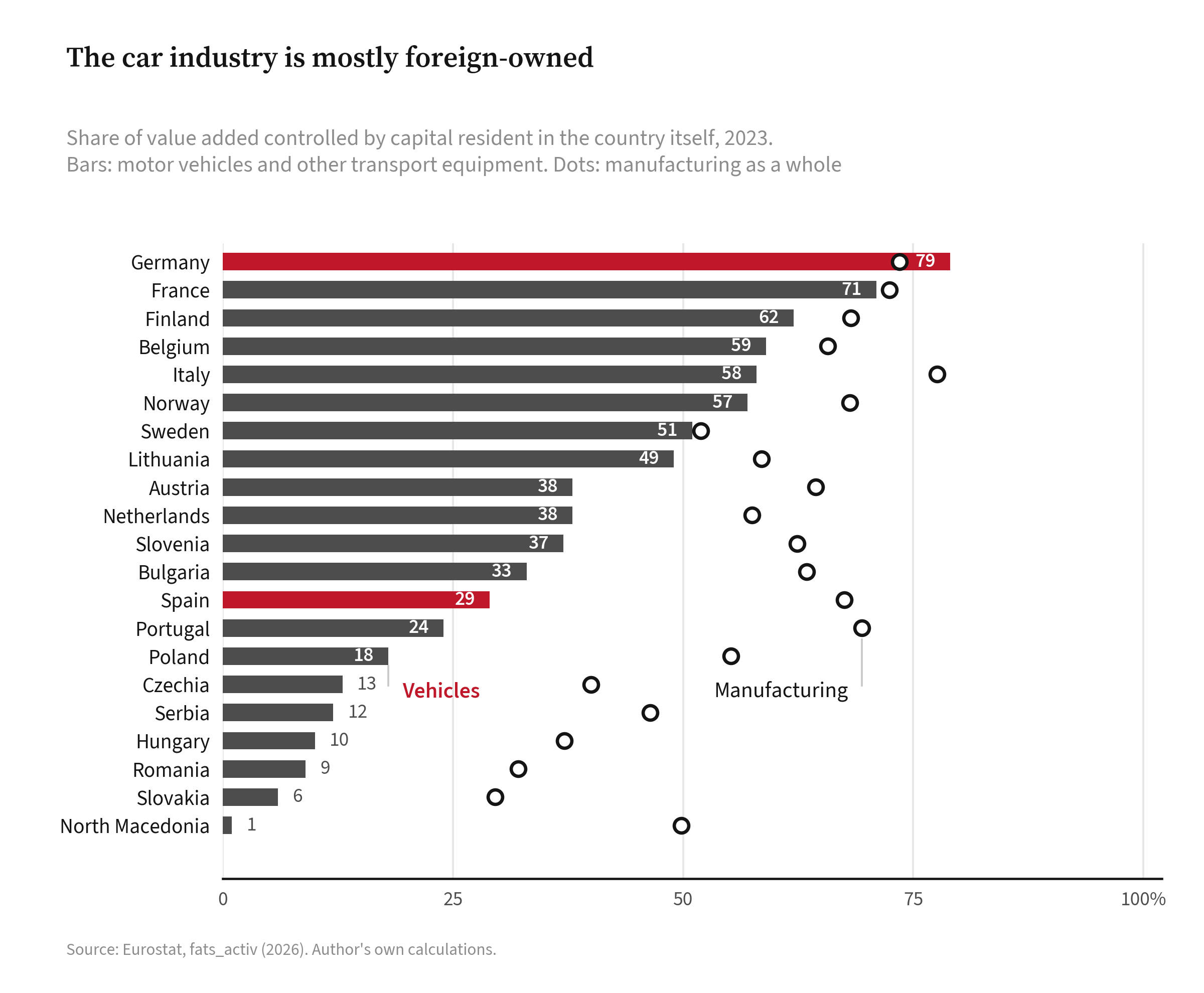
Another relevant figure is that Germany invests two and a half times more in R&D in the sector than France, Italy and Spain combined, which is explained by the fact that it has reserved the highest value-added segments for itself while offshoring and outsourcing others. Both figures reinforce the idea that a hierarchy exists within the chain, placing Spain subordinate to the core (and therefore to the core’s interests).
The arrival of the electric vehicle has changed not only the composition of value chains (where there was once a combustion engine, there are now batteries and other products with different technological and natural-resource requirements), but also international economic geography. The shift of the world economy towards Asia has one of its main vectors here. China began its technological “upgrading” in electric vehicles at the start of the century, when it included them under the well-known Programme 863 on high technology. The new objective was to develop and control the entire value chain of the electric vehicle industry and its critical components, such as batteries and electronics.
As a consequence of those decisions, according to the latest report by the International Energy Agency, China currently controls the refining of as much as 91% of graphite, 85% of rare earth separation, 75% of cobalt, 70% of lithium and up to 49% of copper; in every case these are critical natural resources, since they are indispensable for the production of electric vehicles (although they are also required for other electronic products, such as laptops or smartphones). China also produces 80% of the world’s batteries, and installed capacity is such that there is a real danger of overproduction.
This near-monopoly has, moreover, made Western countries highly dependent on Chinese production, to the point that European battery output covers only 43% of demand, with the rest having to be imported from China — although that share is expected to grow precisely because of the new Chinese investments announced for Europe. These firms dominate the world market by a wide margin (in 2025 CATL held 39.2%, BYD 16.4%, CALB 5.3%, Gotion 4.5% and EVE 2.6%), and clearly outstrip their South Korean and Japanese rivals. European firms, for their part, are some 10 to 20 years behind in technological capability in the battery market, according to a recent research article.
This dominance over batteries extends to electric vehicles as a whole. Behind that success lies the Chinese government’s industrial policy, which takes advantage of economies of scale (with a vast domestic market), technological ecosystems, and the resources devoted to research and development. Most leading battery firms are private, such as BYD and CATL, but other electric vehicle companies, such as SAIC — the firm behind the Ferrol plant — or Chery, are publicly owned. Although the European Commission now criticises the role of Chinese subsidies and accuses its competitors of unfair competition, the fact is that Europe’s decades of neoliberalism were, in this respect, decades lost to China’s far more effective industrial policy.
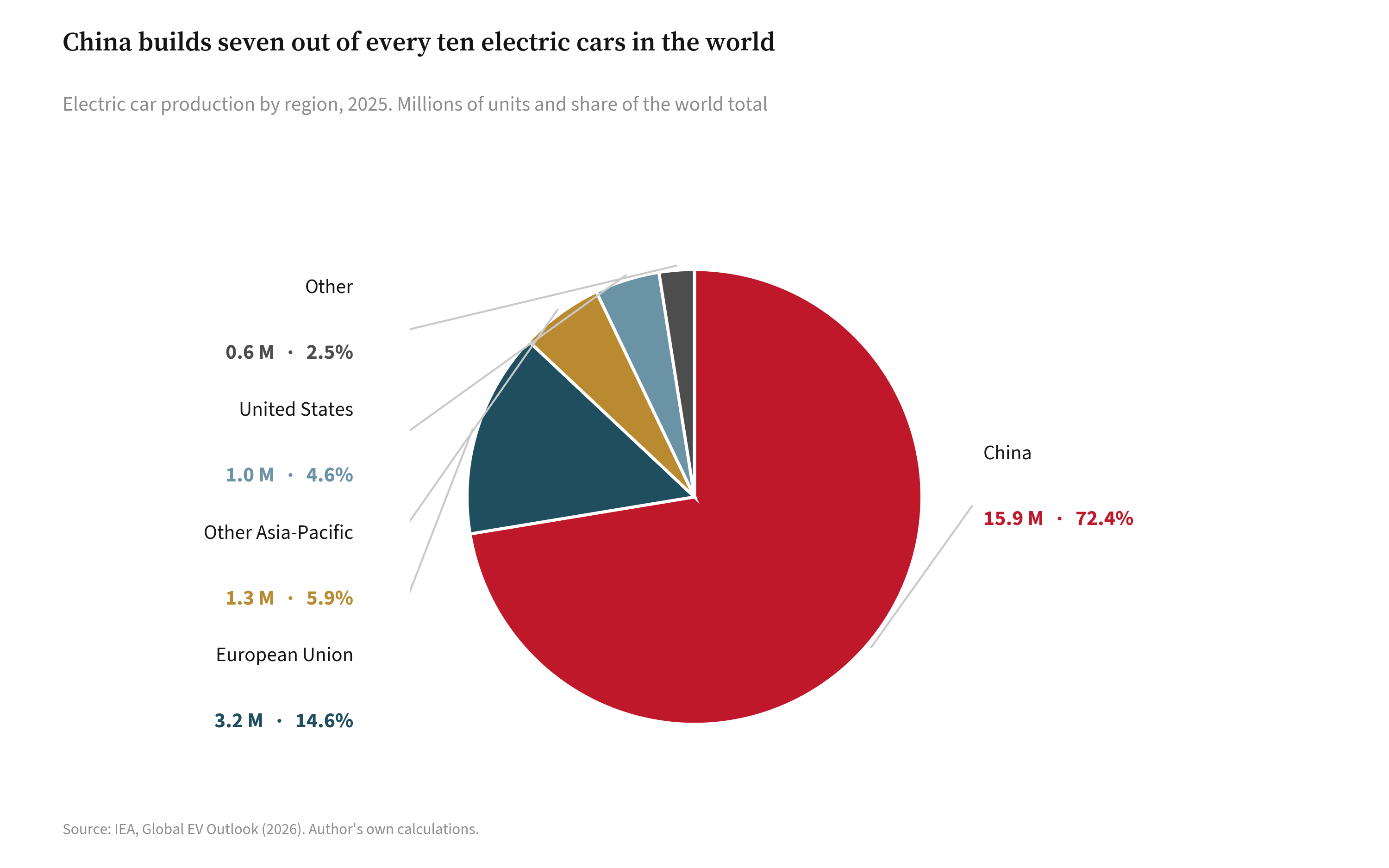
The world production figures speak for themselves. According to the International Energy Agency, 22 million electric vehicles were produced in 2025, 72% of them in China. And although the European Union is the second-largest producing region, its global share was only 14.6%.
European consumers are also increasingly buying Chinese vehicles, since Chinese manufacturers are achieving relatively low prices through rapid innovation in batteries, electronics and software. As the chart below shows, China is now the EU’s main vehicle supplier, and by a wide margin over those that follow, such as Turkey, Japan and Morocco. This is a radically different picture from five years ago. There are qualitative differences too, however: most vehicles imported from China and Japan are electric (over 70%), whereas those from Turkey or Morocco are internal combustion models.
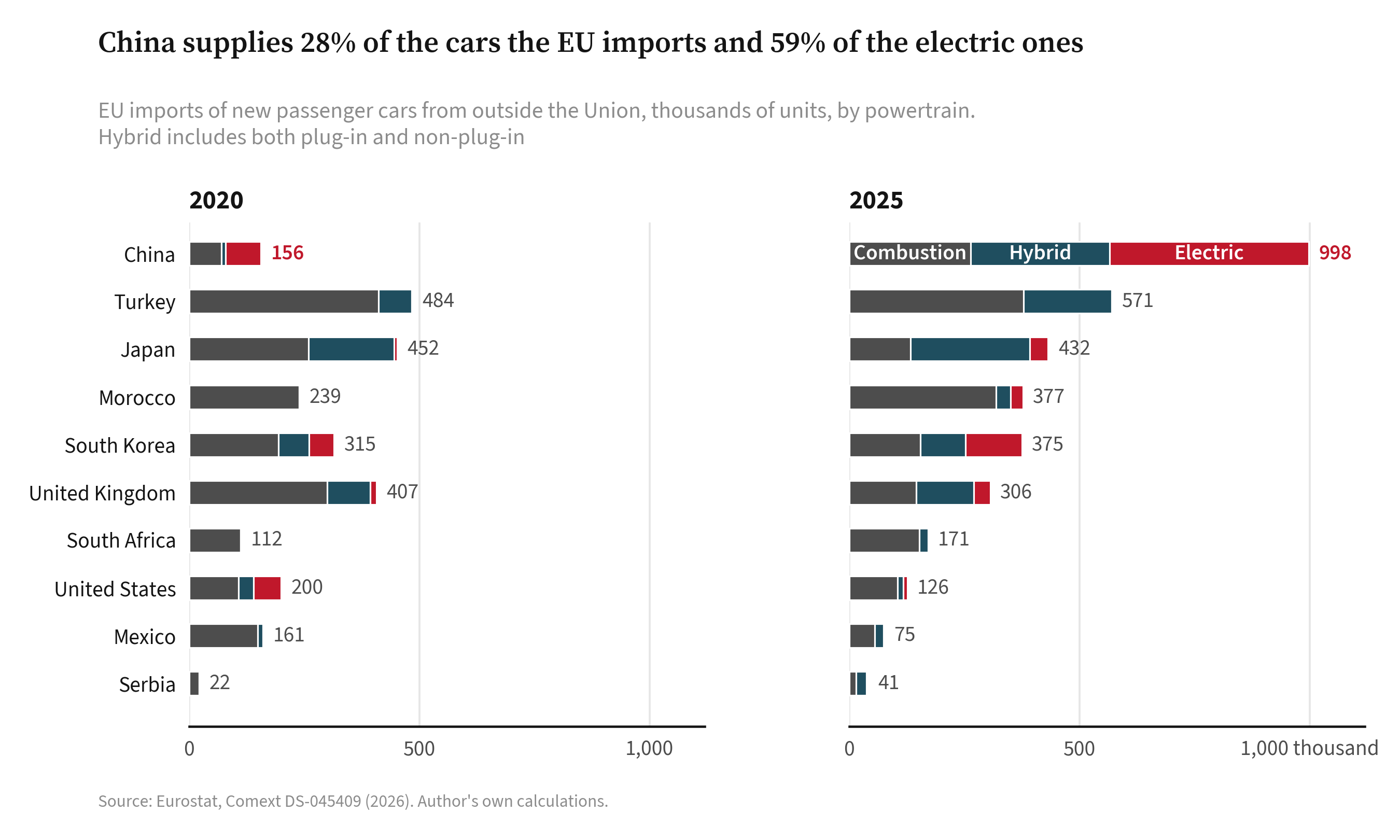
The role of countries such as Morocco and Turkey deserves to be highlighted here, because their growth as exporting countries reveals the creation of new peripheries by the car multinationals. In the search for cost reductions, these countries offer fiscal, labour and economic incentives with which to compete internationally. In this respect, as far as we know the transition to the electric vehicle has not brought about changes in the core-periphery configuration within the European Union: a recent study by the economists Manuel Gracia, María J. Paz and Mario Rísquez has shown that Germany is managing to reinforce its dominant role in Europe, as against the subordinate role of countries such as the United Kingdom, Spain and Italy, and despite the growing importance of Hungary and Poland in battery production. China’s rise as a major automotive power is, however, seriously affecting German business, as we saw in this other analysis discussing Germany’s economic crisis, which some analysts describe as “China shock 2.0”.
Concerned about the competitiveness of Chinese vehicles, the European Union authorities responded by accusing Chinese firms of benefiting from unlawful subsidies, that is, of unfair competition. That made it possible to trigger an anti-subsidy clause, imposing high tariffs on Chinese companies. In SAIC’s case, these reached the maximum rate of 35.3%, for failure to cooperate. In truth, the European Union is not seeking to halt Chinese foreign direct investment, but rather to make its arrival conditional, requiring firms to meet certain commitments in exchange for being allowed to produce within European territory. Spain, incidentally, abstained in the vote on the tariffs — something that may perhaps explain why the SAIC plant will land here and not in Hungary, as was initially mooted.
Another part of the European response has come through the Industrial Accelerator Act, a proposal that is not yet final and is clearly designed to place conditions on China’s expansion. Under the proposal, where FDI exceeds €100 million and originates in countries with a global manufacturing share above 40% — read: China — firms will have to meet at least four out of six conditions, such as not exceeding 49% ownership, having half of their workforce made up of European workers, technology transfer, R&D commitments in the EU, and sourcing at least 30% of inputs from Europe. The regulation is still going through the approval process, and we are still a long way from knowing whether it will work, although it fits the new neo-mercantilist spirit of Western countries.
What is clear is that in 2025 Chinese foreign direct investment in Europe rose by 67%, the highest level since 2018 — when Chinese capital was investing in all manner of activities, many of them considered high-risk by the Chinese government, which eventually curbed them. Indeed, the dynamics of foreign direct investment have changed in recent years, shifting from a focus on mergers and acquisitions to investment in new plants, as in the Ferrol case. It is particularly important to note that 45% of this investment has gone to the car sector, and the overwhelming majority of it to electric vehicle value chains.
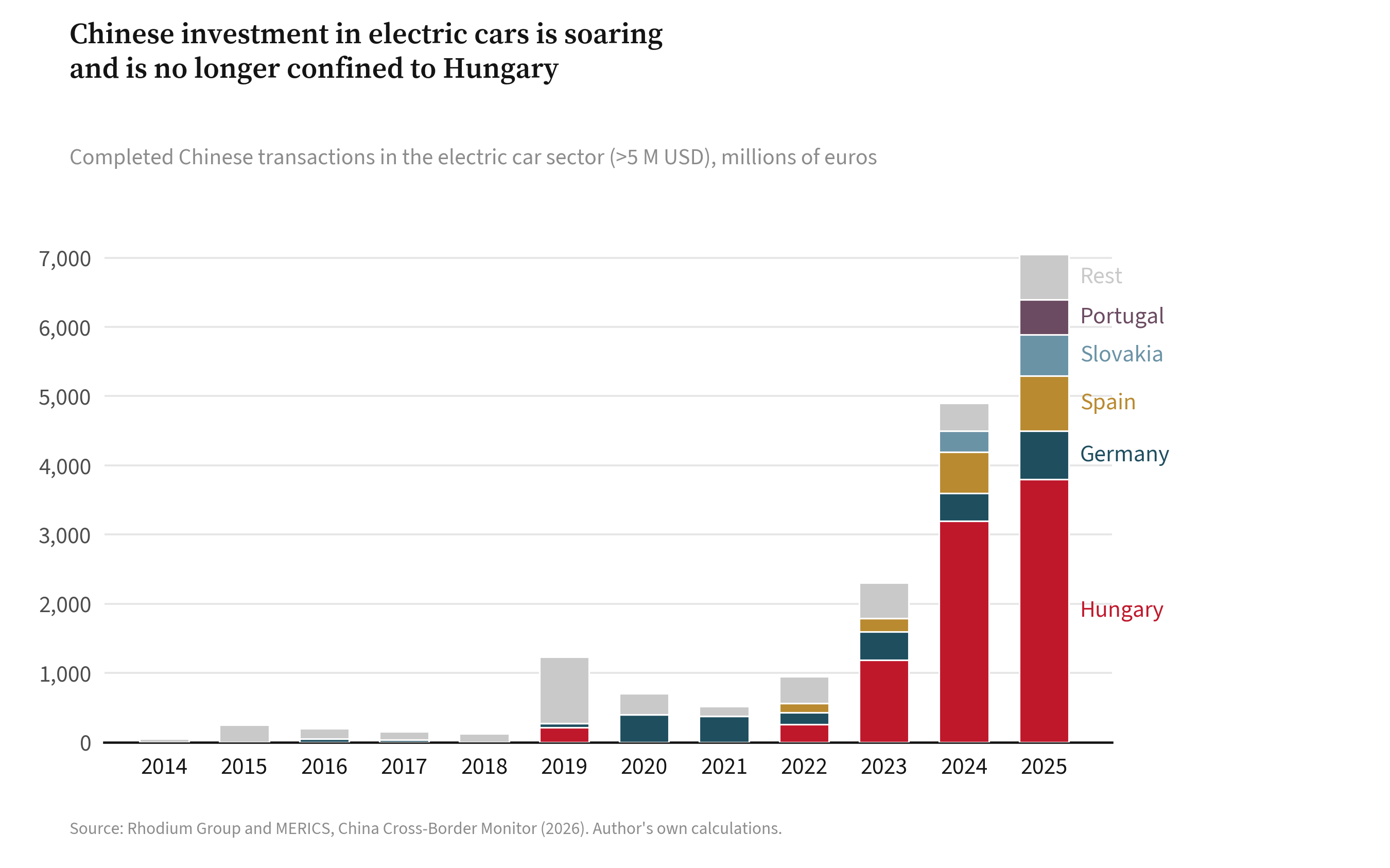
According to Rhodium Group data, Chinese FDI is increasingly heading to Spain, although it remains at very modest levels compared with the figures received by other European countries. As the chart below shows, Chinese investment in electric cars has soared since 2019 and, above all, since 2023. Those investments have gone mainly to the periphery and semi-periphery, with a prominent role for Hungary and, more recently, Spain. This is what one would expect from investments that seek to externalise only those parts of the production process that capture the least value. The capital remains Chinese, and R&D and design remain in the Asian giant.
According to official information, the investment in Ferrol amounts to some €200 million, with 120,000 vehicles a year expected to be produced and around 2,000 direct and indirect jobs created in total. The plant’s operations, however, will be those typical of assembly, using previously manufactured components and bodies, and will not yet include stamping, body construction or painting. These operations, along with the manufacture of other components, are envisaged as later developments of the overall project. This is the kind of task within the value chain that the literature identifies as characteristic of peripheral or semi-peripheral countries, since it does not incorporate the upstream tasks of R&D and design, while the downstream sales and after-sales tasks remain uncertain, depending on whether the products are destined for export or for sale in Spain.
Several dilemmas overlap throughout this analysis. On the one hand, Spain still depends largely on the European core when it comes to internal combustion vehicles. Pressure from those manufacturers already led, in December 2025, to the European Commission abandoning its plan to ban such vehicles by 2035. Meanwhile, the transition to electric vehicles is rapidly altering power relations within the industry and opening the door to new centres of production and decision-making. Spain has also shown itself in favour of maintaining a degree of autonomy in the dispute between the United States and China. That position may give it an advantage in attracting investment, but it remains to be seen whether it will translate into a structural transformation of our position within the industry.
The problem is that what is at stake is not only how much is produced in Spain, but what is produced, who controls it and who captures the value generated. A country can increase its industrial output, its exports, and its employment and still remain in a subordinate position if strategic decisions, technology, design, research, and a substantial share of the profits remain beyond its borders. The result is enormous vulnerability, as well as a less solid and less prosperous productive structure. That is precisely what has happened over much of the development of the Spanish car industry, as we have seen: Spain is a huge vehicle factory, but the firms that control the main strategic decisions are mostly foreign.
The arrival of Chinese capital also poses a paradox. It may help to reindustrialise Spain and, at the same time, reproduce the country’s position within global value chains. Replacing German investment with Chinese investment does not necessarily change Spain’s position in that chain. If the new plants are confined to assembly, and the higher value-added activities — R&D, design, technology, intellectual property and strategic decisions — remain in China, we shall have gained productive capacity without necessarily gaining economic capacity. But it would not be right to assume this will inevitably be the case. SAIC’s arrival in Ferrol may create jobs and economic activity, but its real industrial impact will depend on whether suppliers, technological capabilities, training, research and new higher value-added activities develop around the plant. Those ideas appear in the official tender documents as aspirations, but with no guarantee that they will materialise.
The European response is a paradox too. For decades, the European Union trusted that liberalisation, competition and international specialisation would be enough to maintain its industrial position. Now, faced with Chinese competition and Chinese technological leadership, it is reaching for tools it long regarded as anathema: tariffs, local content requirements, conditions attached to investment, state aid and industrial policies. Europe, in other words, is turning — partially, but at great speed — towards an industrial policy of a neo-mercantilist character.
It is therefore a mistake to frame the debate around what nationality we want incoming capital to have, whether Chinese, German or American. Reducing it to a matter of espionage is even clumsier. What matters most is knowing what we want to do with the arrival of that capital. If foreign investment expands the country’s productive, technological and knowledge capabilities, it can be an instrument of reindustrialisation. China’s own historical example shows precisely that it can be a viable lever. But if that foreign investment simply turns Spain into the place where various multinationals assemble their products in order to access the European market, the change will be far more limited: we shall have more factories, but not necessarily more control over our own economy. We are trapped in the classic dilemma that has tormented all peripheral and Global South countries — and all development economists — for a century. And that, in itself, already tells us something.
No posts
Comments
Nothing yet. Say the first thing.
Sign in to join the conversation.