
Every party agrees that housing is the country’s foremost problem, echoing what Spaniards themselves flag in the polls. That makes the lack of enthusiasm for solving it all the more striking. If everyone accepts the diagnosis, why is it so hard to implement policies that could significantly lower housing prices? The answer has less to do with any shortage of proposals than with the material interests that have been built up around the property market over decades. To understand it, we need to go back several decades.
In 1957, the Franco regime created the Ministry of Housing and appointed José Luis Arrese, a Nazi sympathiser who, during the Second World War, had gone so far as to meet Hitler, as its head. As minister, Arrese pushed for a shift towards a model based on private development and the spread of ownership. Anticipating Margaret Thatcher by several decades, Arrese summed up his policy in a 1959 lecture, declaring that “we do not want a Spain of proletarians but of owners”.
In the 1980s, Thatcher popularised the idea of “popular capitalism”, under which the whole of society could become capitalist — that is, owners of financial assets such as shares, investment funds and other securities representing rights, generally of trifling magnitude, over the ownership of companies. The lifelong wage earner thus also took on the functions of a capitalist investor. The entire neoliberal programme revolved around this project of social reorganisation, and although there was a very marked transfer of wealth — a carving up of public spoils among private agents, as happened during the privatisations — it was also, and above all, an ideological matter: under “popular capitalism”, the interests of certain segments of the working class were aligned with those of the capitalist elite, since if firms made more profit, investors would also receive a share. The ordinary wage earner remained an employee working for someone else, but now had additional income in the form of dividends, interest and other financial returns, which, as a rule, they monitored as though they were George Soros.
This model of “popular capitalism” was never widespread, not even in the United Kingdom, but it further fragmented the working class — a class then suffering the hard blows of globalisation: the erosion of labour rights and wages, deindustrialisation, and the loss of any horizon for the future, in other words, greater precarity and vulnerability. What is surprising is that this “triumph” of Thatcher’s neoliberalism would never be called into question by her successors, still less by Tony Blair, nor indeed by the other European social-democratic parties: the idea that workers could, and even should, top up their meagre wages with financial investment became normalised.
Thatcher’s project might be called a “first cousin” to Arrese’s, since it, too, consisted of extending property ownership. The mass sale of public housing to its tenants — set in motion by the “Iron Lady” in the 1980s — followed the same logic: turning millions of workers into owners so as to tie their material interests to the movement in the value of their assets.
The difference with Spain is that here only one of those two dimensions took full root. Although there were privatisation processes that partly broadened popular share ownership, they never attained the economic, political and cultural significance they had in the United Kingdom. In fact, in Spain property investment is so attractive that even the rich hold the greater part of their wealth in housing rather than financial assets — which already alerts us to the extraordinary appeal of housing as an investment in our country.
It is estimated that in the 1950s fewer than half of households owned a home, a proportion that fell below 10% in large cities such as Madrid or Barcelona. Subsequent Franco-era policy managed to raise those figures, creating a class of small owners whose wealth (the value of their homes) hung on the economic cycle—the property cycle in particular. Over time, those owners who managed to accumulate further homes could also use them as investment assets — like any other financial asset — selling them at a higher price or renting them out to supplement their income. Very few questioned this system, and access to housing via ownership, along with the possibility of anyone becoming the landlord of one or more homes, was read as a sign of prosperity.
This order of things, however, is coming undone. As the following chart shows, at the start of the century the proportion of owners was above 80%, whereas today it is in the region of 70%. That figure conceals, however, that the impact is highly uneven. The wealthiest households have barely seen their housing tenure change, but among the poorest households it has plunged by twenty points. Twenty years ago nearly 74% of the poorest households owned a home, whereas now they barely exceed 50%.
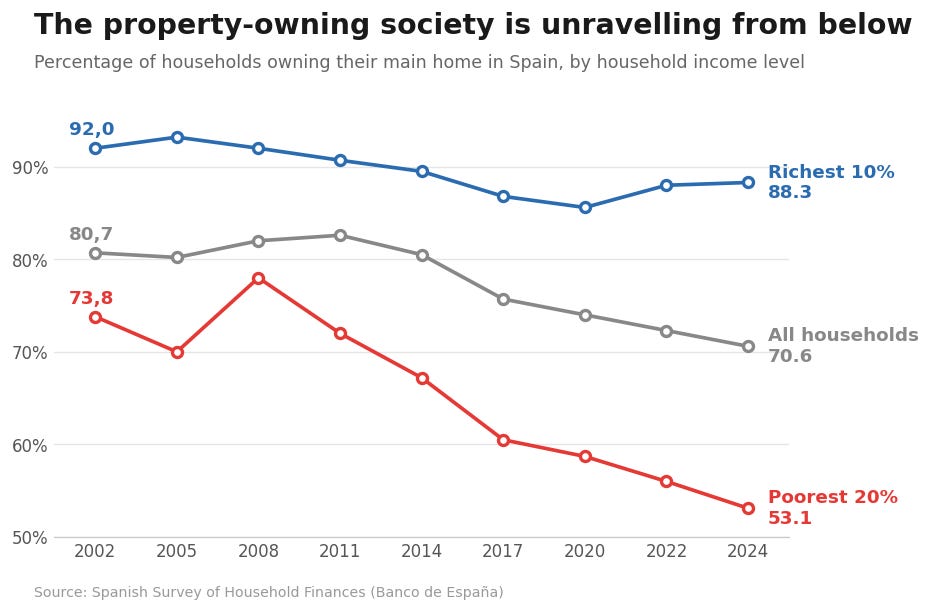
In other words, there is a growing share of society — the poorest — that is being shut out of the owner-occupied housing market. We are currently talking about 30% of families, with roughly two-thirds of these households living in rented accommodation and another third under other arrangements such as homes granted rent-free by relatives, by an employer, and so on. For these non-owners, access to housing has become an almost impossible challenge. According to the Bank of Spain, 32.5% of households living in rented accommodation have to devote more than 30% of their income to payments; in some cities such as Málaga or Seville this proportion exceeds 46.5%. These households, which make up 20% of the total, are living on a knife-edge and are the ones least served by housing policy.
The usual focus of the debate, though, is placed on the other side of the line: on how homes are distributed among those who do own property. According to the Bank of Spain, 45.3% of Spanish households own some property in addition to the home they live in, and 33.7% own specifically another dwelling. That means one in three households in the country has a home it does not live in, which it can put up for rent — which is to say that multiple ownership is a phenomenon with considerable political weight.
The central point is to understand what the report by Ainhoa Díez and Raúl Sánchez calls “the great transfer”. Each month, millions of households living in rented accommodation transfer part of their income to owner households that let out homes. Taken together, that flow amounts to some €28 billion a year. Of that sum, the richest 10% of landlords account for 44.7% of the income, more than €12.4 billion. This is no surprise: those who accumulate the most property are also those who capture the largest share of rental income.
But why would the wealthiest households accumulate more homes in ownership? Quite simply because the total return on housing is higher than most alternative financial investments, as I explained in this article. For these agents with “surplus capital”, housing is conceived not as a place to live but as an additional source of wealth and income. As with financial returns, rental income has been naturalised to the point where it raises no objection to accepting that some people earn money by the mere fact of being an owner—that their account grows “while the owner sleeps”: rentierism has been completely normalised.
As happened with Thatcher’s “popular capitalism”, part of the explanation for its naturalisation has to do with the fact that this rental income is, for many people, a genuine supplement to their modest regular earnings. The image of a retired family drawing a pension and topping it up with the rent from their second home is not unreal. For many people, rentierism has become a mechanism that substitutes for decent wages and functions as a guarantee that, despite low pay, their living conditions do not deteriorate. That is why the left finds it so hard to talk about rentiers: because within that category there are not only investment funds run by multinationals of dubious morality, but also a great many “ordinary people”.
Tax data sheds some light on how rented homes are distributed and who benefits from them. According to these figures, 76% of the people who declare rental income have only one home in that situation, which allows the Bank of Spain to conclude that the rental market is highly atomised and little concentrated. But if we talk about rented homes, 50% belong to landlords with more than one dwelling, which leads the CSIC report for the Ministry of Social Rights to conclude that the rental market is highly concentrated and dominated by multiple landlords. The data are the same, but the interpretations differ and are both true at once: most landlords rent out only one home, but multiple landlords hold enough homes to cover almost half the market. There are professional rentiers who grow rich hand over fist on the rental market, but there are also traditional rentiers who “merely” secure small extra top-ups.
These rules of the game have ended up shaping four social positions — though the boundaries between them are sometimes blurred — and each answers a very simple question differently: who stands to gain from a fall in house prices?
Non-owners certainly stand to gain, and as I have said they make up 30% of households today and have nothing to lose. A collapse in prices would simply make it far easier for them to access a home. Owners of a single home, by contrast, do not stand to gain. When prices rise, their houses appreciate, even if it is wealth they cannot touch: they are not going to sell — they have to live somewhere — nor can they afford to buy another. They are not rentiers but hostages.
This last point is especially true for the poorest households, where housing can amount to as much as 85.3% of all their wealth. This is to be expected in a distribution of this kind, since the wealthiest households diversify their “portfolio” with other types of assets (business, financial, and so on), so that their wealth is not as vulnerable to the property cycle as in the case of the poorest households.
In third place among our social positions are the modest multiple owners, those who supplement a pension or scant salary with rental income from a second home that was inherited or bought with a mortgage; here we have that “popular capitalism” made flesh, and it is a great many people who see themselves as working class. And of course, a fall in prices is of even less interest to the multiple owners who have already cleared the barrier to entry and can buy even without bank finance. For them, housing is just another investment asset — probably the best one. Let us recall that, in 2025, 30% of purchases were made in cash.
Of these four positions, three have material reasons to oppose any fall in house prices, and only one — the youngest, the worst organised, the one that votes least — has reasons to want it. Therein lies an important part of the answer to the question with which we opened this analysis.
That is why the dilemma facing governments has a structural dimension. Making housing cheaper eases access for those on the outside, but it erodes the wealth of those on the inside, who are the majority and vote more. What is more, in an important respect they are right to defend it: as long as housing is the guarantee of a decent life, protecting its price is a form of prudence. In this sense, the small owner’s resistance is a correct reading of their incentives in a country where it was decided that material security is bought through home ownership.
Ultimately, the real question we have to ask ourselves is why we have built a society in which millions of people feel they cannot afford for house prices to fall. As long as the home remains (almost) the only thing people have, they will defend it, and with it they will also defend the business that grows rich at their expense.
This brings us to the most uncomfortable conclusion, above all for the left: rentierism cannot be dismantled without first rebuilding what modern rentierism replaced. There is no viable housing policy without adequate pensions, without wages that allow people to save, and without a stock of public housing that provides security without the need for ownership. Thatcher understood that transforming the economy meant first transforming the material interests of ordinary people: she once said that economics was the method, and the object was the soul. Anyone seeking to reverse that project will have to begin by understanding why she acted as she did.
No posts
Comments
Nothing yet. Say the first thing.
Sign in to join the conversation.