
Three years ago, natural gas was supposed to be a transition fuel on its way out. Renewables were scaling. Electrification was the future. Pipeline companies were being told by ESG-tilted capital markets that their best days were behind them.
Then generative AI showed up and ate the grid.
Thanks for reading AEGIS ! Subscribe for free to receive new posts and support my work.
What followed is one of the most dramatic demand shocks the U.S. energy system has seen since electrification itself. Data centers went from a rounding error on utility planning forecasts to the single largest driver of power demand growth in the country. And the technology companies that spent years publicly committing to 100% renewable energy? They’re now the biggest customers natural gas has had in a generation.
That’s not irony. That’s physics meeting ambition at scale.
THE NUMBERS ARE STAGGERING
Let’s start with what we know. Utility power demand from hyperscale, leased, and crypto-mining data centers is projected to hit 82.9 GW in 2026. That’s up 28% from 2025 and more than double the level from three years ago. By 2030, S&P Global’s 451 Research expects that figure to more than double again to 183 GW.
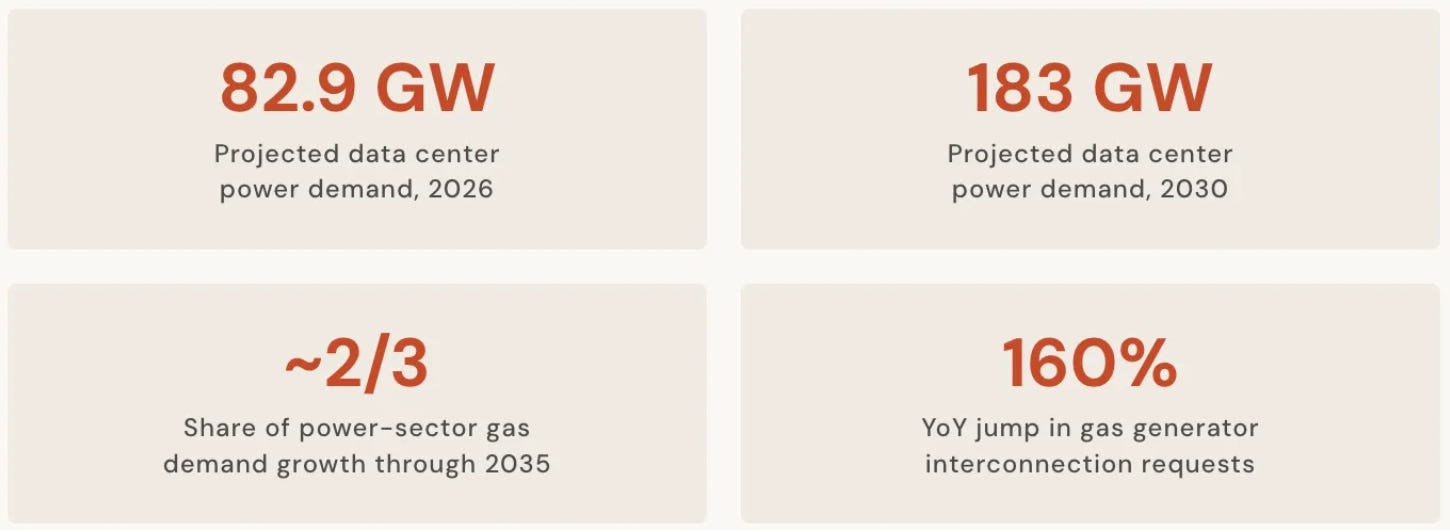
Data centers are expected to account for roughly two-thirds of power-sector gas demand growth through 2035, according to Wood Mackenzie. Interconnection requests for gas generators jumped 160% year over year. The IEA projects that natural gas generation for U.S. data centers alone will climb from roughly 100 TWh last year to around 150 TWh by 2027. Deloitte pegs incremental gas demand from power at up to 12 Bcf/d by 2030, layered on top of the 35-37 Bcf/d the power sector already burns.
Think about those numbers for a second. The United States hasn’t seen this kind of load growth since the 1980s. The EIA now projects total U.S. electricity generation will reach 4,400 TWh by the end of this year with potential to hit 5,200 TWh by 2030. That’s a 24% increase from 2023. We spent the better part of two decades in flat demand growth. Now we’re scrambling.
“The amount of power that’s being asked for, and then the time frame that it’s hoped to be delivered, has just reached such a pace that the utilities, if they ever could keep up, can’t keep up anymore. It’s just gotten out of hand, frankly.” — Dan Thompson, Senior Director, S&P Global 451 Research
That’s a polite way of saying the electric grid was not designed for this. And the people trying to redesign it are losing the race.
BEHIND THE METER: THE GRID BYPASS PLAY
Here’s where it gets interesting for the gas business.
Grid interconnection queues are measured in years. Hyperscalers are measuring project timelines in months. That mismatch has created an entirely new category of natural gas demand: behind-the-meter generation. Data center developers building their own gas-fired power plants on site. No utility in the middle. No interconnection queue. No rate case.
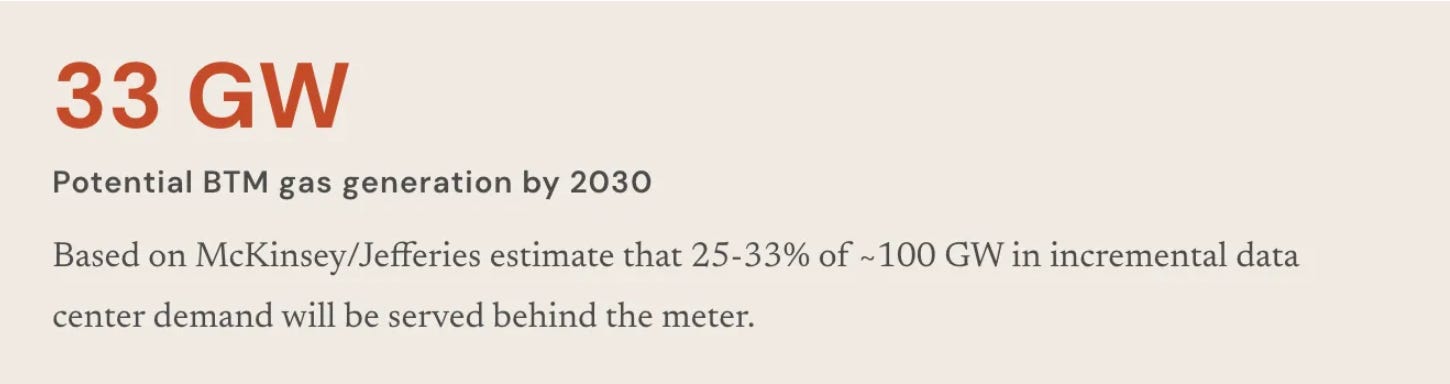
451 Research has tracked more than 100 behind-the-meter power generation projects tied to data center developments. Six operational data centers are already tapping roughly 1 GW of on-site gas generation, with more under construction. Jefferies and McKinsey estimate that 25-33% of incremental data center demand through 2030 will be met by BTM solutions. At average forecast demand of ~100 GW by 2030, that implies up to 33 GW of behind-the-meter gas generation deployed over the next five years.
This is not marginal. This is a structural shift in how power is consumed in this country.
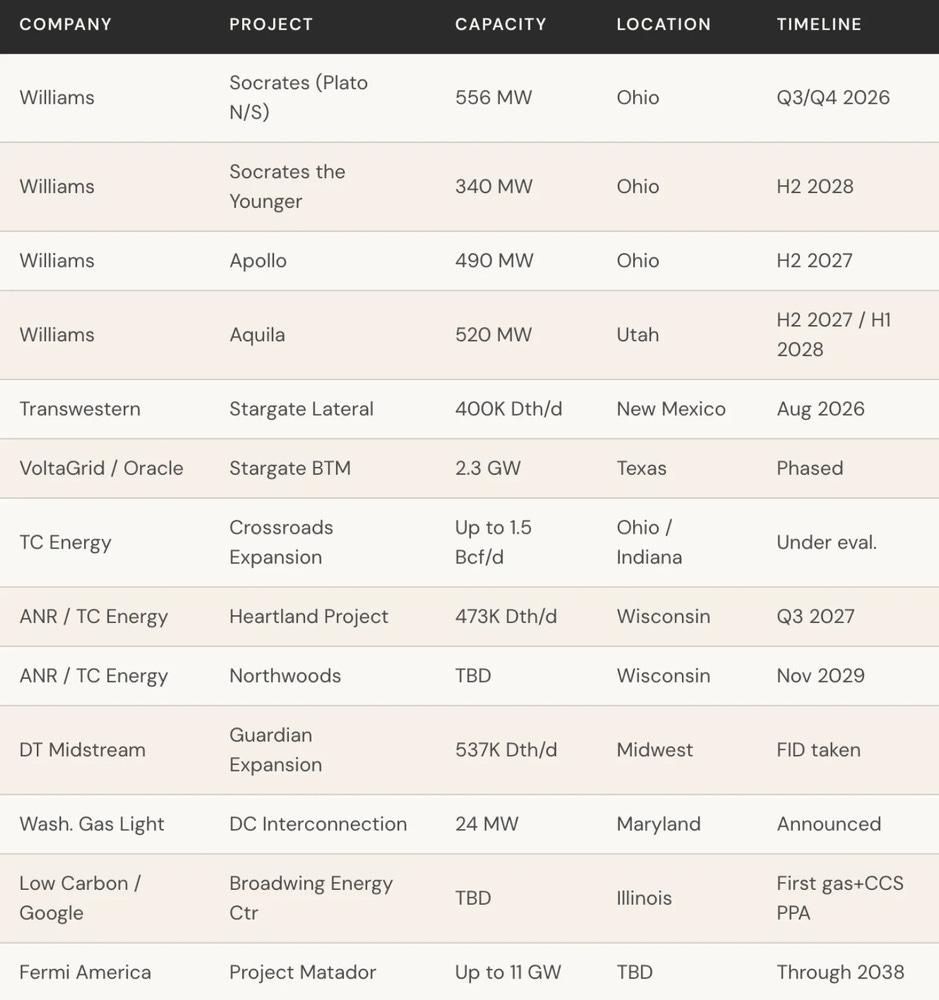
The Stargate program is the clearest case study. OpenAI and Oracle’s sprawling multi-site initiative is deploying behind-the-meter gas microgrids at each campus. The Abilene, Texas site uses Jenbacher reciprocating engines. The Doña Ana County, New Mexico site uses Siemens and GE gas turbines, explicitly designed to operate independently from the local grid. Transwestern Pipeline has already filed at FERC for a $60.2 million lateral to supply up to 400,000 Dth/d of gas to that New Mexico campus, targeting an August 2026 in-service date.
VoltaGrid is supplying 2.3 GW of behind-the-meter gas generation to Stargate’s Texas site alone. GE Vernova is providing 29 stackable aeroderivative turbines capable of nearly 1 GW. Fermi America’s S-1 filing describes Project Matador as an 11 GW behind-the-meter campus supporting 15 million square feet of AI compute by 2038.
Read that again: 11 GW. Behind the meter. One project.
WILLIAMS: THE POSTER CHILD
No company has repositioned itself around this theme more aggressively than Williams Companies.
Three years ago, Williams was a pure-play midstream operator. Today it’s building gas-fired power plants for Meta, exploring upstream production acquisitions to secure fuel supply, and targeting 10%+ compound annual EBITDA growth through 2030. Its market cap has surged roughly 90% in two years to nearly $90 billion, making it the most valuable U.S. pipeline company.
The numbers speak for themselves. Williams has committed over $5 billion to power projects. The Socrates complex in New Albany, Ohio (building two gas plants, Plato North and Plato South, plus a 20-mile pipeline for Meta) comes online late this year. Socrates the Younger, a 340 MW expansion, follows in H2 2028. Apollo in Ohio has been upsized from 350 to 490 MW. Aquila in Utah went from 369 to 520 MW. Both carry 12.5-year PPAs. Combined, these projects could power nearly 1.5 million homes.
“This next five-plus-year period of growth is going to be very much focused on pipe and power.” — Chad Zamarin, President & CEO, Williams Companies, CERAWeek 2026
Williams is also breaking ground on the Northeast Supply Enhancement pipeline expanding Transco through New York, New Jersey, and Pennsylvania. That’s the first new pipeline in New York in over a decade. The Southeast Supply Enhancement expansion on Transco is the company’s biggest earnings contributor in its 118-year history.
The strategic logic is simple and compelling. Williams already owns roughly 33,000 miles of pipeline. Its routes include significant co-located fiber networks. It holds land positions along those routes that can host both power generation and data centers. It owns Sequent Energy Management for gas trading. Add behind-the-meter generation and you have a fully integrated wellhead-to-server-rack value chain. The one-stop shop for hyperscalers.
That’s an investable thesis. And the market is starting to agree.
THE PIPELINE RENAISSANCE
Williams isn’t alone. The broader pipeline sector is experiencing its biggest growth cycle since the early days of shale.
TC Energy is evaluating an expansion of its Crossroads Pipeline in Ohio and Indiana from 250 MMcf/d to 1.5 Bcf/d to serve Midwest data center demand. ANR Pipeline (also TC Energy) is pursuing the Northwoods expansion in Wisconsin and received FERC approval for its 473,000 Dth/d Heartland Project.
DT Midstream took FID on the 537,000 Dth/d Guardian expansion and launched open seasons for up to 1.5 million Dth/d on its Midwestern Gas Transmission system. CEO David Slater cited “approximately 35 gigawatts of coal plant generation expected to retire in the next 10 to 15 years, and increasing announcements of new large loads and data centers” in the Upper Midwest.
Enbridge’s gas transmission segment is entertaining more than 50 data center opportunities totaling up to 10 Bcf/d of potential gas demand. Columbia Gas of Virginia has fielded more than 40 data center supply inquiries. Chesapeake Utilities is trucking CNG to Ohio data center developments. Washington Gas Light just announced its first data center interconnection, a 24 MW project in Maryland.
Fortune ran the headline last week: “Data centers and gas demand make boring pipelines great again.” Hard to argue. U.S. gas production is projected to keep surging to about 160 Bcf/d by 2040, driven by data centers and exports. The EIA forecasts marketed production averaging 121 Bcf/d this year, rising to 124 Bcf/d in 2027.
GAS + CARBON CAPTURE: THE HYPERSCALER COMPROMISE
The sustainability question hasn’t gone away. It’s just been reframed.
Google’s PPA for the Broadwing Energy Center in Decatur, Illinois marks the first corporate procurement of gas-fired power with carbon capture. The plant, developed by Low Carbon Infrastructure, will capture roughly 90% of CO2, with Mitsubishi Heavy Industries supplying the turbine and post-combustion capture equipment. Captured carbon gets transported to ADM’s existing sequestration site nearby.
This is the new template. ExxonMobil and Chevron are both developing plans for BTM gas plants with CCUS dedicated to data center customers. NET Power and California Resources have confirmed they’re in talks with hyperscalers. Meta has an agreement with Entergy to power a $10 billion data center using gas with potential CCUS integration.
BCG recently estimated that for the four biggest U.S. hyperscalers to meet their 2030 clean power commitments using CCGT plants with carbon capture, it would require $70-80 billion in capex and involve over 105 million tonnes per annum of CO2 sequestration. That’s a massive CCUS buildout piggybacking on data center demand.
Mitsubishi says 95% capture is the standard hyperscaler ask, though lower rates on higher volumes can sometimes be more efficient. Julio Friedmann summed up the buyer mentality well: these companies aren’t drawing hard lines at 90%. They want to know how much capture they can get, how fast they can get it, and how much the technology can improve over time.
Meanwhile, interest in direct air capture relative to point-source is fading. DAC developers are struggling to compete with hyperscalers for the same renewable power they need to operate. When your customer is also your competitor for electrons, the economics get ugly fast.
THE GRID RELIABILITY PROBLEM NOBODY SOLVED
The January winter storm made the structural fragility of this situation impossible to ignore.
PJM faces a resource adequacy shortfall of 12 GW by 2030 and 28 GW by 2035. MISO could see gaps of 8 GW by 2030 and 32 GW by 2035. These aren’t hypothetical projections from think tanks. These are planning assessments from the grid operators themselves, driven by the collision of data center demand growth, coal retirements, and insufficient new dispatchable generation.
The electric system and the gas system were designed independently. That worked fine when demand was flat and weather was predictable. Neither of those conditions holds anymore. During the January cold snap, the five days from January 24-28 were among the top 10 highest gas consumption days in the Northeast since 2012. PJM had to pre-commit generation units and align RTO dispatch instructions with pipeline nomination cycles just to keep the lights on.
Grid operators are scrambling. MISO launched its Expedited Resource Addition Study. SPP has its Expedited Resource Adequacy Study. The Texas Energy Fund is deploying $7+ billion in low-interest loans for new gas plants. PJM created a reliability resource initiative to fast-track projects outside the normal interconnection queue.
SPP, Oklahoma’s grid operator, became the first in the nation to get FERC approval for a combined framework that handles transmission, generation, and large-load interconnection in a single 90-day study-and-approval process. That’s a direct response to AI data center demand.
In the EIA’s high-demand growth scenario, natural gas generation between 2025 and 2027 increases the most in ERCOT, rising by 105 billion kWh. In PJM and MISO, coal accounts for more than half the additional generation increase because coal plants have existing spare capacity that can be called on in the interim. The demand shock is so large it’s actually slowing coal retirements.
THE OKLAHOMA ANGLE
Oklahoma is quietly positioning itself as one of the more data-center-friendly states in the country, and the policy moves are worth watching.
Senate Bill 480, the “Behind the Meter” law signed by Governor Stitt in May 2025, allows data center operators to develop and manage their own power generation facilities. The stated goal: attract billions in private investment while easing the burden on existing utilities. It’s a direct play for hyperscaler dollars, and states like Wyoming are running a similar playbook.
But the growth is creating real tension. OG&E has already tried (and failed) to pass along costs from two new gas plants via a $506 million capacity expansion, proposing to charge residential customers an average of 55 cents per month starting this year, escalating to $4.41 by 2031. The Corporation Commission rejected the cost-recovery plan. PSO is pursuing a separate $1.25 billion generation expansion with its own ratepayer recovery request.
The political response is catching up. HB 2992, the Data Center Consumer Ratepayer Protection Act of 2026, passed two House committees unanimously. It defines “large load customers” as those adding 75 MW or more to the grid and requires regulators to ensure residential and commercial customers don’t subsidize data center infrastructure. The Corporation Commission has ordered OG&E to create a new large-user tariff by July 2026.
According to Cleanview’s tracker, Oklahoma currently has five operating data centers at 18 MW, with 10 planned projects that would add 1,700 MW of additional capacity. That’s roughly a hundredfold increase in scale. The buildout is happening. The question is who pays for the grid upgrades.
THE REGULATORY PATCHWORK
Zoom out nationally and you see a spectrum.
New York introduced S.9144, what Food and Water Watch calls the strongest data center moratorium bill in the country. Governor Hochul says developers should “pay their fair share.” Pennsylvania’s Governor Shapiro wants data centers to fully cover their usage costs. Illinois’s ICC is running a “future of gas” proceeding where the Clean Jobs Coalition has proposed banning new gas hookups statewide starting in 2030.
Ohio went the other direction. Senate Bill 103, effective March 20, 2026, established a framework for gas utilities to contract directly with large-load customers. That’s a green light for data center gas supply deals.
The Data Center Coalition’s response to the political pressure is predictable but not wrong: data centers supported over 169,000 jobs and contributed $4.7 billion in tax revenue in 2023. The economic gravity of these projects is real. So is the ratepayer backlash when residential bills go up to fund transmission upgrades that serve a single warehouse full of GPUs.
WHAT THIS MEANS
Here’s the framework I keep coming back to.
The AI buildout has created a structural demand shock for natural gas that will persist for the next decade, minimum. It’s not one pipeline project or one data center campus. It’s a fundamental reordering of who consumes gas, how much they need, and how fast they need it delivered.
The companies that can offer integrated gas supply, pipeline capacity, and power generation in a single package are the ones that will capture the most value. Williams understands this. Enbridge is circling 50+ opportunities. DT Midstream, TC Energy, and a handful of others are making real capital commitments.
But the structural risk that nobody’s pricing correctly is the gas-electric coordination problem. The systems were built independently. The demand shock is hitting them simultaneously. Cold weather plus peak data center load plus coal retirements equals a reliability crisis that gets worse every year until someone builds enough dispatchable generation to fill the gap.
The behind-the-meter trend is the market’s way of saying it doesn’t trust the grid to solve this in time. When Meta builds its own power plant and OpenAI deploys a gas microgrid at every Stargate site, they’re not making an energy policy statement. They’re making a risk management decision.
The irony is thick. The companies that built their brands on renewable energy commitments are now the largest incremental source of gas demand in the country. But irony doesn’t flow through pipelines. Molecules do.
KEY DATA CENTER-GAS PROJECTS: 2026 TRACKER
Sources: S&P Global, EIA STEO (Feb/Mar 2026), BCG, Fortune, Latitude Media, Deloitte 2026 Oil & Gas Outlook, IEA, Jefferies, company filings and earnings calls.
Thanks for reading AEGIS ! Subscribe for free to receive new posts and support my work.
Comments
Nothing yet. Say the first thing.
Sign in to join the conversation.