
In this episode of Adults in the Room, I reconnect with resilience researcher Dr. Michael Ungar to explore what has changed, and unfortunately what hasn’t, since the publication of his early work on overprotective parenting.
Michael is a world renowned and award winning social work professor, researcher and prolific author. He is a Canada Research Chair in Child, Family and Community Resilience, director of the Resiliency Research Centre and teaches in the School of Social Work at Dalhousie University.
Michael reflects on his 2007 book Too Safe for Their Own Good, in which he warned that shielding children from risk and responsibility could undermine their resilience. Nearly two decades later, he admits he expected the trend to be temporary. Instead, he argues that overprotection has intensified, while rates of anxiety, depression, and stress-related challenges among young people have continued to rise.
A central theme throughout the discussion is what Ungar calls the “risk-taker’s advantage” and I drew a parallel term from this chat which was the “responsibility-taker’s advantage.” Drawing on decades of research with children thriving in some of the world’s most challenging environments, he explains that resilience grows when young people are trusted with meaningful responsibilities, contribute to their communities, and learn to navigate manageable risks.
The conversation also examines the growing tendency to pathologize normal human experiences. We discuss the expansion of therapeutic language, the rise of self-diagnosis, increasing accommodations in universities, and the risk of labeling ordinary developmental challenges as mental health disorders. Rather than focusing exclusively on what is wrong with young people, Ungar argues for paying greater attention to strengths, relationships, purpose, contribution, and supportive environments.
Another key insight is that resilience is not simply an individual trait. It emerges from the interaction between people and the systems around them. Strong relationships, meaningful routines, opportunities to contribute, and a sense of belonging all play a crucial role in helping young people thrive.
The discussion also touches on technology, social media, artificial intelligence, and concerns about excessive screen exposure, particularly among young children. Ungar emphasizes that while technology can be useful, it should not replace the real-world experiences that foster healthy development.
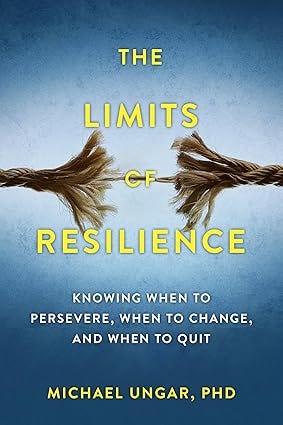
The episode concludes with a discussion of Ungar’s recent book, The Limits of Resilience. In it, he challenges the popular notion that resilience is always the answer. Sometimes the healthiest response is not asking people to become more resilient but changing the conditions that make resilience necessary in the first place. As Michael puts it, communities facing chronic adversity often don’t need another lecture about resilience. Instead, they need better housing, cleaner water, stronger social supports, and fairer opportunities.
Highlight:
One of the most memorable moments comes when Michael reflects on a criticism he received from people living under difficult conditions: “Can people stop telling us to be resilient and just change the things that make it necessary for us to be resilient?” That observation neatly captures the episode’s central message that resilience matters, but so do the environments that shape our ability to develop it.
Overall, this is a thoughtful and nuanced conversation about resilience, mental health, parenting, education, and the importance of giving young people both protection and opportunities to grow.
adults in the room. is a reader-supported publication. To receive new posts and support my work, consider becoming a free or paid subscriber.
Comments
Nothing yet. Say the first thing.
Sign in to join the conversation.