
**Apologies, it has a been a minute since contributing to this Substack. Welcome to those who have recently joined. And thanks to those who have stayed. For those who don’t know my background, I am a professor at U of Victoria but I also maintain a small private counselling practice which operates primarily outdoors.**
I am often asked “why outdoor therapy?”
I usually respond with the question, “Do you feel better in your office or out in nature?” I get all sorts of answers about professionalism, ethics, standards of practice…and yet “when I’m out in nature…” usually gets woven in there somewhere. An indirect acceptance of my question as rationale for my work.
Outdoor therapy is not for everyone. I’ve never claimed it was. I could easily have asked in response “Why indoor therapy?” The point is, I know I feel better, and enough evidence exits to suggest that the health benefits alone of connection with nature to support my choice. Further, if clients prefer therapy outdoors, then I only need to ensure I can answer the rest of those solid practice question regarding ethics and standards.
In this short essay, I am simply making the argument that human connection with nature is a biological imperative, so why not outdoor therapy?! I will admit I took “nature connection” for granted for many years, even while maintaining it in my own life. Now, with a more informed view of its benefits, I am a biased advocate. No apologies.
Sorry of this is too basic for you. I am trying to bolster my point:). We have been taught survival and reproduction are the two human biological imperatives. I argue here that nature connection might be the third in our modern lives.
Let me start with oxygen, which we rarely think about as nature connection. Every breath you take pulls it into your lungs, and that oxygen travels your bloodstream and into every cell in your body. Where does it come from? Plants, trees, algae in the ocean. The green world produces the invisible resource that keeps you alive from one minute to the next. This is not a metaphor, it is biology.
Then if we consider what we eat. The minerals in our bones, iron in our blood, the calcium that builds your teeth. These all come from soil that was built over millennia by the slow work of decaying flora, fauna and eroding rocks. Our meals are a direct transfer of the earth’s minerals into our bodies. Your body is quite literally derived from the earth. Think: calcium in your bones was once part of a mountain. We are nature.
Thanks for reading adults in the room.! This post is public so feel free to share it.
I could ramble on lots about sunlight too. Our skin absorbs it and to produce Vitamin D, which in turn regulates our immune systems, supports bone density, and influences our mood. Tell me you don’t feel happier on sunny days. Our eyes monitor the changing quality of light through the day, and that information calibrates your circadian rhythm and tells our body to adjust melatonin levels accordingly. Circadian rhythms also manage our sleep cycle, and influence hormone release, and cellular repair. We are solar-powered organisms.
Modern day sees dietary supplements, SAD lamps and pharmaceuticals to help with all sorts of ailments. These effort do not however, replace our intimate but often unacknowledged relationship with nature that sustains us. We evolved in contact with these sources for hundreds of thousands of years. It’s simple. We are designed to breathe air, eat food grown in living soil and move our bodies under an open sky, even better with your feet in contact with the ground. Our body expects these conditions and functions best when they are present. Many have forgotten or ignore this relationship.
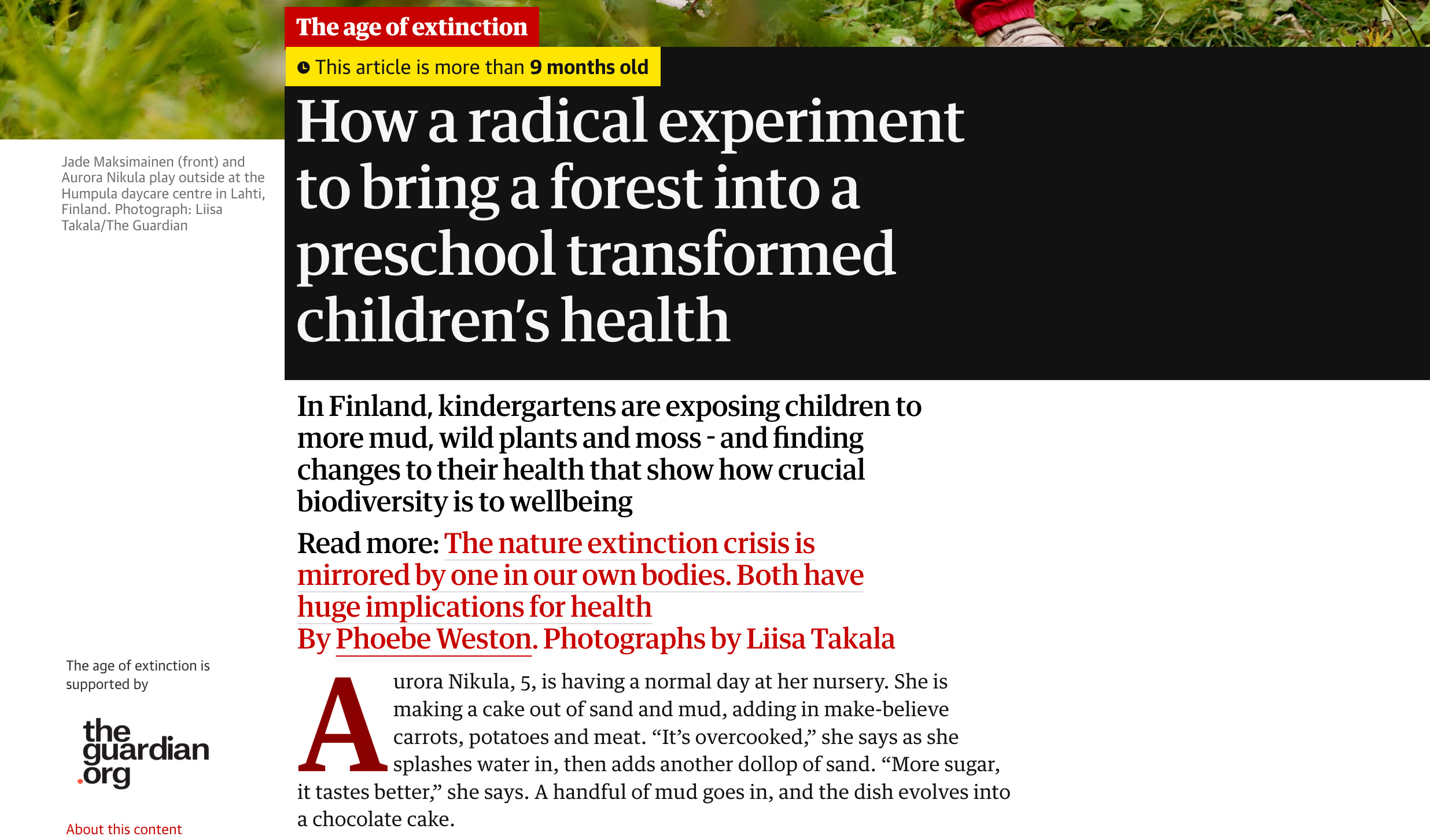
An example in Finland where a “radical” idea was to rip out EU-approved rubber playground surfaces and replace with dirt and plants led to an amazing discovery in children—-improved immune function!! Sorry, but duh! Off-gassing EPDM (Ethylene Propylene Diene Monomer) sourced from used tires, for safety, aesthetics and ease of cleaning…
The psychological need for nature is equally important as the biological one, though it is harder to recognize or measure. The evidence is present and accumulating rapidly. We now have evidence that spending time in green spaces lowers cortisol levels, our bodies stress hormone. We have seen patients recover quicker from illness when their hospital window opens to trees rather than a brick wall. Children with ADD show measurable improvement in focus after spending time in nature. These are not just nostalgic or romantic claims. They are findings from a growing body of research that continues to inform our understanding of how humans need nature connection, although as a species, we are slow to learn, or have simply forgotten nature’s contributions.
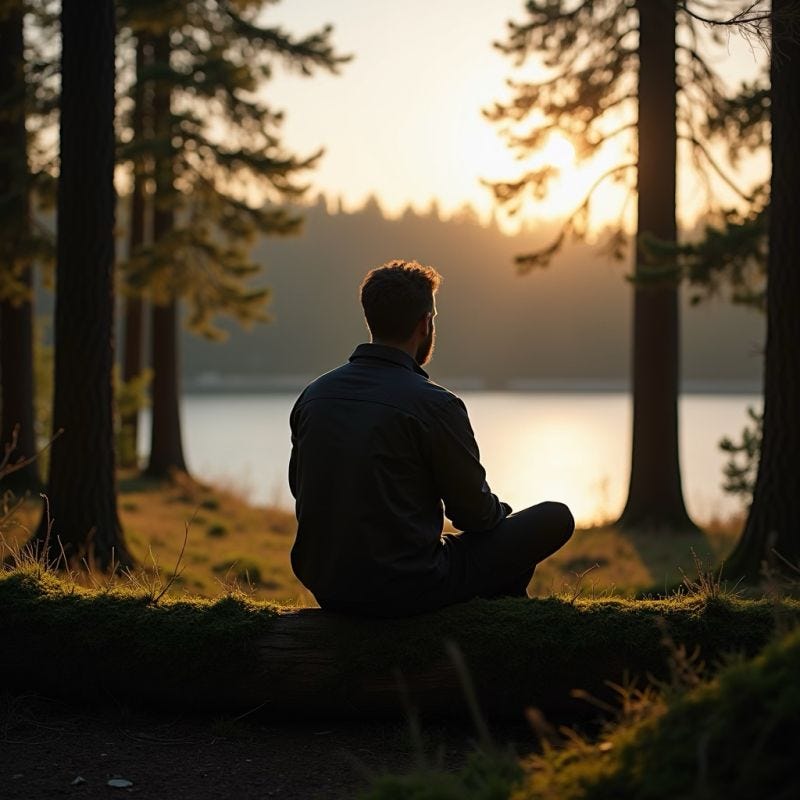
Ai generated image.
What happens when we remove nature? You do not have to look far to find out. Modern life has engineered a condition that is essentially unprecedented in the history of our species. Millions of people now spend their days primarily indoors, under artificial light, breathing recycled air, eating food grown in depleted and chemical-laden soil, and looking at screens for the majority of their waking hours. The results are not encouraging.
Anxiety (or stress) and depression (or sadness) have become more common as we become more disconnected from the natural world, and researchers are increasingly drawing lines between those two trends. More easy to see is the evidence that nature connection can reduce the symptoms of these mental health issues. Children who grow up without regular contact with soil, water, animals and experiencing diverse environments may miss out on the necessary microbial exposure that natural environments provide. This absence may play a role in the rising rates of allergies and autoimmune conditions seen today. The immune system, it turns out, needs practice. It needs to meet the natural world in realtime.
Loneliness too can be seen as having a biological dimension. We are social animals, but we are also ecological animals. We evolved in small groups, and obviously, in nature, attuned to the rhythms of the seasons and changing weather. If we are removed from that context entirely, does our nervous system registers the absence? I believe it does. Some describe it as a void or flatness. A disconnection and persistent feeling that something essential is missing. This occurs today even when all our material needs appear to be met. That feeling is a signal, and one often ignored.
Biologist Edward Wilson gave a name to this: biophilia, our innate affinity for other living things arguing that our connection to nature is not a preference or a cultural artifact but a biological inheritance, written into our genes over the deep time of our evolution. If he is right, and the evidence suggests he is, then a life lived entirely apart from the living world is not simply a lesser version of a good life. It is detrimental to life.
Your daily living must include nature, it is not impossible. To extend beyond basics of breathing air and eating food, we need a more intimate connection wth the natural world. To believe nature connection is unnecessary or “nice but not required,” is short-sighted. It would be ludicrous to design a hospital without considering the need for clean air, and it is equally ignorant to design a life, a community or a society without considering the need for contact with the natural world.
We need oxygen to breathe. We need minerals to build our bodies. We need sunlight to regulate the systems that keep us healthy. And we need the presence of other living things, the sight and sound and smell of them, to keep our minds intact. These are not luxuries. They are not amenities or nice-to-haves or line items you can cut from the budget when times are tight.
They are the conditions under which human beings were built to thrive. Any plan for health, for education, for community, for prosperity that leaves nature out of the equation is not a plan. It is an oversight. And given what we now know about how deeply we depend on the natural world, it is an oversight we can no longer afford.
Nature connection is a biological imperative. I suggest considering how you can weave increased contact with nature it into your work and/or daily routines. Even moments of nature awareness count. And find ways to encourage in those in your life or whom you serve to connect more with nature too.
No posts
Comments
Nothing yet. Say the first thing.
Sign in to join the conversation.