
Hey Friend!
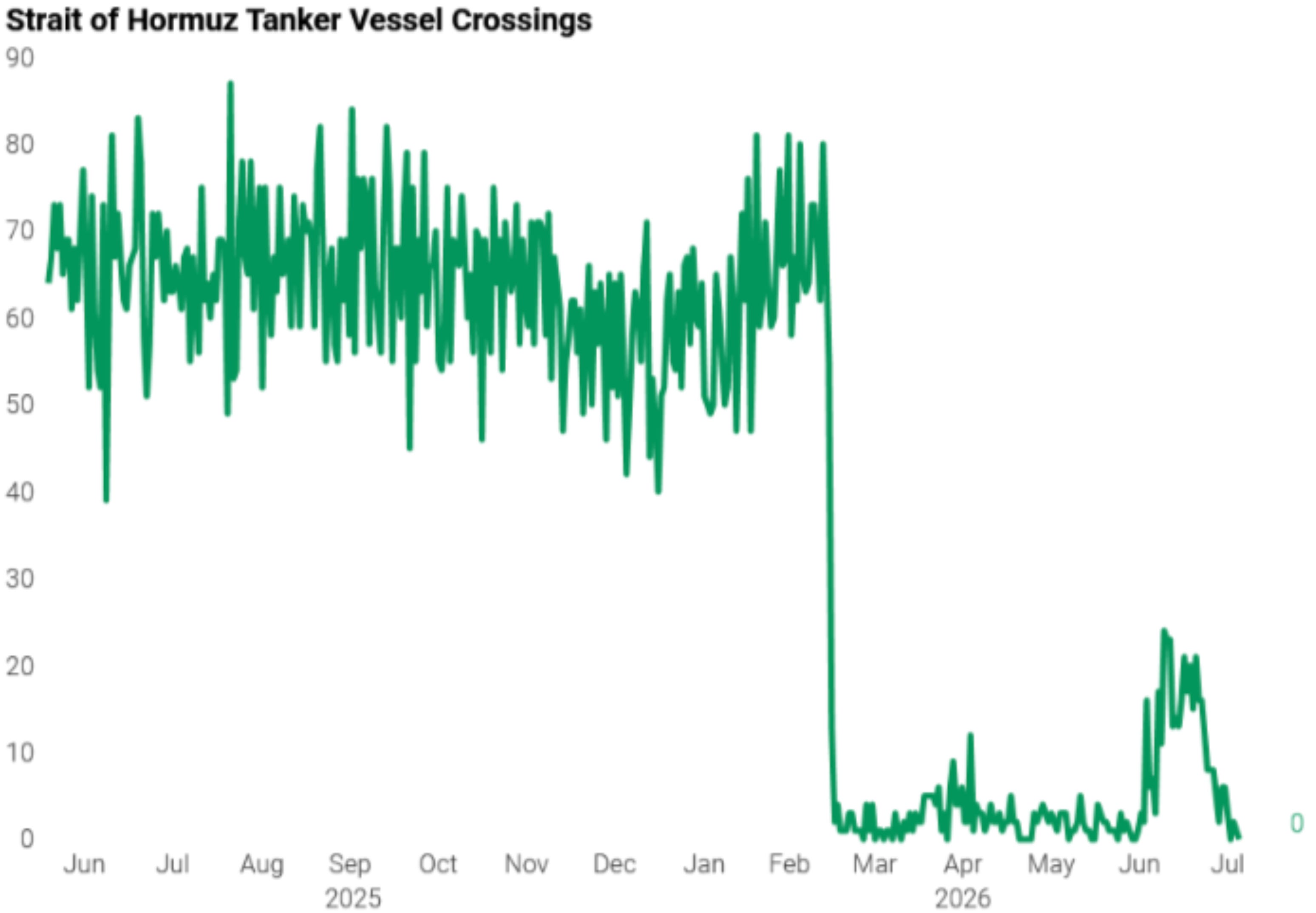
Oil is back above $90, Iran is still escalating, and the Strait of Hormus is effectively shut again.
A few months ago that mix would have sent every market into the deep red. This week the Dow was sent to a short rally literally after Trump threatened to bomb Iran again. Markets get bored of repetitive news, and this news has become very repetitive.
But boredom is not the same as safety. We are sitting on the most leveraged US stock market on record, the narrowest rally in years, and a Bitcoin cycle that either follows the 4 year cycle or does whatever it wants. The classic capitulation everyone waited for did not show so far. Neither did the classic euphoria.
Let’s get into the broader picture and how to set up for the coming week:
️ ⚡ On today's Episode:
📈 Market Update – Oil is back near $90, rate-hike expectations are rising, and record margin debt leaves a narrow equity rally vulnerable to forced selling. Bitcoin’s MVRV low stopped at 0.18 instead of crossing below zero, while whales accumulated roughly 60,000 BTC and ETFs drew $727 million over five days. The old capitulation script may be changing.
🔊 Project Updates – Aave widened its lending lead, Hyperliquid kept generating around $1.4 million in daily fees as HYPE showed distribution, and Solana captured 95% of tokenized-stock volume.
🐂 Alpha Insights – I’m staging spot Bitcoin buys through the roughly $47.2K–$55.5K value zone, keeping dry powder for a final flush and reserving leverage for value near $50K

The current state of the market.
Market Overview
Start with energy, because everything else hangs off it. Oil pushed back above $90 as the Iran conflict escalated, with Iran striking Bahrain’s datacenters and the Houthis warning Saudi Arabia they’ll make shipping harder.
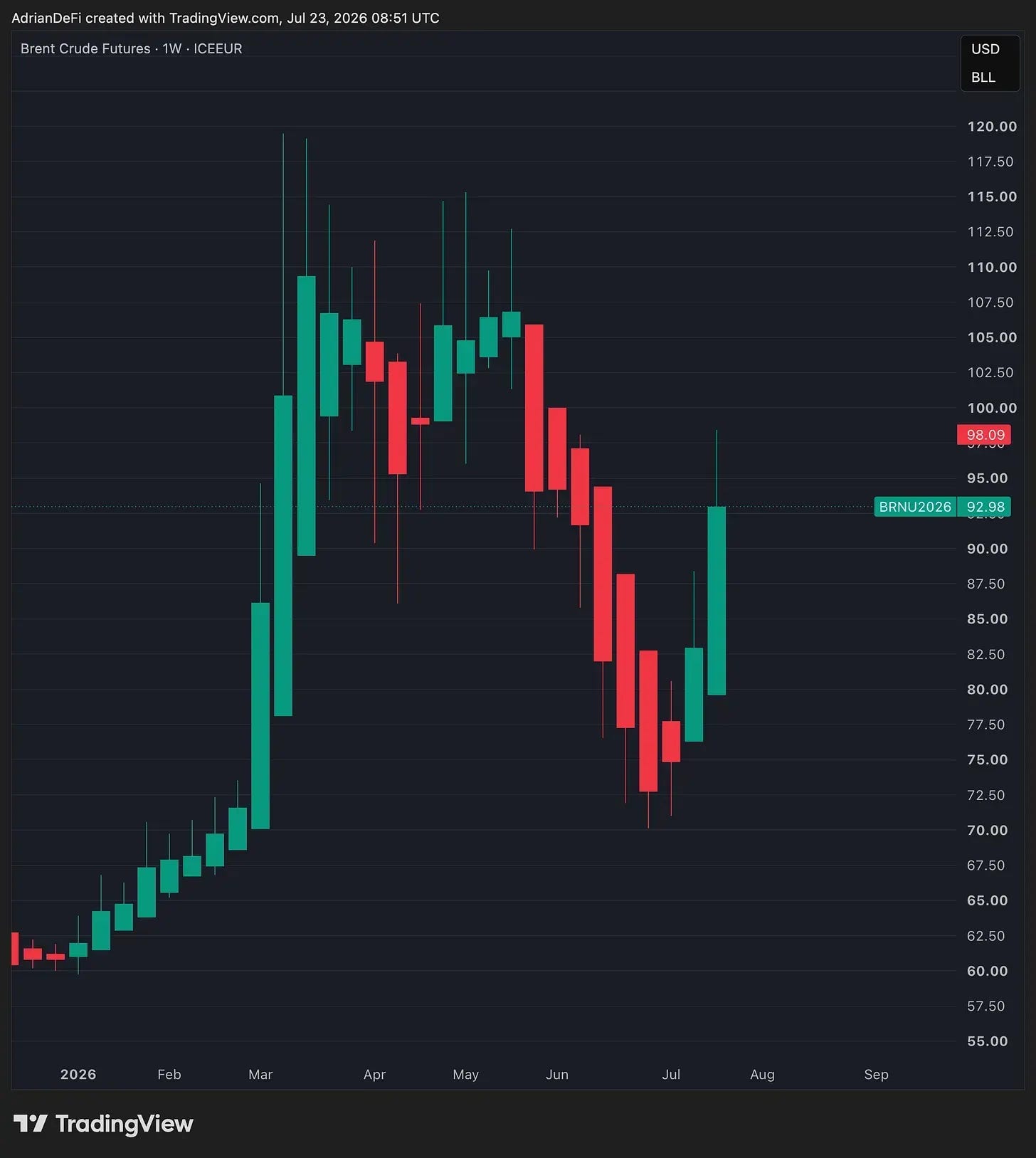
The quick de-escalation that was priced in, ships flowing through Hormus again, just didn’t happen.
Here’s why that’s a problem: Higher oil feeds straight into inflation expectations. The market has now started pricing rate hikes, not cuts, with a first one expected around September and a second in Dezember.
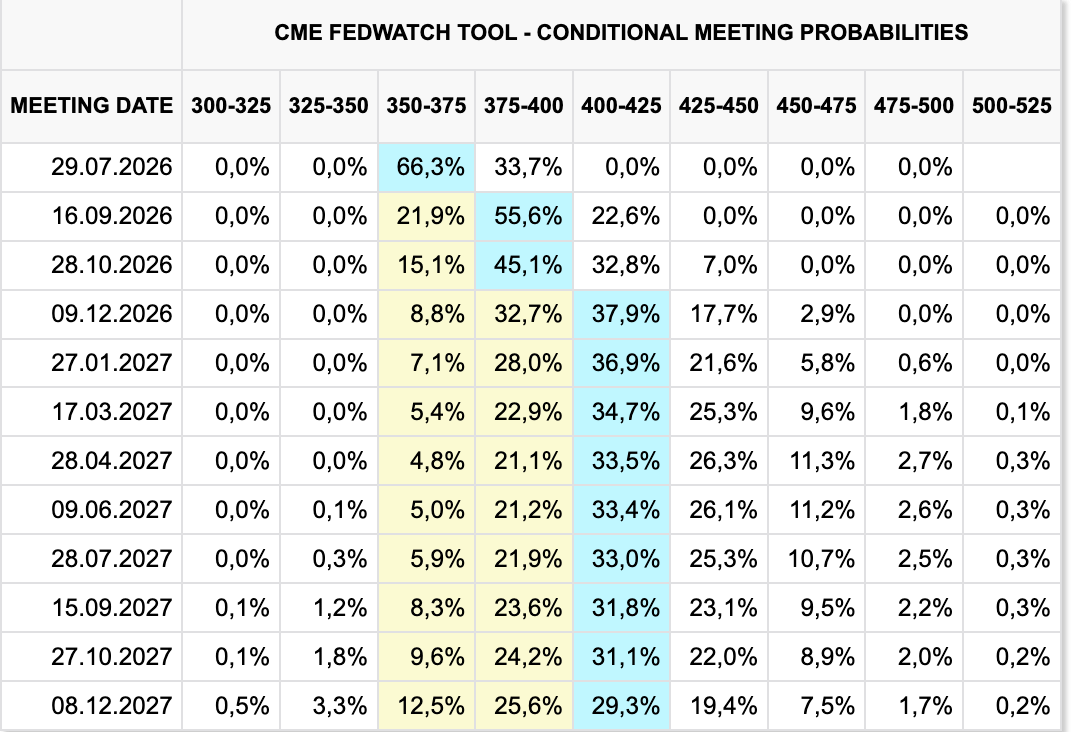
Those odds move with every PCE print and every dollar on the oil price. For Europe, and Germany especially, pricier energy heading into winter reserve season is its own problem.
Now look at equities. The rally was carried by a handful of mega-cap tech and AI stocks while most of the market went nowhere or bled.
And the smart money is stepping back. US hedge funds sold equities at the fastest pace since 2017, even faster than the mid-2024 washout, mostly de-risking tech and AI after a strong run.
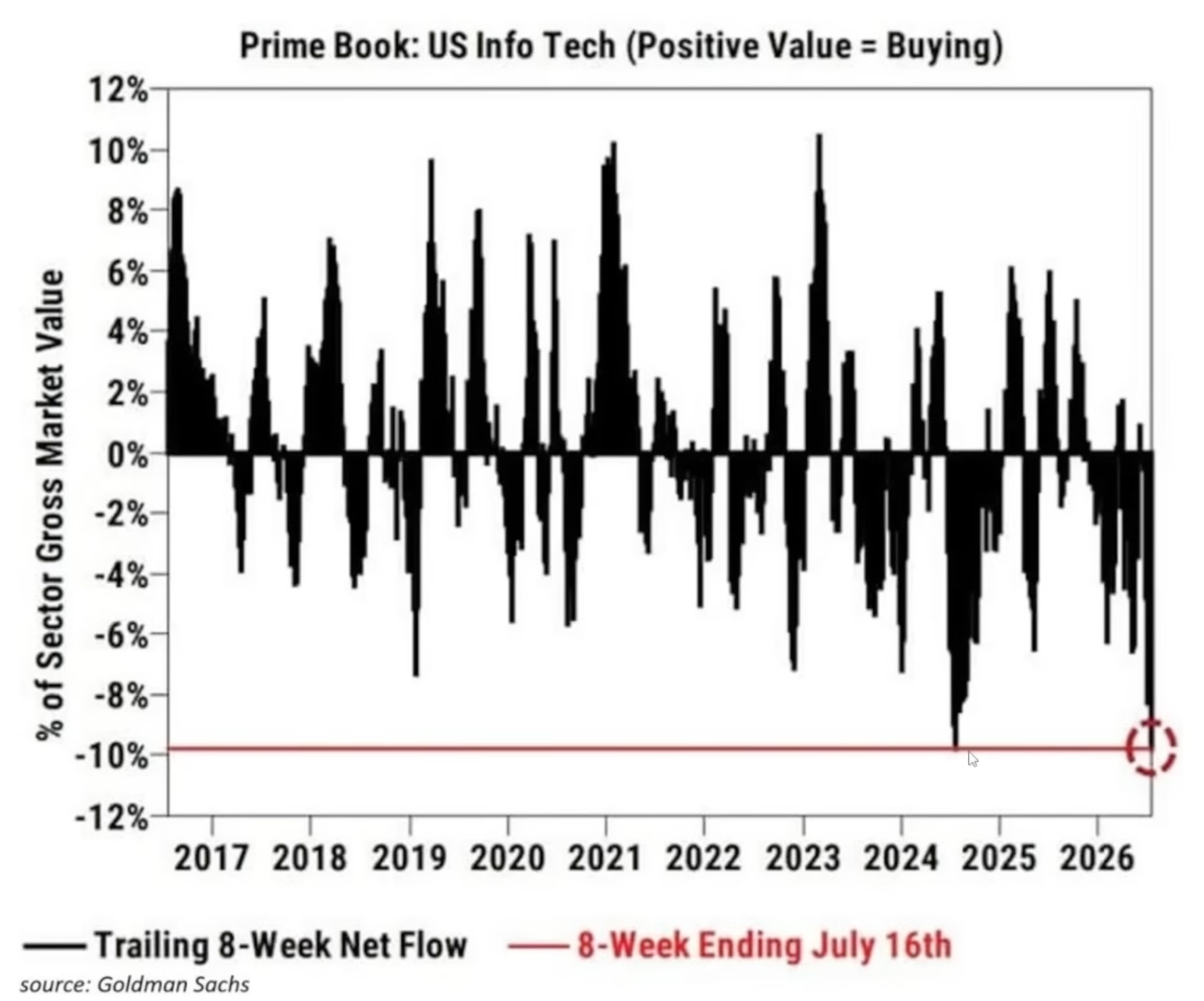
Several chipmakers are already down 30% to 40% from their highs. The move is amplified by how much of this exposure was built with leverage, including leveraged ETFs.
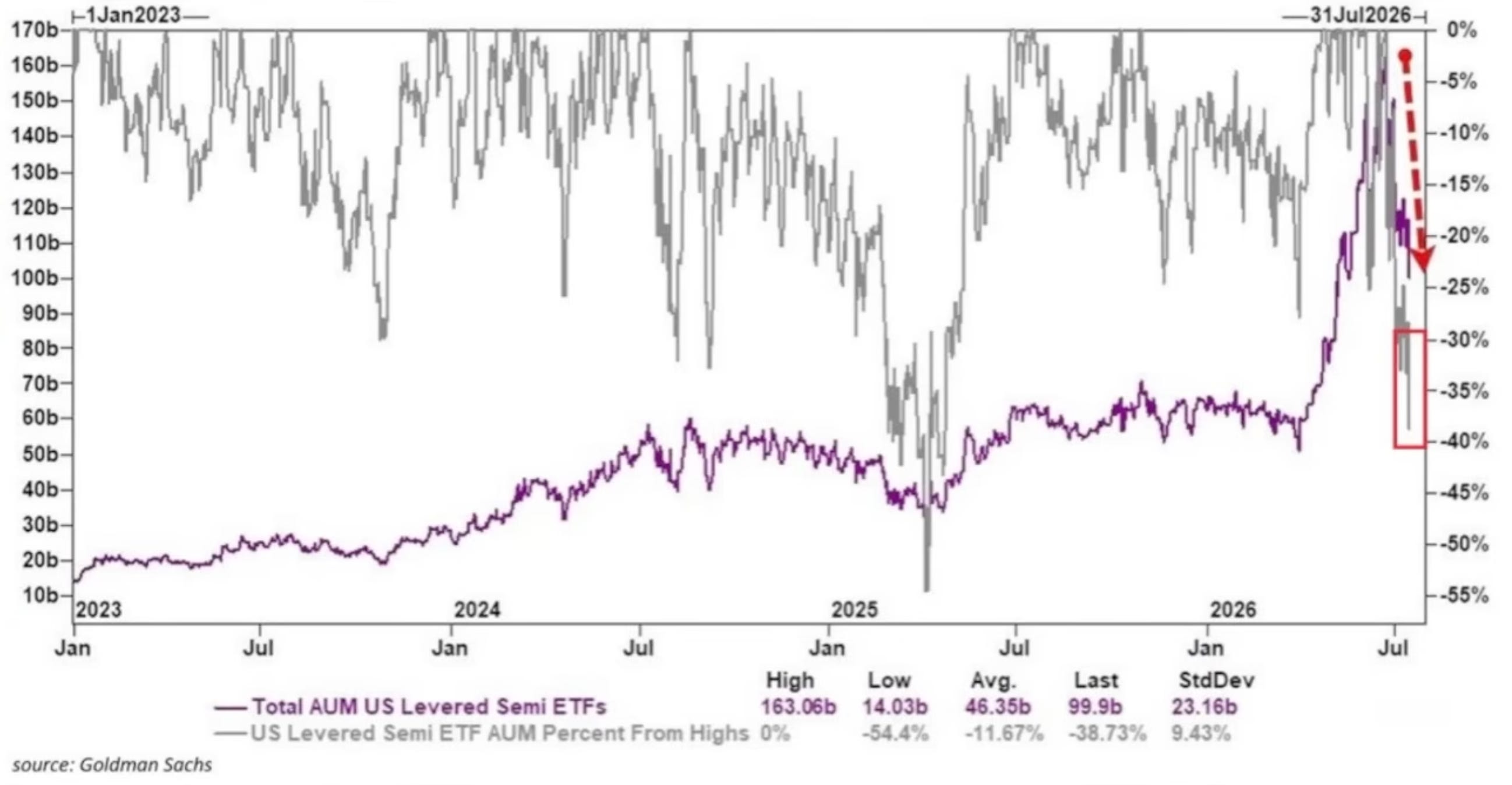
When price drops, forced selling feeds on itself. Korea is already seeing forced liquidations spike. That’s what a leveraged market looks like when confidence starts to crack.
And you can see that clearly in one macro chart this week:
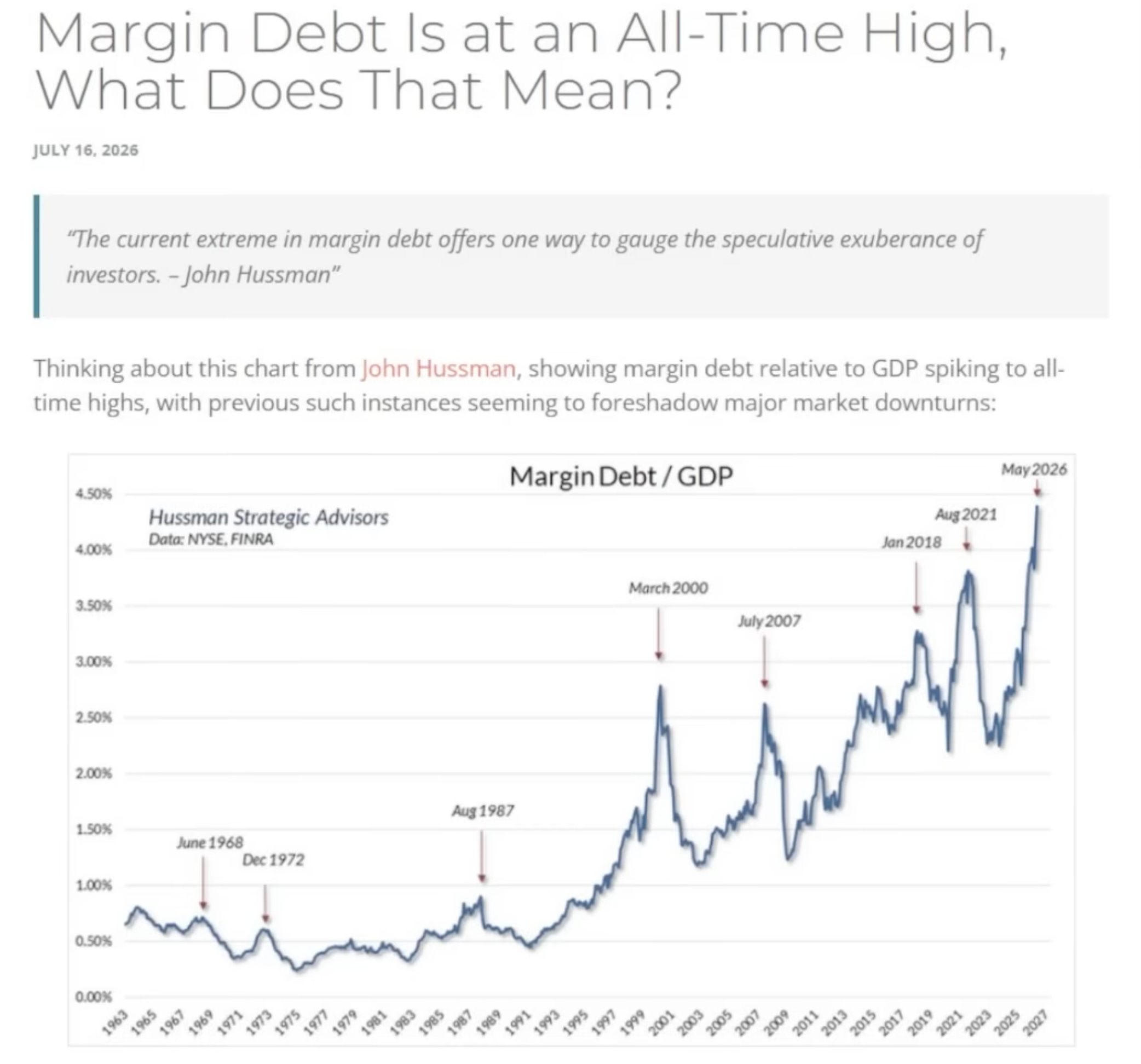
→ Margin debt (money investors borrow against their portfolios to buy more stock) has hit a record high relative to US GDP. After past extremes like this, the S&P 500 lost roughly 11% on average over the following twelve months. That is an average, not a promise, and it doesn’t have to repeat. What it does tell us is that the market is highly leveraged, which means even a modest drop can trigger margin calls, forced selling, and a bigger correction than the initial move deserved. The parallel to crypto is exact: What matters is whether demand is real spot buying or borrowed futures and margin.
Now the other side of the coin: Regulation. The Clarity Act (the Digital Asset Market Clarity Act, the main US crypto market-structure bill) had a wild week on the prediction markets. Odds of it passing and being signed into law in 2026 round-tripped from roughly 31% to as high as 49% and back to the low 30s, all in a few days.
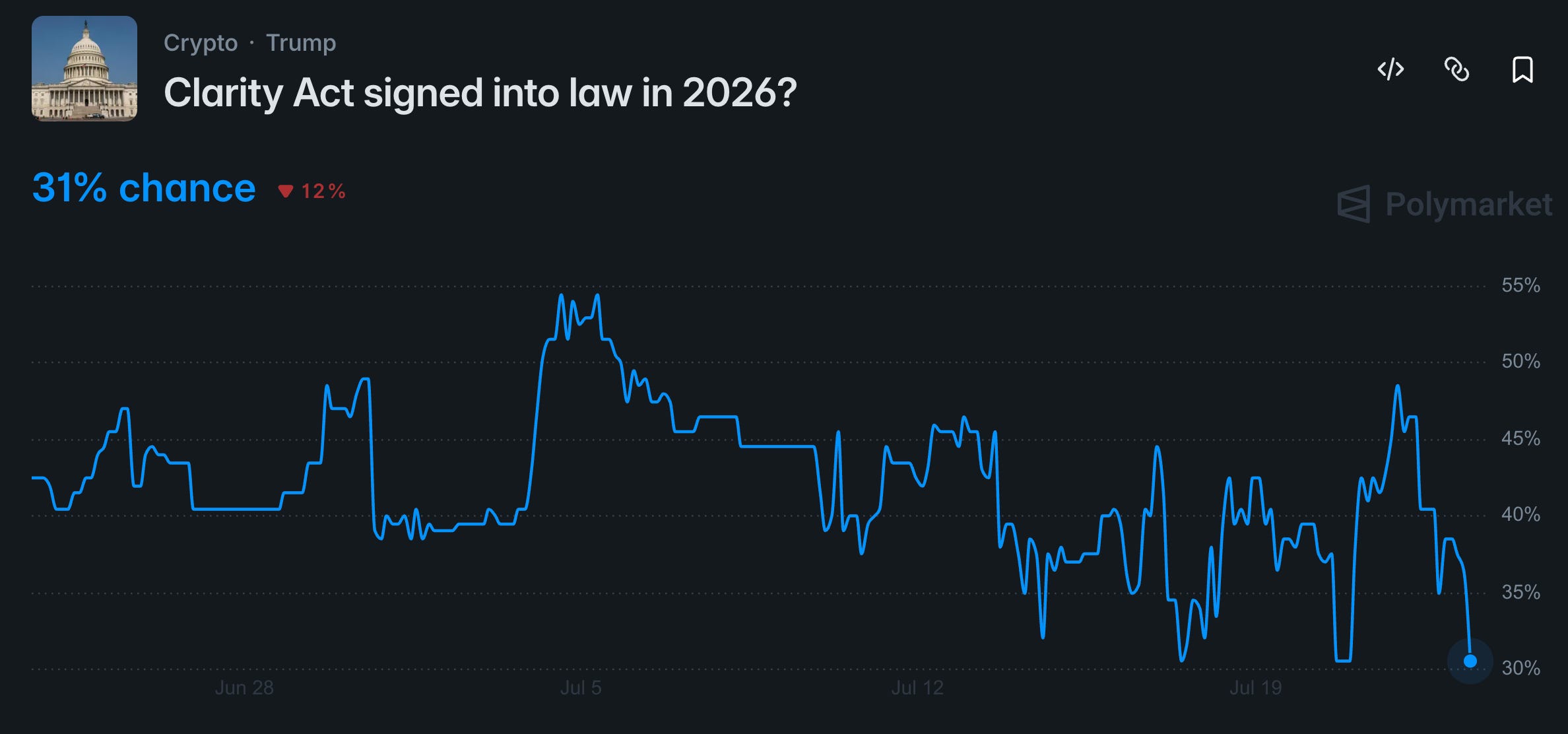
The spike came when Trump and the White House agreed to ethics language, including a ban on sitting officials (president, VP, Congress, their spouses) from issuing or sponsoring their own tokens while in office. The reversal came just as fast, once Senate Democrats called the draft too weak, mainly over who gets to enforce it and a sunset clause that would conveniently let those ethics rules expire in January 2029, right as Trump leaves office (lol).
For markets and policy, the key facts are simple: the bill is real, a concrete Senate text is now circulating, and leadership wants a floor vote before the August recess. But 2026 passage is still below a coin flip, and the ethics fight, sharpened after Trump’s disclosures showed around $1.4 billion in crypto income last year, is the main obstacle. Regulation is moving from threat to framework, just not in a straight line. Miss the pre-recess window and the midterm calendar makes this much harder.
Thanks for reading Adrian DeFi! Subscribe for free to always receive the best DeFi insights and investment opportunities.
Market Pulse
What’s important to track underneath the macro:
The MVRV Z-Score has done something this cycle it had never done in 15 years of Bitcoin history. Quick for your understanding: MVRV compares Bitcoin’s market value to its realized value, roughly the average price at which every coin last moved onchain, so it approximates the whole market’s cost basis. The Z-Score just measures, in statistical terms, how far price sits from that cost basis.
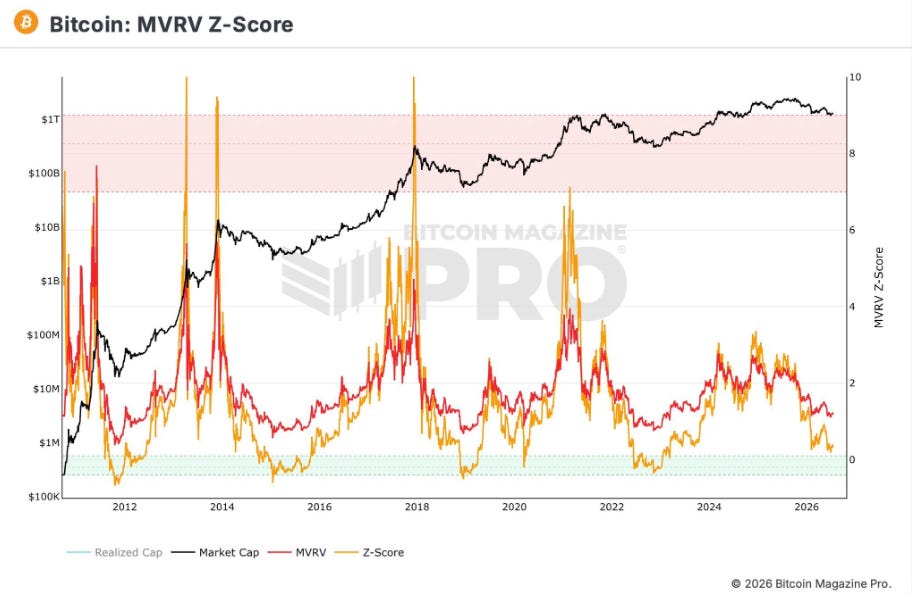
→ Readings above 7 have historically marked cycle tops. Readings below 0 have marked the bottoms. And every bear market low, 2011, 2015, 2018, 2022, printed below that zero line, without exception. This cycle, the low was 0.18. Just above it. The historical capitulation zone was never reached. The mirror image is just as strange: At the last all-time high, the score never touched the red overheat zone either. No classic euphoria, no altseason, none of the social mania that defined past tops.
That leaves two scenarios. Let’s be honest, nobody knows which one wins, so we hold both.
Scenario one: the final flush is still coming. The market’s cost basis gets tested one last time, weak hands fold, the score finally dips below zero, and only then is the bottom confirmed the way every prior cycle confirmed it. That is the classic four-year playbook.
Scenario two: the market structure changed. Spot ETFs, Bitcoin treasury companies, and institutions absorb selling pressure before it can ever reach the old extremes. If that’s true, everyone waiting for a 2018-style signal is waiting for a phase of the market that no longer exists.
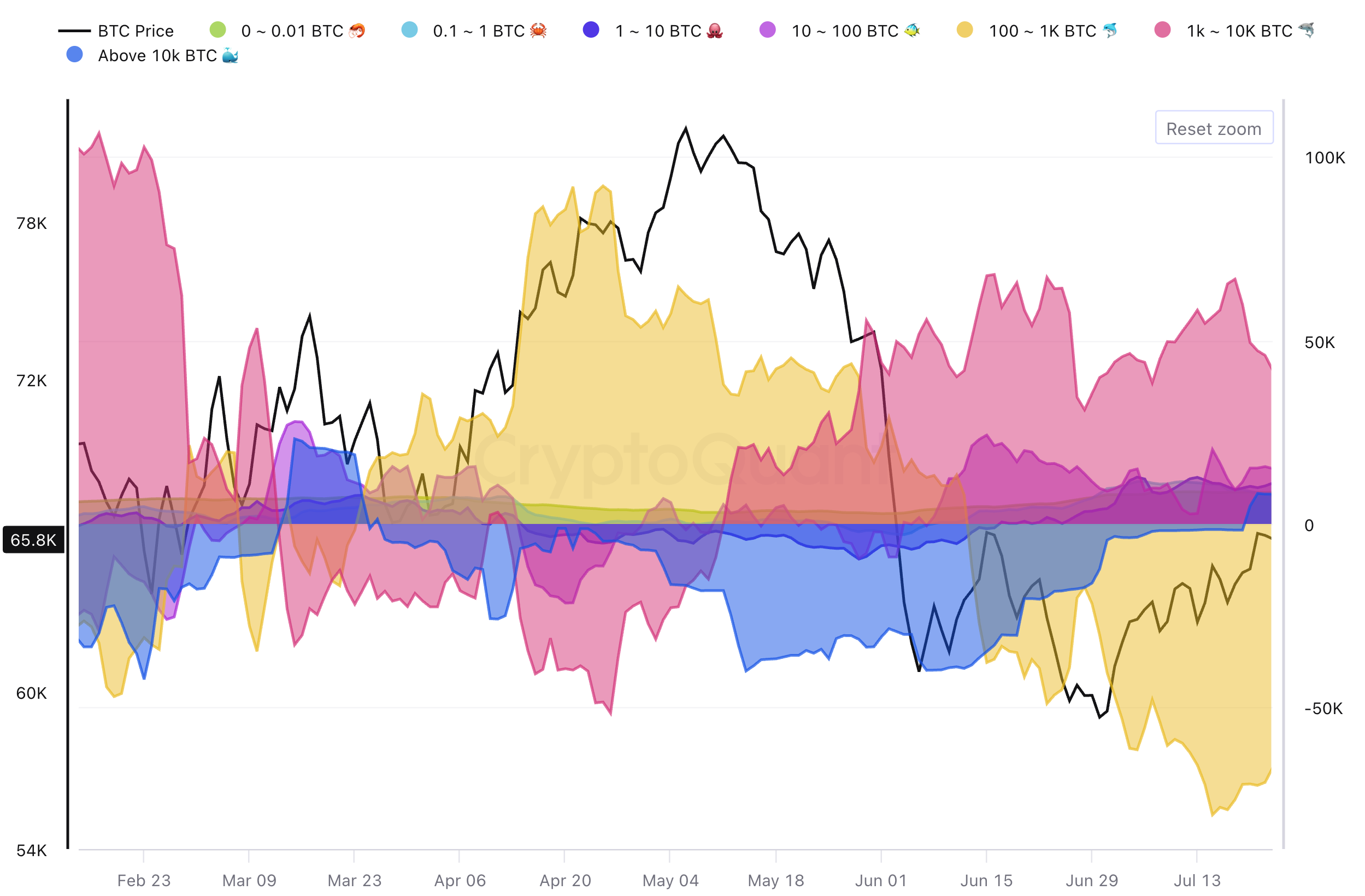
The flows lean toward the second read, at least for now. Whales (pink: 1k-10k BTC) accumulated roughly 60k BTC over the past 60 days while mid-sized holders (yellow: 100-1k BTC) sold into them.
And Bitcoin ETFs just posted a seventh straight day of inflows, $1B since July 14, the first such streak since late April.
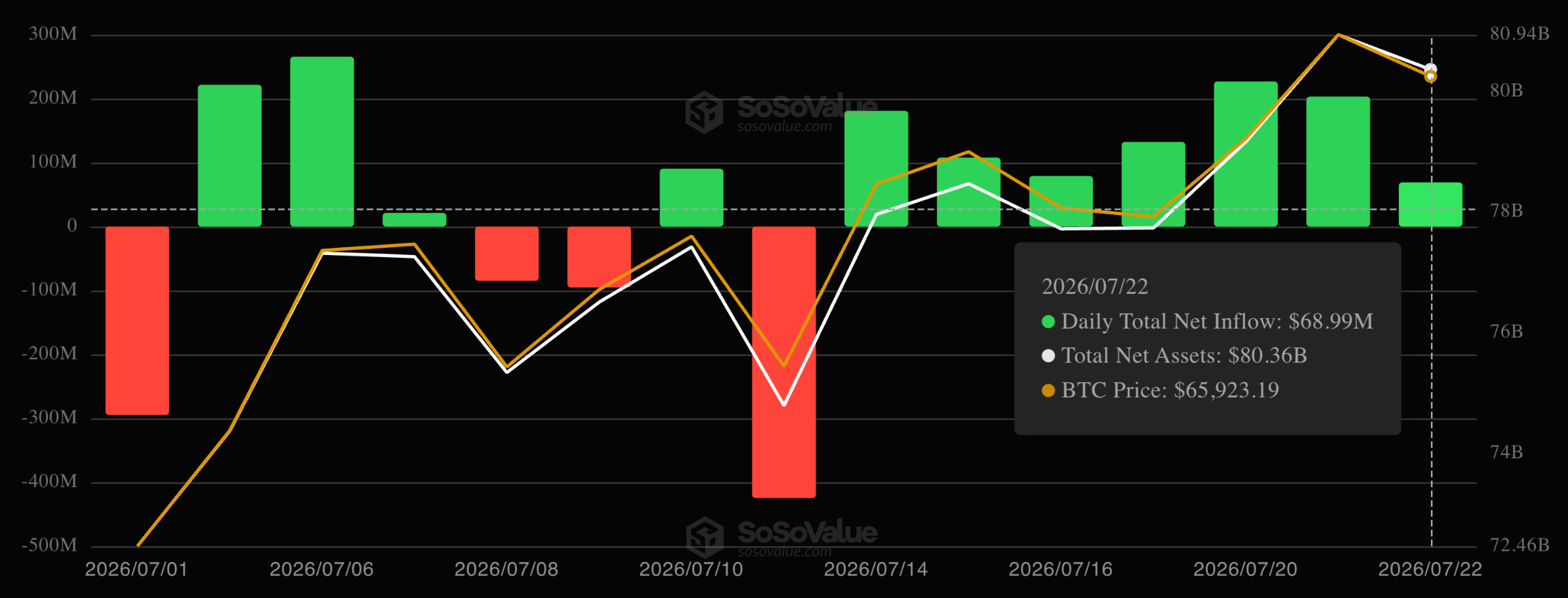
Those buyers are not waiting for a hypothetical November bottom.

That covers the broader market. Now let’s move to the opportunities I discovered.
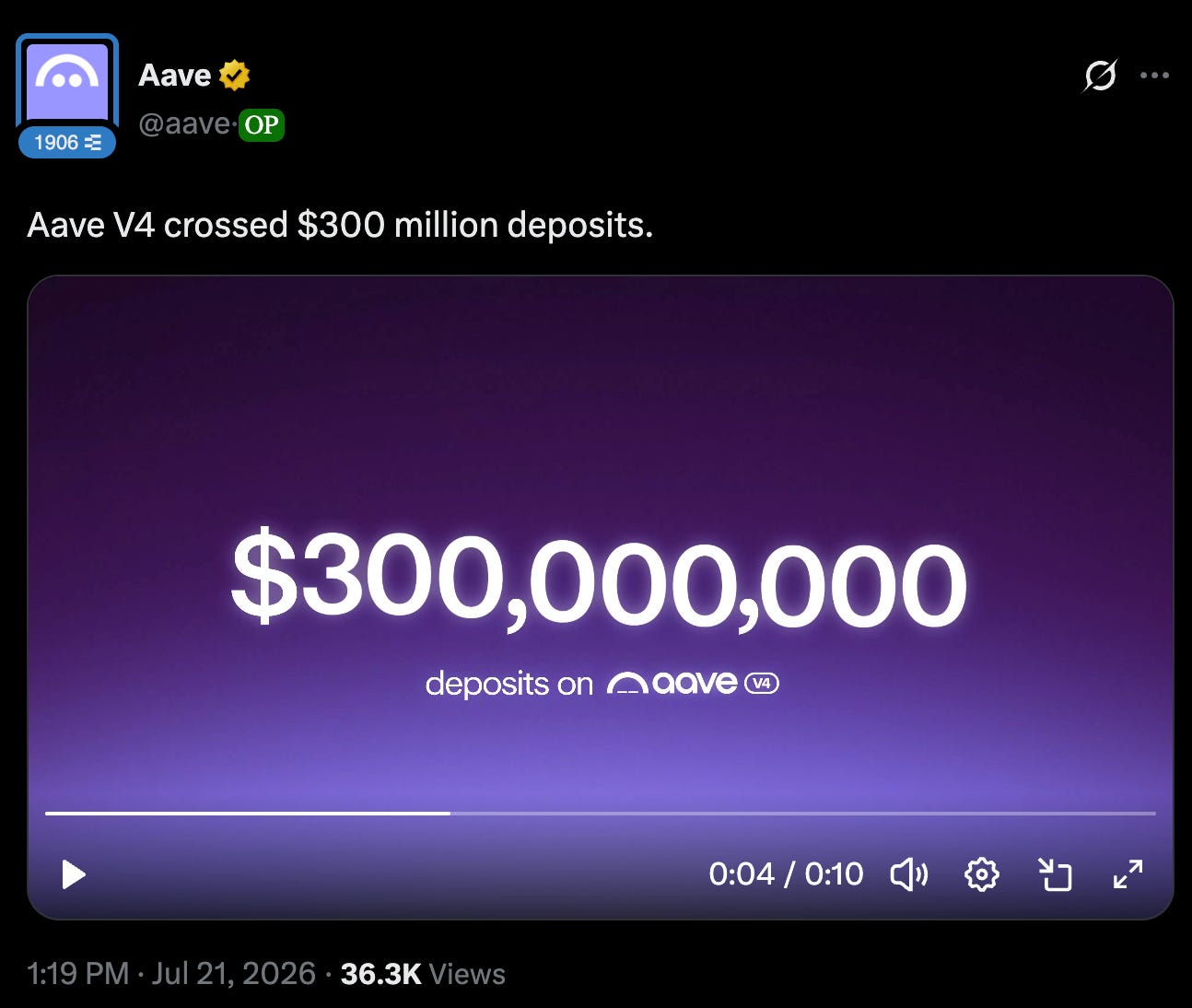
Aave keeps compounding its lead. Aave V4 hit back-to-back all-time highs, crossing $300 million in deposits and its first $100 million in active loans Source: Aave.
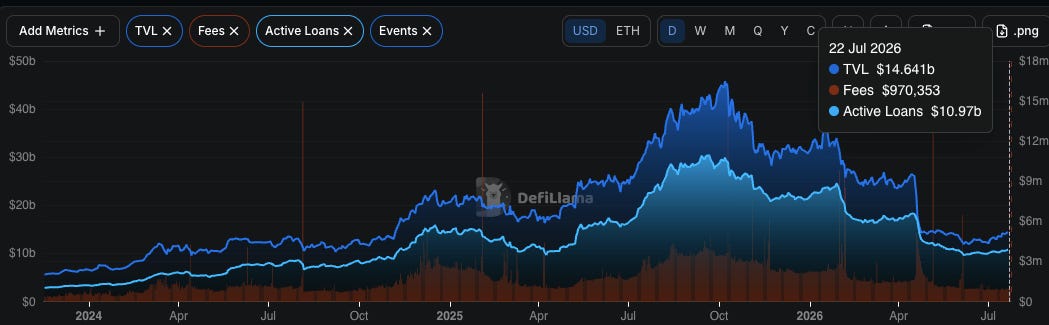
Zoom out and the moat is quite visible: Aave now holds $10.9 billion in active loans, more than every other EVM lending protocol combined. Lending is the least glamorous corner of DeFi and the one where trust compounds hardest.
Hyperliquid is the more interesting read this week. HYPE, the bear-market darling, is finally showing signs of distribution, meaning early holders taking profit into strength. That’s not a reason to look away. The DEX keeps taking share from centralized exchanges
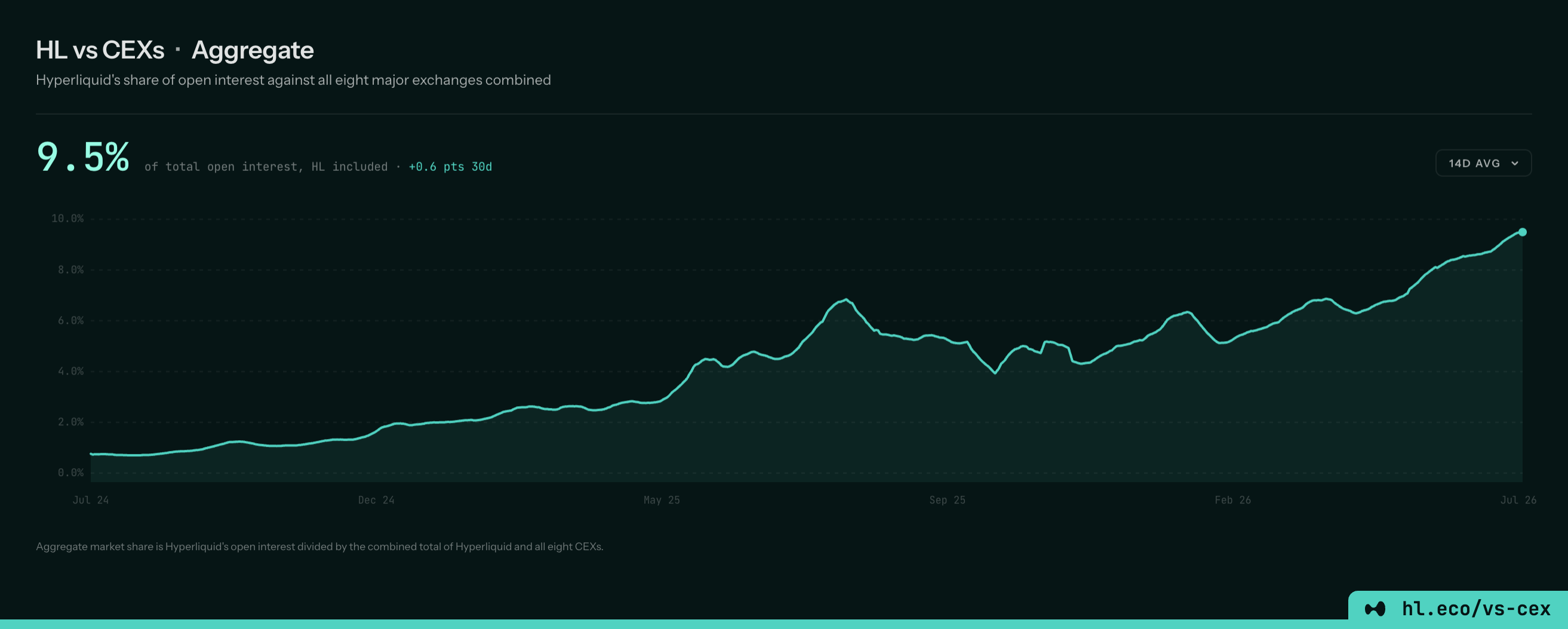
while printing around $1.4 million in fees per day.
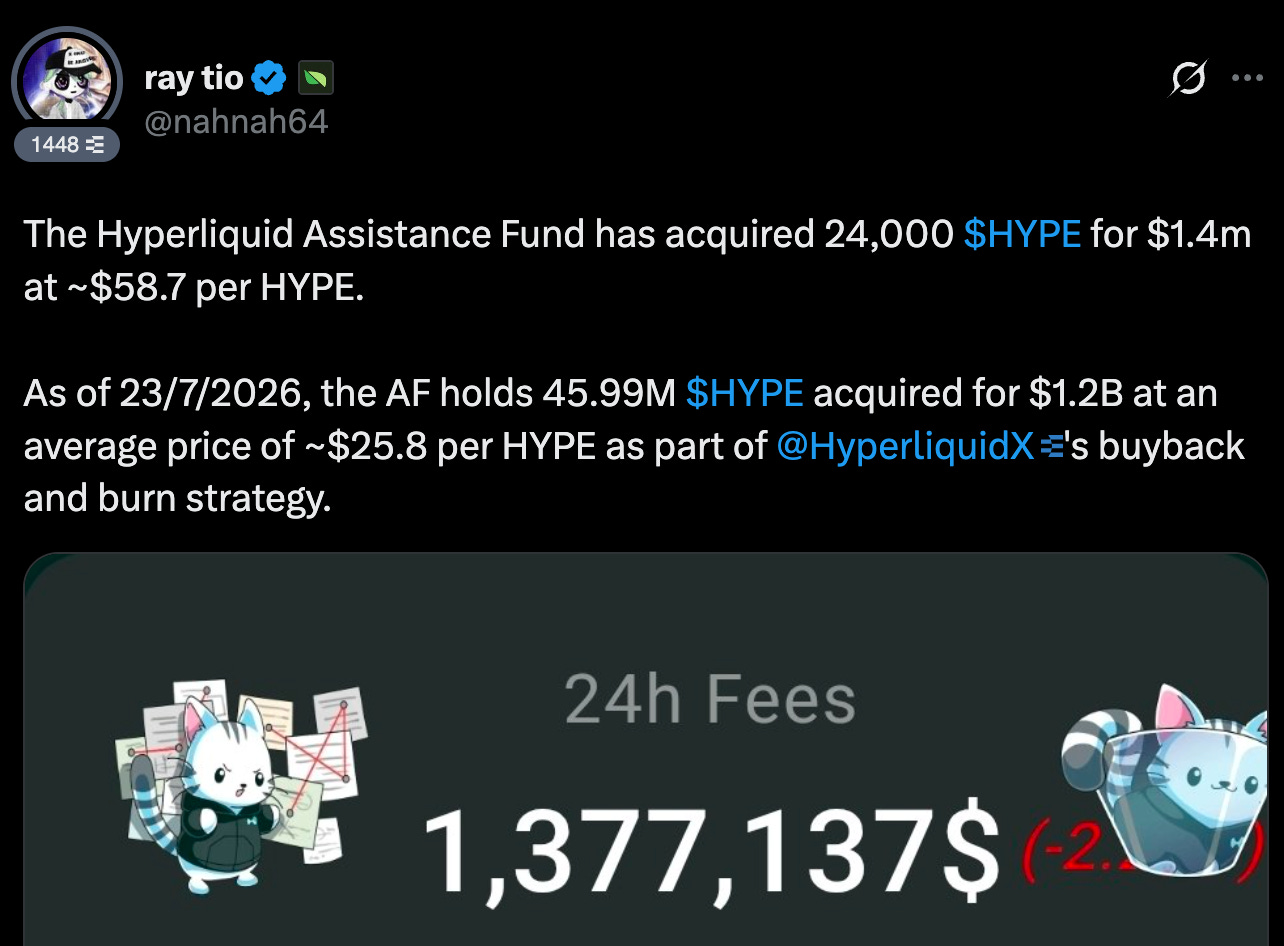
A protocol that captures real volume and real fees while the token cools off is exactly the setup where lower prices can become an opportunity rather than a warning. I’m watching it, not chasing it.
And keep Monad on the radar. Its TVL climbed to $728 million, already the number 11 chain by that measure
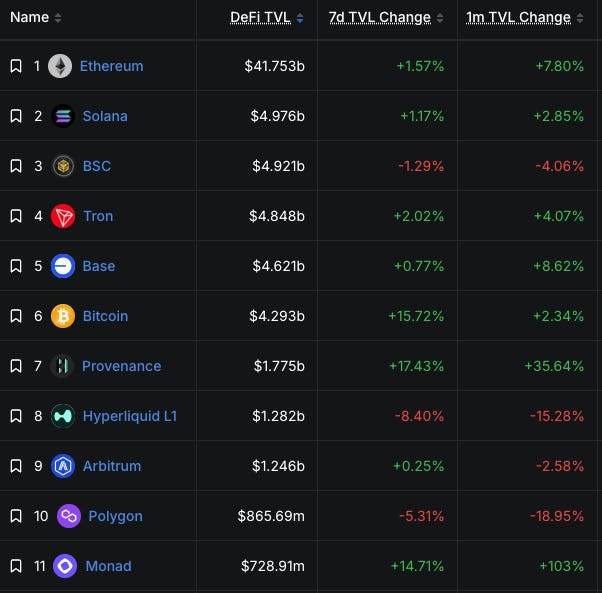
This increase can be largely explained by the deployment of Aave on the chain on July 2 but we are seeing across the board a good mix of protocols growing strong on thr 1m change in TVL.
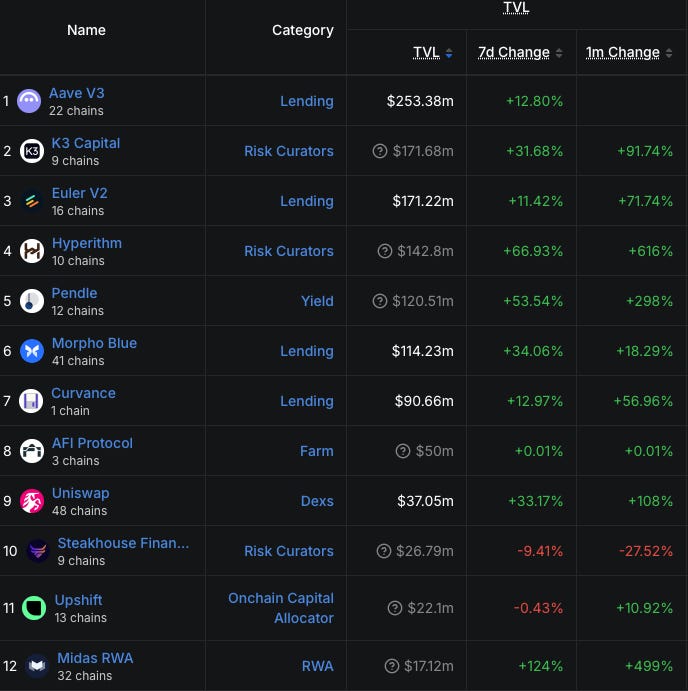
A newer chains that pulls liquidity this fast has to be watched. Whether it holds is the open question.

Let's talk Bitcoin. First, the caveat that keeps me honest: short-term, the demand quality is still thin. This latest push to higher highs is carried by the futures market. Open interest is rising and shorts are getting liquidated, but spot buying isn't confirming underneath. Futures-led breakouts are the less durable kind. It supports the constructive read on the cycle, it doesn't yet confirm the short-term move.
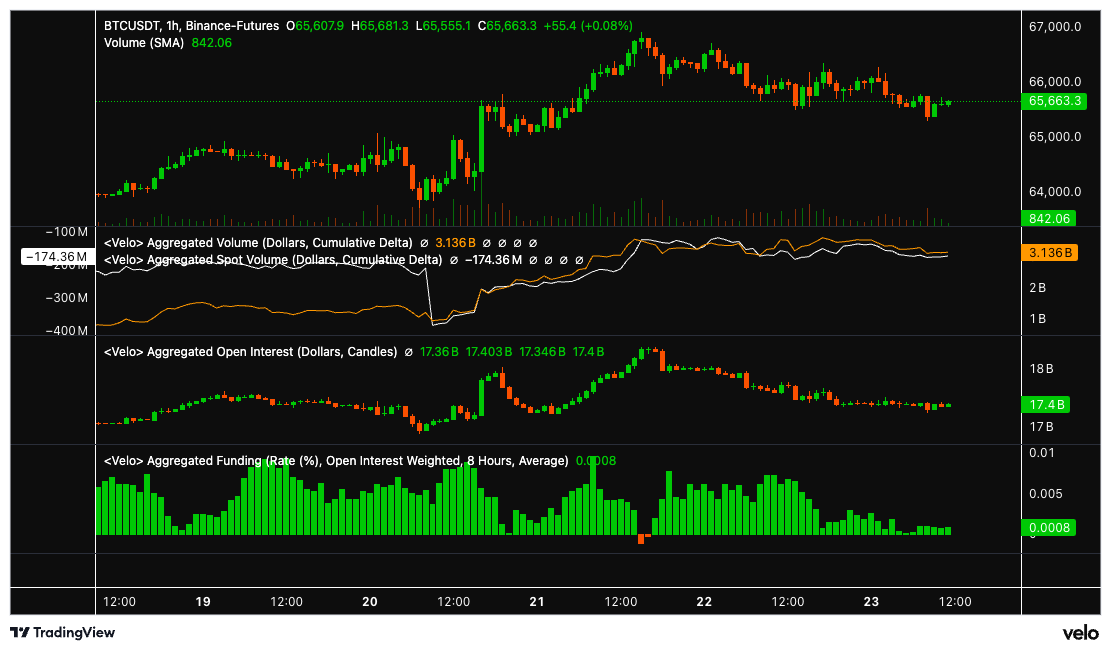
So the decision isn’t “has the indicator broken.” It’s whether the Bitcoin market of 2026 has the same participants it had in 2018. Anyone blindly waiting for an old-cycle signal isn’t making their own decision. They’re delegating it to the past.
Thesis: I don’t know which of the two scenarios I laid out earlier wins. So I’m not betting the portfolio on either one. The play is to be positioned enough to profit if Bitcoin simply grinds higher, and to hold enough dry powder to buy hard if the final flush arrives.
What I’m doing: buying spot Bitcoin in stages inside the dynamically calculated value zone, roughly $47.2k to $55.5k. I’ve already been accumulating around $60k, so I’m not rushing to add at the top of the zone. I’d rather scale deeper into it than guess an exact bottom.
The two levels I’m watching for accumulation:
~$47.2k (lower edge of the current onchain value zone, an estimate of Bitcoin’s fair price)
~$55.5k (upper edge of that zone, where recent accumulation has concentrated)
The middle of that band, around $50k, is where I'd want both a long-term spot tranche and my long-term leveraged position. The leveraged piece belongs in the speculative part of a portfolio, not the core.
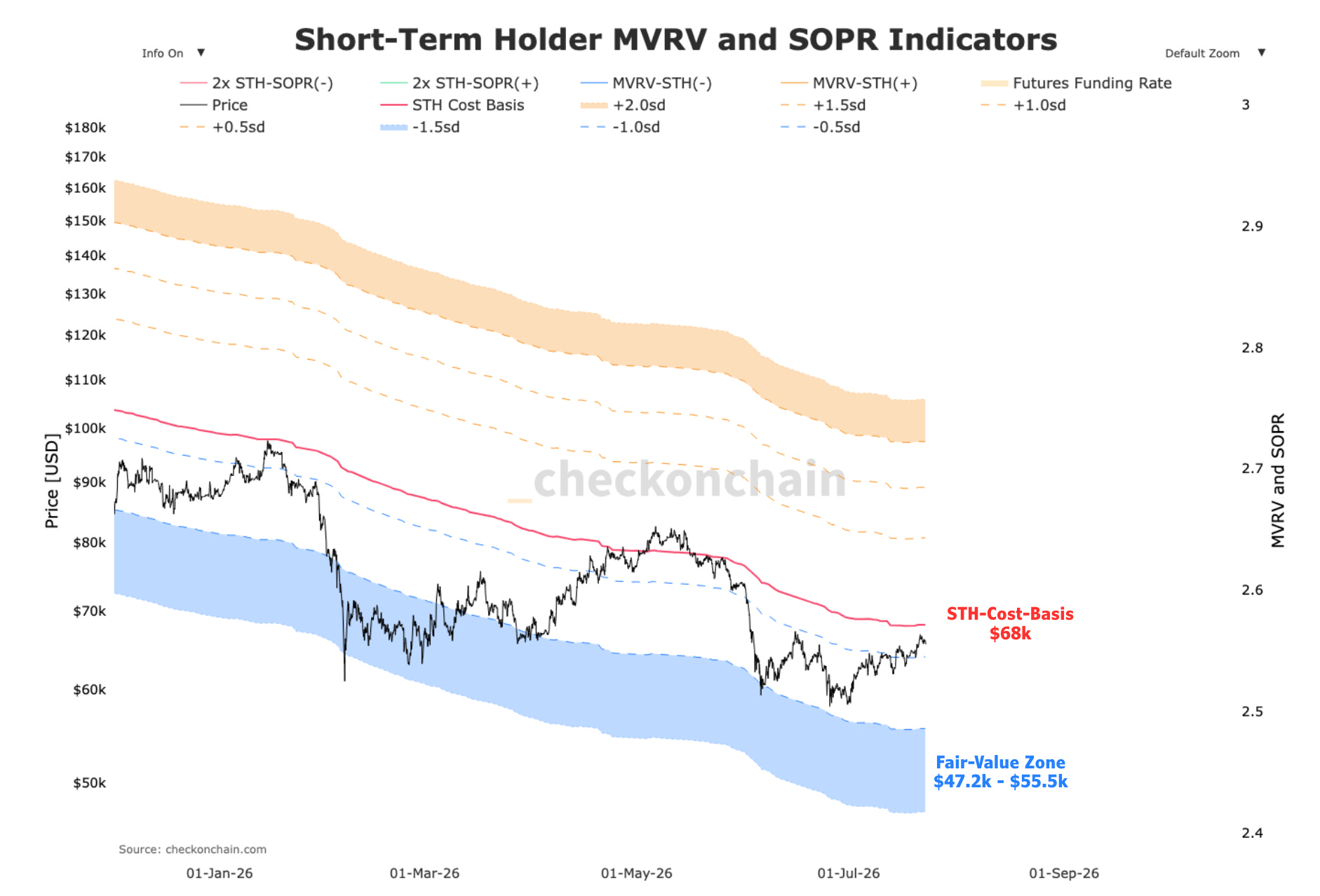
Why it matters: I’m treating this as a structure call, not a price target. If institutions keep absorbing supply, the people waiting for a sub-zero MVRV print never get their entry. If we get one last capitulation instead, my reserves do the heavy lifting at lower prices. Both outcomes are survivable.
Near term, Bitcoin is holding stubbornly above $60k. I could see a push toward $74k before any real counter-move. But my bigger expectation is a much lower price in Q3 or Q4, which is exactly why I’ve already bought spot. I want to be positioned before the zone comes to me, not chasing it after.
The risk: short-term demand is futures-led, not spot-led, so a sharp shakeout is very much on the table before any of this plays out. The spot accumulation is staggered and unleveraged on purpose. The leveraged position only goes on deep in the value zone, sized small enough that it isn’t the fragility we spent the whole macro section warning about. I’ll keep you updated as it plays out.
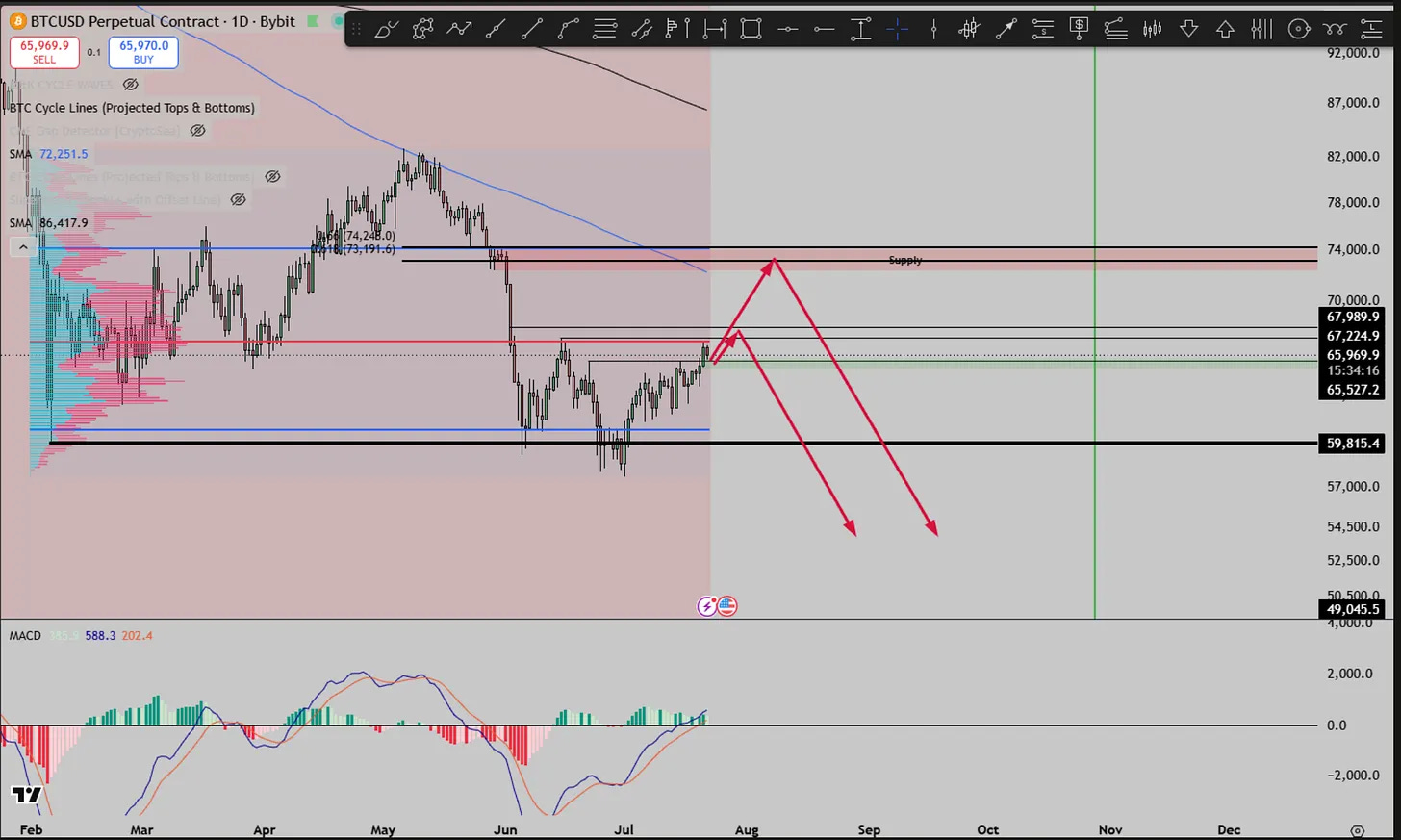
→ I am preparing to add to my long Bitcoin position around $50k, because I expect the value zone to come into play in Q3 or Q4. Stay with me and updated on Telegram: I’ll announce the entry there too.
For education and discussion only, not financial advice.
That’s it for today’s episode, thank you for being here!
The market looks calm because it’s bored of the war, not because the risk went away. But TradFi is the most leveraged it’s ever been, and Bitcoin is sitting in a cycle that never gave us the clean capitulation signal to wait for. The move now is simple to say and harder to do: Stay positioned for both scenarios, in spot, with reserves, so a forced-selling cascade becomes an opportunity instead of a margin call.
Till next time, stay safe!
Comments
Nothing yet. Say the first thing.
Sign in to join the conversation.