
Hey Friend!
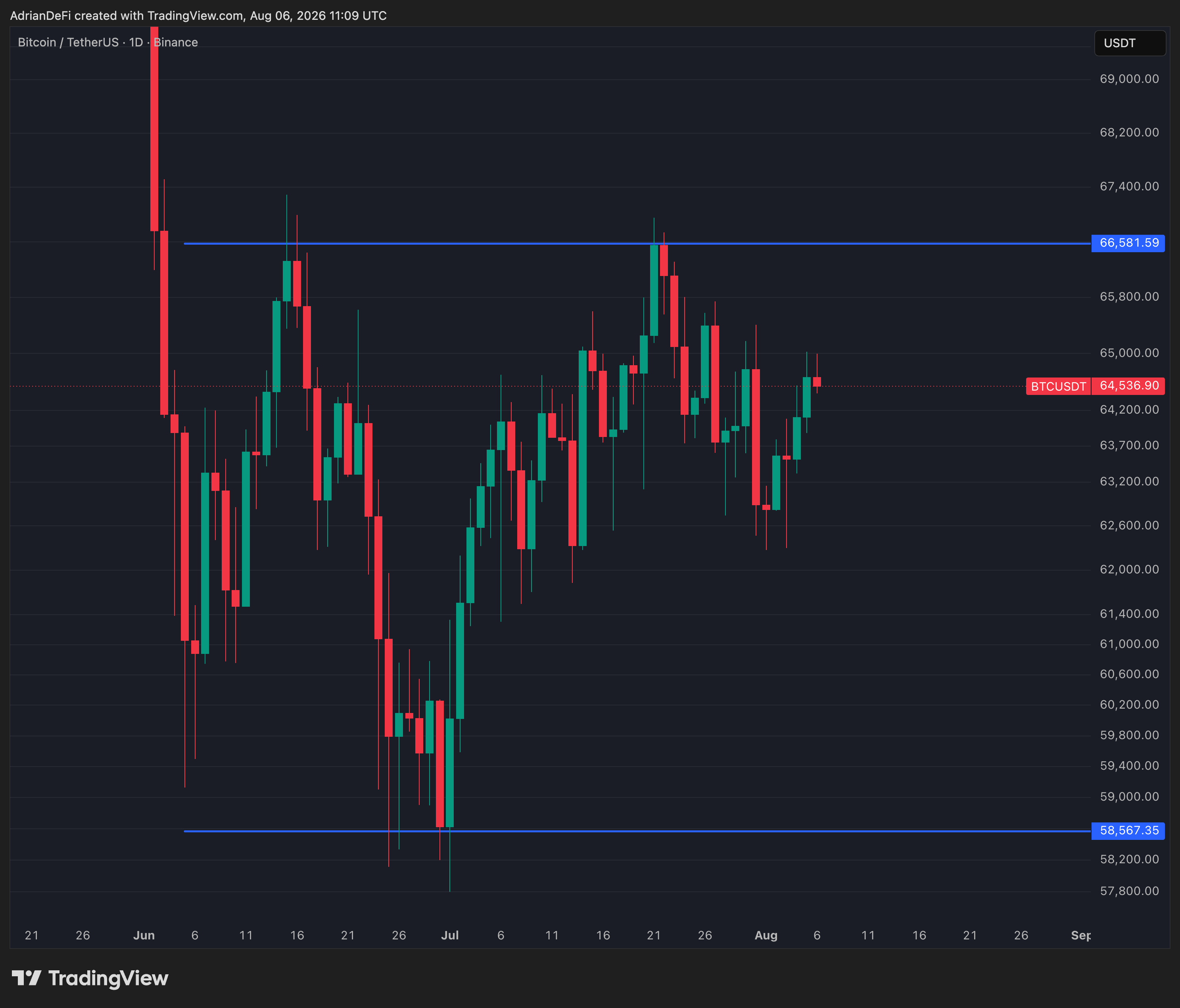
Bitcoin has spent 182 days orbiting $60,000. One convincing rally, which turned into a fakeout, and the last 60 days otherwise stuck between $58,000 and $66,000.
That makes it easy to conclude nothing is happening.
The low activity is the story. Onchain DEX and perpetual volumes closed July near yearly lows, while a small number of protocols kept finding new ways to monetize the order flow that’s left.
📈 Market Update – Is Bitcoin building a floor, or just pausing before another leg down?
🔊 Project Updates – Why are trading interfaces out-earning protocols that hold billions in TVL?
🐂 Alpha Insights – Are Hyperliquid and Uniswap building durable token value, or riding temporary activity?
Let’s get into it.

The current state of the market.
Bitcoin fell to $59k in early February and has treated $60k as its pivot ever since. It trades near $64,5k today, with the last two months contained between $58k and $66k. Unusually tight for an asset that has never been famous for sitting still.
The temptation is to read six months of sideways as proof the bottom is in. I wouldn’t go that far.
A long consolidation after a heavy drawdown creates the conditions for a floor. It doesn’t confirm one. Time can exhaust sellers, but it says nothing about whether buyers are ready to take control.
So the question isn’t whether Bitcoin has spent enough time down here. It’s what would show the balance between buyers and sellers has actually changed.
What confirms the bullish case: a break above $66k that holds, with volume expanding behind it. We’ve already seen what happens when price leaves the range without real participation. It gets pulled straight back in.
What confirms the bearish case: a sustained break below $58k. That would be the first hard evidence this range was a pause inside the correction rather than the last stage of it. Below there, the levels I’m watching:
$55k (upper edge of the recent onchain value zone)
$46.7k (lower edge of that zone)
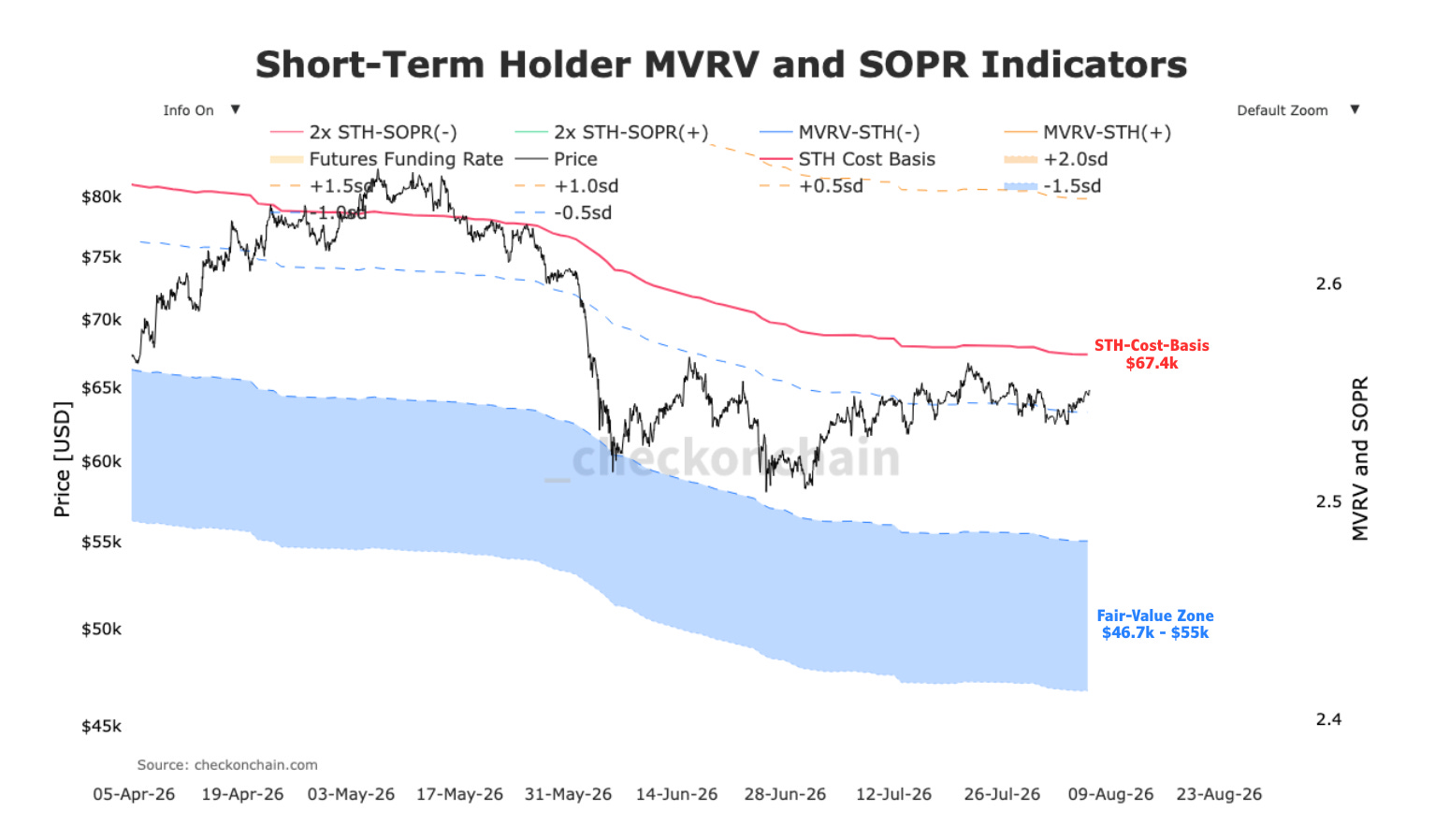
My base case is still that the low is closer to done but the burden of proof sits with the bulls.
→ The bottoming conditions are starting to show. The confirmation isn’t.
The onchain data tells the same story in a less emotional way.
Total DEX and perpetual volumes both recorded another down month in July. Weekly DEX volume has rebounded 12% off its low and perp volume 20%. Quick for your understanding: a perpetual, or perp, is a futures contract with no expiry date, which is how most crypto traders take leveraged positions onchain.
Both still sit around 60% below their October 2025 highs.
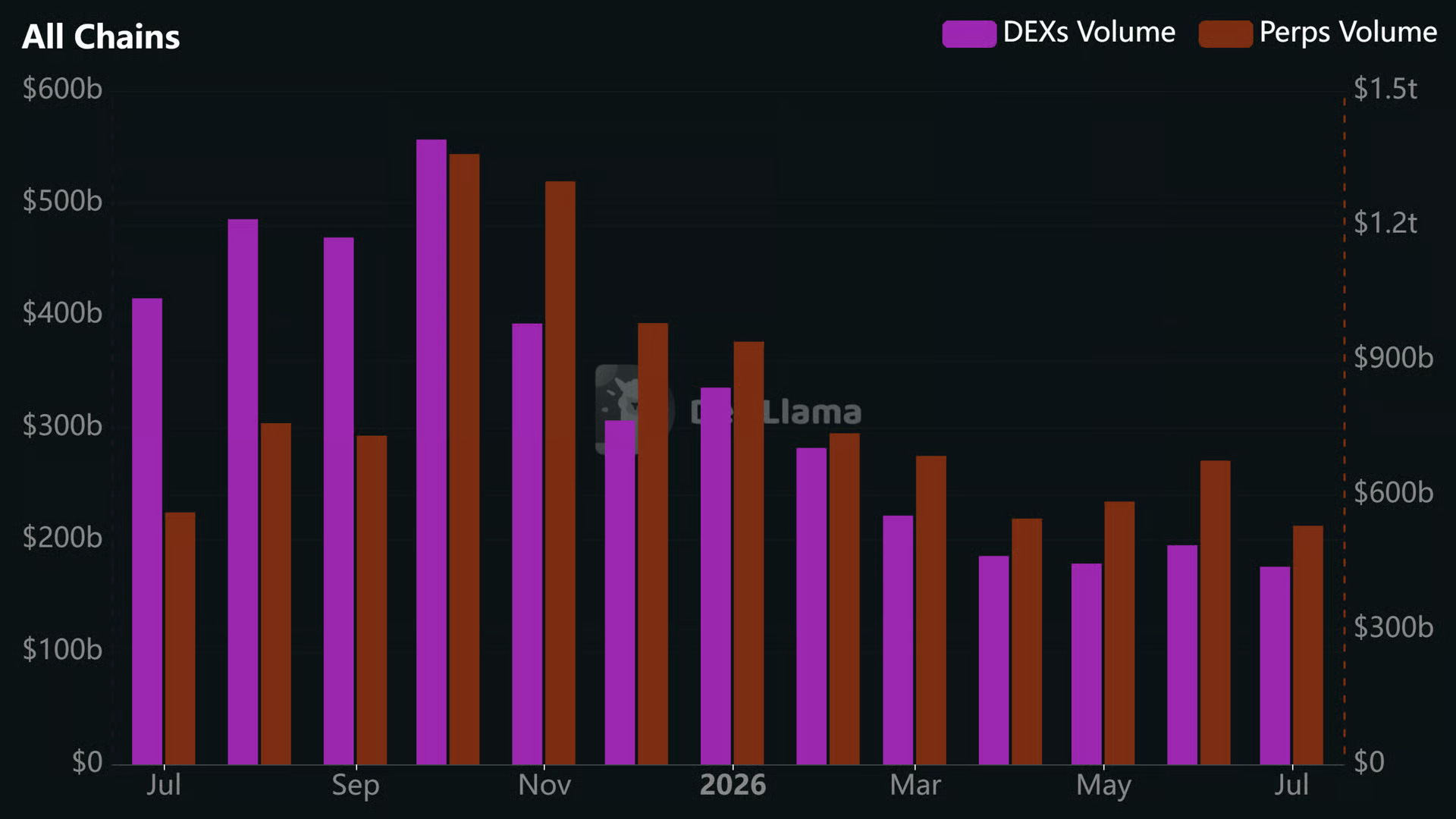
Falling volume doesn’t call a bottom. It tells us the marginal speculator has already left. That’s necessary before a durable recovery, and nowhere near sufficient. The next move only means something when new demand pushes price and volume out of the range together.

That covers the broader market. Now let’s move to what’s hot in the market.
While overall trading activity fell, a certain type of apps kept collecting fees: The interfaces traders actually place their orders through.
Trading apps generated 6x more weekly revenue than risk curators, the teams that set risk parameters on lending vaults and take a cut of the yield, despite holding essentially no TVL across 26 tracked protocols.
Axiom and fomo wallet produced 90% of the category’s 30 day revenue. Axiom’s weekly revenue has doubled since a slow June, though they’re still well below last year. July was fomo wallet’s strongest month for both volume and revenue.
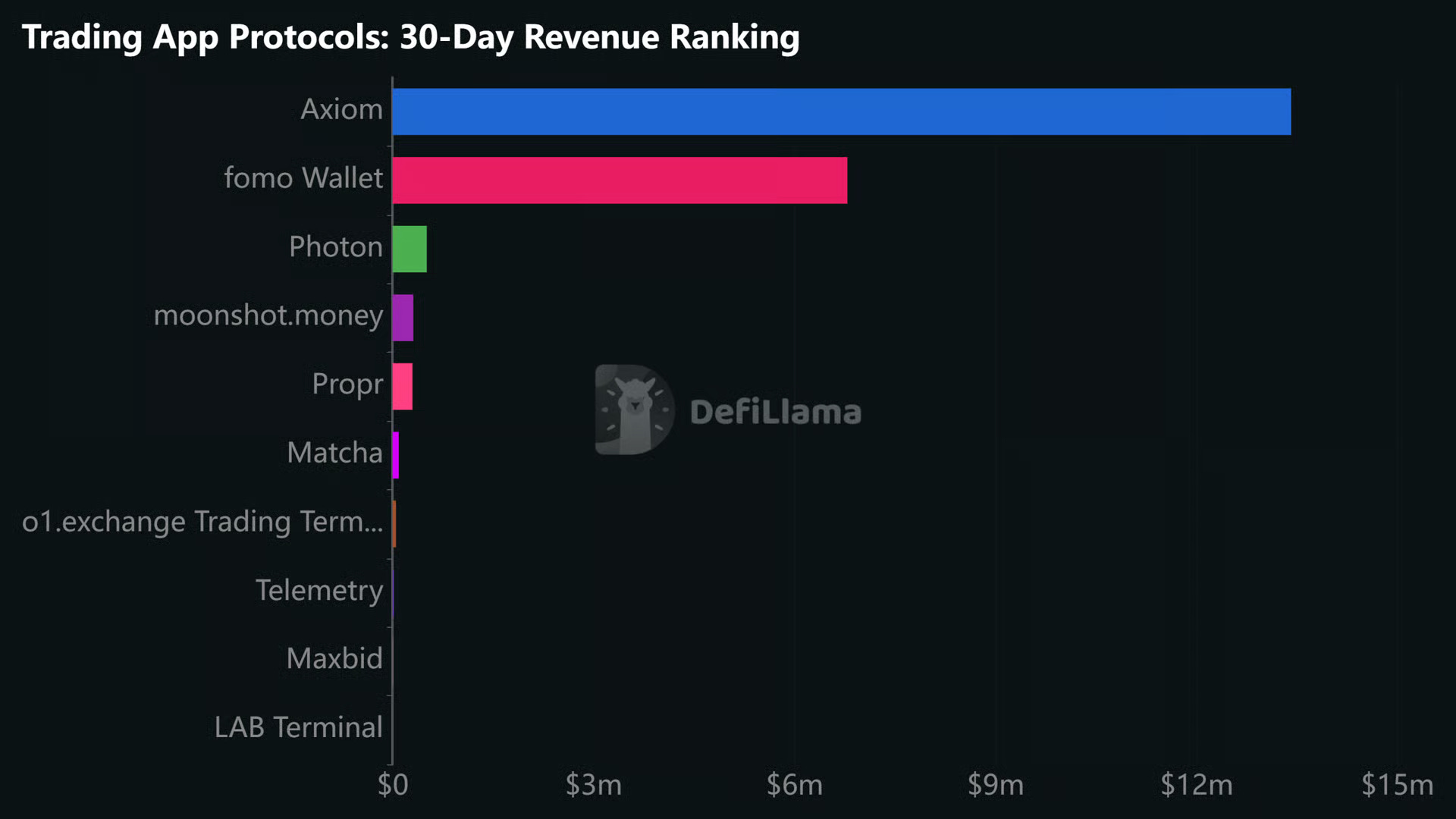
In a low-volume market, owning distribution beats warehousing capital.
The obvious risk: When two apps generate 90% of a category’s fees, you don’t have a diversified sector. You have two successful companies and a long tail of almost nothing. And unfortunately we can’t invest in them because there’s no token but maybe there’s an airdrop at some point.
→ I personally like FOMO due to the sleek UI and the social trading features, I’m testing it for small speculative positions right now. Join here.
That tension between activity and monetization is what makes Hyperliquid interesting.

Hyperliquid is no longer just an exchange for crypto perpetuals. Through HIP-3, outside teams can deploy markets for perpetuals on equities, commodities, indices, FX and pre-IPO companies on its infrastructure.
As of early August the HIP-3 universe covered 103 deployed markets, 88 of them actively traded, averaging $3.7 billion in daily volume over the previous month. That was on August 5th 59.93% of all perpetual volume on Hyperliquid.
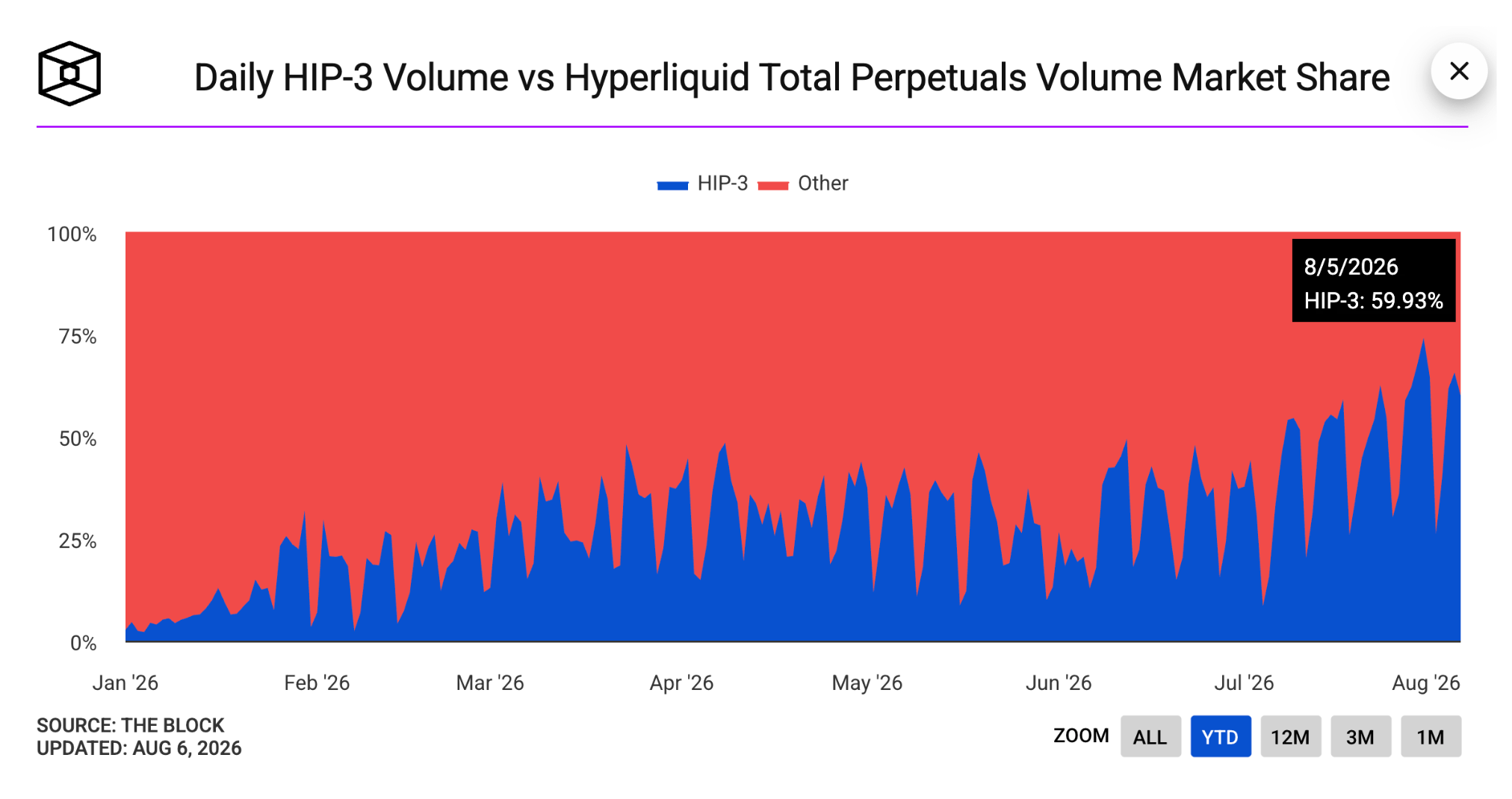
That growth is impressive. It isn’t the thesis.
RWA markets charge lower base fees, and deployers keep part of the revenue their markets generate. DefiLlama also found these markets pulled in genuinely new users while contributing under 10% of fee revenue from those cohorts.
The more interesting development is what Hyperliquid can sell around the trading itself.
The new revenue layer. Priority fees launched in April. They let sophisticated traders pay for earlier position in the order queue or faster access to market data, the onchain equivalent of a trading firm paying an exchange for faster connectivity. They’ve generated $5.07 million since launch, including $2.75 million in the latest 30 day period, with HIP-3 markets producing 70% of write-priority revenue.
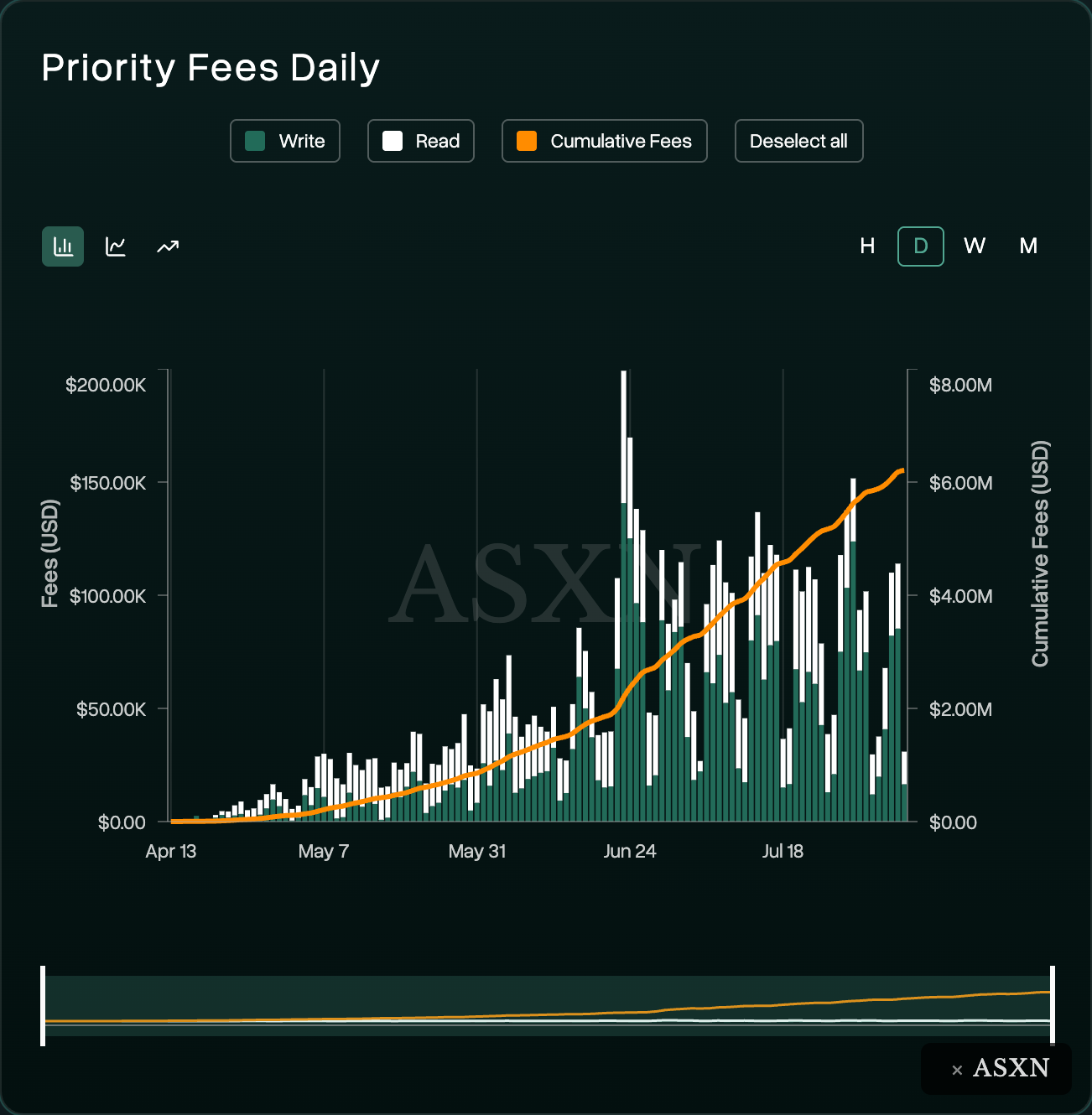
That matters because perp RWA markets can be poor business on trading fees alone and still create fierce competition for execution speed. Hyperliquid ends up monetizing the same order flow several ways: Base trading fees, priority fees, HIP-3 deployer activity, listing auctions, spot markets, and yield on its stablecoin reserves.
The bull case isn’t that RWA volume rises forever. It’s that Hyperliquid keeps adding revenue layers without needing core crypto perps to grow at the same pace.
What I’m watching. Three things would strengthen it:
Priority-fee revenue keeps growing even when total perp volume slows.
RWA users move into higher-fee crypto markets over time.
Non-core revenue gets large enough to reduce dependence on speculative cycles.
At a circulating market cap of roughly $12.3 billion, HYPE trades at around 30x its latest 30-day revenue run rate. That does not leave much room for core trading revenue to keep declining unless the newer revenue lines continue to expand.
Rather than argue over one perfect multiple, I care more about whether HIP-3, priority fees and the other non-core lines remain additive when crypto-perp activity is weak.
→ HIP-3 is already a strong revenue engine. Priority fees improve the economics, but durability and retained revenue have to be monitored.
If you want a straight to the point newsletter full of calls, new projects, airdrop farms, memecoin and DeFi moonshots, then Hix0n’s Confidential is the place for you. I can really recommend his take (if you’re comfortable with high risk).
Uniswap spent years generating enormous trading fees without sending meaningful revenue to UNI. That’s finally started to change. In late July, governance activated protocol fees for selected v4 pool families. A fee controller sorts pools into categories and applies the rates governance approved.
The headline numbers need care. DefiLlama currently shows $4.70 million in total Uniswap holder revenue over 30 days, $1.59 million over seven days, and $779,000 of that seven day figure from Robinhood Chain. So Robinhood Chain produced 49% of Uniswap’s reported holder revenue in the latest week.
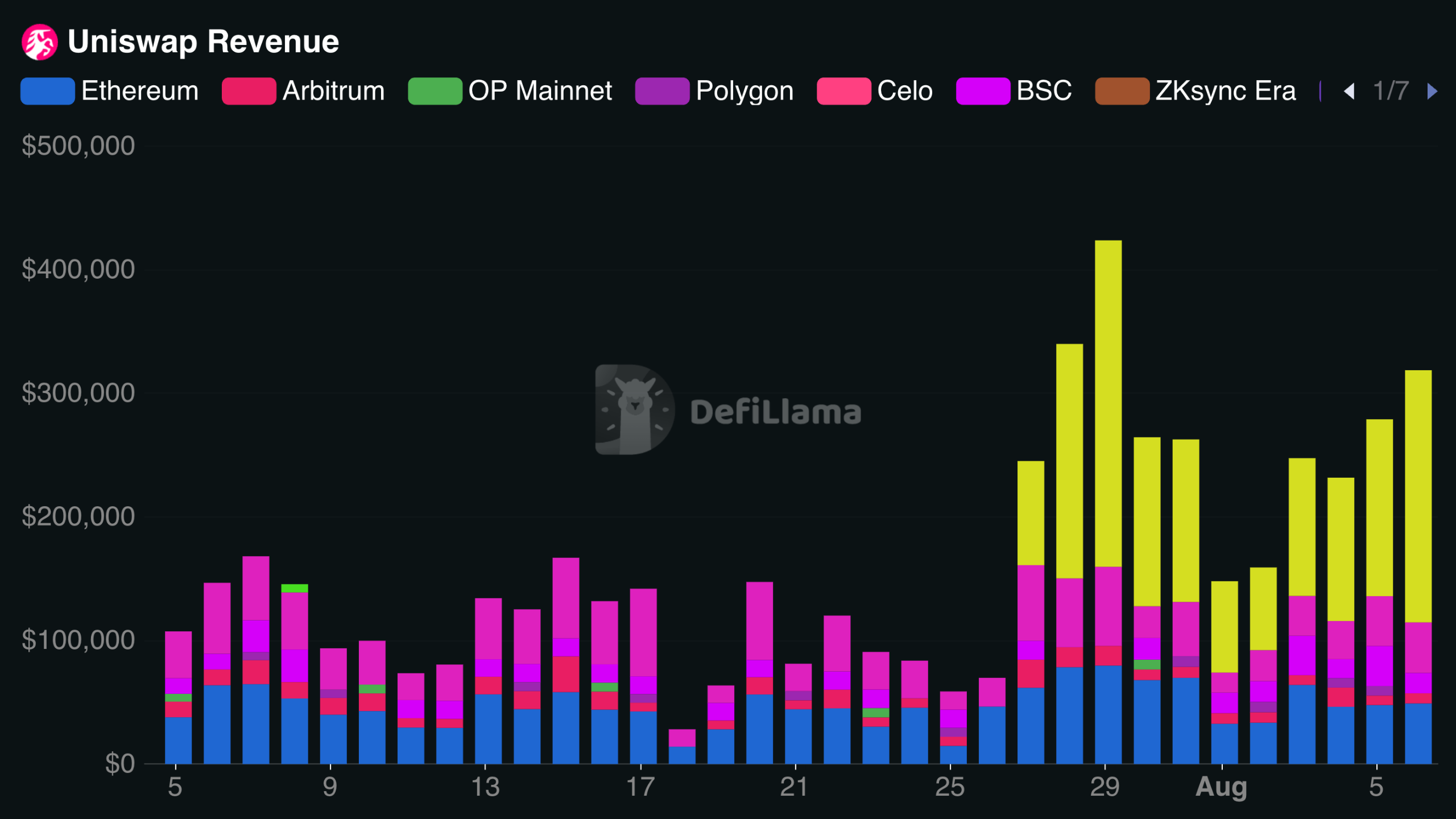
But that $4.70 million is not revenue from the new v4 activation. It’s Uniswap’s total holder revenue, mostly from the broader fee rollout on v3. DefiLlama’s separate v4 adapter still reports no attributed v4 revenue, so it’s too early to isolate what the new system contributes.
How the v4 fee works. The protocol fee stacks on top of the pool’s LP fee, and the trader pays the sum. Quick for your understanding: LPs, or liquidity providers, deposit both sides of a trading pair and earn a cut of every swap routed through it. A pool with a 30 basis point LP fee can add a five basis point protocol fee. The trader pays about 35. The LP fee stays defined at 30.
That changes where the risk sits. Nobody is confiscating the LP’s 30 basis points. Uniswap raised the effective cost to the trader, and now has to prove its liquidity, routing and distribution can hold volume anyway.
What I’m watching. Three numbers:
Whether volume stays stable in fee-enabled pools.
Whether Robinhood Chain’s contribution holds up after the launch period.
When measurable v4 revenue starts showing separately in the data.
At $4.70 million over 30 days, Uniswap runs near $56 million annualized. Against a circulating market cap around $2.4 billion, that’s roughly 43x the current run rate. Not a distressed valuation. The market is already assuming the fee switch expands and volume holds.
My read: Uniswap has started to make it’s token capture value. It hasn’t proven it’s durable.
Bitcoin has spent enough time near $60,000 for a durable floor to be possible. Time isn’t confirmation, and a sustained break below $58,000 would lead me to continue buy and build my position..
Underneath the flat market, the protocols worth tracking are the ones learning to charge for distribution, execution priority, market deployment, routing and access to liquidity.
For the coming week I’m watching:
Bitcoin: a sustained move outside $58,000 to $66,000
Hyperliquid: whether priority fees stay additive as core activity slows
Uniswap: whether holder revenue holds after the initial rollout and the Robinhood Chain launch
Which onchain business model should I break down next: lending, stablecoins, or trading interfaces? Hit reply and tell me.
For education and discussion only, not financial advice.
That’s it for today’s episode, thank you for being here!
Till next time, stay safe!
No posts
Comments
Nothing yet. Say the first thing.
Sign in to join the conversation.