
If you had to guess where English is spoken least often at home in Australia, you might say western Sydney or outer Melbourne.
You’d be wrong.
The answer lies more than 3,000 kilometres away in East Arnhem Land, where fewer than one in five residents report speaking English as their primary language at home.
Using 2021 Census data1, I calculated the share of residents speaking English at home across every suburb-sized statistical area (SA2)2 in Australia.
The results reveal not only Australia’s extraordinary linguistic diversity, but also the different forces that shape it in cities and remote communities.
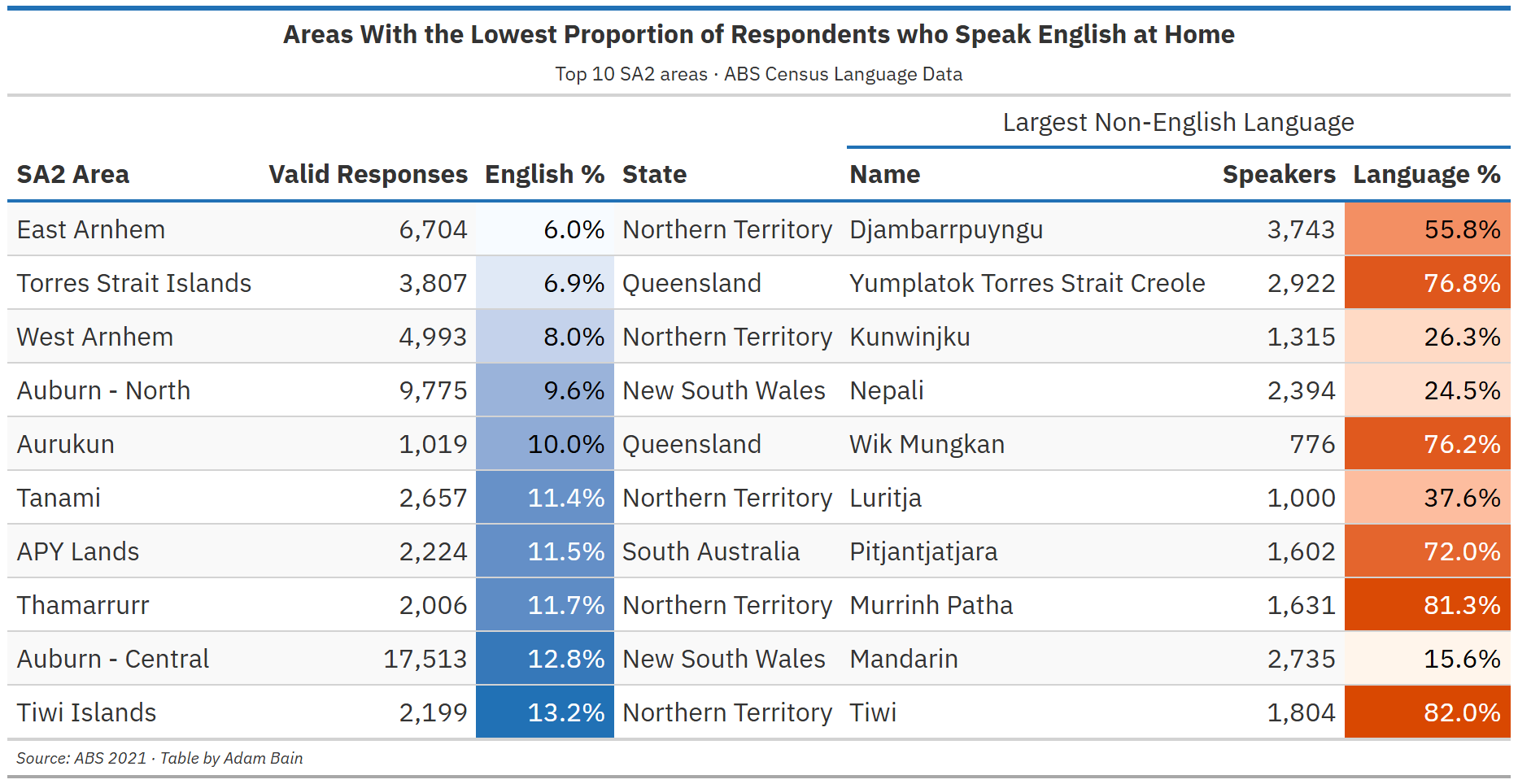
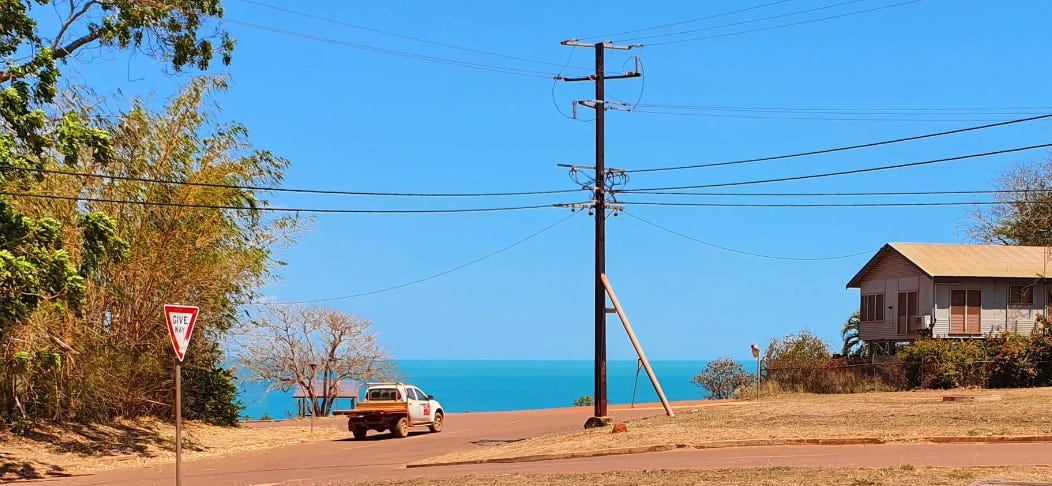
These SA2s are predominately remote outback communities with majority indigenous communities, such as the number one East Arnhem.
East Arnhem has a large portion of Djambarrpuyngu speakers, particularly concentrated on Elcho Island. However, it is not necessarily so simple, as defining Djambarrpuyngu as a discrete language is somewhat of a western imposition.
Djambarrpuyngu is one of eight patrilects (clan and situation associated dialects) of Dhuwul, itself being one of six partially mutually intelligible languages of the Yolŋu Matha linguistic family.
These patrilects are traditionally associated with different clan groups but Djambarrpuyngu is unusual in that it is spoken more often than the traditional demarcations would suggest. It has become a common lingua franca for many indigenous people in East Arnhem and its prominence is so that it was the first indigenous language spoken in an Australian Parliament.
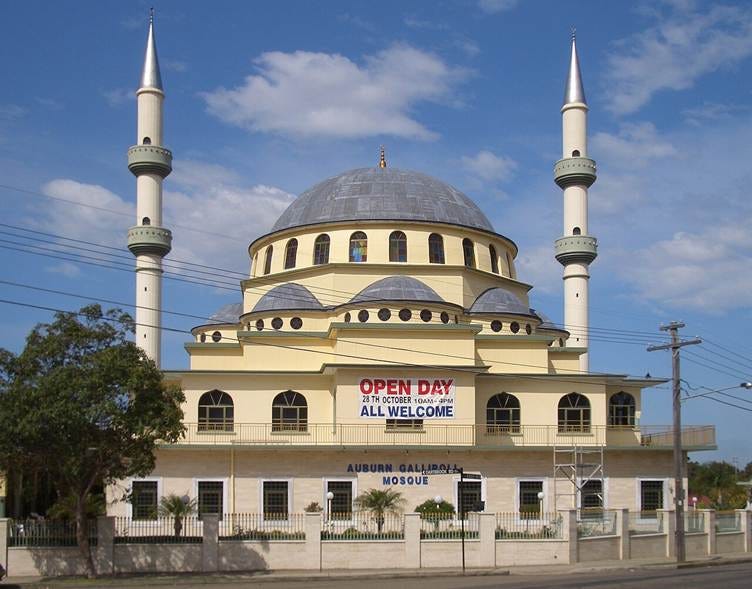
The only non-remote SA2s that appeared on the top ten list were Auburn - North and Auburn - Central, parts of the suburb of Auburn in Western Sydney. A major difference between urban areas with a low proportion of English speaking at home and remote areas is that the non-English speaking portion is typically more diverse, reflecting strong international migration.
In Auburn - North, Nepali is the most common language spoken at home is Nepali with 24.5%. Auburn - Central has an even smaller plurality with Mandarin at only 15.6%. Auburn is so diverse that it has been referred to as the “Transit lounge” of Sydney.
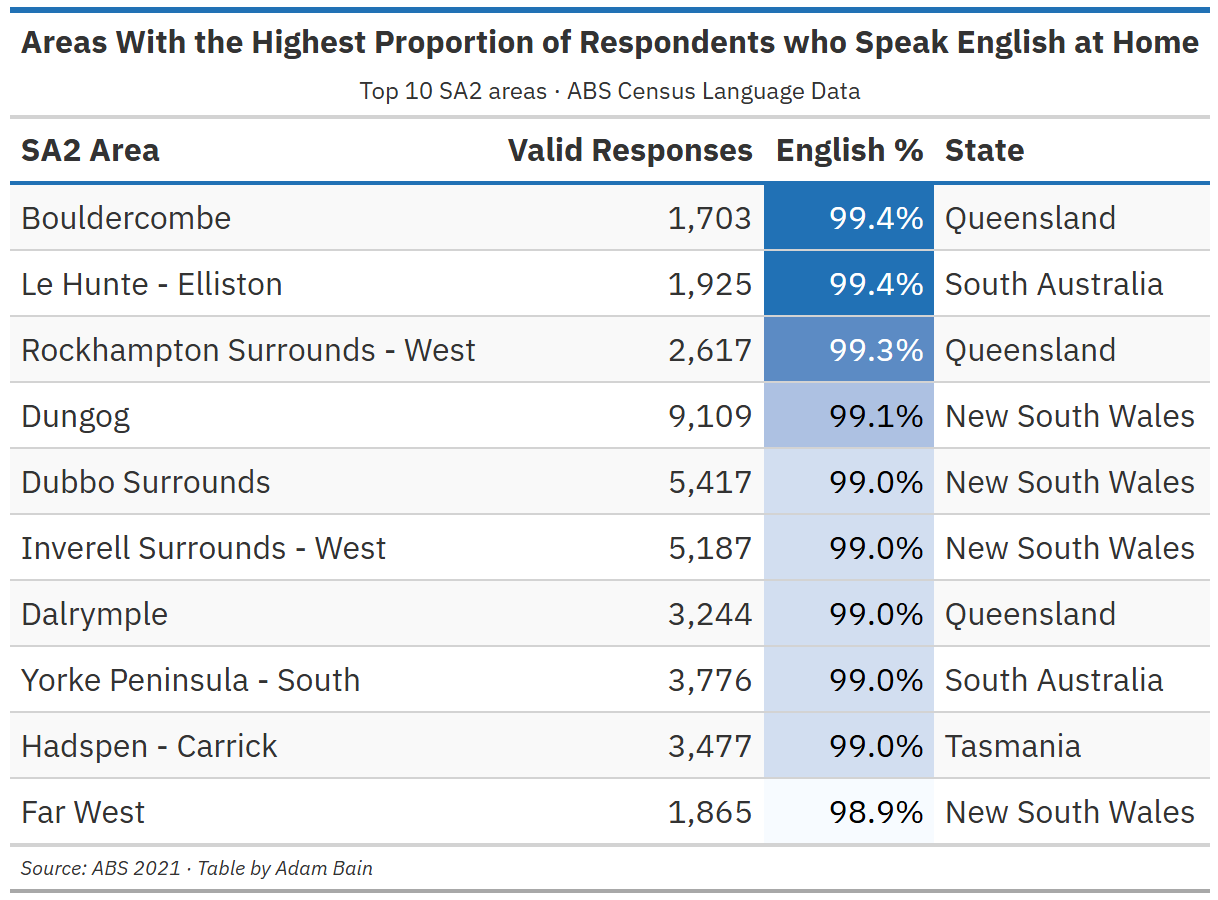
Flipping it around we see the SA2 areas with the highest proportion of English speaking at home are all regional, but truly remote. From the grain farming Yorke Peninsula to pastoral lands around Dubbo, these areas are all very “White Bread Australia”. The exception is Far West NSW, which had a very high non-stated response, suggesting potential difficulties in recording indigenous responses.
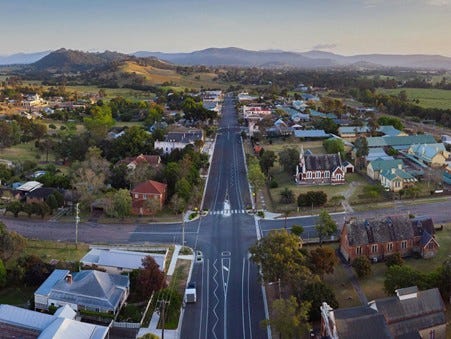
Of all places on this list, Dungog stuck out to me on, because it is an actual, albeit small, town rather than an agricultural area around towns like the other entries on this list. Dungog is in the Hunter Valley region of NSW.
After an early colonial boom, post WWII the town has been on a slow decline, with a shrinking dairy industry and the timber industry all but disappearing. However, a bright spot is that it remains attractive to tree-changers – urban residents in search of a rural retirement in their later years.
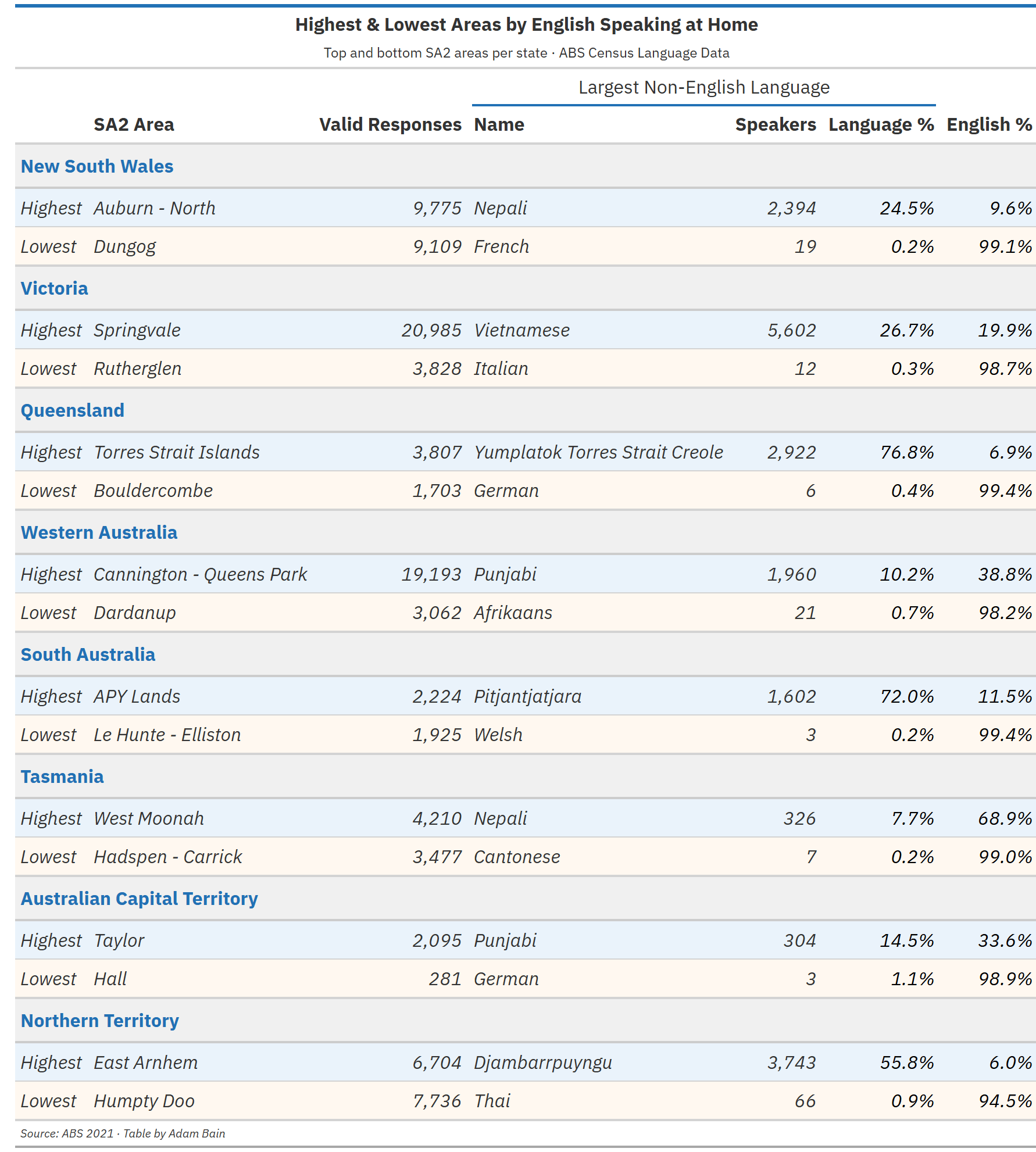
I am sure some of you are asking: “What about my state?” So below is a chart with the top and bottom SA2 areas by English speaking at home for each state:
We’ve looked at the extremes: the SA2s where English is least or most spoken at home. But just as important is how linguistic diversity is distributed.
To see the broader pattern, it helps to look at the distribution of linguistic diversity across all SA2s. The chart below shows, for each capital city and its surrounding regional areas, how SA2s are distributed by the proportion of residents who speak a language other than English at home.
Abrupt peaks indicate the most common percentages of English spoken at home, while wider or more stretched-out curves suggest greater variation between suburbs.
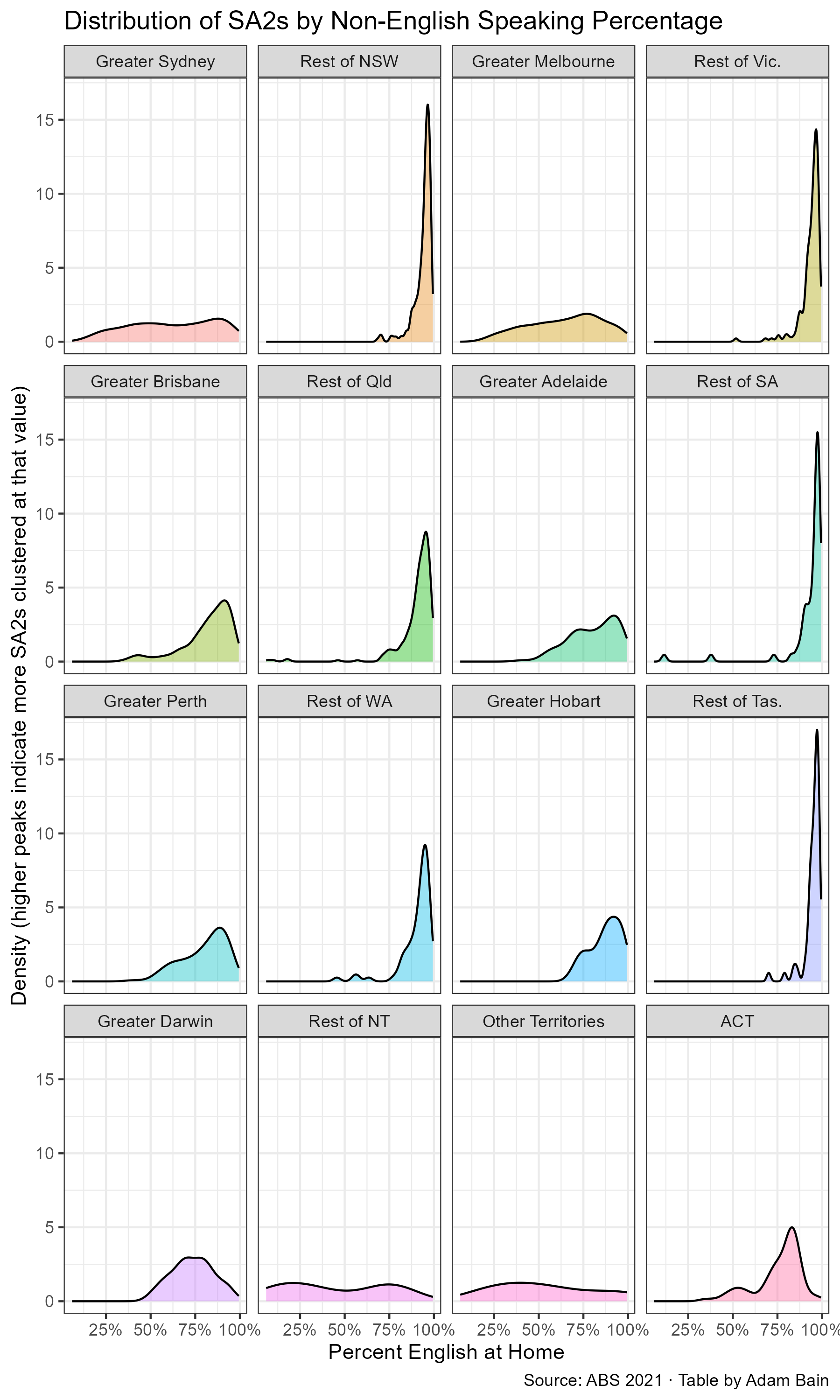
The clearest differences between urban and rural areas of states are Victoria and NSW, with Melbourne and Sydney respectively. The other capitals seem less distinct than their corresponding rural regions – except for NT, where Darwin has a more noticeable concentration of SA2s with high proportions of English at home than rural NT.
The particularly flat curves of Sydney and Melbourne indicate an even distribution diversity, with some suburbs being largely English speaking and some being largely non-English speaking, with dozens of languages present on the same street.
In Part 2, we'll find Australia's most linguistically diverse suburb and find out if it’s in Melbourne or Sydney.
The ABS records language used at home in the national census, with over 500 languages measured. It is important to mention that this is not a record of what language respondents can speak, only the language they use at home. Many Australians are multilingual and switch languages depending on context.
No posts
Comments
Nothing yet. Say the first thing.
Sign in to join the conversation.