
In Part One, I investigated which SA2s (Suburb sized census areas) had the highest and lowest rates of English spoken at home.
One might think that the SA2s with the lowest proportion of census respondents speaking English at home might be the most diverse SA2s, but that SA2 (East Arnhem in the Top End of the NT) has only 54 different languages spoken at home.
“Only 54?!” you may say, as if that is a lot. Well, it is a lot, but Australia is an extraordinarily diverse country. In fact, 54 happens to be the median number of languages spoken across SA2s, making East Arnhem by this metric unusually ordinary.
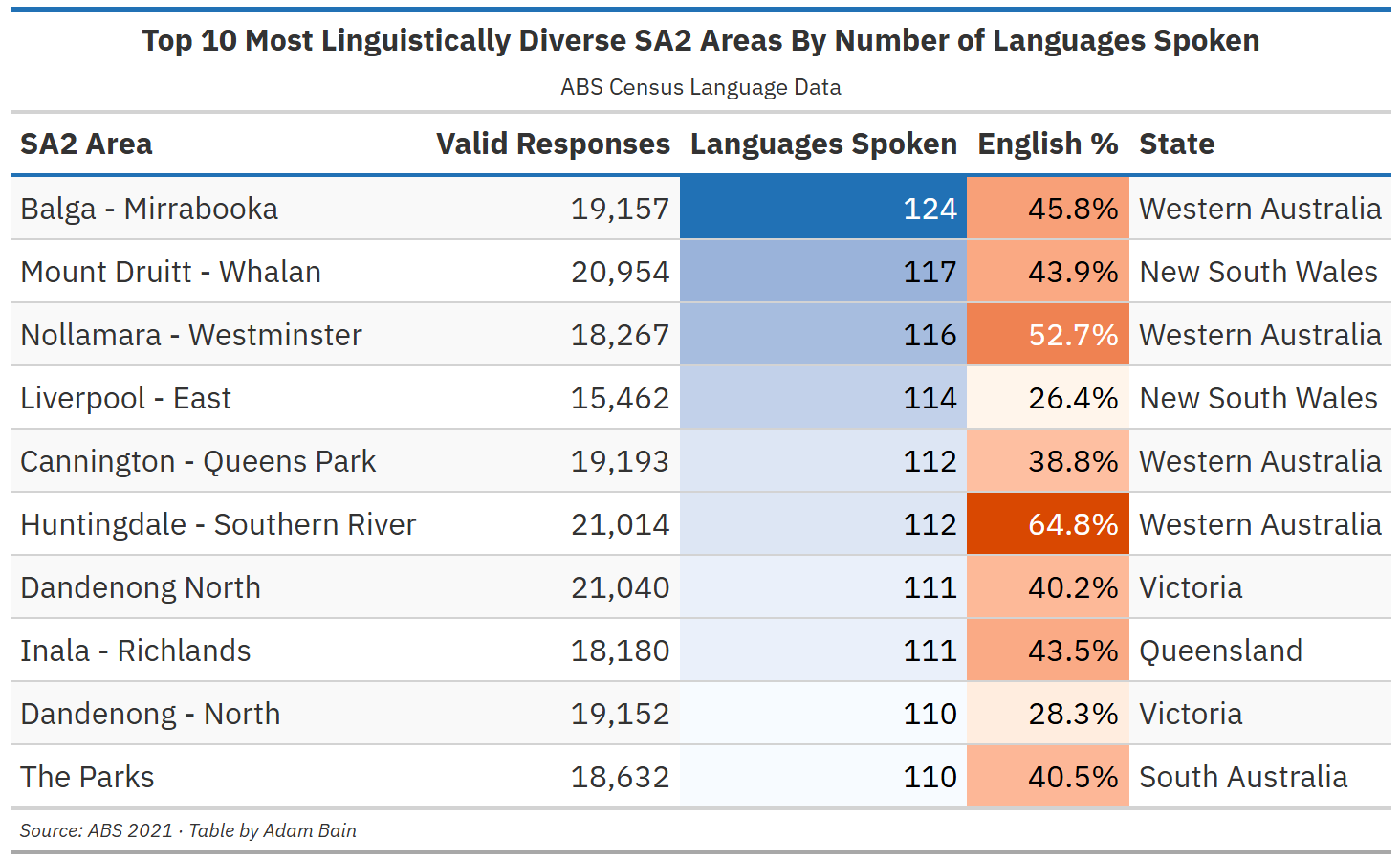
At the top of the list is Balga – Mirrabooka in the north of Perth. This area is part of an area jokingly referred to as the “KGB” - Koondoola, Girrawheen and Balga - known for its ethnic diversity and somewhat seedy reputation. These areas featured in an ABC comedy series simply titled “KGB”, which features two indigenous detectives on a mission to solve the case of a meth lab explosion in the area.

Whilst a count of unique groups like this is a popular and intuitive method for determining diversity levels, it carries with it a fatal problem.
In the table, I included the % of English spoken to demonstrate that even areas with the most languages represented can still have large majority populations that speak English at home, such as 64.8% in Huntingale – Southern River (in Southern Perth). A majority of the 112 represented languages in that area have 10 speakers or less.
This exposes a deeper problem: imagine two suburbs, both with 100 languages represented. In one, 98% of residents speak English and the other 99 languages have one household each. In the other, no single language exceeds 10%. The count method calls them identical.
To remedy this issue, I have decided to attack this question with an alternative method – Shannon entropy. Shannon entropy comes from information theory, originally used to measure uncertainty in communications1.
Applied to languages, it rewards places where many languages are spoken in relatively similar proportions, rather than places dominated by one language with many tiny minority groups.
Put another way: if you picked two random people from the suburb, how likely would it be that they speak different languages at home?
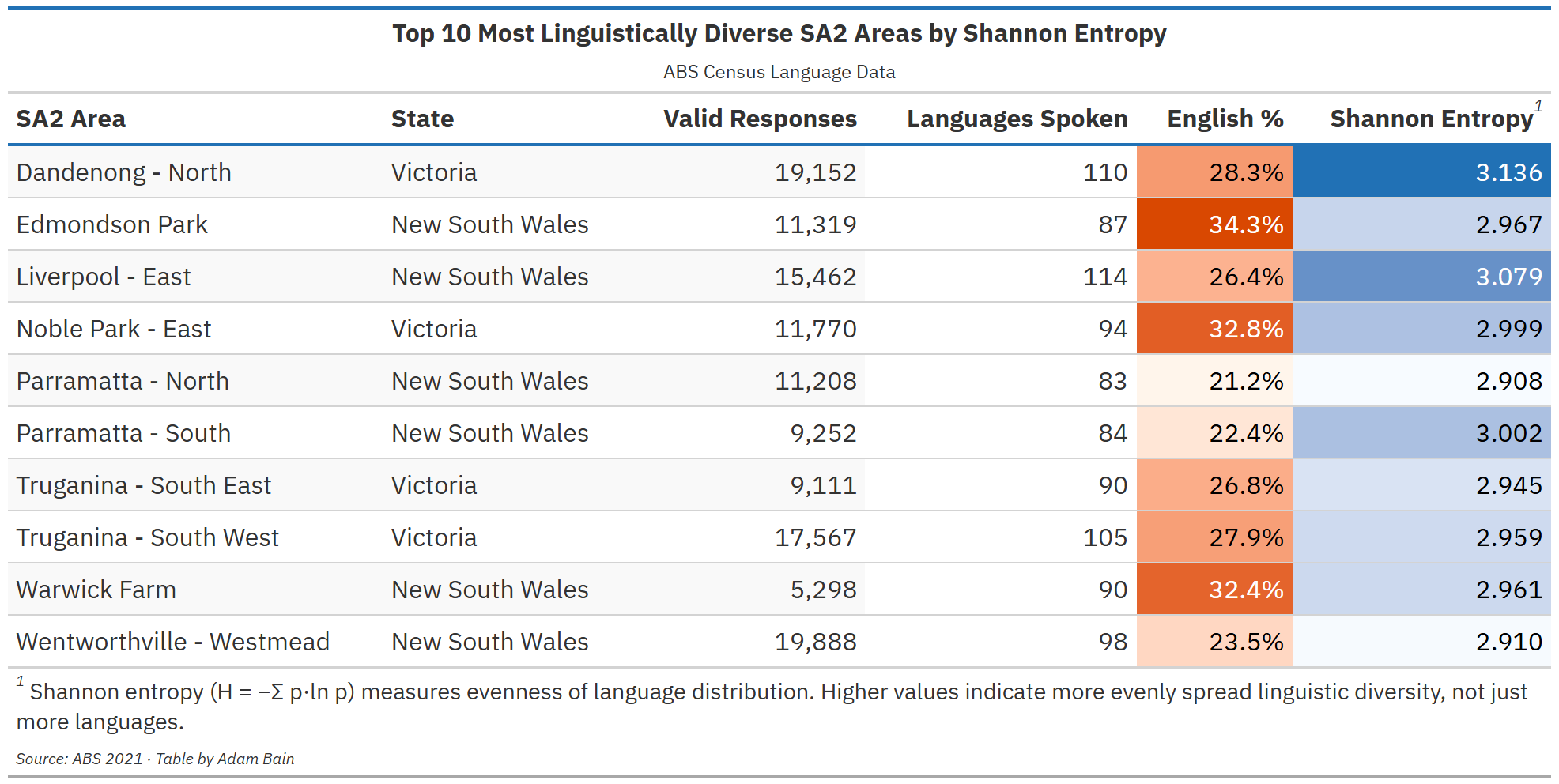
Unlike the previous WA-oriented list, this top 10 list is dominated by entries from Melbourne and Sydney, unsurprising given their reputations as the melting pots of modern Australia.
And from this list, I think I am comfortable to anoint what I believe is the most linguistically diverse SA2 in Australia: Dandenong – North.
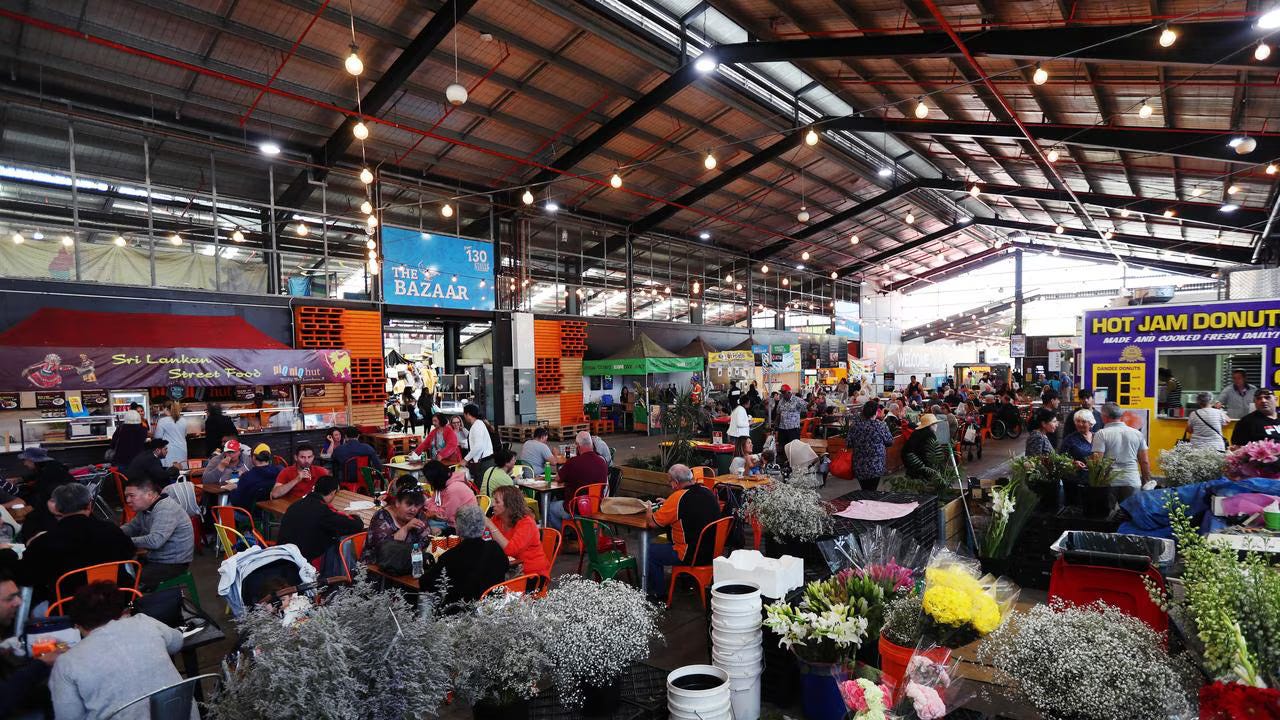
Because of how SA2s are slightly confusingly labelled by the ABS, I just want to clarify that the dash in the name means that it is the northern part of Dandenong, not the suburb of Dandenong North, also very linguistically diverse, just not as much.
A Shannon entropy of 3.136 means Dandenong – North has the same diversity as a hypothetical suburb where roughly 22 languages were spoken equally often, which seems unrealistic. So, I made a mosaic chart to visualise the languages spoken there.
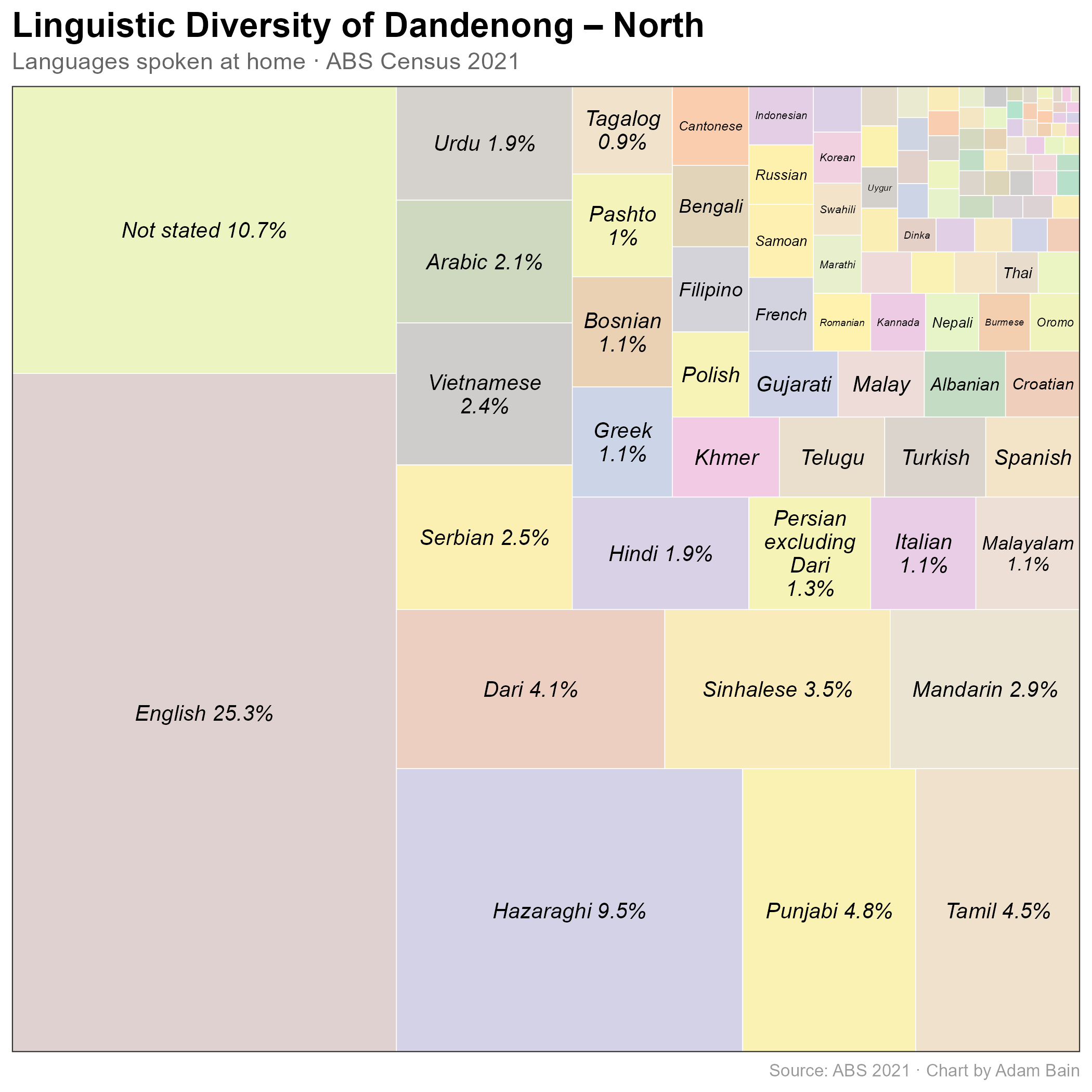
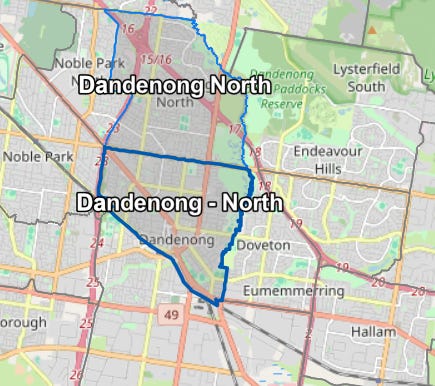
This is a stunning level of linguistic diversity in one place. The largest non-English language, Hazaraghi, and its close relative Dari, are languages from Afghanistan, reflecting the established Afghan immigrant community in Dandenong.
The Australian Hazara community largely migrated in the first era of Taliban rule (1996 - 2001) in Afghanistan, as refugees of religious persecution. In Dandenong, they have built a vibrant community, establishing many small businesses and organisations.
Dandenong is also home to the Little India shopping precinct and is the headquarters of the Serbian Community Association of Australia, cementing its reputation as a multicultural hotspot.
As part of this investigation, I made a QGIS map of SA2 areas by largest non-English language, and whilst I was looking around Victoria, I found two clusters I thought were particularly notable, both of minority languages from Myanmar, from where Burmese is the majority and official government language.
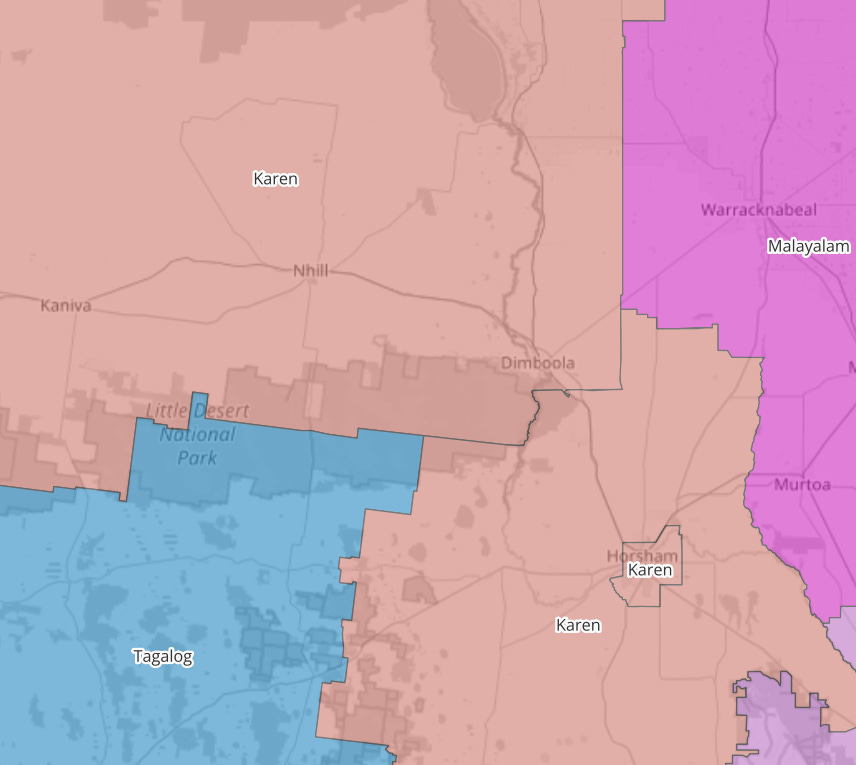
The first is in the rural Victorian Wimmera region around Horsham and Nhill, where Karen language speakers are the largest non-English speaking group. This seems very unusual – it’s typically in the big cities that we find our largest multicultural communities. So why have Karen speakers settled in this far off corner of the state?
The story starts in the early 2010s, when five Karen workers moved to Nhill to work for the poultry company Luv-a-Duck. The company had struggled to find enough workers in the sparsely populated Wimmera region.
John Millington, a general manager at Luv-a-Duck had heard about the growing numbers of Karen refugees coming from Myanmar and wondered if he could give some of them a new start in Nhill.
Armed with a PowerPoint presentation and experience employing skilled migrants, he travelled to Werribee to meet a gathering of Karen refugees looking for new opportunities.
The first Karen refugees to move to Nhill reported back to communities in Melbourne their positive experiences, enjoying the country lifestyle and being embraced by the residents, triggering a trickle of migration.
Karen people have not only contributed to the Poultry industry but occupy diverse jobs including education, mechanics and government service workers.
“I miss my home. I miss the jungle and the rivers. But life here is good, I like living in Nhill and it’s a good place for my family.” – Kaw Doh, one of the first Karen residents of Nhill (Source)
The Karen speaking community continues strong in the region, with a new storytelling project bringing young families together to read stories in both English and Karen languages in libraries, neighbourhood houses, and even the swimming pool.
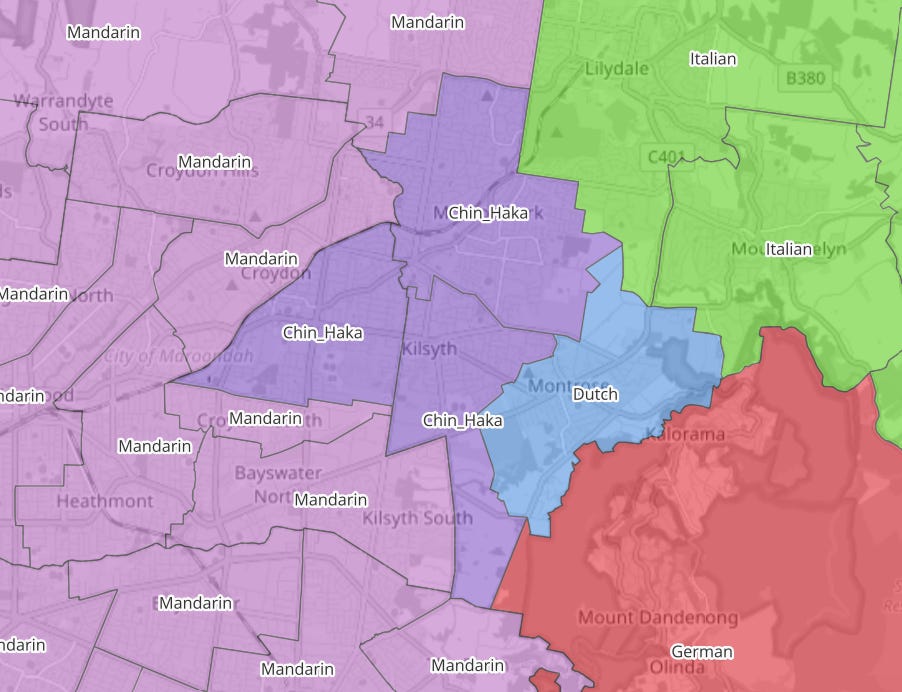
The second cluster I noticed was of Chin Haka in the Croydon area. This was surprising to me, as I happen to live in the Eastern Suburbs of Melbourne and I didn’t know that there was such a large community of Chin Haka speakers in the area. Like the Karen, many migrated here due to religious persecution back home. Australia Chin Community Eastern Melbourne Inc. is based in Croydon North, serving as an important community organisation dedicated to maintaining Chin culture and language, among many other activities.
Whilst Karen migration to the Wimmera was driven by employment, the concentration of Chin in the Croydon area has partially to do with faith.
The large VCBC (Victorian Chin Baptist Church) is based in Croydon. The church was founded in 2003 by 13 Chin refugees with the support Rev Darrell McKerlie from the Mooroolbark Baptist Church. They initially used the Mooroolbark church on Sunday afternoons for weekly services, but as the community grew, this arrangement became difficult. They decided to move into a church building of their own.
First, they chose a spot in Chirnside Park, but after being knocked back by the council, they found a different location in Croydon. After a two-year long construction period, using volunteer labour where possible, the church opened in 2018, as the first Chin Baptist Church in Australia.
I think what struck me about these examples is how during the beginning of migration waves, small events, such as a businessman offering work at a Poultry plant or a language-specific Sunday service being initiated in local church can have outsized impacts on future demography. These events act as seeds around which communities grow, as migrants gravitate to areas they can connect with their local community, and maintain their cultures and languages.
In Part 3, the final instalment of this series, we will take a look at language clustering, and find which languages are most likely to be found near each other.
In 1948, Claude Shannon (of whom the popular LLM is named after) revolutionised information theory by positing that it was not the length of a message that indicated its importance, but rather the surprise it generates.
If a message is very predictable, such as “11111111111”, it does not carry much information. If, however, a message is very unpredictable such as “I ate my hat”, it carries a lot of information, much more than the first one despite containing the same number of characters.
Applied to languages, Shannon’s entropy formula finds that if a language is spoken by 90% of people, hearing it is not surprising. If a language is spoken by 1% of people, hearing it is very surprising.
No posts
Comments
Nothing yet. Say the first thing.
Sign in to join the conversation.